
Views: 265 Author: Weishi Sheets Publish Time: 2026-11-02 Origin: Site
Content Menu
● FR4 Sheet vs G11 Sheet: A Quick Comparison
● What Are FR4 Sheet and G11 Sheet?
>> FR4 Sheet: Flame-Retardant Glass-Epoxy Insulation
>> G11 Sheet: Elevated-Temperature Structural Insulation
● Thermal Performance: Compare Conditions, Not Headline Temperatures
>> Distinguish Three Different Temperature Measures
>> Measure the Component's Local Temperature
● Electrical Insulation: G11 Is Not Automatically Superior
>> Dielectric Strength Does Not Determine Safe Part Thickness Alone
>> Keep Tracking Resistance Separate from Bulk Insulation
● Mechanical Performance: Compare Strength at Operating Temperature
● Flame Resistance: Verify Before Substituting
● Humidity: A Wind-Converter Reliability Issue Worth Prioritizing
● Two Practical FR4 vs G11 Selection Scenarios
>> Scenario 1: A Flame-Retardant Insulating Barrier
>> Scenario 2: A Loaded Support Near a Heat Source
● A Five-Step Qualification Plan for Converter Insulation
>> 1. Define the Operating Envelope
>> 2. Request Product-Specific Evidence
>> 3. Approve Representative Machined Samples
>> 4. Test the Relevant Assembly
>> 5. Control Production Changes
● Procurement Cost: Compare Qualified Parts, Not Sheet Prices
● Discuss Your Wind Converter Insulation Requirements
>> Is G11 sheet better than FR4 sheet for wind power converters?
>> Can G11 directly replace FR4?
>> What is the operating temperature of FR4 sheet?
>> Does higher dielectric strength mean thinner insulation is safe?
>> What should I include in an FR4 or G11 quotation request?
Choosing between FR4 sheet vs G11 sheet for wind power converters comes down to three questions: how hot the insulation component becomes, what mechanical load it carries, and which flame-resistance requirements apply. FR4 sheet is a strong candidate for flame-retardant electrical barriers and supports operating within verified temperature limits. G11 sheet deserves closer consideration when retaining mechanical performance at elevated temperatures becomes the priority.
My recommendation is to select the material around the component's operating conditions—not the converter's overall power rating. Neither grade is automatically better everywhere, and neither designation alone proves that a finished part is suitable for service.
For Guangdong Weishi New Materials Co., Ltd., which develops and supplies epoxy glass-fiber insulation materials and custom-machined components, this application-led approach provides a practical foundation for discussing drawings, material specifications, and qualification requirements.
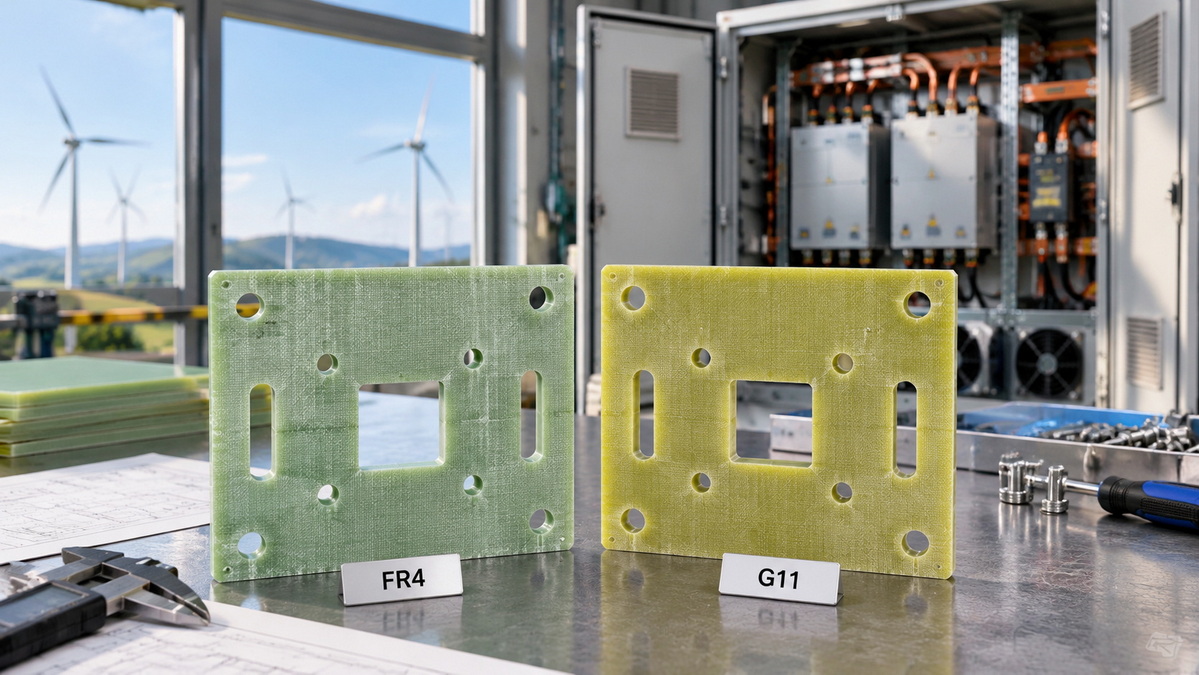
Both materials combine woven glass reinforcement with an epoxy resin system. Their main distinction lies in the balance between flame retardancy and elevated-temperature performance.
| Selection factor | FR4 sheet | G11 sheet |
|---|---|---|
| Primary characteristic | Flame-retardant glass-epoxy insulation | Glass-epoxy insulation emphasizing elevated-temperature performance |
| Potential converter applications | Insulating barriers, mounting plates, terminal supports | Thermally stressed supports, spacers, structural insulation |
| Flame classification | Commonly offered with UL 94 V-0 classification; verify the specific product | Must be verified; G11 designation alone does not establish V-0 |
| Temperature suitability | Depends on formulation and supporting documentation | Often selected for improved mechanical retention at elevated temperature |
| Electrical suitability | Requires application-specific verification | Requires application-specific verification |
| Selection priority | Fire requirements and adequate thermal margin | Hot mechanical performance and documented fire suitability |
The deciding factor is qualification: evidence that the selected sheet, thickness, machining geometry, and assembled component meet the actual duty.
FR4 is a glass-fabric-reinforced epoxy laminate with flame-retardant characteristics. It combines electrical insulation, mechanical strength, and machinability.
In wind converter assemblies, these properties make it a candidate for barriers, mounting components, and supports separating energized conductors from adjacent structures.
However, FR4 is not one universal formulation. Temperature characteristics, tracking resistance, thickness tolerances, and recognized flame classifications can differ between products.
An unclad FR4 insulation sheet should also be specified separately from copper-clad circuit-board laminate. Sharing a familiar material name does not make every product interchangeable.
G11 is another woven-glass epoxy laminate, generally selected where elevated-temperature mechanical performance matters.
Its potential value is especially relevant to load-bearing insulating components. A support must maintain geometry and stiffness while carrying load near heat-generating equipment.
G11 should not, however, be described as automatically flame-retardant to the same classification as a selected FR4 product. Published G11 products include HB classifications.
If both high-temperature performance and stringent flame resistance are essential, request a specifically documented solution. FR5 may be another grade worth evaluating rather than forcing the decision into only two options.
A useful FR4 vs G11 temperature comparison separates:
- Glass transition temperature, or Tg: the region where the resin's mechanical behavior changes substantially.
- Thermal endurance information: evidence concerning property retention during prolonged heat exposure.
- Supplier-stated operating temperature: a product-specific recommendation that needs interpretation.
These figures answer different questions. A high Tg is not, by itself, proof of a suitable continuous operating temperature or complete insulation-system lifetime.
One published FR4 datasheet lists a temperature index of 130°C, while a G11 datasheet from the same manufacturer lists 155°C and a typical Tg of 193°C.
Those figures illustrate why G11 attracts attention for hotter applications. They are not universal limits, and they are not verified specifications for Guangdong Weishi products.
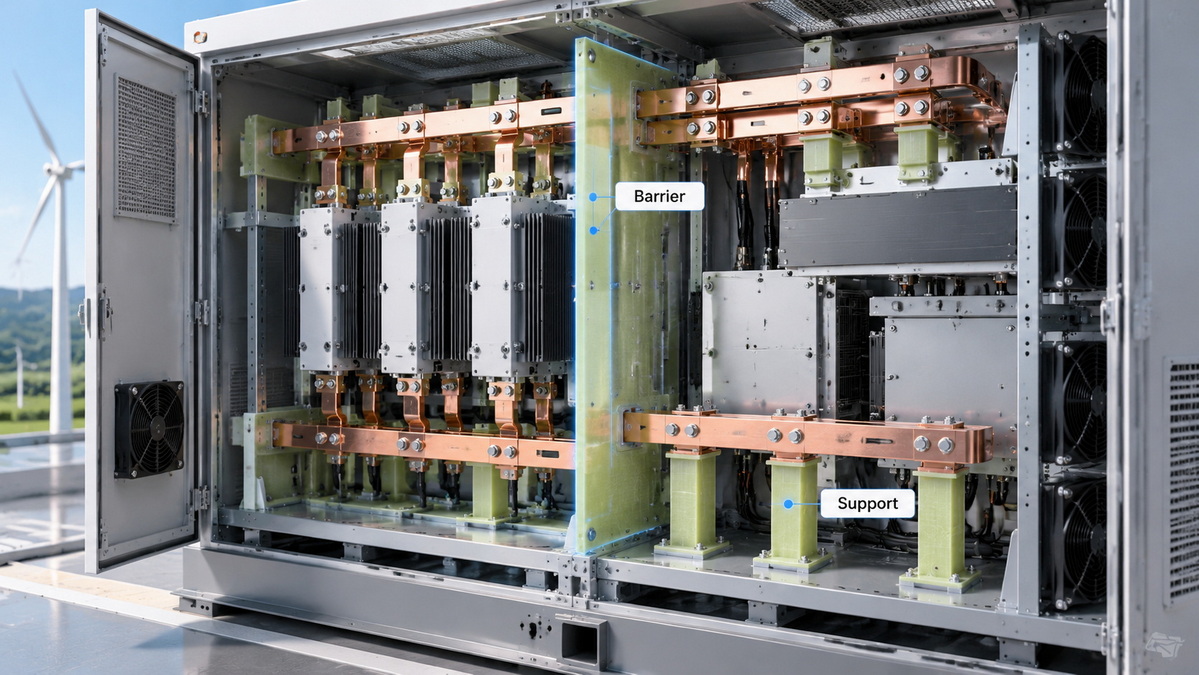
Cabinet ambient temperature is only part of the picture. An insulating support close to a heated conductor may experience a different temperature from a barrier elsewhere in the enclosure.
My preferred selection sequence is:
1. Identify the actual insulating component.
2. Establish its normal and exceptional thermal exposure.
3. Define the mechanical load at those temperatures.
4. Compare documented candidate materials.
5. Validate the finished assembly.
G11 becomes more compelling when hot mechanical retention is the limiting requirement. FR4 remains credible when it satisfies the thermal duty and other requirements.
Both grades can provide useful electrical insulation. However, a published dielectric-strength value is a test result—not a direct design allowance for every converter component.
Thickness, test conditions, electrode geometry, conditioning, and voltage waveform affect how results should be interpreted.
Avoid calculating a safe insulation thickness simply by dividing converter voltage by a datasheet's dielectric-strength figure.
A proper assessment must also consider:
- Working voltage and transient exposure.
- Clearance through air.
- Creepage distance along surfaces.
- Pollution conditions and altitude.
- Material tracking characteristics.
- Finished-part geometry and assembly details.
IEC 62477-1:2022 provides a relevant safety framework for power electronic converter systems within its stated voltage scope, including systems associated with wind energy. Confirm the applicable product standards and project requirements before using it as the design basis.
Comparative tracking index, or CTI, addresses resistance to tracking under specified test conditions. It is not interchangeable with dielectric strength.
Neither "FR4" nor "G11" alone establishes the CTI required by a particular design. Obtain evidence for the exact formulation.
This distinction matters when surface contamination and moisture influence insulation performance.
Room-temperature strength tables can make two materials appear almost identical.
For example, one supplier publishes typical room-temperature flexural strengths of 549 MPa for FR4 and 550 MPa for G11. Those closely matched figures do not establish equal performance under prolonged hot loading.
For converter supports and spacers, request information relevant to the actual failure mode:
- Flexural properties at operating temperature.
- Compressive behavior beneath fasteners.
- Long-term deformation under sustained load.
- Strength in the specified laminate direction.
- Resistance to cracking around holes and edges.
A poorly positioned hole or excessive clamping load can undermine an otherwise appropriate laminate.
From a component-design perspective, material selection and geometry should be reviewed together. Moving to G11 does not eliminate the need to check fastening details, tolerances, and load paths.
FR4's flame-retardant character can be a significant advantage where converter specifications require a documented flammability classification.
Nevertheless, buyers should verify the actual product, relevant thickness, and supporting test or recognition documents rather than relying on a generic grade description.
Published G11 products demonstrate why substitution requires care: a high-temperature laminate may carry an HB classification rather than V-0.
Ask the supplier:
- What flame classification applies to this formulation?
- Which thicknesses does the evidence cover?
- Does the supplied material match the documented product?
- What additional requirements apply to the assembled converter?
A material flammability classification does not establish compliance of the complete enclosure or converter.
A useful industry insight comes from Fraunhofer's published research on humidity in wind-turbine power converters.
The research identifies seasonal failure patterns and highlights humidity as a critical environmental stressor. It also reports that converter cooling concepts significantly influence conditions inside power cabinets.
This does not prove that insulation sheets caused the observed failures. It does show why material selection should not focus exclusively on dry electrical properties and temperature.
For FR4 and G11 components, consider:
- Insulation performance after moisture conditioning.
- Surface contamination and cleaning procedures.
- Condensation exposure during relevant operating states.
- Inspection of machined edges and holes.
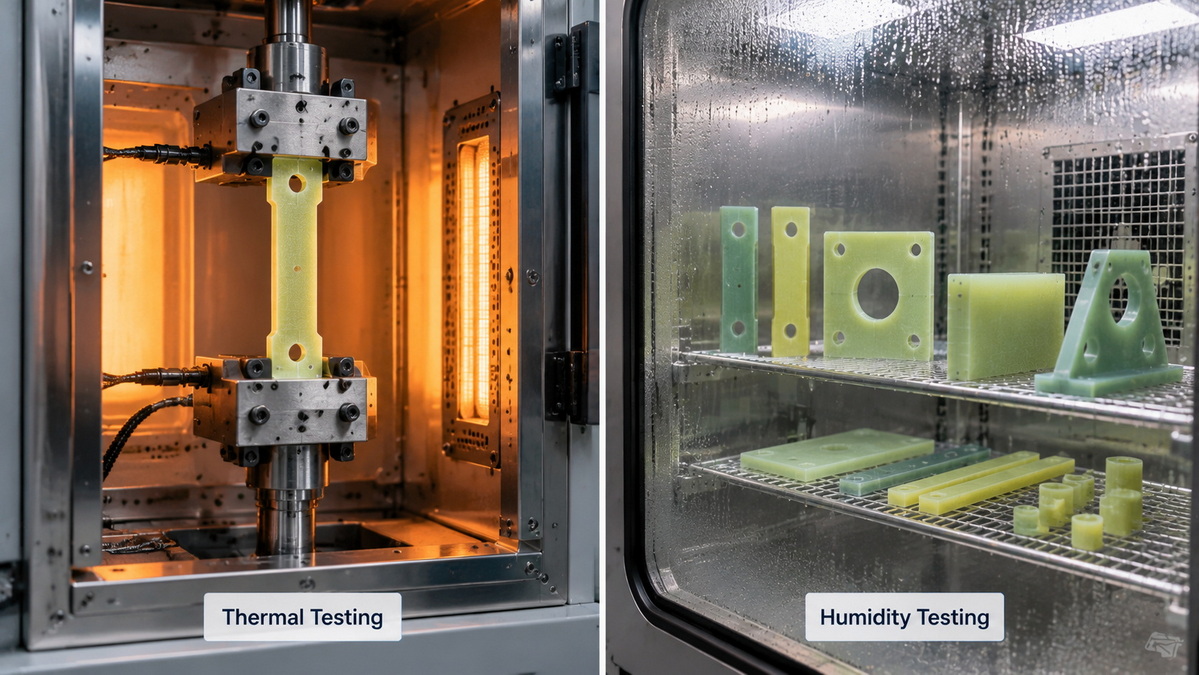
- Appropriate damp-heat or condensation qualification.
A low water-absorption figure is useful evidence, but it does not guarantee reliable behavior on a contaminated surface.
The following examples are illustrative engineering scenarios, not reported customer projects.
A converter needs a machined barrier with modest structural loading. Thermal evaluation confirms that its temperature remains within the selected FR4 product's qualified limits.
The specification also requires documented V-0 performance.
FR4 is a logical candidate, provided electrical spacing, environmental exposure, and finished-part requirements are satisfied. Replacing it with G11 solely because G11 is associated with higher temperatures may add no useful benefit.
A second component carries sustained mechanical load in a hotter location. Room-temperature properties appear adequate, but deformation at operating temperature remains a concern.
G11 deserves evaluation because elevated-temperature mechanical performance is central to the decision.
The next step is not immediate substitution. Obtain hot-property evidence and verify flame requirements. If the proposed G11 cannot satisfy both, evaluate another documented formulation or redesign the component.
These scenarios illustrate a practical principle: different locations within one converter can justify different laminate grades.
Record voltage, temperature, mechanical loading, expected environmental exposure, service conditions, and required flame classification.
Obtain a controlled datasheet identifying the formulation, test methods, conditioning, and thickness-related limitations.
Separate typical values from guaranteed acceptance requirements.
Check thickness, flatness, dimensions, holes, edge quality, and visible defects.
Use representative geometry rather than assuming that an unmachined coupon proves finished-part suitability.
Plan electrical, thermal, humidity, and mechanical checks around the component's actual risks and applicable standards.
Define acceptance criteria before testing.
Agree on material identification, lot traceability, inspection records, and notification of formulation or process changes.
A successful prototype does not remove the need for consistent production control.
The lowest sheet quotation does not necessarily produce the lowest finished-component cost.
Compare offers using the same drawing, material requirements, inspection criteria, and order quantity. Include machining, scrap, documentation, qualification effort, and replacement implications.
Do not assume a fixed G11 price premium or a universal machining-cost difference. These depend on formulation, dimensions, tolerances, availability, and supplier capability.
For custom FR4 and G11 insulation parts, a complete drawing package often improves quotation quality more than a broad request for the "best" grade.
Guangdong Weishi New Materials Co., Ltd. supplies epoxy glass-fiber insulation materials, including FR4 and G10/G11 products, with custom-processing capabilities.
Send your component drawing, operating-temperature range, voltage requirements, mechanical loading, flame classification, and expected quantity. Request a material-specific proposal with available test documentation and a representative sample plan before approving production.

Not universally. G11 merits evaluation when elevated-temperature mechanical performance is important. FR4 may be more appropriate when documented flame retardancy is essential and its thermal capability is adequate.
Only after checking electrical, thermal, mechanical, environmental, and flame requirements. A matching drawing and thickness do not establish equivalent performance.
No. Published G11 products include HB classifications. Verify the specific formulation and supporting documentation.
There is no single value suitable for every product and application. Use the selected material's documented thermal characteristics and validate the component under its intended conditions.
Not automatically. Thickness selection must also address insulation coordination, geometry, environmental conditions, manufacturing tolerances, and applicable safety requirements.
Include the drawing, thickness, tolerances, quantity, voltage, temperature, loading, flame requirement, environmental exposure, and required inspection or qualification documents.
1. Jiujiang Xinxing Insulation Material Co., Ltd. — *Technical Data Sheet: NEMA FR4 / EPGC202*. Source for the cited temperature index, typical flexural strength, and product-specific flame classification. [xx-insulation]
2. Jiujiang Xinxing Insulation Material Co., Ltd. — *Technical Data Sheet: NEMA G11 / EPGC203*. Source for the cited temperature index, Tg, typical flexural strength, and HB classification. [xx-insulation]
3. International Electrotechnical Commission — *IEC 62477-1:2022: Safety Requirements for Power Electronic Converter Systems and Equipment—Part 1: General*. The publication page states its scope and incorporates the April 2024 corrigendum. [webstore.iec]
4. International Electrotechnical Commission — *IEC 62477-1 Seminar Presentation*. Background on insulation coordination, environmental conditions, and fire and thermal hazards; not a substitute for the applicable standard. [assets.iec]
5. Fraunhofer publication repository — *Humidity in Power Converters of Wind Turbines—Field Conditions and Their Relation with Failures*. Source for the discussion of seasonal failure patterns, humidity, and cabinet cooling concepts. [publica.fraunhofer]
6. Atlas Fibre — *Glass Epoxy G-11 Data Sheet*. Additional published example showing an HB flame classification for a G11 product. [atlasfibre]


