
Views: 220 Author: Weishi Sheets Publish Time: 2026-11-01 Origin: Site
Content Menu
● Why Source Phenolic Sheet from China?
>> What the Latest Market Research Actually Shows
● How These Phenolic Sheet Suppliers Were Selected
● Understand the Material Before Comparing Manufacturers
>> Phenolic Sheet Is Not FR4, G10, or G11
>> Specify Standards and Test Conditions
● Top 10 Phenolic Sheet Manufacturers in China
>> 1. Guangdong Weishi New Materials Co., Ltd.
>> 2. Hebei Jinghong Electronic Technology Co., Ltd. / J&Q Export Organization
>> 3. Henan Jinzhi Electrical Insulation New Material Co., Ltd.
>> 4. Shenzhen Xiongyihua Plastic Insulation Ltd.
>> 5. Noves Electronics Co., Ltd.
>> 6. Hony Engineering Plastics Co., Ltd.
>> 8. Wuxi Chifeng Metal Products Co., Ltd.
>> 9. Beijing New Friend Insulation Material Co., Ltd.
>> 10. Shanghai Weifen Industry Co., Ltd.
● Supplier Comparison: Capacity, MOQ, and Certification
● Buyer's Guide: Qualifying a Phenolic Sheet Manufacturer
>> 1. Verify the Factory and Contracting Entity
>> 2. Build an Application-Based RFQ
>> 3. Use a Three-Stage Sample Process
>> 4. Separate Certification from Product Performance
>> 5. Compare Accepted-Part Cost
>> 6. Define Packaging and Logistics Before Shipment
● An Often-Overlooked Procurement Trap: Machining Away the Qualified Surface
● Conclusion: Choose a Repeatable Supply System, Not Just a Sheet Price
>> 1. How Can I Check Whether a Manufacturer's ISO Certificate Has Expired or Been Suspended?
>> 2. Can I Accept 3025 Phenolic Cotton Sheet as a Direct Replacement for NEMA CE or LE?
>> 3. What Should I Specify for ESD Phenolic Sheet Used in Electronics Fixtures?
>> 4. What Is the Real MOQ for a Custom Phenolic Sheet Order?
>> 5. What Should I Do If the Production Batch Passes a Datasheet Check but Fails in My Application?
China offers a broad sourcing base for phenolic sheet, from industrial laminate producers to precision fabricators supplying finished insulation components. For international procurement teams, this creates opportunities to consolidate material purchasing, machining, and export coordination—but it also makes supplier qualification essential.
A low quotation does not reveal whether a factory controls resin impregnation, laminate pressing, dimensional inspection, or material traceability. Nor does a familiar product name such as "Bakelite sheet" establish a particular electrical or mechanical grade.
The most useful starting point is traceability: can the supplier connect the quoted material, production facility, test report, sample, and delivered batch?
This guide examines ten China-based manufacturers and manufacturing-oriented suppliers worth evaluating. It compares their disclosed capabilities, identifies information that still requires verification, and explains how to qualify a phenolic laminate supplier for repeat purchasing.

China's insulation-material supply chain includes laminate manufacturers, resin and reinforcement suppliers, machining businesses, and export-service companies. The suppliers examined here illustrate several sourcing centers: Guangdong for composite materials and machined engineering plastics, Hebei for industrial insulation-board production, Henan for electrical-insulation materials, and the Shanghai–Jiangsu area for diversified laminate supply.
For buyers, the practical advantage is not simply access to inexpensive sheet. It is the ability to compare different supply models:
- Full-size industrial phenolic laminate sheets.
- Cut-to-size panels for assembly operations.
- Drawing-based insulation components.
- Consolidated orders combining phenolic, epoxy-glass, and other engineering materials.
These models serve different purchasing needs. A high-volume laminate producer may suit recurring pallet orders, while a machining-oriented supplier may offer better value for small batches of finished components.
Grand View Research's 2026 phenolic resins report values the global market at USD 15.9 billion in 2025 and projects USD 16.7 billion in 2026. Asia Pacific represented 31.1% of 2025 revenue. However, that market includes wood adhesives, molding, insulation, laminates, paper impregnation, and other applications—not phenolic sheet alone.
The distinction matters. Resin-market revenue, copper-clad laminate statistics, and finished phenolic insulation-sheet demand are different measures. None should be presented as a verified figure for China's industrial phenolic sheet exports.
The shortlist prioritizes publicly identifiable companies with relevant phenolic laminate products or fabrication capabilities. It does not award points for unsupported claims about being the largest or most advanced.
A purchasing team should evaluate each candidate against six criteria.
| Selection criterion | Evidence to request | Purchasing significance |
|---|---|---|
| Manufacturing responsibility | Factory address, process map, equipment list, subcontracting disclosure | Identifies who actually controls sheet production and machining |
| Material expertise | Grade-specific datasheets, reinforcement details, applicable standards | Prevents substitution between superficially similar boards |
| Quality control | Incoming inspection, process records, batch identification, release reports | Supports repeat-order consistency |
| Development capability | Technical review, trial records, sample feedback, change-control procedure | Demonstrates practical support beyond quotation handling |
| Delivery reliability | Capacity allocation, production schedule, historical dispatch records | Distinguishes available capacity from advertised capacity |
| Compliance documentation | Valid management-system certificates and product-specific reports | Separates organizational certification from material conformity |
A website review cannot establish actual delivery performance, certificate validity, or batch consistency. Those remain qualification tasks for the buyer.
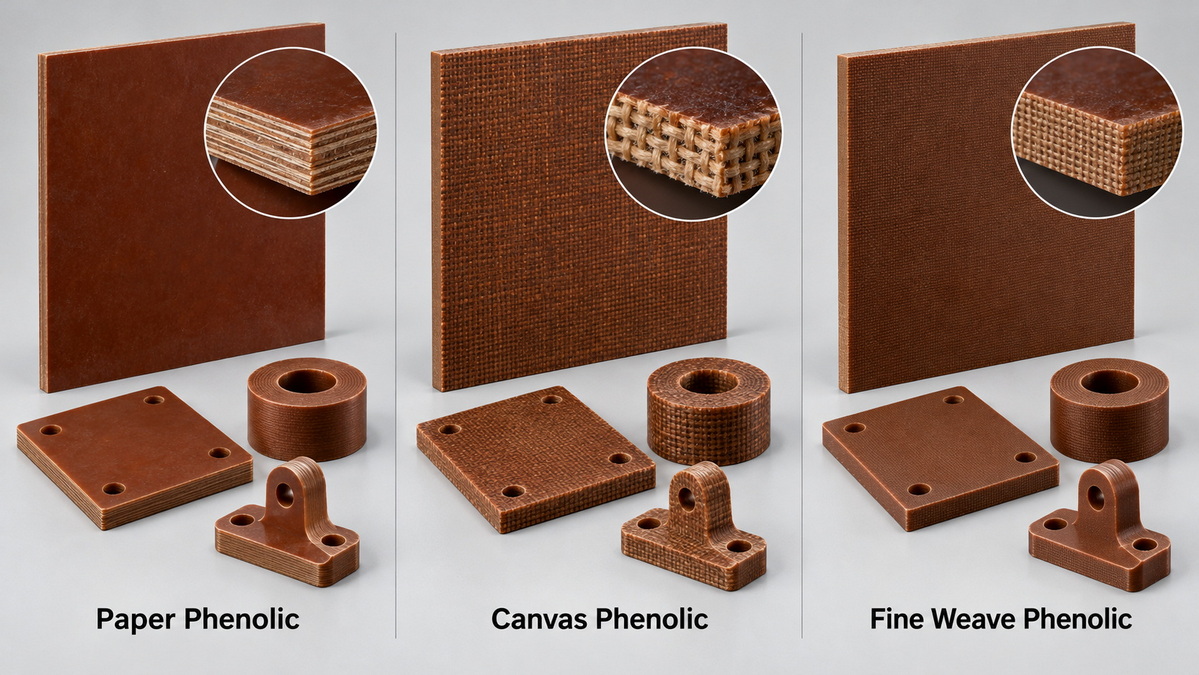
Phenolic sheet is a thermoset laminate typically produced by impregnating paper or cotton fabric with phenolic resin and consolidating the layers under heat and pressure. Reinforcement and grade influence its machining behavior, mechanical strength, and electrical performance.
Phenolic laminate and epoxy-glass laminate belong to different material families. A supplier offering both can help with material selection, but one should not replace the other without engineering approval. IEC 60893 distinguishes thermosetting resin systems and reinforcement types within its industrial rigid-laminate framework.
| Material family | Common designations | Typical purchasing consideration |
|---|---|---|
| Paper phenolic | NEMA X, XX, XXX | Electrical insulation and relatively light mechanical applications |
| Cotton-canvas phenolic | NEMA C, CE | Mechanical components, wear parts, and grade-dependent electrical use |
| Fine-weave fabric phenolic | NEMA L, LE | Small machined parts and applications requiring finer machining detail |
| Epoxy-glass laminate | FR4, G10, G11 | A separate family requiring its own electrical, mechanical, and thermal qualification |
Paper, canvas, and fine-weave phenolic grades should not be treated as interchangeable simply because all are sold as Bakelite or phenolic board.
IEC 60893-3-4 addresses rigid laminated sheets based on phenolic resins, while IEC 60893-2:2023 provides test methods for industrial rigid laminated sheets. The IEC explicitly cautions that compliance with a material specification alone does not establish suitability for every application.
A useful purchase specification therefore includes:
- Exact material designation and reinforcement.
- Thickness tolerance and inspection method.
- Flatness requirements.
- Mechanical and electrical acceptance limits.
- Sample conditioning and test conditions.
- Requirements for machined edges, holes, and finished surfaces.
- Batch identification and documentation.
Do not accept a cross-reference between local and international grades without checking the actual property requirements.
Guangdong Weishi is a candidate for buyers seeking composite insulation materials alongside customization support. Its website lists phenolic board, processing board, FR4/G10/G11-family fiberglass sheets, copper-clad laminate, mica, and GPO-3 products. The company reports establishment in October 2007, a building area exceeding 16,000 square meters, ten engineers, more than sixty technical staff, and monthly output above 100 tonnes. These figures cover its broader business rather than verified phenolic-only capacity.
- Established: 2007.
- Core strength: A broad insulation-material portfolio with production, processing, sales, and service functions.
- Market focus: Electronics, electrical equipment, and machinery applications; a geographic sales breakdown is not publicly established.
- OEM/ODM scope: The website states that it can develop product ideas and designs for mass production. Buyers should confirm phenolic grades, drawing-based processing, tolerances, and documentation during technical review.
For smaller and midsized customers, Weishi is worth evaluating as a potential cost-conscious development partner rather than only a full-sheet vendor. Its published engineering resources and customization proposition support that positioning, but communication speed, quotation responsiveness, trial-order flexibility, and accepted-part cost should be measured rather than assumed.
A practical qualification project would combine a material recommendation, a sample panel, and one representative machined component. This tests how effectively the company translates an application requirement into a repeatable supply specification.
Jinghong's published product portfolio includes Bakelite sheet and phenolic cotton sheet alongside epoxy insulation boards. Its website identifies J&Q as the export organization controlled by Hebei Jinghong and describes two manufacturing operations, including the older Hongda factory.
- Established: Jinghong in 2018; the group website dates Hongda to 2002.
- Core strength: Industrial insulation-board manufacturing with a dedicated export interface.
- Market focus: Domestic and international insulation-material customers; named leading export markets are not disclosed in the reviewed material.
- OEM/ODM scope: Grade, sheet dimension, and processing requirements should be negotiated directly; proprietary formulation-development capability should not be presumed.
The company reports combined annual capacity of 43,000 tonnes across two factories. This is not phenolic-only capacity. Its public pages also contain differing facility-area descriptions, making a current plant-by-plant capability statement an important qualification document.
Henan Jinzhi lists phenolic cotton-fabric laminate among a wider electrical-insulation product range. Its published 3025 sheet description identifies cotton cloth impregnated with phenolic resin and consolidated under heat and pressure.
- Established: 2009.
- Core strength: Electrical-insulation materials serving transformer and motor applications.
- Market focus: Industrial electrical-equipment manufacturers; geographic revenue distribution is not disclosed.
- OEM/ODM scope: Discuss grade-specific sheets, dimensions, and component requirements; verify machining and development responsibilities before contracting.
The supplier reports eight production lines and annual capacity of 12,000 tonnes across its insulation-material business. It also claims ISO 9001 and various testing or conformity documents. Buyers should request current certificates and product-specific reports rather than interpreting these claims as approval of every phenolic grade.
Xiongyihua is relevant to buyers sourcing machined phenolic components as well as sheet material. Its published profile describes a manufacturer and trader of engineering and insulation plastics, including phenolic laminates and epoxy fiberglass products.
- Established: 2006.
- Core strength: Combining material supply with fabrication.
- Market focus: Engineering-plastic and electrical-insulation applications; leading destination markets are not established in the reviewed profile.
- OEM/ODM scope: Its listed equipment includes CNC carving and laser engraving machines, supporting discussion of cutting, drilling, and drawing-based fabrication. Confirm which processes are suitable for the specified phenolic grade.
For this supplier model, an important distinction is whether the company presses the purchased laminate itself or fabricates board obtained from another producer. Either arrangement can work, provided the original material source remains traceable.
Noves is a Dongguan-based composite-material and insulation-engineering-plastic supplier whose listed products include ESD Bakelite sheet, FR4, G10, and G11 sheets. Its portfolio also includes wave-solder pallet materials.
- Established: 2002.
- Core strength: Electronics-oriented composite materials and ESD-related products.
- Market focus: Electronics manufacturing; country-level sales distribution is not disclosed in the reviewed source.
- OEM/ODM scope: Discuss fixture and insulation-component requirements directly, including material selection and machining responsibility.
Noves is particularly relevant when phenolic material is being considered for a production fixture rather than a general-purpose insulation panel. An ESD label alone, however, does not define a usable resistance range or guarantee performance after machining; those requirements belong in the qualification specification.
Hony is listed as a Guangdong manufacturer of plastic and metal components, with Bakelite insulation sheet included in its supplier profile.
- Established: 2008.
- Core strength: Component-oriented engineering-plastic supply.
- Market focus: Industrial component purchasers; major export destinations are not disclosed in the reviewed profile.
- OEM/ODM scope: Drawing-based component supply is the relevant area to investigate; confirm material sourcing, machining capability, and inspection coverage for each project.
Hony is worth evaluating when the purchasing objective is a finished insulation component rather than a bulk laminate contract. Qualification should establish who manufactures the underlying board and how incoming material is identified and accepted.
QUANDA's published profile identifies the Shenzhen company as a manufacturer and distributor offering phenolic Bakelite sheet. That combined role makes it relevant to buyers considering a consolidated materials supply relationship.
- Established: 2007.
- Core strength: Access to phenolic sheet through a manufacturing-and-distribution business model.
- Market focus: Industrial plastic-material purchasing; principal geographic markets are not publicly established.
- OEM/ODM scope: Confirm cut-to-size, machining, labeling, and packaging options in the quotation rather than assuming a standard customization package.
The key procurement question is responsibility: which legal entity supplies the material, which factory produces it, and which party authorizes any change of source?
Despite its corporate name, Chifeng's listed portfolio includes phenolic cotton-cloth sheet, phenolic paper sheet, epoxy sheet, and other electrical-insulation materials. Its profile gives a Wuxi business address and a factory address in Lin'an, Zhejiang.
- Established: 2014.
- Core strength: A diversified insulation-material offering.
- Market focus: Global industrial customers, according to its published introduction; individual leading markets are not named.
- OEM/ODM scope: The company describes production and processing functions. Buyers should confirm the exact sheet-production site, processing location, and drawing-based services for the order.
This candidate may suit consolidated purchasing across several material families. The RFQ should nevertheless identify the original production site and quality documents for each family.
Beijing New Friend's published profile describes an insulation-material business with research, production, sales, and service functions. Its product range includes phenolic cotton-cloth sheet, insulation rods, fiberglass sheet, molding compounds, and phenolic resin.
- Established: 2000 for the company; its predecessor or group history dates to 1996.
- Core strength: A broader thermoset-material and insulation-product background.
- Market focus: Electrical-insulation and industrial applications; major geographic markets are not disclosed.
- OEM/ODM scope: Its stated development and production functions justify a technical discussion, but formulation changes and application-specific development require project-level confirmation.
Buyers should keep the operating company's establishment date separate from its predecessor's history and verify the current legal entity, factory, and certification scope.
Shanghai Weifen's supplier profile lists electrical laminated sheets, phenolic resin, epoxy-glass laminates, and other insulation materials. It describes a business engaged in composite-material development.
- Established: 1990, according to its published introduction.
- Core strength: A diversified electrical-laminate and composite-material portfolio.
- Market focus: Industrial insulation customers; leading geographic markets are not established in the reviewed profile.
- OEM/ODM scope: Discuss laminate specifications and application requirements directly. Current phenolic grades, processing services, and development deliverables need written confirmation.
For long-term purchasing, request a current capability statement. A long operating history is useful context, but it does not replace evidence of present equipment, personnel, and quality controls.
The following table distinguishes published claims from missing information. "Not disclosed" does not mean unavailable; it means a reliable public figure or current document was not established in the reviewed sources.
| Supplier | Main sourcing focus | Published production capacity | Phenolic-sheet MOQ | Certification evidence reviewed |
|---|---|---|---|---|
| Guangdong Weishi | Composite insulation materials and customization | Above 100 tonnes/month across its portfolio; not phenolic-only | Not disclosed | Current certificate numbers and scope require confirmation |
| Jinghong / J&Q | Industrial insulation-board supply | Claimed 43,000 tonnes/year across two factories and multiple materials | Not disclosed | ISO 9001 and ISO 14001 claimed in supplier listing; validate current records |
| Henan Jinzhi | Electrical-insulation materials | Claimed 12,000 tonnes/year across its portfolio | Not disclosed | ISO 9001 and product-document claims; validate by grade and site |
| Xiongyihua | Sheet supply and fabrication | Not disclosed | Not disclosed | Current documents require confirmation |
| Noves | Electronics and ESD-related materials | Not disclosed | Not disclosed | Grade-specific evidence requires confirmation |
| Hony | Engineering-plastic components | Not disclosed | Not disclosed | Current documents require confirmation |
| QUANDA | Material manufacturing and distribution | Not disclosed | Not disclosed | Original manufacturing-site evidence requires confirmation |
| Wuxi Chifeng | Mixed insulation-material supply | Not disclosed | Not disclosed | Current documents require confirmation |
| Beijing New Friend | Insulation and thermoset materials | Not disclosed | Not disclosed | Current documents require confirmation |
| Shanghai Weifen | Electrical laminates and composites | Not disclosed | Not disclosed | Current documents require confirmation |
Capacity and certification claims above come from company websites or supplier profiles, not independent factory audits.
Avoid comparing mixed-product tonnes per year with phenolic-specific square meters per month. A meaningful comparison requires the same material, thickness mix, measurement period, and definition of available capacity.
Before approving samples, request:
1. The supplier's registered Chinese legal name.
2. The manufacturing-site address.
3. The export-contracting entity.
4. A process map showing in-house and outsourced operations.
5. An explanation of how production batches are identified.
If sheet pressing and machining occur at different sites, include both in the quality agreement. A trading or fabrication business can be a suitable partner, but its role must be transparent.
"Brown Bakelite sheet, 10 mm" leaves too much open to interpretation.
A stronger RFQ defines reinforcement, grade, dimensions, tolerances, operating conditions, critical properties, processing requirements, quantity, and documentation.
Ask the supplier to identify every deviation rather than returning a blanket statement of compliance. Also require written approval before changes to resin formulation, reinforcement, original material source, or production site.
A practical qualification sequence is:
- Material screening: Test the proposed grade against the required properties.
- Machining trial: Produce representative holes, pockets, threads, and thin sections.
- Pilot order: Evaluate normal production material, packaging, documentation, and repeatability.
Where relevant, use the agreed IEC test methods and conditioning procedures so results remain comparable. A dry specimen and a conditioned specimen do not represent the same acceptance condition.
Retain an approved reference sample and its associated report. It should represent the purchase specification—not merely an attractive color or surface finish.
ISO certification concerns a management system; it is not a substitute for grade-specific material testing.
RoHS restricts ten substances in electrical and electronic equipment. For a phenolic material intended for such equipment, obtain evidence that corresponds to the actual formulation or product family being supplied.
CE marking is not a universal raw-material quality label. European Commission guidance states that it applies only where relevant legislation requires it and must not be used where no such requirement applies. Ask a supplier claiming "CE-certified phenolic sheet" to identify the applicable legislation and product scope.
The lowest sheet price may not produce the lowest purchasing cost.
Include these items in the comparison:
- Usable area after edge trimming.
- Thickness allowance and machining time.
- Nesting yield.
- Scrap and rework.
- Inspection and testing.
- Packaging and freight.
- Documentation and replacement handling.
For machined parts, compare cost per accepted component. For full sheets, compare usable area at the specified tolerance—not nominal area alone.
Agree on rigid support, corner protection, stacking limits, moisture protection where required, and batch labels.
The purchase order should also identify the delivery term, freight responsibility, cargo-insurance arrangement, and claims procedure. Confirm customs classification with the importer or customs broker rather than treating another supplier's historical declaration as universally applicable.
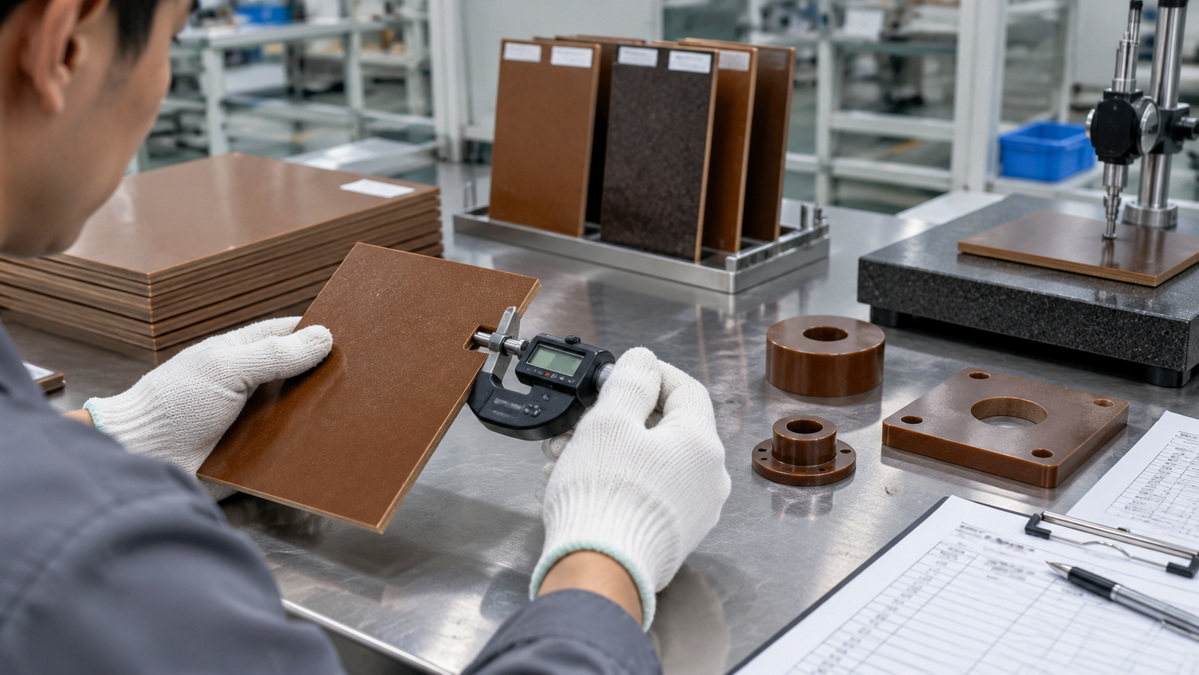
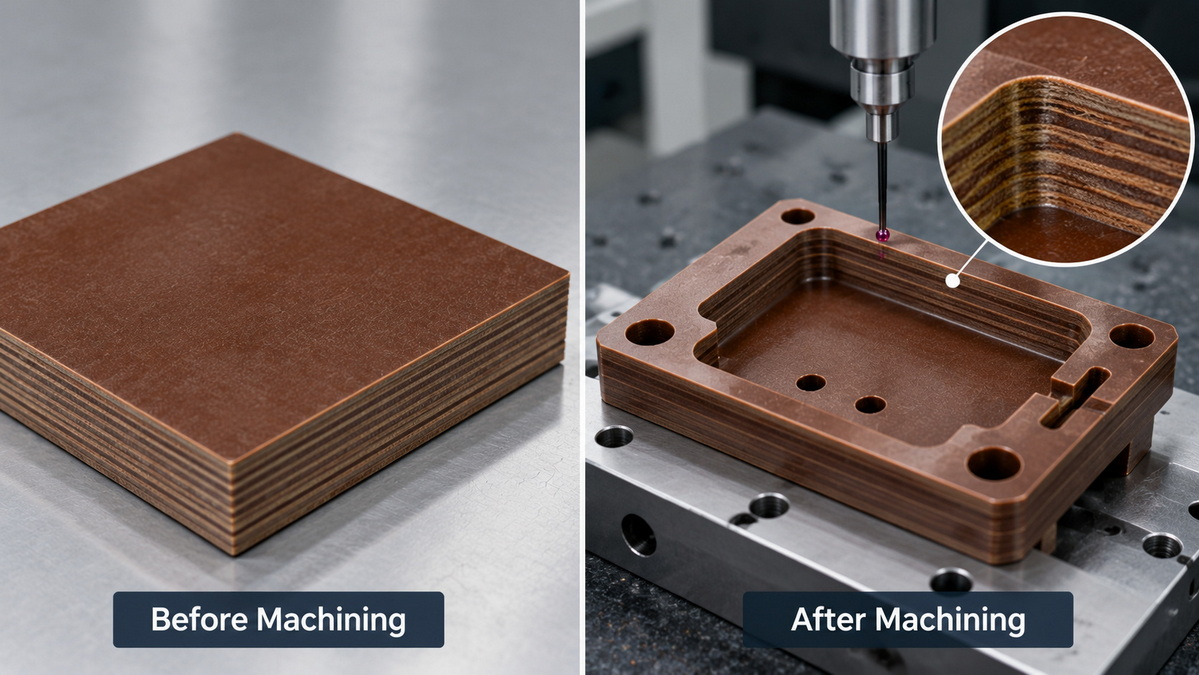
An overlooked qualification risk is approving a full-thickness sheet, then purchasing a component that is extensively face-machined.
The delivered component no longer has the same surfaces or geometry as the approval coupon. A deep pocket, thin web, or machined insulation face may therefore require evaluation beyond the original flat-sheet test.
The important insight is not that every phenolic laminate has a defective interior. It is that qualification should represent the finished part and its manufacturing route. IEC guidance likewise distinguishes compliance with a material specification from suitability for a particular application.
To control this risk:
- Include a representative machined part in initial approval.
- Identify which surfaces provide functional insulation.
- Inspect exposed edges and internal features.
- Test the final geometry when application risk justifies it.
- Prevent substitutions based only on color, nominal thickness, or a generic datasheet.
This approach also helps detect a familiar purchasing problem: a mechanically acceptable board being supplied where a particular electrical grade was required.
The right phenolic sheet manufacturer depends on the purchasing model. Bulk laminate contracts require evidence of production consistency and available capacity. Finished-component orders require material-source control, machining capability, and dimensional inspection. Electronics fixtures may add ESD requirements.
Guangdong Weishi New Materials Co., Ltd. is a practical starting point for buyers comparing phenolic materials with a wider insulation-material portfolio and customization support. Its published business scope includes phenolic board, processing services, and several epoxy-glass product families, while phenolic-specific capacity, grade availability, and order conditions should be confirmed during quotation.
Send your drawing, required grade, operating conditions, annual demand, and compliance requirements to Weishi's technical team. Request a material recommendation, a representative sample, and an itemized quotation covering material, processing, inspection, and packaging. Compare competing suppliers against the same specification before making a long-term commitment.
Request the complete certificate number, certified legal entity, factory address, standard, scope, issuing body, and validity dates.
Search the certificate in IAF CertSearch and review its current status. The platform distinguishes active, suspended, withdrawn, and expired certificates; a printed expiry date alone does not establish that certification remains active. Also confirm that the scope and site cover the activities relevant to your purchase. If the record cannot be resolved, contact the issuing certification body directly.
Not on the product name alone.
Require a documented comparison of reinforcement, applicable specification, electrical properties, mechanical properties, test conditions, and dimensional requirements. NEMA C/CE and L/LE designate different phenolic material categories, while IEC specifications establish their own material requirements. The engineering team should approve equivalence for the actual application.
Define the required resistance range, measurement method, conditioning environment, test locations, and whether the requirement applies before or after machining.
Also identify functional surfaces, grounding arrangements, and acceptance limits for finished components. "Antistatic Bakelite" is a product description, not a complete purchasing specification. A supplier listing ESD Bakelite is a sourcing candidate, but the project still requires agreed test criteria.
The reviewed sources do not establish a consistent MOQ across these suppliers. MOQ should therefore be requested for the exact grade, thickness, size, and processing route—not inferred from a general company profile.
Ask for separate quantities and prices for:
- Stock sheet.
- Cut-to-size stock material.
- A dedicated manufacturing run.
- A machined prototype or pilot batch.
This separates inventory availability from production economics and prevents a low sample quantity from being mistaken for the normal production MOQ.
First determine whether the datasheet values were contractual acceptance limits, typical values, or results from a different test condition.
Compare the approved specification, sample report, production-batch report, and actual operating conditions. Then investigate material identity, conditioning, machining, installation, and any unauthorized changes.
IEC distinguishes typical values from specification requirements and warns that material-standard compliance alone does not establish application suitability. The remedy is to define measurable acceptance criteria and representative qualification tests before production purchasing.
1.Guangdong Weishi New Materials Co., Ltd. — Company history, facility information, product categories, and customization statement. [wsepoxysheet]
2.Jinghong / J&Q — Manufacturing organization, establishment dates, product range, and stated capacity. [jhd-material]
3.Henan Jinzhi — Phenolic cotton laminate listing, company background, capacity, and certification claims. [jzelec.en.made-in-china]
4.Xiongyihua, Noves, Hony, and QUANDA — Supplier profiles and product classifications compiled in the 2026 paper-Bakelite manufacturer directory. [us.metoree]
5.Wuxi Chifeng — Company profile, product portfolio, and stated factory location. [chifengproducts.en.made-in-china]
6.Beijing New Friend — Company and predecessor history, insulation products, and development functions. [shop.equipmentimes]
7.Shanghai Weifen — Establishment history and electrical-laminate portfolio. [shweifeninsulation.en.made-in-china]
8.International Electrotechnical Commission — IEC 60893-1, definitions, designations, and general requirements for industrial rigid laminated sheets. [webstore.iec]
9.International Electrotechnical Commission — IEC 60893-2:2023, methods of test. [webstore.iec]
10.International Electrotechnical Commission — IEC 60893-3-4, phenolic-resin laminate requirements, consolidated edition. [webstore.iec]
11.International Electrotechnical Commission — IEC TR 60893-4, guidance on typical property values. [webstore.iec]
12.China Electronic Materials Industry Association, Copper Clad Laminate Materials Branch — Industry-association information portal. Its coverage concerns copper-clad laminates and should not be treated as phenolic-sheet-only market data. [chinaccl]
13.European Commission, Your Europe — Official guidance on when CE marking applies. [europa]
14.European Commission — Official RoHS Directive overview. [environment.ec.europa]
15.IAF CertSearch — Accredited-certificate search and verification guidance. [iafcertsearch]
16.Grand View Research — Phenolic Resins Market, 2026–2033; broader resin-market context, not a standalone phenolic-sheet market estimate. [grandviewresearch]
17.Piedmont Plastics — Phenolic reinforcement types, NEMA grade families, and application overview. [piedmontplastics]


