
Views: 218 Author: Weishi Sheets Publish Time: 2026-11-03 Origin: Site
Content Menu
● How These Fiberglass Sheet Suppliers Were Selected
● Why Source Fiberglass Sheets from Italy?
>> An Established Composites Industry
>> Northern Italian Manufacturing Networks
● First, Define Which Fiberglass Sheets You Need
● Five Fiberglass Sheets Manufacturers and Suppliers to Evaluate
>> 1. Guangdong Weishi New Materials Co., Ltd. — Direct-Factory Alternative for Italian Buyers
>>> Core Strengths and Customization Scope
>>> Best-Fit Purchasing Scenario
>> 2. La Misolet S.r.l. — Italian Electrical Insulation Processing Specialist
>>> Core Strengths and Customization Scope
>>> Best-Fit Purchasing Scenario
>> 3. Brianza Plastica S.p.A. — Polyester Fiberglass Sheets and Rolls
>>> Core Strengths and Customization Scope
>>> Best-Fit Purchasing Scenario
>> 4. Vetroresina S.p.A. — Industrial GRP Laminate Manufacturer
>>> Core Strengths and Customization Scope
>>> Best-Fit Purchasing Scenario
>> 5. Röchling Industrial — Composite Materials with an Italian Contact Channel
>>> Core Strengths and Customization Scope
>>> Best-Fit Purchasing Scenario
● Supplier Comparison: Capacity, MOQ, and Certification Evidence
● Technical Qualification: What Buyers Should Actually Check
>> Material Grade and Manufacturing Route
>> CE Marking, RoHS, and REACH Are Different Requirements
● Buyer's Guide: From Supplier Verification to Shipment
>> 1. Verify the Actual Manufacturing Chain
>> 2. Approve a Representative Sample
>> 3. Evaluate Cost per Accepted Component
>> 4. Define Packaging and Delivery Responsibilities
● The Insider Pitfall: A Machined Part Can Lose Its Batch Identity
● FAQ
>> 1. How can I verify whether a supplier's ISO certificate is expired, suspended, or outside scope?
>> 2. Can I accept G11 instead of FR4 if the supplier says G11 has better heat resistance?
>> 3. What should I do if the sample passes but the first production shipment does not?
>> 4. Does a "V-0" statement prove the supplied sheet is approved for my application?
>> 5. Should I buy full sheets from a factory or finished parts from an Italian processor?
Italy offers professional buyers a useful combination of established composite manufacturers, specialist insulation processors, and industrial supply networks. However, choosing a long-term supplier requires more than comparing sheet prices. Material traceability, machining accuracy, certification scope, and delivery consistency can have a greater impact on total purchasing cost.
This guide evaluates fiberglass sheets manufacturers and suppliers serving Italy, with particular attention to electrical insulation materials such as FR4, G10, and G11. It also includes manufacturers of polyester fiberglass sheets for transport panels and industrial surfaces, while clearly distinguishing these products from electrical-grade epoxy laminates.
Guangdong Weishi New Materials Co., Ltd. appears first as a China-based sourcing alternative for Italian buyers—not as an Italian manufacturer. Its inclusion provides a practical comparison between direct factory purchasing overseas and sourcing through Italian production or processing networks.

This is an application-based shortlist, not an independently audited ranking by revenue, production volume, or customer satisfaction. The companies were selected using publicly available information about their products, manufacturing or processing capabilities, technical documentation, and relevance to industrial buyers.
The evaluation considers six areas:
1. Material specialization: Does the company supply electrical-grade epoxy fiberglass laminates, polyester GRP sheets, or application-specific composites?
2. Manufacturing transparency: Does it identify its production processes, facilities, or processing capabilities?
3. Technical support: Can buyers access material grades, technical properties, and application information?
4. Quality management: Does the company publish relevant management-system information, and can its certificates be verified?
5. Customization capability: Can it support drawing-based components, customized sheet dimensions, finishes, or production formats?
6. Supply continuity: Can the supplier demonstrate repeatable inspection, batch identification, capacity planning, and delivery performance?
Published information does not establish current factory capacity, available production slots, certificate validity, or delivery reliability. Buyers should verify these during qualification.
Italy remains a significant European composites-processing market. AVK's report covering 2025, published in 2026, places Italy at approximately 134,000 tonnes and 14.1% of the regional market category discussed in its country comparison. The report gives a corresponding Italian figure of 140,000 tonnes for 2024. These figures describe a broader composites-processing segment—not Italy's FR4 or G10 sheet production alone.
That distinction matters. Broad composites statistics provide useful industrial context, but they should not be presented as evidence of demand or production capacity for electrical insulation boards.
The shortlisted businesses illustrate two relevant industrial concentrations:
- Lombardy and the Brianza area: fiberglass laminate manufacturing, electrical insulation processing, and access to industrial customers.
- Emilia-Romagna, particularly the Ferrara area: established GRP laminate production and connections to vehicle-body and industrial-panel applications.
Brianza Plastica's manufacturing history and Vetroresina's investments around Ferrara demonstrate these regional capabilities. An industry profile also identifies the Bologna–Ferrara–Modena area as a plastic value-chain cluster.
For buyers with European production operations, local sourcing can simplify technical discussions, factory visits, and replacement-part coordination. Nevertheless, local availability and delivery advantages must be confirmed for the specific grade and order—not assumed from the supplier's address.
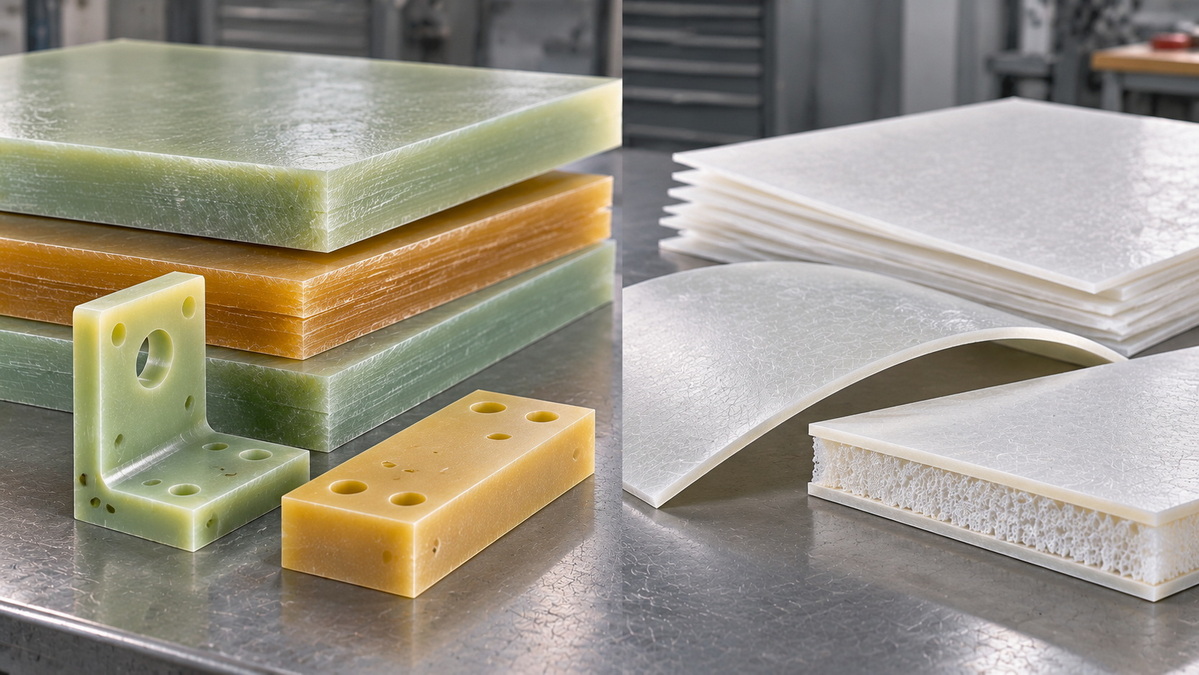
"Fiberglass sheets" describes several materially different product families.
| Product family | Typical construction | Common purchasing applications | Important distinction |
|---|---|---|---|
| FR4 epoxy glass laminate | Glass fabric reinforced with flame-retardant epoxy resin | Electrical insulation components and machined supports | Verify the exact grade and flame-performance evidence |
| G10 epoxy glass laminate | Glass fabric reinforced with epoxy resin | Mechanical and electrical insulating components | Do not assume it carries the same flame classification as FR4 |
| G11 epoxy glass laminate | Glass fabric with a higher-temperature epoxy system | Insulating parts exposed to elevated temperatures | Verify the supplier's actual grade and temperature-related data |
| Polyester GRP laminate | Glass reinforcement in polyester resin | Vehicle skins, sandwich-panel facings, industrial surfaces | Not automatically interchangeable with electrical epoxy laminates |
| Solder-pallet composite | Application-specific glass-reinforced composite | PCB assembly tooling | Select against the actual thermal and chemical process |
La Misolet publishes separate FR4, G10, G11, and FR5 product information, including references to NEMA and IEC/EN material designations. Brianza Plastica describes Elycold as a polyester-resin and glass-fiber laminate. Röchling documents separate composite grades developed for solder-pallet applications. These are different purchasing categories, even when their products share glass reinforcement.
- Established: October 2007.
- Location: Heyuan, Guangdong, China.
- Supply role: Composite-material manufacturer integrating production, processing, sales, and trade.
- Main application markets: Electronics, electrical equipment, and machinery.
- Geographic market disclosure: A country-by-country sales breakdown was not established from the reviewed company page.
Guangdong Weishi New Materials Co., Ltd. is relevant to buyers seeking epoxy fiberglass sheets and customized insulating components rather than vehicle-facing polyester laminates.
Its website lists FR4, G10, G11, FR5, and 3240 fiberglass sheets, alongside copper-clad laminates, antistatic boards, and other insulation materials. The company reports more than 16,000 square meters of building area, 10 engineers, more than 60 technical staff, and monthly output exceeding 100 tonnes. These are supplier-published figures and should be verified during qualification.
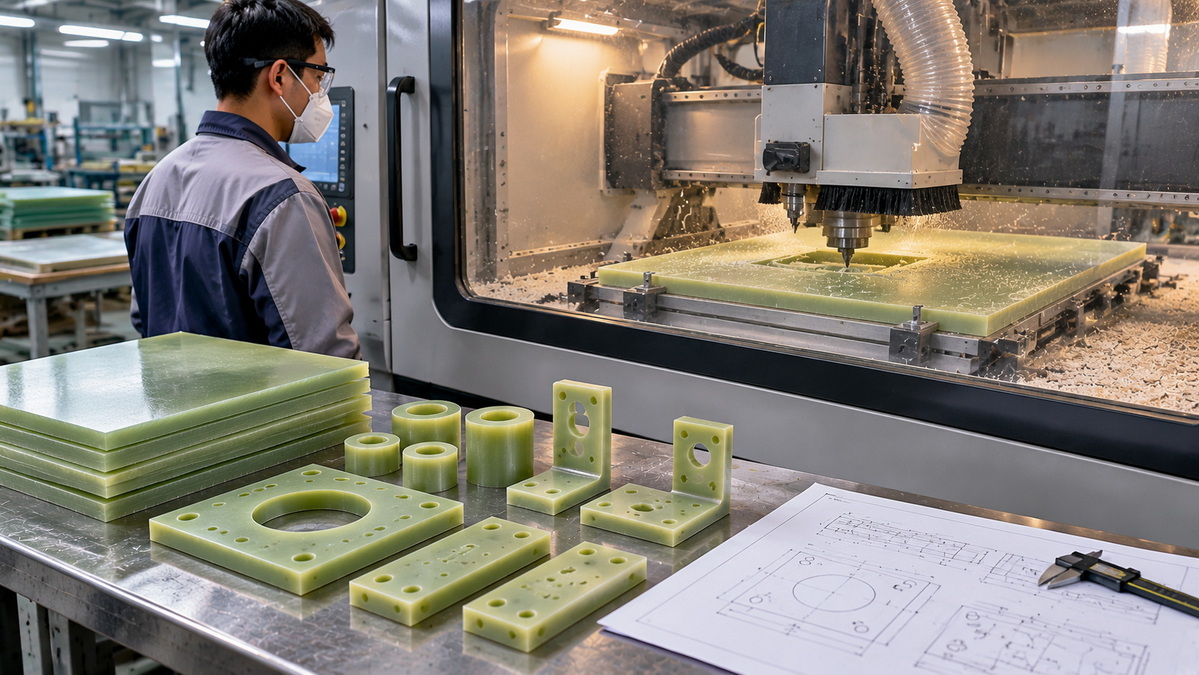
Weishi's product range and stated ability to adapt customer designs for mass production make it a candidate for drawing-led OEM projects. Potential inquiries include full sheets, cut components, and processed insulation parts, with feasibility established through a drawing review.
For smaller manufacturers and emerging equipment brands, its relevance lies in the possibility of combining material supply and processing through one factory relationship. However, low MOQ, rapid communication, and superior pricing should be treated as qualification objectives—not guaranteed facts.
A practical first inquiry should request:
- Recommended grade and supporting technical data.
- Drawing review and achievable tolerances.
- Sample quantity, sample charge, and production MOQ.
- Named technical and commercial contacts.
- Separate sample and repeat-order lead times.
- Batch-specific inspection and compliance documents.
Include Weishi in a competitive RFQ when evaluating cost-conscious, customized epoxy fiberglass supply. Compare its landed cost and accepted-part yield against Italian alternatives rather than relying on sheet price alone.
The reviewed page does not establish independently verified certification scope or a quantified price advantage.
- Established: 1983.
- Location: Somaglia, Lombardy, Italy.
- Supply role: Insulation-material supplier and processor.
- Main application markets: Electrical, electromechanical, thermoelectrical, and thermomechanical equipment.
- Geographic market disclosure: Detailed sales distribution was not established from the reviewed sources.
La Misolet is particularly relevant when the requirement is FR4, G10, G11, or another electrical insulating laminate rather than general-purpose GRP panel material.
Its published range includes epoxy glass, polyester glass, melamine glass, and silicone glass materials. It supplies sheets, tubes, and rods and offers mechanical processing. The company states that it operates under ISO 9001:2015 certification.
The company's main value is the combination of material selection and drawing-based component production. Its business profile specifically describes production to customer drawings in both small and large quantities.
Published material tables include grade designations and thermal classifications. For example, its product information distinguishes standard G11 from a higher-temperature G11H offering. This gives buyers a useful starting point for technical discussions, although product-table classifications should not replace application validation.
La Misolet deserves consideration for Italian or European equipment manufacturers that need locally coordinated insulation parts, material advice, and machining support.
Buyers should establish the original laminate manufacturer, batch documentation, and responsibility for both raw-material and finished-part conformity.
- Established: 1962.
- Location: Carate Brianza, Lombardy, with additional production operations.
- Supply role: Fiberglass laminate manufacturer.
- Main application markets: Commercial vehicles, recreational vehicles, agriculture, industrial applications, and construction-related products.
- Geographic reach: Its published group literature identifies operations including Plasti-Bat and Brianza USA Corporation; current sales distribution should be requested directly.
Brianza Plastica began producing translucent fiberglass laminates in 1962. Its portfolio subsequently expanded into flat, curved, corrugated, opaque, and translucent products for multiple applications.
Its Elycold and Elyplan ranges are important options for buyers looking for fiberglass sheets and rolls used as surfaces or facings—not direct substitutes for FR4 electrical insulation boards.
Brianza Plastica describes both continuous hot-laminating and discontinuous cold-laminating capabilities across four fiberglass laminate production sites. Its product information highlights customized small-quantity production for Elycold and requested roll lengths for Elyplan.
Published Elycold dimensions include:
- Thicknesses from 1 to 3.6 mm.
- Maximum width of 3,400 mm.
- Length up to 60 m in the stated product dimensions.
The company publishes ISO 9001:2015 management-system information covering activities including fiberglass laminate design and production. Buyers should still verify the current certificate and relevant site coverage.
Consider Brianza Plastica for transport-panel skins, refrigerated-body facings, recreational-vehicle laminates, and similar polyester GRP applications.
Discuss finish, adhesive compatibility, dimensional requirements, and minimum production runs before treating a catalogue product as production-ready.
- Established: 1968.
- Location: Ferrara area, Emilia-Romagna, Italy.
- Supply role: Manufacturer of fiberglass-reinforced plastic laminates.
- Main application markets: Industrial panels, with motorhomes and refrigerated trucks identified in an industry profile.
- Geographic reach: International operations have included Italy, Brazil, and the United States.
Vetroresina manufactures GRP sheets and rolls, including customized versions. Its company history describes collaborations with the Universities of Ferrara and Trieste and successive investments in production facilities.
The company reports that a 2019 Italian factory expansion added approximately 5,000 square meters and increased total production by 20%. Its history also records the opening of the Quartiere plant in 2022, with eight new workbenches and a further 5,000 square meters.
These investments provide evidence of manufacturing development, but they do not establish current spare capacity.
An industry profile published in 2020 cited group capacity of eight million square meters of flat GRP laminates. That figure is historical and should not be reused as confirmed 2026 capacity.
Vetroresina is relevant for buyers qualifying repeat-volume industrial GRP facings and vehicle-related laminate programs.
Its publicly described customization capability supports an OEM discussion, but exact resin options, surface finishes, minimum runs, certification requirements, and delivery commitments need quotation-specific confirmation.
- Established: The group describes a history exceeding 200 years; the reviewed sources did not establish the incorporation year of the specific Italian entity.
- Italian contact: Röchling Machined Plastics Italia S.r.l., Gozzano, appears in the reviewed solder-pallet brochure.
- Supply role: International composite-material and component supplier.
- Main application markets relevant here: PCB assembly tooling and technical industrial applications.
- Geographic reach: The group reports operations in 25 countries.
Röchling is useful for buyers seeking branded, application-specific composites rather than an undifferentiated fiberglass sheet.
Its Durostone portfolio includes materials developed for PCB assembly processes. The reviewed brochure distinguishes grades by reinforcement, antistatic characteristics, and resistance to demanding soldering environments.
Röchling's wider composites offering includes semi-finished products and machined components. For Italian sourcing, buyers should confirm which legal entity supplies the material, where the selected grade is manufactured, and where machining occurs.
A local contact does not establish Italian origin for every product.
Include Röchling when process durability, a defined branded grade, or solder-pallet performance matters more than the lowest general-purpose laminate price.
For drawing-based programs, distinguish machining an existing qualified material from developing a new material formulation.
The table separates published evidence from information that requires a current quotation.
| Supplier | Primary focus | Public capacity evidence | MOQ position | Certification or compliance evidence |
|---|---|---|---|---|
| Guangdong Weishi | FR4, G10/G11 and related insulation sheets | Supplier reports more than 100 tonnes monthly; allocation by grade not stated | Request by grade, thickness, and processing scope | Reviewed page does not establish independently verified certificate scope. |
| La Misolet | Electrical insulation materials and machined parts | No quantified capacity established in reviewed sources | Small and large quantities described; numerical MOQ not stated | Publishes ISO 9001:2015 status; verify validity and scope. |
| Brianza Plastica | Polyester fiberglass sheets and rolls | Four fiberglass production sites described; current annual output not established | Elycold customization in small quantities described; numerical MOQ not stated | Publishes ISO 9001:2015 management-system information. |
| Vetroresina | Industrial GRP sheets and rolls | Historical 2020 group figure: eight million m²; current capacity requires confirmation | Request by laminate specification and production run | Obtain current certificates and application-specific test evidence. |
| Röchling Industrial | Technical composites and solder-pallet materials | Italian product-specific capacity not established | Request by grade and component geometry | Obtain supplying-site certificates and selected-grade documentation. |
Tonnes per month and square meters per year are not directly comparable. Thickness, density, product mix, and manufacturing route affect the relationship between these measures.
La Misolet describes epoxy fiberglass laminates as layers of resin-impregnated glass fabric consolidated under heat and pressure. Brianza Plastica describes different continuous and discontinuous manufacturing routes for its fiberglass sheet ranges. These process differences reinforce why buyers should identify the resin, reinforcement, and intended function before comparing quotations.
An RFQ should specify:
- Material designation and agreed standard.
- Resin and reinforcement family.
- Nominal dimensions and acceptance tolerances.
- Required electrical, mechanical, and thermal properties.
- Flame-performance requirements, where relevant.
- Inspection method and reporting format.
- Application environment and expected service conditions.
Do not use a grade name alone as the complete purchasing specification.
CE marking is not a universal quality certificate. EU guidance states that it applies only to products covered by legislation requiring it; products outside that scope must not carry the mark. Therefore, asking every raw fiberglass sheet supplier for a generic "CE certificate" is not a reliable qualification method.
For electrical and electronic applications, request documentation addressing the applicable RoHS requirements and the supplied material's identity. Do not accept a report for an unrelated resin, thickness, or product family as evidence for your order.
For REACH, request a dated declaration referencing the applicable Candidate List. ECHA maintains the authoritative list and notes that inclusion can trigger legal obligations under the regulation.
Where an article contains a Candidate List substance above 0.1% by weight, Article 33 communication obligations may apply. This is different from treating REACH as a simple pass-or-fail certificate.
Ask whether the company manufactures the laminate, purchases and processes it, or distributes it.
Each model can be commercially appropriate. The risk is an undisclosed chain in which nobody accepts responsibility for material origin or batch conformity.
Request:
- Legal company name and manufacturing-site address.
- Raw-material producer identification where applicable.
- Current certificate copies and verification details.
- A sample batch inspection report.
- Written control of material substitutions.
- Identification linking finished parts to the original sheet batch.
A loose catalogue sample demonstrates only what that sample can do.
Use a qualification sequence:
1. Review technical data and compliance documents.
2. Obtain material matching the proposed production grade and thickness.
3. Machine or process it using the intended production route.
4. Inspect dimensions and application-critical properties.
5. Approve a pilot shipment.
6. Release repeat orders against the agreed specification.
For critical components, agree on independent testing where justified by the failure risk.
A cheaper sheet can produce a more expensive finished part if it causes excessive machining waste, dimensional rejection, or reinspection.
Compare quotations using:
- Usable nesting area.
- Machining time and tool consumption.
- Accepted-part yield.
- Inspection expense.
- Packaging and freight.
- Duties, taxes, and brokerage where applicable.
- Replacement lead time and inventory exposure.
This comparison is particularly important when evaluating an overseas factory against an Italian processor.
Specify flat support, surface protection, edge protection, and maximum stack weight. For rolls, agree on core dimensions, winding orientation, and unloading requirements.
Use a named delivery location and clearly defined trade terms. Ask for separate commitments covering production completion, dispatch, and expected transport duration.
Do not treat advertised monthly output as a delivery promise.
A procurement risk that receives less attention than price or certification is the break between original sheet documentation and the finished component.
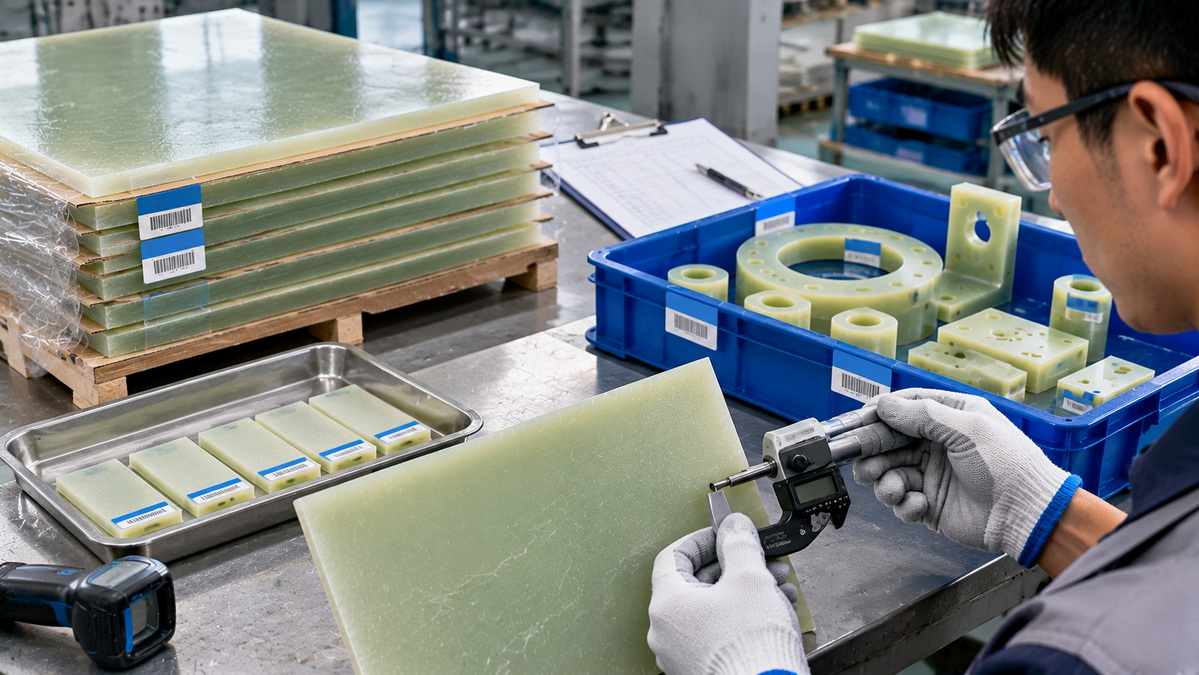
A supplier may provide an acceptable technical data sheet while the delivered parts carry no link to the inspected laminate lot. If a performance problem appears later, the buyer cannot establish which sheet batch was used.
A practical prevention method is to require:
- Original sheet-batch identification.
- A cutting or machining traveler carrying that identification.
- Finished-part packaging labels linked to the traveler.
- Retained inspection records.
- Written approval before material substitution.
For demanding applications, also agree whether sheet orientation, conditioning, and test-specimen location matter to acceptance. This converts a generic material purchase into a controlled manufacturing specification.
A certificate in an email is useful only when it can be connected to the goods received.
The right fiberglass sheets supplier depends first on the material family and application.
La Misolet is relevant to electrical insulation materials and drawing-based processing. Brianza Plastica and Vetroresina are relevant to polyester GRP sheets and rolls. Röchling offers an application-specific technical-composites route. Guangdong Weishi New Materials Co., Ltd. provides an overseas factory option for epoxy fiberglass materials and customized insulation inquiries.
For a productive comparison, send every shortlisted supplier the same drawing package, material requirements, annual demand estimate, inspection criteria, and delivery destination.
To evaluate Guangdong Weishi for your next FR4, G10, or G11 project, submit the required grade, dimensions, tolerances, quantities, and operating conditions. Request a documented sample proposal and landed-cost quotation before committing to production.
Check the legal entity, manufacturing address, standard, certificate number, scope, and validity dates.
Then verify the certificate directly with the issuing certification body or its verification service. An accredited-certification database such as CertSearch can provide an additional verification route, including status monitoring. A printed expiry date alone does not establish that a certificate remains active.
Also check whether the scope covers laminate manufacturing, component machining, or only trading. These activities are not interchangeable.
Not automatically. The reviewed product information treats FR4 and G11 as distinct grades with different classifications. A higher-temperature offering does not by itself establish the flame behavior, electrical performance, or application approval required for an FR4 component.
Require a documented engineering review against the original specification before approving substitution.
First establish whether the sample and shipment share the same grade, source, thickness, and acceptance conditions.
The purchasing agreement should define the inspection method, sampling plan, rejection criteria, retained samples, and remedy process before shipment. Without those controls, the dispute can become a comparison between two differently tested materials.
For high-risk parts, approve a pilot lot rather than moving directly from a small sample to full annual volume.
No. Request the underlying evidence and confirm the material identity, tested thickness, applicable conditions, and relevance to the finished component.
A material flame classification addresses behavior under a defined test. It does not establish that an entire electrical assembly meets every applicable safety requirement. The reviewed UL 94 testing overview describes the method as a preliminary indication for material acceptability in a particular application.
Compare the cost and risk at the finished-part level.
Full sheets may suit buyers with qualified machining capability, predictable consumption, and a documented incoming-inspection process. Finished parts may suit buyers who need local drawing coordination or want machining responsibility included in the supply contract.
In either case, require the same material identity, batch records, and acceptance criteria. Geographic proximity does not replace technical qualification.
1.Weishi's company page supports its stated establishment date, product range, staffing, facility area, and monthly-output claim; these remain supplier-published information. [wsepoxysheet]
2.La Misolet's company and product pages support its history, insulation-processing focus, published certification claim, and laminate classifications. [misolet]
3.Brianza Plastica's history, product, and certification pages support its establishment date, production routes, Elycold dimensions, and published management-system scope. [brianzaplastica]
4.Vetroresina's company page supports its history and facility investments; the eight-million-square-meter capacity figure comes from a 2020 industry profile and is not presented as current capacity. [vetroresina]
5.Röchling's group and product materials support its international presence, composites offering, and Italian contact channel. [roechling]
6.AVK provides the 2025 industry figures; EU, ECHA, and certification-verification sources support the compliance discussion. [avk-tv]


