
Views: 241 Author: Weishi Sheets Publish Time: 2026-10-22 Origin: Site
Content Menu
● Introduction: Why Source G10 Epoxy Sheet Through France?
>> What the Latest Industry Report Actually Shows
● Selection Criteria: How to Evaluate a Qualified Supplier
>> 1. Identify the Supplier's Actual Role
>> 2. Verify Factory Certification and Its Scope
>> 3. Review Engineering and Development Support
>> 4. Examine the Quality-Control Process
>> 5. Evaluate Delivery Reliability
● Technical Essentials: G10, FR4, and G11 Are Not Interchangeable Labels
>> Compliance: What to Request Instead of a Generic Certificate
● Five Manufacturers and Suppliers to Consider for French-Market Procurement
>> 1. Guangdong Weishi New Materials Co., Ltd. — Direct Manufacturing and Customization Alternative
>>> Core Strengths
>>> Best-Fit Procurement Scenario
>> 2. Abaqueplast — French Distribution of Machinable Glass-Epoxy Sheet
>>> Core Strengths
>>> Best-Fit Procurement Scenario
>> 3. ISOTAC – Isolants du Sud-Est — Custom Electrical-Insulation Components
>>> Core Strengths
>>> Best-Fit Procurement Scenario
>> 4. Final Advanced Materials — Application Engineering for Glass-Epoxy Alternatives
>>> Core Strengths
>>> Best-Fit Procurement Scenario
>> 5. Angst+Pfister / APSOparts — Documented Technical-Material Supply
>>> Core Strengths
>>> Best-Fit Procurement Scenario
● Supplier Comparison: Capacity, MOQ, and Certification
● Buyer's Guide: How to Qualify a Supplier Before Ordering
>> Step 1: Build an Application-Based Specification
>> Step 2: Confirm the Manufacturing Chain
>> Step 3: Qualify Samples in Three Stages
>> Step 4: Compare Delivered Cost
>> Step 5: Define Delivery and Change-Control Rules
● Common Procurement Pitfalls—and How to Avoid Them
>> Pitfall 1: Buying by Color Instead of Material Identity
>> Pitfall 2: Treating G10 and FR4 as Automatically Equivalent
>> Pitfall 3: Accepting Company-Level Documents for Every Product
>> Insider Guide: Test Flatness After Machining and Unclamping
● Conclusion: Select the Right Supply Model, Not Just a Company Name
● FAQ
>> 1. How Can I Check Whether an ISO 9001 Certificate Has Expired or Been Suspended?
>> 2. Can FR4 Replace G10 Without Requalifying the Finished Part?
>> 3. Does "RoHS Compliant" Mean a G10 Sheet Is Halogen-Free?
>> 4. Should Raw G10 Epoxy Sheet Carry CE Marking?
>> 5. Why Can a Qualified Sheet Produce Warped Parts After CNC Machining?
G10 epoxy sheet combines woven glass reinforcement with an epoxy resin matrix. Buyers use it where electrical insulation, mechanical rigidity, and dimensional stability must work together.
Typical applications include electrical supports, machined insulating spacers, industrial fixtures, equipment components, and structural insulation parts. Related grades such as FR4 and G11 broaden the available options when flame resistance or elevated-temperature performance becomes important.
France's value proposition is not simply low-cost sheet production. It is access to technical distribution, application engineering, local machining, and industrial customers with demanding qualification requirements.
The Aerospace Valley cluster connects aerospace activities across Occitanie and Nouvelle-Aquitaine. Around Grenoble, the Tenerrdis energy-transition cluster supports industrial collaboration in Auvergne-Rhône-Alpes. These ecosystems help explain the country's demand for engineered materials and specialist insulation services; they do not, by themselves, prove that a supplier manufactures G10 laminate locally.
AVK's March 2026 report places European composites production at approximately 2,281 kilotonnes in 2025, compared with 2,351 kilotonnes in 2024—a decline of about 3%. European thermoset composites represented approximately 952 kilotonnes of the 2025 total.
These figures describe the wider composites industry, not the French G10 epoxy sheet market. They should not be presented as G10-specific demand, French production capacity, or supplier market share.
For procurement teams, the practical implication is to assess both local service capability and international manufacturing options rather than assuming that geographic proximity alone guarantees capacity or commercial competitiveness.
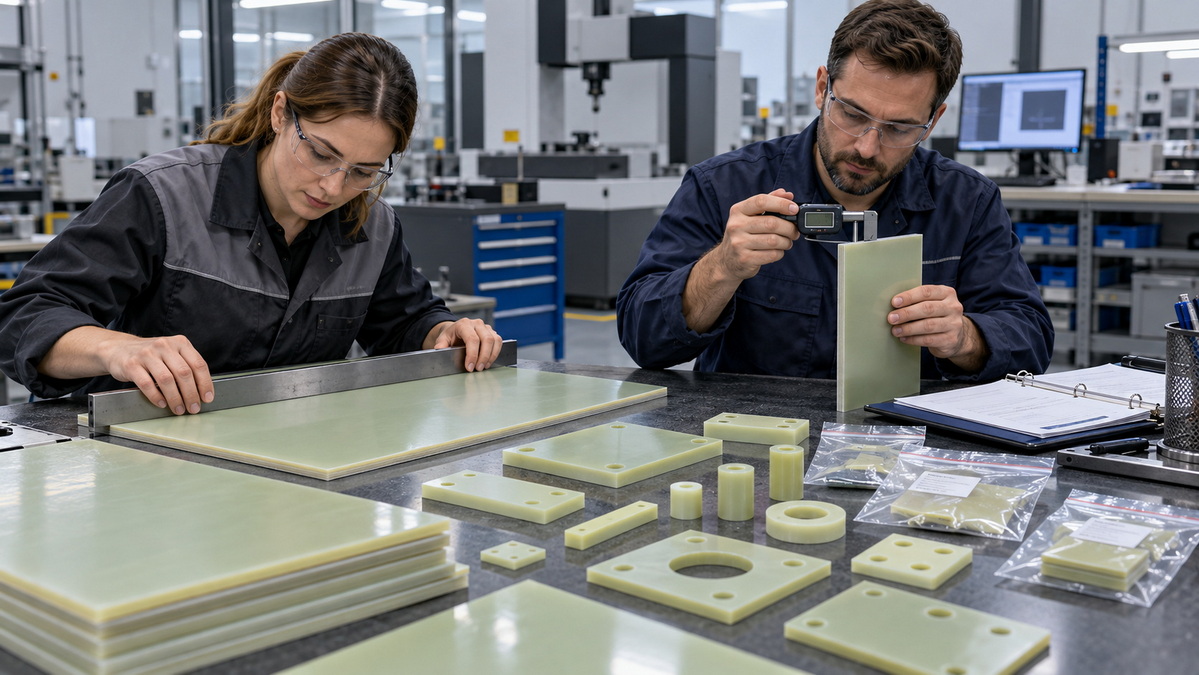
A useful supplier assessment starts with traceability and then moves through manufacturing capability, technical evidence, and delivery reliability.
The following criteria were used to structure this shortlist. They are also suitable starting points for a purchasing qualification checklist.
Ask whether the company:
- Manufactures glass-epoxy laminate.
- Distributes purchased sheet.
- Machines or assembles insulation components.
- Provides application engineering.
- Subcontracts any of these activities.
The purchase order should identify who is responsible for laminate quality and who is responsible for finished-part conformity.
An ISO 9001 certificate is relevant only when its scope covers the activities and facilities supporting your order.
Check the legal entity, site address, certification body, certificate number, and current status. IAF CertSearch provides verification of status, scope, issuing bodies, and related accreditation information.
For customized products, assess whether the supplier can:
- Review drawings before quotation.
- Explain material-grade alternatives.
- Identify difficult tolerances.
- Support prototype-to-production transitions.
- Document proposed changes.
Do not confuse drawing-based machining with full material-formulation development.
A practical qualification discussion should cover incoming materials, thickness inspection, flatness checks, batch identification, machining inspection, and nonconformance handling.
Ask which properties are tested for every batch and which appear only as typical values in a technical datasheet.
Request separate commitments for material availability, production, inspection, dispatch, and transport.
For repeat programs, ask how the supplier controls material changes and whether it can reserve inventory or production slots. Published factory output is not the same as capacity available for your order.
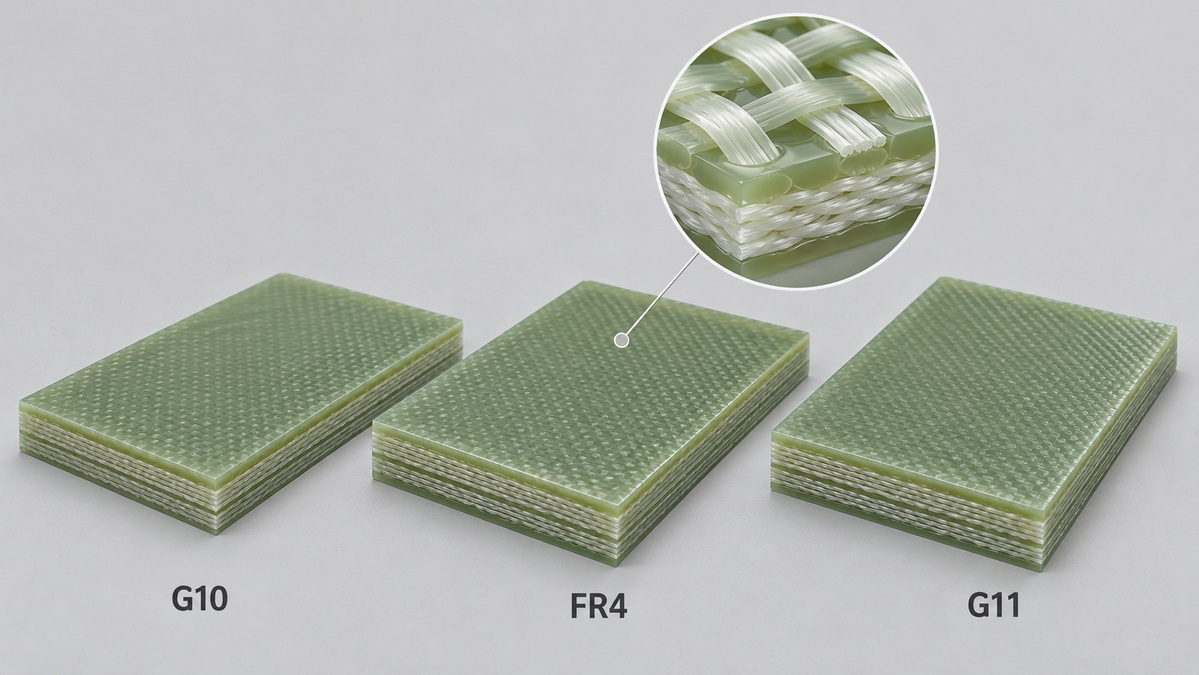
G10 and FR4 are closely related glass-epoxy laminates, but the distinction matters. FR4 incorporates flame-resistant characteristics; G10 should not automatically be treated as a flame-rated material. G11 is associated with higher-temperature applications, subject to the specific product's datasheet and qualification evidence.
| Material designation | Procurement significance | What buyers should verify |
|---|---|---|
| G10 | Woven glass-epoxy laminate for mechanical and electrical insulation | Grade declaration, mechanical properties, electrical performance, conditioning |
| FR4 | Flame-resistant glass-epoxy laminate | Flammability evidence, applicable thickness, electrical and mechanical properties |
| G11 | Glass-epoxy grade used for more demanding thermal conditions | Product-specific temperature capability and retained properties |
| EPGC designation | Identifies a glass-cloth-based epoxy laminate under the relevant standards framework | Exact grade and standard stated in the supplier's documentation |
| EPGM designation | Identifies a glass-mat-based epoxy material rather than glass-cloth laminate | Whether reinforcement construction suits the application |
Supplier catalogs illustrate why exact identification matters: ISOTAC lists glass-mat epoxy separately from glass-cloth FR4 and G11, while APSOparts identifies its EP GC 203/308 board against EN 60893 and NEMA G11.
Avoid approving a substitution merely because two boards have similar color, density, or advertised strength.
For materials used in electrical and electronic equipment, request a grade-specific RoHS declaration and supporting evidence appropriate to the application. Review REACH information against the current Candidate List rather than accepting an undated "compliant" statement. ECHA identifies information obligations for articles containing Candidate List substances above 0.1% by weight.
CE marking requires particular care. It applies only where relevant harmonized legislation requires it. It is not a universal quality certificate for raw insulation sheet, and it must not be affixed to products outside the applicable requirements.
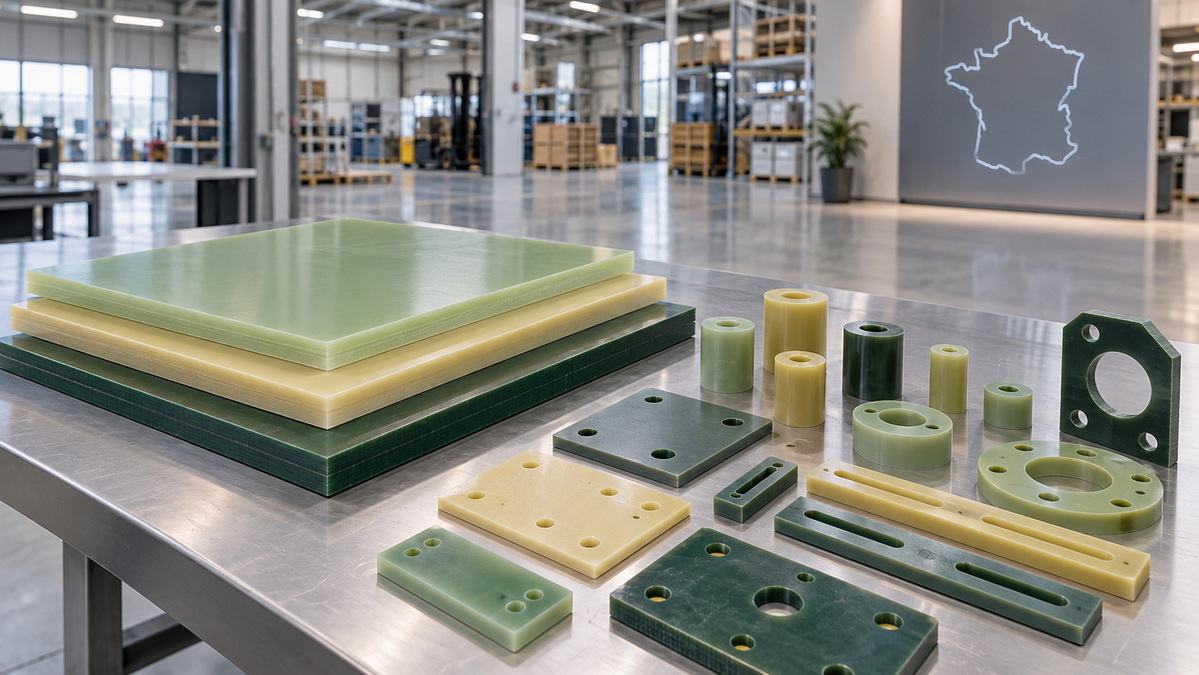
Guangdong Weishi New Materials Co., Ltd. is a Chinese composite-material manufacturer founded in October 2007 and located in Heyuan, Guangdong.
Its website reports more than 16,000 square meters of building area, three standard workshops, 10 engineers, more than 60 technical staff, and monthly output exceeding 100 tonnes. These are company-published figures covering the business's wider materials production, not independently verified G10-only capacity.
Weishi's published range includes FR4, G10, G11, and other insulation-board categories. Its combination of material production and processing makes it relevant to buyers seeking a direct factory relationship rather than purchasing only through a stockist.
For smaller equipment manufacturers and growing brands, the commercial attraction is the possibility of coordinating sheet supply and customized processing through one partner. Its website also invites customers to submit product ideas and designs for adaptation to mass production.
The company identifies electronics, electrical equipment, and machinery as application sectors. It targets international customers, but the reviewed page does not disclose an audited geographic sales breakdown.
Its published service offering supports discussion of drawing-based customization and production adaptation. Buyers should separately confirm machining processes, achievable tolerances, design responsibility, tooling ownership, and any formulation-development work.
Weishi is worth evaluating when a project prioritizes factory-direct commercial terms, repeat production, and customization flexibility.
Its engineering staff provides a basis for investigating technical support, but communication efficiency, small-order suitability, and delivered cost should be tested during quotation and sampling—not assumed from promotional language.
Ask for:
- A G10-specific datasheet and batch documentation.
- MOQ by thickness, format, and processing requirement.
- A named technical contact and drawing-review schedule.
- Grade-specific compliance evidence.
- A landed-cost quotation for delivery to France.
Abaqueplast has operated since 1974. Its company website describes a distribution business supplying plastic semi-finished products and services, while the French public business directory confirms the company's establishment year.
Its catalog includes glass-epoxy sheet described for mechanical and insulating components, with machinability and permanent stock emphasized on the product-category page.
Abaqueplast is relevant to buyers who want a French distribution contact for semi-finished materials.
Its role differs from Weishi's: the reviewed evidence supports distribution of glass-epoxy board, not manufacture of the original laminate.
Its published positioning centers on professional users of plastic semi-finished products. For customized requirements, discuss dimensions, cutting services, and any additional processing separately.
The reviewed glass-epoxy listing does not establish proprietary G10 formulation development or a complete OEM/ODM manufacturing service.
Consider Abaqueplast for French-market purchasing of machinable glass-epoxy sheet, especially when sourcing convenience and material availability are priorities.
Before approval, request written confirmation of the exact grade. A "glass-epoxy" listing alone does not establish NEMA G10 conformity.
Founded in 1987, ISOTAC operates near Grenoble and specializes in electrical and thermal insulation products.
Its published material range includes glass-cloth FR4/EPGC 202 and G11 grades, alongside glass-mat epoxy and other insulating materials.
ISOTAC explicitly describes machining, fabrication, and assembly services. Its listed capabilities include:
- Thermoset-component machining.
- Cutting to size.
- Brass or stainless-steel inserts.
- Assembly and bonding.
- Varnishing.
- Engraving.
This makes the company particularly relevant when the purchasing requirement is a finished insulation part rather than an unprocessed sheet.
ISOTAC identifies power generation and distribution, nuclear industry, and energy storage among its customer sectors.
Its published services support drawing-based subcontract manufacturing and assemblies. They do not establish that the company manufactures the underlying G10 laminate or develops proprietary resin formulations.
Evaluate ISOTAC for locally manufactured insulation components requiring machining and assembly support.
However, G10 is not explicitly identified on the reviewed material list. For a G10-specific contract, obtain confirmation of availability and conformity rather than accepting FR4 or G11 as an automatic substitute.
Final Advanced Materials was established in 1988 and is based in Alsace. Its published history and the French public business directory support that date.
The company serves European customers with advanced-material solutions for demanding operating conditions. Its glass-epoxy portfolio includes E6000 and E60 boards.
Final Advanced Materials offers an application-led sourcing route when thermal behavior, mechanical strength, and insulation requirements need to be considered together.
Its catalog distinguishes glass-mat-based E6000 from glass-roving-based E60. These are technically relevant epoxy composites, but neither should be described as certified G10 without additional evidence.
The company's regional industry profile describes an engineering office supporting businesses and research centers in France and Europe.
Its services make it relevant to material selection and project-specific engineering. The exact scope of custom machining or component manufacture should be confirmed for the proposed board and drawing.
Consider Final Advanced Materials when the application may require an engineered alternative to conventional G10.
Its website displays management-system references, but buyers should request the actual certificates and verify their scope. ISO 26000 concerns social-responsibility guidance and should not be treated as a product conformity certificate.
Angst+Pfister was founded in 1920. The group identifies France among the countries served by its local specialized sales organizations.
Its APSOparts catalog provides a French-market listing for EP GC 203/308 glass-epoxy board, identified as G11 under NEMA LI 1 and against EN 60893.
The reviewed product page provides clear technical identification, dimensions-related information, cut-to-size availability, and references to REACH and RoHS.
This level of product documentation is useful when a purchasing team needs to connect a material designation with a controlled specification.
Angst+Pfister positions itself as an engineering and supply-chain partner for industrial customers. For the laminate under discussion, the published offering includes cut pieces and other qualities or dimensions on request.
Do not interpret wider group engineering capabilities as proof that every laminate customization is performed in-house.
Consider this route for documented technical-material procurement, particularly when G11 is appropriate.
For G10 epoxy sheet, request a separate grade-specific quotation. The reviewed G11 listing is not evidence of G10 stock availability.
The table separates published facts from information that still requires quotation or verification.
| Supplier | Published role and product fit | Published capacity | MOQ | Certification or conformity information |
|---|---|---|---|---|
| Guangdong Weishi | Chinese laminate manufacturer and processor; G10/FR4/G11 categories | Company reports 100+ tonnes/month across its wider production | Not disclosed; request by specification | Obtain current certificates and grade-specific declarations; no verified certificate details on the reviewed homepage |
| Abaqueplast | French distributor; glass-epoxy sheet | Not disclosed; laminate production not established | Not disclosed | Request exact grade, upstream manufacturer, and supporting documents |
| ISOTAC | French insulation-part manufacturer; listed FR4/G11 processing | Not disclosed | Project-specific quotation required | Catalog lists material classifications; company certification requires separate verification |
| Final Advanced Materials | French engineering/material supplier; specialist epoxy composites | Not disclosed | Project-specific quotation required | Website displays management-system references; verify documents and scope |
| Angst+Pfister / APSOparts | Technical-material supply with French-market access; documented G11 listing | G10/G11 sheet capacity not disclosed | Confirm by item and processing request | Group publishes ISO 9001/14001 information; listed G11 product references REACH/RoHS |
Sources supporting the comparison: Weishi's published company profile, Abaqueplast's distribution and material listings, ISOTAC's capabilities, Final Advanced Materials' catalog, and Angst+Pfister's company and product information.
"Not disclosed" does not mean unavailable or inadequate. It means the reviewed public information does not support a reliable numerical comparison.
Your enquiry should state:
- Required material grade and governing standard.
- Sheet dimensions, thickness, and tolerances.
- Machined-part drawing and revision.
- Working temperature and exposure conditions.
- Electrical and mechanical requirements.
- Flammability requirements, if applicable.
- Compliance documentation.
- Estimated annual demand and release quantities.
Avoid specifications such as "green epoxy sheet, industrial quality." They leave too much room for substitution.
For distributors and component manufacturers, identify the upstream laminate producer and establish whether batch identity remains available after cutting.
For direct factories, request a production walkthrough and discuss the process controls relevant to your grade. Keep supplier qualification separate from product qualification: a credible company can still supply an unsuitable material.
A practical approval sequence is:
1. Material coupon for initial property review.
2. Representative machined component.
3. Pilot-production batch using the proposed production material and process.
Record the approved grade, thickness, source, batch identity, drawing revision, and inspection criteria.
Do not allow a successful small coupon to replace validation of a large, thin, or heavily machined component.
Evaluate more than price per kilogram.
Include cutting yield, machining scrap, inspection costs, packaging, transport, customs handling, inventory, and replacement arrangements. Require overseas quotations to state the delivery term and responsibilities clearly.
A French stockist and a direct overseas factory may both be competitive, but for different order sizes and service requirements.
Specify packaging protection, batch labeling, inspection documents, and the point at which lead time begins.
For repeat orders, require notification before changing the laminate source, grade, reinforcement construction, or approved manufacturing process.
Similar appearance does not establish equivalent reinforcement, resin chemistry, electrical properties, or flame behavior.
Prevent substitution through written grade identification, lot documentation, and agreed acceptance tests. The catalog distinction between glass-mat epoxy and glass-cloth epoxy demonstrates why the generic term "epoxy board" is insufficient.
If flame performance is required, specify it directly and request supporting evidence for the supplied product.
A combined commercial label such as "G10/FR4" should trigger clarification—not automatic approval.
A management-system certificate does not certify every sheet's mechanical performance. Likewise, a compliance declaration for one grade should not silently cover another formulation.
Connect each document to the actual legal entity, production site, material grade, and supplied product.
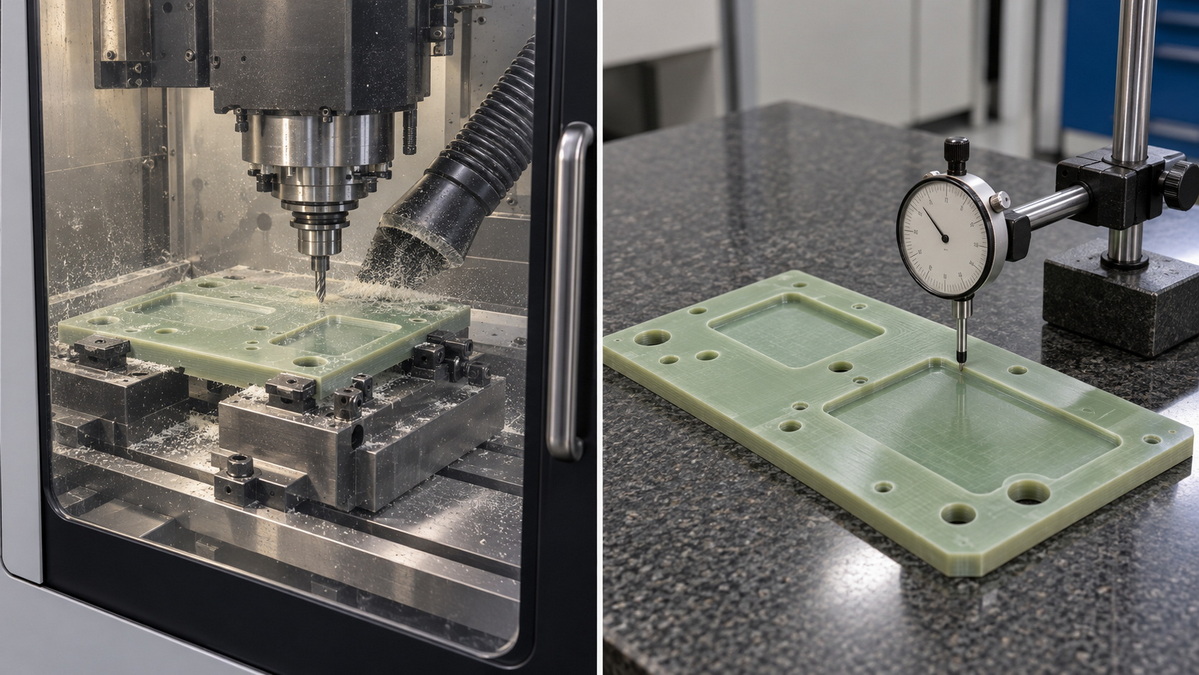
One under-discussed procurement risk is approving sheet flatness while overlooking finished-part distortion.
Composite machining can release internal stresses. Heavy clamping can temporarily hold a part flat, while asymmetric material removal can lead to movement after release. Atlas Fibre recommends balanced machining, distributed support, and repeatable flatness checks after unclamping and a dwell period.
For large insulating plates or thin precision fixtures, define:
- Incoming-sheet flatness.
- Finished-part flatness in the free state.
- Inspection conditions.
- Measurement timing after machining.
- Acceptance limits after representative processing.
Do not prescribe a generic heat-treatment cycle without the material supplier's approval. Qualification should reproduce the actual part geometry and manufacturing route.
The most useful shortlist for French-market buyers combines different capabilities.
Weishi offers a direct Chinese manufacturing route for buyers evaluating customized laminate supply. Abaqueplast provides French distribution of glass-epoxy sheet. ISOTAC focuses on machined insulation parts and assemblies. Final Advanced Materials supports application-led evaluation of specialist composites. Angst+Pfister offers a documented technical-material sourcing route, including the reviewed G11 product.
None should be approved solely because it appears in a supplier list.
Send the same specification package to shortlisted companies and compare material identity, sample performance, documentation, customization scope, delivered cost, and delivery commitments.
For a factory-direct proposal, submit your G10 epoxy sheet specification, drawings, annual quantity, and French delivery destination to Guangdong Weishi New Materials Co., Ltd. Request material documentation and a representative sample alongside the quotation.
Search the company name or certificate number in IAF CertSearch. Review status, scope, locations, issuing certification body, and accreditation information—not just the printed expiry date.
If verification is inconclusive, contact the issuing certification body through independently obtained contact details. Keep the result in the supplier qualification file.
Not automatically. The grades are related, but flame characteristics and product-specific properties must be considered.
Check the drawing, governing specification, operating conditions, and approval requirements. Where substitution is proposed, compare datasheets and validate representative parts before authorizing the change.
No. RoHS conformity and a halogen-free requirement address different specifications. Conventional FR4 products may use brominated flame-retardant chemistry, so buyers should not infer halogen-free status from a RoHS statement.
Request the required halogen limits, test method, and grade-specific evidence separately.
CE marking is required only when legislation applicable to the product mandates it. It is not a general-purpose certification for insulation-sheet quality.
For raw laminate procurement, prioritize material specifications, conformity documentation, and the evidence needed by the finished-equipment manufacturer. Check the applicable legal framework if the supplied item has a different regulated function.
Material qualification does not eliminate machining-related movement. Internal stress, uneven material removal, workholding, and inspection timing can affect the finished result.
Specify free-state flatness after unclamping and validate the actual machining strategy. Balanced machining and a post-machining dwell check can help reveal problems that immediate inspection misses.
1.Guangdong Weishi New Materials Co., Ltd., company profile, production figures, product categories, and customization information. [wsepoxysheet]
2.Curbell Plastics, "G10/FR-4 Glass Epoxy," material composition and applications. [curbellplastics]
3.Misolet, "Vetronite FR4, G10, G11," grade distinctions and flame-performance discussion. [misolet]
4.AVK, "The European Market for Fiber-Reinforced Plastics/Composites 2025," March 2026 report. [avk-tv]
5.Aerospace Valley, official regional aerospace-cluster information. [aerospace-valley]
6.French Directorate General for Enterprise, Tenerrdis cluster profile. [entreprises.gouv]
7.Abaqueplast, company information and glass-epoxy sheet category. [abaqueplast]
8.French government business directory, Abaqueplast legal-entity record. [annuaire-entreprises.data.gouv]
9.ISOTAC – Isolants du Sud-Est, materials, manufacturing capabilities, and customer sectors. [isotac]
10.Final Advanced Materials, company history and glass-epoxy composite portfolio. [final-materials]
11.French government business directory, Final Advanced Materials legal-entity record. [annuaire-entreprises.data.gouv]
12.Aéro Alsace, Final Advanced Materials engineering and market profile. [aero-alsace]
13.Angst+Pfister, group history, French-market presence, and management-system information. [angst-pfister]
14.APSOparts, EP GC 203/308 glass-epoxy sheet technical listing. [apsoparts]
15.European Commission, CE-marking requirements and limitations. [europa]
16.European Commission, RoHS guidance for equipment and components. [environment.ec.europa]
17.European Chemicals Agency, Candidate List and article-related information obligations. [echa.europa]
18.IAF CertSearch, accredited certificate verification and status checks. [iafcertsearch]
19.Atlas Fibre, "Machining Composite Sheets Without Warp," February 2026. [atlasfibre]


