
Views: 243 Author: Weishi Sheets Publish Time: 2026-10-15 Origin: Site
Content Menu
● Introduction: Why Source G10 Epoxy Sheets from Germany?
● How We Evaluate G10 Epoxy Sheet Suppliers
● Technical Essentials Before Purchasing G10 Epoxy Sheets
>> Understand the Material Behind the Grade Name
>> Do Not Treat G10, FR4 and G11 as Automatic Substitutes
>> Interpret Certification Claims Correctly
● Leading G10 Epoxy Sheet Manufacturers and Supply Partners
>> 1. Guangdong Weishi New Materials Co., Ltd.
>>> Company Profile
>>> Core Strengths
>>> OEM and Customization Scope
>>> Suitable Purchasing Scenario
>>> Company Profile
>>> Core Strengths
>>> OEM and Customization Scope
>>> Suitable Purchasing Scenario
>> 3. Krempel
>>> Company Profile
>>> Core Strengths
>>> OEM and Customization Scope
>>> Suitable Purchasing Scenario
>>> Company Profile
>>> Core Strengths
>>> OEM and Customization Scope
>>> Suitable Purchasing Scenario
>> 5. Dr. Dietrich Müller GmbH
>>> Company Profile
>>> Core Strengths
>>> OEM and Customization Scope
>>> Suitable Purchasing Scenario
● Supplier Comparison: Capacity, MOQ and Certification
● Buyer's Guide: How to Qualify a Long-Term Supplier
>> Confirm Who Manufactures the Laminate
>> Order Production-Representative Samples
>> Avoid Grade Substitution Based on Appearance
>> Insider Purchasing Check: Approve the Component Route, Not Just the Coupon
>> Establish Logistics Requirements Before Shipment
● Conclusion: Match the Supplier to the Application
>> 1. How Can I Verify Whether an ISO Certificate Is Expired or Covers the Wrong Factory?
>> 2. Can EP GC 201 Replace NEMA G10 Without Additional Testing?
>> 3. Does a UL 94 V-0 Claim Apply to Every Thickness of the Same Laminate?
>> 4. Does a CE Statement Prove That a G10 Sheet Is Suitable for EU Electrical Equipment?
>> 5. How Should Buyers Assess a Supplier That Does Not Publish G10 Capacity or MOQ?
Germany is a valuable sourcing destination for industrial insulation materials because its electrical-equipment industry, engineering-materials expertise and precision-processing capabilities support a technically demanding supplier ecosystem.
For procurement managers, the advantage is not simply buying a sheet made in Germany. It is finding a supplier that understands how material properties, machining tolerances and documentation requirements affect the finished component.
The scale of the surrounding market is substantial. German electrical and digital industry exports reached approximately €257.5 billion in 2025, increasing 5.1% year on year. In January–July 2026, exports reached €162.9 billion, up 9.7%.
These figures describe the broader electrical and digital industry, not the market size of G10 epoxy sheets. Nevertheless, they demonstrate the industrial demand supporting electrical insulation suppliers and component manufacturers.
Germany's relevant supplier ecosystem spans several locations rather than one dedicated G10 manufacturing cluster. The companies reviewed here connect materials engineering and laminate production with processing capabilities in areas including Baden-Württemberg, Lower Saxony and Brandenburg.
Choosing a long-term partner within this ecosystem requires more than comparing prices. Buyers need to examine material specifications, factory certifications, technical support, quality-control procedures and delivery commitments.
This guide presents four Germany-based manufacturers or supply partners and one China-based alternative: Guangdong Weishi New Materials Co., Ltd. Weishi appears first as an option for buyers considering customized international sourcing. It is not presented as a German manufacturer.
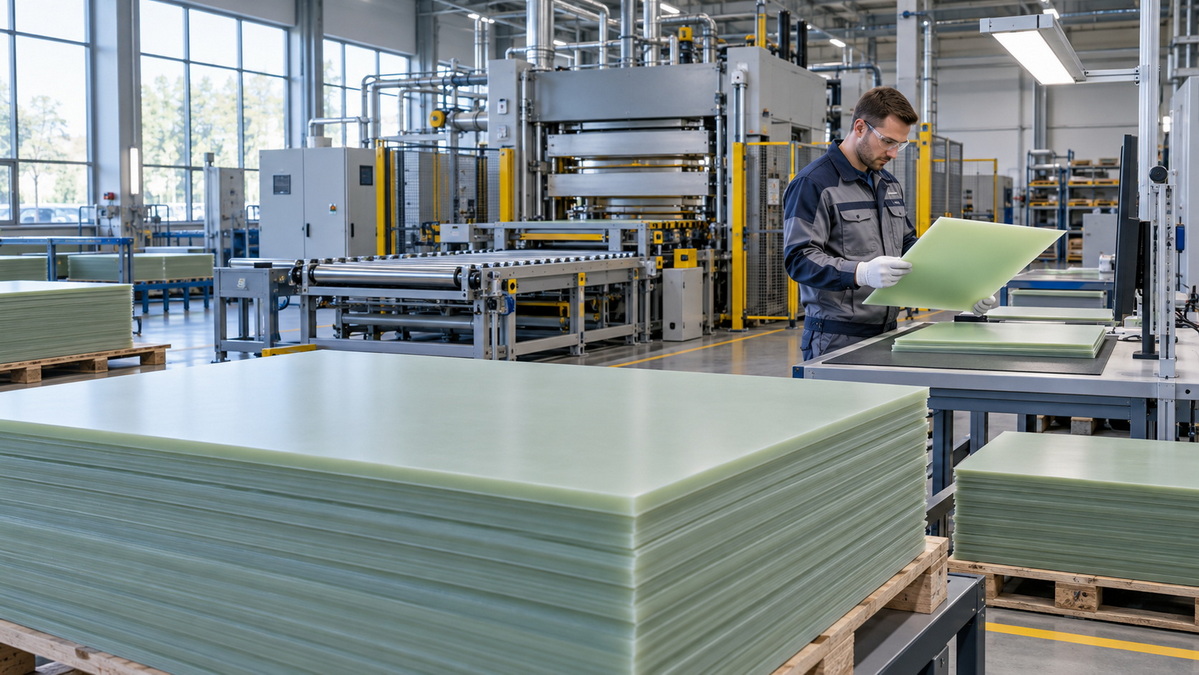
A credible supplier assessment should separate published capabilities from claims that require direct verification.
The following criteria provide a practical starting point.
| Evaluation Area | What Buyers Should Verify |
|---|---|
| Material capability | Documented glass-cloth epoxy grades, relevant standards and suitable sheet formats |
| Manufacturing role | Whether the company presses laminates, processes purchased sheets, distributes materials or combines these activities |
| Technical support | Material-selection advice, drawing review, testing resources and development assistance |
| Quality control | Thickness inspection, mechanical and electrical testing, batch identification and nonconformity management |
| Customization | Special dimensions, CNC machining, prototype support and repeat-order consistency |
| Supply reliability | Available production slots, stock policies, subcontracting controls and realistic lead times |
| Compliance documentation | Current site-specific certificates and material-specific regulatory evidence |
A website can establish relevance, but it cannot establish final approval.
For example, an ISO-certified organization may still offer a grade that does not meet a particular component specification. Similarly, a supplier with extensive equipment may not have available capacity for the required delivery window.
For long-term purchasing, traceability deserves more weight than unsupported descriptions of quality or scale.
G10 epoxy sheet is a rigid laminate made from glass cloth impregnated with epoxy resin and consolidated under heat and pressure.
Its combination of mechanical strength and electrical insulation makes it relevant to structural insulating components, machined parts and industrial equipment applications.
German suppliers frequently use European grade terminology. EP GC 201 is commonly associated with G10-type glass-cloth epoxy laminate, while HGW 2372 remains a recognizable legacy designation.
However, a commercial cross-reference does not establish that every requirement in two specifications is identical. The purchase order should state the required standard, grade and acceptance properties.
For example, Erhard Hippe's published EP GC 201 information includes a minimum flexural strength of 340 MPa, a density range of 1.8–2.0 g/cm³ and a minimum temperature index of 130°C.
These figures relate to that published product specification. They should not be treated as universal guarantees for every board marketed as G10.
G10, FR4 and G11 belong to the wider glass-epoxy laminate family, but their grade designations are not interchangeable purchasing descriptions.
When considering a substitution, evaluate the properties required by the application rather than relying on a supplier's statement that the materials are similar.
Particular attention should be given to:
- Flame-performance requirements.
- Mechanical performance at operating temperature.
- Electrical properties under the specified test conditions.
- Thickness tolerance and flatness.
- Machining suitability.
- The applicable material standard.
A higher temperature-related figure also needs interpretation. A temperature index is not automatically the allowable continuous operating temperature of a finished component under mechanical load.
Likewise, a flame classification must match the relevant material and thickness. A published V-0 result at one thickness should not be extended to other thicknesses without supporting evidence.
CE marking is not a general quality certificate for raw G10 epoxy sheets. It applies only where relevant legislation requires it for the product concerned.
RoHS addresses restrictions on hazardous substances in electrical and electronic equipment. A supplier's material declaration or supporting laboratory report may contribute to a finished-equipment compliance assessment, but it does not independently prove compliance of the completed assembly.
ISO 9001 addresses a quality-management system. It does not certify that every supplied sheet meets a particular G10 specification.
Buyers should therefore request documents tied to the actual manufacturing site, material grade and supplied product.
Guangdong Weishi New Materials Co., Ltd. is based in Heyuan, Guangdong, China. Its website states that the business was established in October 2007 and integrates composite-material production, processing and sales.
Its published product categories include G10, FR4, G11 and other fiberglass insulation sheets.
The company reports a production facility exceeding 16,000 m², 10 engineers, more than 60 technical personnel and monthly output above 100 tonnes.
These are company-reported figures for its broader operation. They should not be interpreted as independently verified G10-only capacity or immediately available production allocation.
Weishi is relevant to buyers looking for a direct manufacturing relationship covering both insulation sheets and processed components.
Its published offering includes assistance in converting customer product ideas and designs into production solutions. This makes it a candidate for projects requiring more than standard stock-sheet delivery.
For smaller equipment manufacturers and developing brands, combining material supply with processing may simplify the transition from prototype to repeat production.
Weishi can therefore be evaluated as a potential cost-conscious manufacturing partner, with commercial value assessed through actual quotations and accepted-part costs.
An initial inquiry should cover:
- Required G10, FR4 or G11 grade.
- Custom thicknesses and sheet dimensions.
- Drawing-based processing requirements.
- Prototype and pilot-order support.
- Inspection and documentation requirements.
- Planned production volumes.
Communication efficiency, low-volume flexibility and development support should be demonstrated through the inquiry and sampling process rather than assumed.
Weishi identifies electronics, electrical equipment and machinery among its application sectors. Its reviewed homepage does not establish a country-by-country sales breakdown.
German buyers should request relevant export experience, sample shipping arrangements and documentation examples.
Current management-system certification also requires direct verification. Ask for the certificate number, legal entity, manufacturing address, scope and validity dates.
Weishi is a relevant alternative when the project requires customized insulation materials, coordinated processing and a direct relationship with a China-based manufacturer.
Röchling's group history dates to 1822. This date describes the origins of the group, not the beginning of G10 sheet manufacturing.
Its Industrial business offers engineering materials, including Durostone glass-fiber epoxy products for electrical and industrial applications.
Published Durostone documentation identifies applications including motors, generators, transformers and electrical insulating components.
Röchling is particularly relevant when material selection depends on documented performance rather than a generic product label.
Its technical data sheets distinguish mechanical, electrical and thermal properties. This gives procurement and engineering teams a more precise basis for evaluating whether a grade suits the intended application.
Its industrial management-system information also describes material and system testing as part of production control.
Buyers should discuss:
- The appropriate Durostone grade.
- Required sheet or semi-finished format.
- Finished-component processing availability.
- Application-specific testing.
- Supply arrangements for the intended region.
Not every Durostone product is a G10 equivalent. Obtain a written grade recommendation against the specified standard before approval.
Röchling operates internationally, while the cited epoxy-laminate documentation identifies electrical equipment and insulating components as relevant markets.
Certification must be checked for the actual supplying site. A group-level management-system description does not replace the certificate covering the production location assigned to an order.
A universal G10 MOQ and G10-specific annual capacity were not established from the reviewed information.
Röchling is a relevant candidate for technically demanding applications requiring detailed material documentation and structured engineering support.
Krempel traces its history to 1871 and is headquartered in Vaihingen an der Enz, Germany.
Its portfolio includes electrical insulation, composites, electronic materials and rigid laminates.
The company is worth considering when a project requires broader insulation-material expertise or development support alongside sheet supply.
Krempel's published quality information describes electrical breakdown testing, insulation-resistance measurement, thermal analysis, dimensional measurement and mechanical testing.
These resources are relevant when an equipment manufacturer needs to validate material behavior rather than purchase an unspecified epoxy board.
Its thermal-analysis capabilities include dynamic mechanical analysis and differential scanning calorimetry, which can support investigation of material characteristics during development.
Potential discussions include:
- Suitable glass-epoxy laminate grades.
- Application-specific material development.
- Customized composite components.
- Electrical and thermal testing requirements.
- Repeat-production controls.
The reviewed information establishes rigid-laminate capability but does not verify a specific currently offered G10 designation.
Buyers should request an explicit G10 or EP GC 201 cross-reference before approving Krempel for that exact requirement.
Krempel describes itself as an international manufacturer of composites and electrical insulation materials, making it relevant to electrical and industrial customers.
Its quality information states that all companies within the group are ISO 9001 certified. Buyers should nevertheless obtain the current certificate for the supplying entity and confirm the relevant scope.
Public G10-specific capacity and standard MOQ figures were not identified.
Krempel is relevant when the purchasing decision involves insulation-system knowledge, material development and testing support.
Erhard Hippe KG was founded in Dresden in 1935.
The company manufactures technical plastics and thermoset laminates and publishes capabilities covering material production and finished-part processing.
Its EP GC 201 sheet offering provides direct product relevance for buyers seeking G10-type epoxy glass laminate.
Published sheet formats include approximately 2,780 × 1,200 mm and 2,150 × 1,020 mm, with special sizes available on request.
Hippe's company information describes an 8,400 m² production plant, a 5,000 m² development center used for glass-fiber-reinforced laminates, and a Hildesheim processing operation with more than 120 machines.
These disclosures demonstrate facilities and processing resources. They do not establish annual G10 output or available capacity for a particular order.
The combination of laminate production and machining is relevant to buyers seeking fewer handoffs between material supply and component manufacture.
Published processing capabilities include turning, drilling and milling, from individual parts to larger production batches.
Typical qualification discussions should cover:
- Special sheet dimensions.
- Drawing-based components.
- Machined-part tolerances.
- Development requirements.
- Consistency between prototypes and series production.
Hippe positions its products for industry and trade, with EP GC 201 specified for electrical and mechanical applications.
An industry directory identifies worldwide sales coverage.
A manufacturing-platform profile lists ISO 9001:2015 certification. Procurement teams should request the current certificate directly rather than relying solely on a directory entry.
Numeric sheet MOQ and G10 tonnage capacity remain quotation-stage questions.
Hippe is a particularly relevant candidate when the requirement combines documented EP GC 201 sheets with integrated precision machining.
Dr. Dietrich Müller GmbH is based in Ahlhorn, Lower Saxony. Its manufacturing-platform profile gives a founding year of 1967.
The company describes itself as a global supplier of electrical insulating materials, thermally conductive products, seals and technical films.
Its role is particularly relevant where the buyer needs material-selection assistance and conversion into finished components.
The company publishes capabilities covering laminates, CNC parts, cutting and precision manufacturing from flexible and rigid materials.
It identifies motors and generators among the application markets for laminate blanks and stamped parts.
This makes it relevant to procurement teams that require technical support alongside drawing-based supply.
Project discussions can cover:
- Material selection.
- Laminate blanks.
- CNC-machined components.
- Cutting and conversion services.
- Production documentation.
Buyers should establish whether the required laminate is produced internally or purchased from an upstream manufacturer.
Where material is sourced externally, preserve the upstream manufacturer and grade identity in the purchasing documentation.
The company reports serving businesses worldwide from six locations.
Its website states ISO 9001 and ISO 14001 certification and a UL repackager listing under E341377.
A repackager listing should not be interpreted as proof that every supplied laminate has the required flame classification. Request product-specific evidence.
G10-specific capacity and a standard numeric MOQ were not established.
Dr. Dietrich Müller is relevant when precision conversion, material-selection support and technical documentation are central to the project.
| Supplier | Main Purchasing Focus | Public Capacity Information | MOQ Information | Certification Position |
|---|---|---|---|---|
| Guangdong Weishi | China-based sheet manufacturing and customized processing | Reports more than 100 tonnes monthly across its operation; not G10-specific | Numeric MOQ requires quotation | Current certificates require direct verification |
| Röchling Industrial | Materials engineering and Durostone supply | G10-specific capacity not established | Depends on grade, format and supplying site | Industrial certification information published; verify the assigned site |
| Krempel | Electrical insulation, composites and rigid laminates | G10-specific capacity not established | Obtain grade- and project-specific terms | Company states group companies are ISO 9001 certified |
| Erhard Hippe | EP GC 201 laminates and integrated machining | Facilities and more than 120 processing machines described; no G10 tonnage figure | Individual parts and larger batches described; sheet MOQ requires quotation | ISO 9001:2015 listed by a manufacturing platform; verify directly |
| Dr. Dietrich Müller | Material selection, laminate supply and conversion | G10-specific capacity not established | Obtain sheet- or component-specific quotation | Website states ISO 9001, ISO 14001 and UL repackager listing |
A monthly tonnage claim, a machinery count and a converter's processing capability measure different aspects of a business. None independently proves available capacity for a specific G10 order.
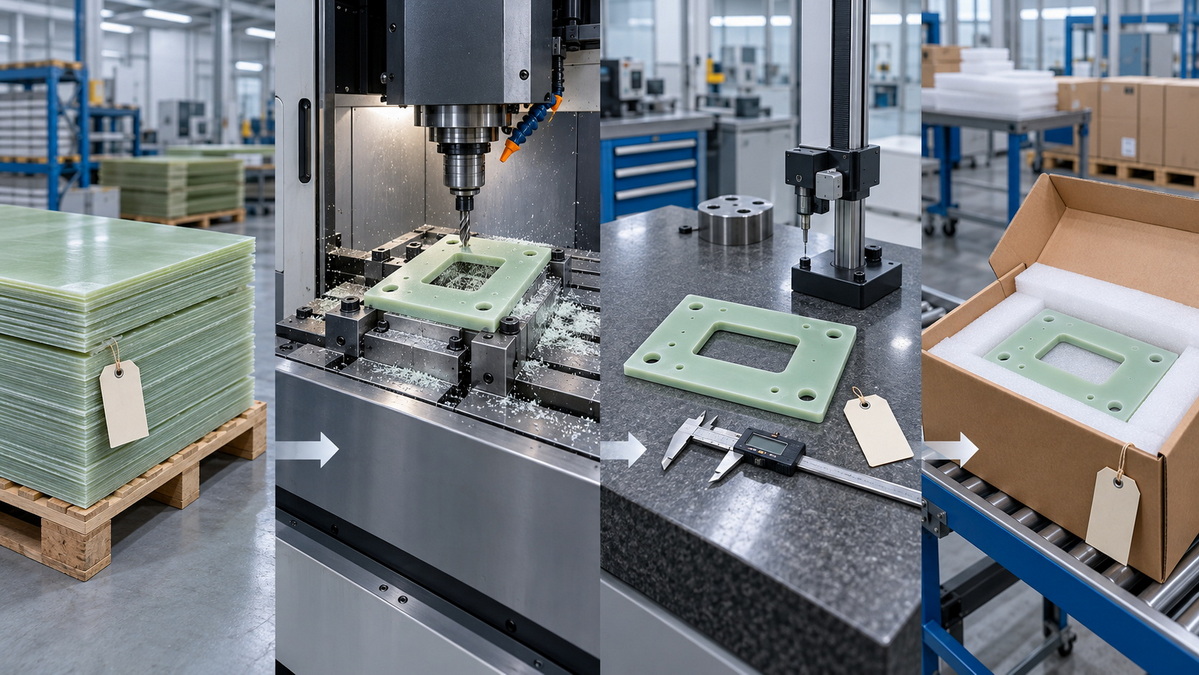
Ask who impregnates the glass cloth, presses the laminate and performs final machining.
A supplier may legitimately outsource part of the process. The important requirement is transparency and control.
Request:
1. Legal company and factory details.
2. Current management-system certificates.
3. A process flow showing internal and subcontracted operations.
4. A sample certificate of conformity or batch record.
5. Written procedures for material-source changes.
A distributor or converter can be a dependable partner. The purchasing risk arises when manufacturing sources change without approval.
Define the sample requirements before placing the order.
Specify the grade, thickness, dimensions, tolerances, intended application and inspection criteria.
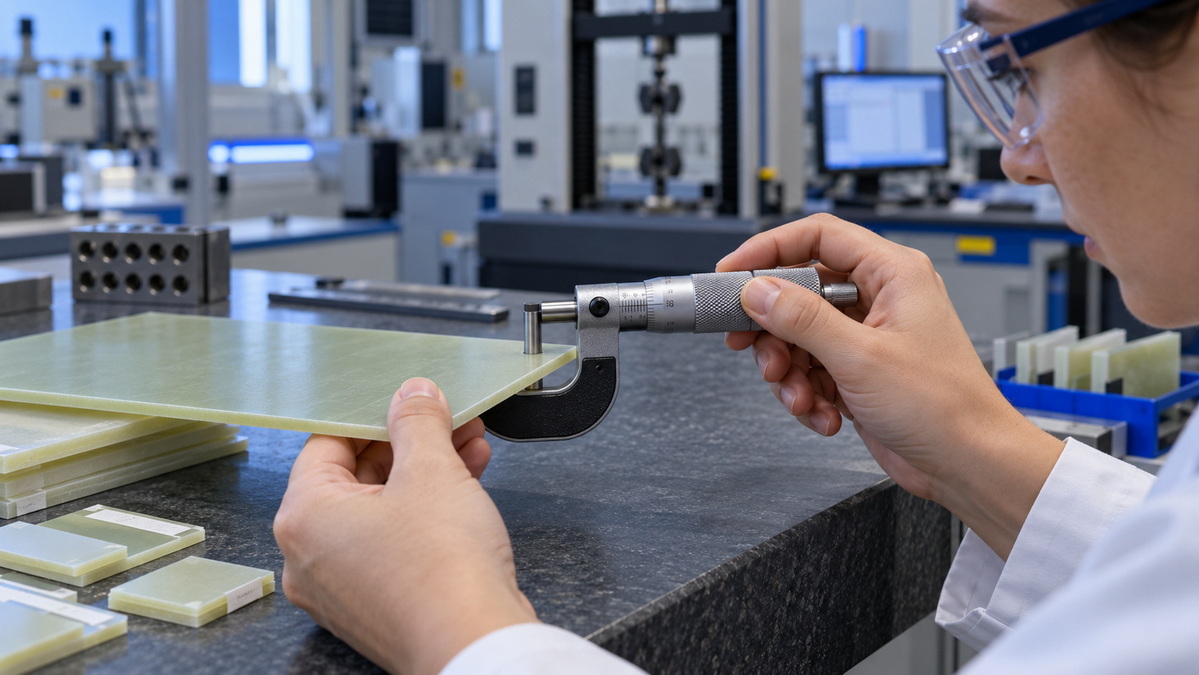
Assess both the supplied sheet and the finished component. A laminate can satisfy a material requirement while the machined part fails the drawing.
Sample evaluation should therefore cover:
- Material documentation.
- Dimensional conformity.
- Surface and edge condition.
- Required electrical and mechanical tests.
- Machining acceptance.
- Assembly suitability.
Record the approved sample identity so that later deliveries can be compared against a controlled reference.
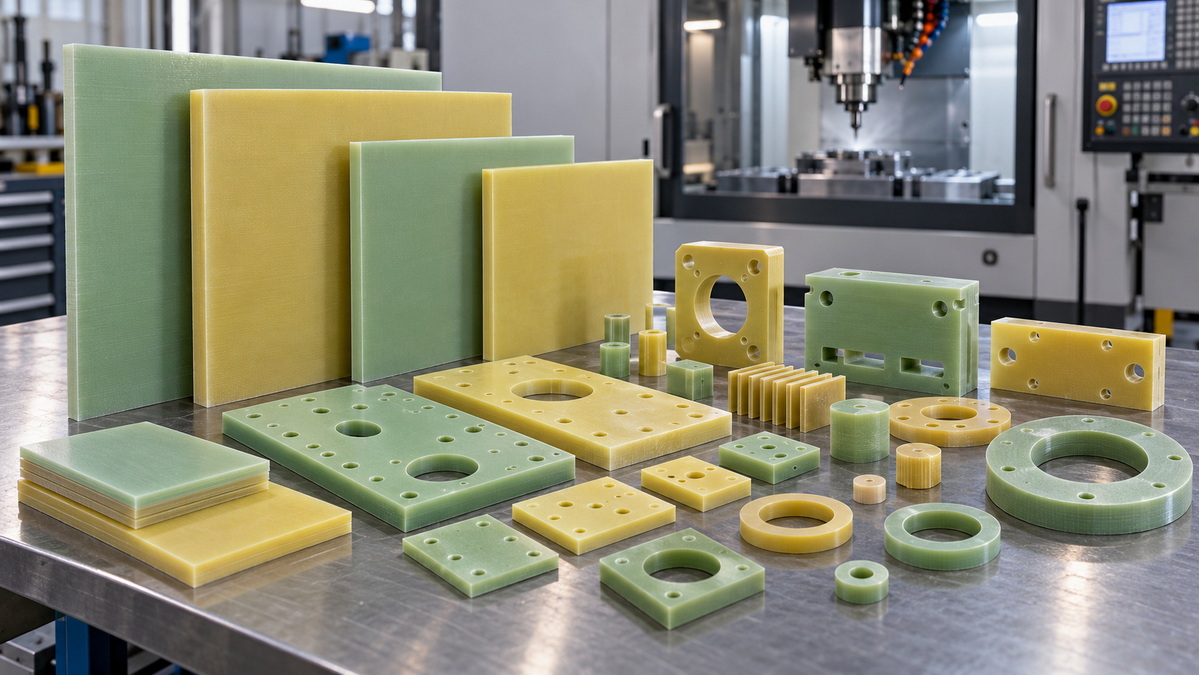
Color does not establish compliance with a material specification.
A green, yellow or natural-colored epoxy board should not be approved simply because it resembles an earlier shipment.
Require a named grade, technical data sheet and batch-linked documentation. State that alternative grades or manufacturing sources need written approval before shipment.
A less visible sourcing risk is approving one material sample while leaving the finished-component manufacturing route undefined.
The order should connect:
- The approved laminate grade.
- The upstream manufacturing source.
- The supplied batch.
- The drawing revision.
- The machining route.
- The final inspection record.
This matters particularly when a converter buys sheets from another company.
A successful prototype does not provide sufficient control if later production may use an undocumented alternative laminate.
The practical safeguard is to define material-source changes as approval events, rather than treating them as routine purchasing decisions.
The lowest sheet price does not necessarily produce the lowest component cost.
Compare quotations using the cost of conforming parts delivered to the required destination. Include:
- Sheet utilization.
- Cutting and machining.
- Inspection.
- Packaging.
- Transport.
- Rejected material.
- Replacement and schedule consequences.
For customized parts, require the quotation to distinguish material cost, processing cost, tooling and inspection charges.
For cross-border purchases, agree on delivery terms, importer responsibilities, shipping documents and acceptance procedures before dispatch.
Specify packaging appropriate to the sheet dimensions and handling requirements. Protect the agreed flatness, surface condition and edges.
Ask the logistics provider to confirm how the actual package will be handled rather than relying on a generic shipping description.
Germany offers credible options across documented laminate supply, materials engineering and precision conversion.
Hippe provides a direct EP GC 201 offering. Röchling and Krempel offer broader materials expertise. Dr. Dietrich Müller is relevant to technical selection and component processing.
Guangdong Weishi New Materials Co., Ltd. provides a China-based alternative for buyers evaluating direct manufacturing and customized insulation-material supply. Its published facilities and processing offering support its inclusion in a shortlist, while pricing, available capacity, certification and response efficiency require project-specific validation.
Before awarding a long-term contract, send shortlisted suppliers the same drawing package, grade specification, quantity forecast and documentation requirements.
Compare their technical responses and production-representative samples, not only their initial quotations.
For customized G10, FR4 or G11 requirements, contact Guangdong Weishi with the required thickness, dimensions, operating conditions and annual demand to request a technical review, sampling proposal and quotation.
Check the certificate number, legal entity, manufacturing address, standard, scope and validity dates.
Use an accredited-certification validation database where available, and resolve inconsistencies directly with the certification body.
A certificate covering a sales office does not automatically establish certification of a separate production site. Certification also does not replace verification of the supplied material grade.
Do not approve the replacement solely from a commercial cross-reference.
EP GC 201 is commonly associated with G10, but the applicable standards, required properties and test conditions should be compared.
Ask the supplier to confirm conformity to the specification stated on the purchase order. Include additional application-specific requirements separately.
Not automatically.
Obtain evidence applicable to the exact material identity and supplied thickness. A rating published for one thickness should not be extended to others without supporting documentation.
Also distinguish a supplier's organizational listing from the classification of the material being purchased.
No.
First determine whether the product, as supplied, falls under legislation requiring CE marking. CE marking is not a universal approval for raw materials.
The finished-equipment manufacturer must assess the obligations applicable to the completed product. Material-specific RoHS evidence can support that process but does not replace it.
Request a delivery commitment for the actual grade, thickness, dimensions and quantity.
Separate installed capacity from available production allocation. Ask about stock availability, production scheduling, subcontracting and repeat-order lead times.
Use a controlled pilot order to evaluate performance. Do not create a capacity ranking from unrelated figures such as total output, floor space or machinery counts.
1. [ZVEI — Foreign Trade Report February 2026]. Broader German electrical and digital industry export figures; not a G10-specific market-size report. [zvei]
2. [Deutschland.de — Significant Surge in German Electronics Exports]. September 2026 reporting of January–July export figures attributed to ZVEI. [deutschland]
3. [Guangdong Weishi New Materials Co., Ltd. — Official Website]. Company-reported founding date, facilities, staffing, monthly output, product categories and customization offering. [wsepoxysheet]
4. [Röchling — Group History]. Group origins and development. [roechling]
5. [Röchling Industrial — Materials Portfolio]. Industrial materials and Durostone product range. [roechling]
6. [Röchling — Durostone EPC 204 Technical Data Sheet]. Product-specific mechanical properties and thickness-specific flame classification. [roechling]
7. [Röchling Industrial — Integrated Management System]. Production testing, traceability and management-system information. [roechling]
8. [Krempel — FRP and Rigid Laminate]. Rigid-laminate and composite-material portfolio. [krempel]
9. [Krempel — Quality]. Laboratory capabilities and published certification statements. [krempel]
10. [Krempel — Why Krempel]. Company-history information identifying its origins in 1871. [krempel]
11. [Erhard Hippe KG — Company]. Founding history, facilities, development resources and processing capabilities. [hippe]
12. [Erhard Hippe KG — EP GC 201]. Published sheet formats, material properties and product specifications. [hippe]
13. [Techpilot — Erhard Hippe KG]. Supplementary machining and certification information; current certificate status requires direct verification. [techpilot]
14. [Dr. Dietrich Müller GmbH — Official Website]. Materials, technical support and manufacturing-service information. [mueller-ahlhorn]
15. [Dr. Dietrich Müller GmbH — Laminates]. Laminate processing and application information. [mueller-ahlhorn]
16. [Dr. Dietrich Müller GmbH — Imprint]. Published company details, management-system certification statements and UL repackager listing. [mueller-ahlhorn]
17. [Techpilot — Dr. Dietrich Müller GmbH]. Supplementary company profile and founding-year information. [techpilot]
18. [European Union — CE Marking Requirements]. Official guidance on the scope and permitted use of CE marking. [europa]
19. [European Commission — RoHS Directive]. Official guidance on hazardous-substance restrictions in electrical and electronic equipment. [environment.ec.europa]
20. [IAF CertSearch — Accredited Certificate Validation]. Database for checking accredited management-system certification. [iafcertsearch]


