

Views: 218 Author: Weishi Sheets Publish Time: 2026-10-12 Origin: Site
Content Menu
● Phenolic Board vs FR4: Comparison at a Glance
>> Paper Phenolic for Economical Electrical Insulation
● What Is FR4 Electrical Insulation Board?
>> FR4 vs G10: Why the Distinction Matters
● Electrical Performance: Compare Grades, Not Names
>> Dielectric Strength Is Not an Operating-Voltage Guarantee
● Moisture Resistance: Where FR4 Deserves Attention
● Heat Resistance and Flame Behavior Are Different Requirements
>> Compare the Actual Temperature Limits
>> Verify Flame Ratings at the Required Thickness
● Mechanical Strength and Machining: The Cost Connection
>> Insulating Components May Also Be Structural
>> Phenolic Can Offer Fabrication Advantages
● Compare Price per Accepted Component
● Two Practical Selection Scenarios
>> Cost-Sensitive Insulating Washers and Spacers
>> Insulating Supports in Variable-Humidity Equipment
● A Procurement Checklist for Phenolic and FR4
● Conclusion: Choose the Material That Meets the Complete Requirement
>> Is Phenolic Board Cheaper Than FR4?
>> Which Material Is Better for Humid Conditions?
>> Is Every Phenolic Board an Electrical Grade?
>> Which Material Is Easier to Machine?
Phenolic board vs FR4 is a practical comparison for manufacturers seeking reliable electrical insulation without unnecessary material costs. Both materials are used for insulating components, but they differ in reinforcement, mechanical strength, moisture performance, flame behavior, and machining requirements.
Paper-based phenolic laminates offer an economical starting point for washers, spacers, terminal boards, and similar components. FR4 glass epoxy laminate is often a stronger candidate when insulation must also withstand mechanical loading, humidity, or specified flame-performance requirements.
The right choice comes down to value: select the lowest-cost material that meets the complete application specification, not simply the sheet with the lowest price.
This guide compares the two materials, explains where each deserves consideration, and provides a practical framework for evaluating quotations and finished components.
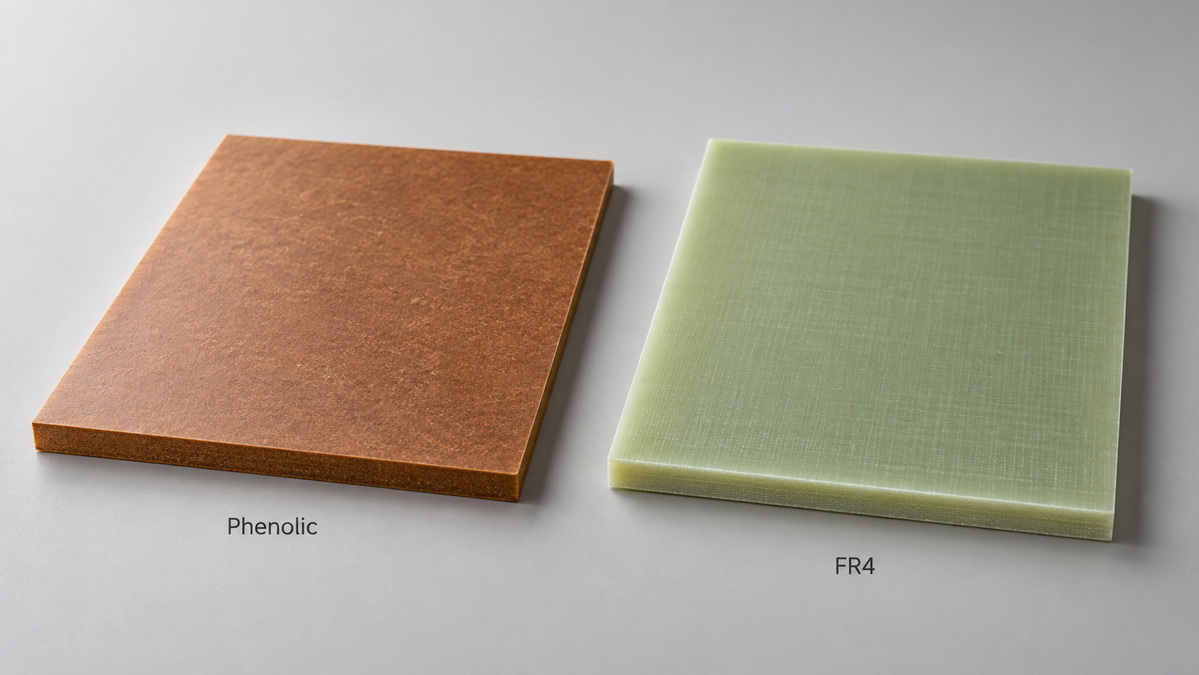
| Selection factor | Phenolic board | FR4 board |
|---|---|---|
| Material construction | Phenolic resin reinforced with paper, cotton fabric, or other substrates | Flame-retardant epoxy resin reinforced with woven glass fabric |
| Purchase cost | Paper grades offer an economical starting point | Generally higher than common economical phenolic grades |
| Electrical insulation | Varies substantially by grade | Strong electrical characteristics |
| Mechanical strength | Useful strength, particularly in fabric-reinforced grades | High strength for insulating structural components |
| Moisture performance | Depends on reinforcement and grade | Low water absorption |
| Machining | Generally readily fabricated; finer fabric grades offer machining advantages | More demanding to machine |
| Flame performance | Must be verified for the specific grade | Flame-resistant material family; verify the actual rating and thickness |
| Typical selection priority | Cost-sensitive insulation with manageable service requirements | Insulation requiring greater environmental or mechanical performance |
This comparison describes material families. It does not mean every phenolic product has identical properties or every FR4 product carries the same documented performance.
Phenolic board is a thermoset laminate manufactured by consolidating resin-impregnated reinforcement under heat and pressure. The reinforcement may be paper, cotton canvas, linen, or another substrate.
For purchasing purposes, "phenolic board" is an incomplete specification. The reinforcement and grade influence electrical properties, machining behavior, and suitability for the intended component.
Paper phenolic grades include X, XX, and XXX. Applications include insulating washers, spacers, switch bases, and terminal boards.
Paper-based phenolic is particularly relevant when:
- Material cost is a major consideration.
- The component has modest structural requirements.
- Operating conditions are clearly defined.
- The selected grade can meet the necessary electrical tests.
An economical grade can be a sound engineering choice. It becomes a poor choice only when its limitations conflict with the application.
Canvas phenolic grades include C and CE, while linen grades include L and LE.
These grades should not be treated as interchangeable. CE has better electrical properties than C, and LE has better electrical properties than L. Finer-weave linen reinforcement also supports improved machinability and surface finish.
When requesting a quotation, specify the required grade rather than asking for generic brown phenolic sheet.
FR4 is a glass epoxy laminate consisting of woven fiberglass reinforcement and a flame-resistant epoxy resin system.
It combines electrical insulation with mechanical strength and low water absorption. These characteristics make it relevant to terminal boards, insulating supports, housings, and other components that must perform electrically and structurally.
In this article, FR4 refers to unclad industrial insulation board. Copper-clad material for printed circuit boards is a different purchasing requirement and should be identified separately.
G10 and FR4 belong to the glass epoxy laminate family, but flame resistance is an important distinction. FR4 is commonly described as the flame-retardant counterpart of G10-type glass epoxy laminate.
Some suppliers group products under a "G10/FR4" label. Buyers should still confirm the exact material being supplied, especially when flame classification forms part of the specification.
A product-family label does not replace grade identification or supporting documentation.
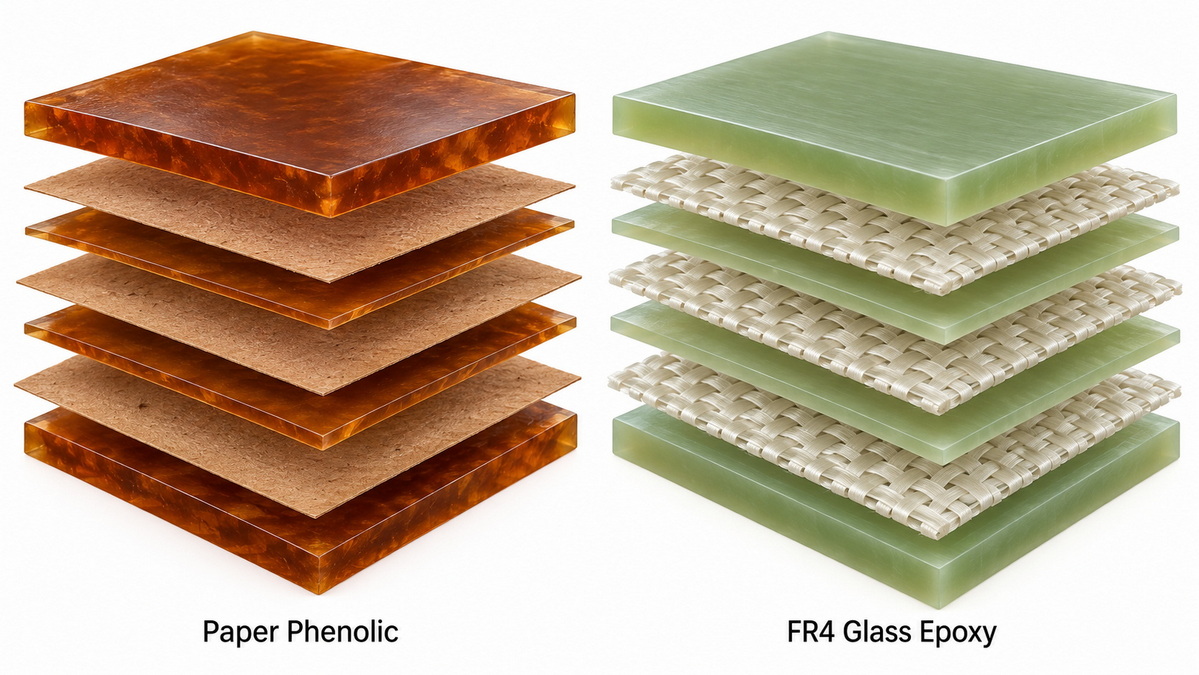
Both phenolic and FR4 can provide electrical insulation. The meaningful comparison is between identified grades tested under understood conditions.
The following figures illustrate published typical properties for CE canvas phenolic and a G10/FR4 glass epoxy laminate.
| Typical published property | CE phenolic | G10/FR4 glass epoxy |
|---|---|---|
| Dielectric strength | 550 V/mil | 800 V/mil |
| Water absorption after 24-hour immersion | 2.5% | 0.1% |
| Tensile strength | 10,000 psi | 45,000 psi |
| Compressive strength | 36,000 psi | 65,000 psi |
| Dissipation factor at 1 MHz | 0.051 | 0.019 |
These figures are reference values, not guaranteed specifications for every manufacturer's products. They also compare CE phenolic, not the entire phenolic family.
The CE table identifies ASTM D149 for dielectric strength, while the referenced G10/FR4 table does not specify that method. Consequently, the dielectric figures should not be presented as a fully controlled head-to-head test.
A published dielectric-strength value should not be multiplied by sheet thickness and treated as the finished component's allowable operating voltage.
Material reference data does not establish the performance of every geometry, assembly, or service condition. Laminate orientation can also affect properties.
A practical selection process therefore has two stages:
1. Use material data to identify suitable candidates.
2. Validate the finished design against its actual requirements.
The reference values above show substantially lower water absorption for the G10/FR4 product than for CE phenolic.
This makes FR4 a strong starting candidate when low water uptake is important. However, it does not establish identical moisture behavior across all phenolic grades. Linen phenolics, for example, are also described as having good moisture resistance.
For equipment exposed to condensation or changing humidity, evaluate the exact proposed material rather than relying on a general "moisture-resistant" description.
Useful questions include:
- Does the technical data address the intended environment?
- Are electrical properties available after relevant conditioning?
- Has the finished component been evaluated under representative conditions?
An immersion test provides useful information, but it does not reproduce every installed environment.
The referenced CE phenolic product lists a maximum continuous operating temperature of 125°C. The referenced G10/FR4 product lists 284°F, approximately 140°C.
These are product-specific reference figures, not universal temperature limits for every phenolic or FR4 board.
For heat-sensitive applications, identify:
- Continuous operating temperature.
- Short-duration temperature exposure.
- Mechanical loading during operation.
- Required electrical performance at temperature.
Request data for the proposed grade rather than assuming that all glass epoxy laminates behave alike.
The referenced CE phenolic table lists UL 94 HB, while the G10/FR4 table lists V-0.
HB and V classifications use different test arrangements. They should not be treated as equivalent descriptions of flame behavior.
UL 94 evaluates material specimens through defined small-scale tests. A material rating does not, by itself, establish the fire safety of an entire electrical assembly. Specimen thickness also matters.
If flame performance is required, obtain documentation that identifies the actual material and applicable thickness. Neither "phenolic" nor "FR4" alone provides sufficient evidence.
An insulating board may serve as a spacer, but it may also support equipment or transmit mechanical loads.
The reference tensile and compressive values favor the glass epoxy product over CE phenolic. FR4 therefore deserves consideration when electrical isolation and structural performance are both important.
Nevertheless, do not approve a component using one strength figure alone. Review reinforcement orientation, fastener locations, remaining material around holes, and the loads the component must withstand.
Phenolics are generally readily fabricated, and finer-weave linen grades offer machining advantages. Glass epoxy laminate is comparatively more demanding to machine.
This distinction becomes commercially important when parts contain:
- Numerous drilled holes.
- Pockets or slots.
- Intricate profiles.
- Tight dimensional requirements.
- Significant material removal.
Request finished-part quotations whenever possible. Sheet price does not reveal the complete cost of delivering an acceptable machined component.

The most useful cost comparison is not price per sheet. It is the cost of producing an accepted component that meets the same requirements.
Use a consistent quotation scope covering:
1. Material grade and thickness.
2. Cutting layout and material consumption.
3. Machining and setup.
4. Inspection and qualification.
5. Rework or rejected parts.
6. Packaging and delivery.
Consider a hypothetical order for insulating spacers. If both proposed materials pass the same qualification criteria, phenolic may provide better economics.
If the phenolic option fails a required environmental or flame-performance criterion, its lower quotation does not make it an acceptable substitute.
There is no defensible universal percentage saving for phenolic vs FR4. Grade, thickness, dimensions, quantity, and processing scope must be aligned before comparing prices.
For a small component operating inside a protected assembly with modest mechanical demands, paper phenolic is a reasonable candidate to evaluate.
Its established uses include insulating washers and spacers. The next step is to confirm that the chosen grade meets the actual electrical, environmental, and dimensional requirements.
Low cost should trigger careful specification—not automatic rejection.
For a support carrying mechanical loads in an environment with changing humidity, FR4 is a stronger starting candidate.
Its combination of mechanical strength, low water absorption, and electrical characteristics makes it relevant to this type of requirement.
These scenarios illustrate a selection process. They are not documented customer projects, and neither replaces application-specific qualification.
Before contacting suppliers, prepare the following information:
- Exact grade and permitted alternatives.
- Sheet or finished-part dimensions.
- Thickness and tolerances.
- Drawings and order quantity.
- Electrical operating requirements.
- Temperature and moisture exposure.
- Mechanical loads and fastening details.
- Required flame documentation.
- Inspection and traceability requirements.
Then request a technical data sheet for the material actually being quoted.
Where qualification is important, evaluate representative components before committing to production. Avoid converting another supplier's typical reference data into a guaranteed specification for your chosen manufacturer.
Phenolic board is worth evaluating when economical electrical insulation is the main priority and the selected grade can satisfy the service conditions.
FR4 is often the stronger starting point when insulation must also provide high mechanical strength, low water absorption, or documented flame performance.
The deciding question is not which material is universally better. It is which identified grade can meet your requirements at the lowest acceptable finished-component cost.
Guangdong Weishi New Materials Co., Ltd. specializes in epoxy glass insulation boards and composite materials, including FR4 and G10/G11 products, with customization and machining capabilities.
Send your drawings, quantities, operating conditions, and documentation requirements to the Weishi team for a material and processing review. Request a quotation tied to a specific grade and technical data sheet, and compare alternatives against the same acceptance criteria.
Paper phenolic offers an economical starting point. Published relative-cost indicators also place the referenced CE phenolic below the G10/FR4 product. Actual savings depend on comparable quotations, not a universal price difference.
Potentially, if the selected phenolic grade meets the complete specification. Treat substitution as a qualification decision covering electrical, mechanical, environmental, and flame requirements—not simply matching thickness.
FR4 is generally a stronger starting candidate when low water absorption is important. The reference comparison shows 0.1% for G10/FR4 and 2.5% for CE phenolic after 24-hour immersion. Other phenolic grades require separate evaluation.
No generic phenolic description establishes suitability. Reinforcement and grade matter. CE provides better electrical properties than C, while LE provides better electrical properties than L.
No. Flame resistance does not mean fireproofing. Verify the actual material's flame classification and applicable thickness, and assess the complete assembly separately.
Phenolic generally offers easier fabrication than glass epoxy, with linen grades providing machining advantages. Finished-part economics still depend on geometry, tolerances, processing requirements, and supplier capability.
1. Boedeker Plastics — "Phenolic Industrial Laminate Product Family." Material construction, paper and fabric grades, typical applications, relative economy, and fabrication characteristics. [boedeker]
2. Boedeker Plastics — "Phenolic CE Canvas Electric Laminate." Typical CE phenolic electrical, mechanical, moisture, temperature, and flame-performance data, including technical-reference limitations. [boedeker]
3. Boedeker Plastics — "G10/FR4 Glass Epoxy Laminate Natural." Typical glass epoxy properties, applications, machining limitations, and application-validation guidance. [boedeker]
4. Professional Plastics — "FR4." Material composition and general characteristics of FR4 glass epoxy laminate. [professionalplastics]
5. Boedeker Plastics — "G10 Glass Epoxy Laminate." Relationship between G10, G11, and flame-retardant FR4 glass epoxy materials. [boedeker]
6. UL Solutions — "Combustion (Fire) Tests for Plastics." Explanation of UL 94 classifications and horizontal and vertical test arrangements. [ul]
7. UL Code Authorities — "Understanding UL 94 Rating Certifications and Limitations." Scope and limitations of material flammability classifications, including thickness considerations. [code-authorities.ul]


