

Views: 246 Author: Weishi Sheets Publish Time: 2026-08-28 Origin: Site
Content Menu
● What Is FR4 Epoxy Fiberglass Sheet?
>> Main Components of FR4 Sheet
● Why Choose FR4 Epoxy Fiberglass Sheet?
>> Flame-Retardant Performance
>> Electrical Insulation Capability
>> Mechanical Strength and Rigidity
>> Dimensional Stability During Machining
● FR4 vs. G10 vs. G11 Epoxy Glass Laminate
>> When FR4 Is the Better Choice
>> When G11 Is the Better Choice
● Key Properties to Check Before Ordering FR4 Sheet
● A Practical Four-Step Material Selection Process
>> Step 1: Define the Working Environment
>> Step 2: Select the Appropriate Grade
>> Step 3: Confirm Dimensions and Processing Details
>> Step 4: Validate the Finished Part
● Expert Insight: The Sheet Is Only One Part of the Solution
● Why Guangdong Weishi New Materials Is a Reliable Partner
● Summary
>> Is FR4 the same as fiberglass?
>> What is the main difference between FR4 and G10?
>> Can FR4 epoxy fiberglass sheet be CNC machined?
>> Is FR4 suitable for high-temperature applications?
>> Does every FR4 sheet have the same flame rating?
>> What information is needed to request an FR4 quotation?
FR4 epoxy fiberglass sheet is a reliable choice when an application needs electrical insulation, mechanical strength, dimensional stability, and flame-retardant performance in one material. Made from woven fiberglass cloth and flame-retardant epoxy resin, FR4 is widely used in electrical equipment, electronics, industrial machinery, tooling, and precision-machined insulation components.
For engineers, purchasers, and manufacturers, selecting FR4 is rarely only about buying a green insulation board. The right material must match the operating temperature, voltage level, fire-safety expectations, humidity conditions, mechanical load, machining requirements, and dimensional tolerances of the final part.
Guangdong Weishi New Materials Co., Ltd. supplies high-performance epoxy insulation sheets and composite materials, including FR4 sheets, G10 sheets, G11 sheets, and customized machined insulation components. Our materials are designed for customers who need dependable insulation performance in demanding industrial environments.
FR4 epoxy fiberglass sheet is a rigid laminated composite material. It is made by combining layers of woven fiberglass cloth with epoxy resin and curing them under controlled heat and pressure.
The fiberglass reinforcement provides structural strength and rigidity. The epoxy resin binds the fabric layers together and gives the material its electrical insulation properties. Flame-retardant additives are incorporated into the resin system to help the material resist burning.
FR4 is often used where ordinary plastics cannot provide enough mechanical strength, heat resistance, or electrical insulation reliability. It is especially valuable in applications where a component must support electrical parts, withstand machining, resist deformation, and remain stable during long-term service.
FR4 epoxy fiberglass sheet generally includes:
- Woven fiberglass cloth for strength and stiffness
- Flame-retardant epoxy resin for insulation and bonding
- Multiple compressed laminate layers
- A rigid thermoset structure that does not melt during normal machining
- A dense surface suitable for drilling, routing, milling, and CNC processing
Unlike many thermoplastic materials, FR4 does not soften significantly when exposed to moderate heat during fabrication. This makes it suitable for precision insulation parts that require accurate holes, slots, edges, and thickness control.

FR4 is selected because it offers a practical balance of performance characteristics. It can provide insulation, strength, flame resistance, and machinability without requiring separate materials for each function.
One of the primary reasons to choose FR4 epoxy fiberglass sheet is its flame-retardant behavior. In many electrical and industrial applications, material safety is an essential requirement.
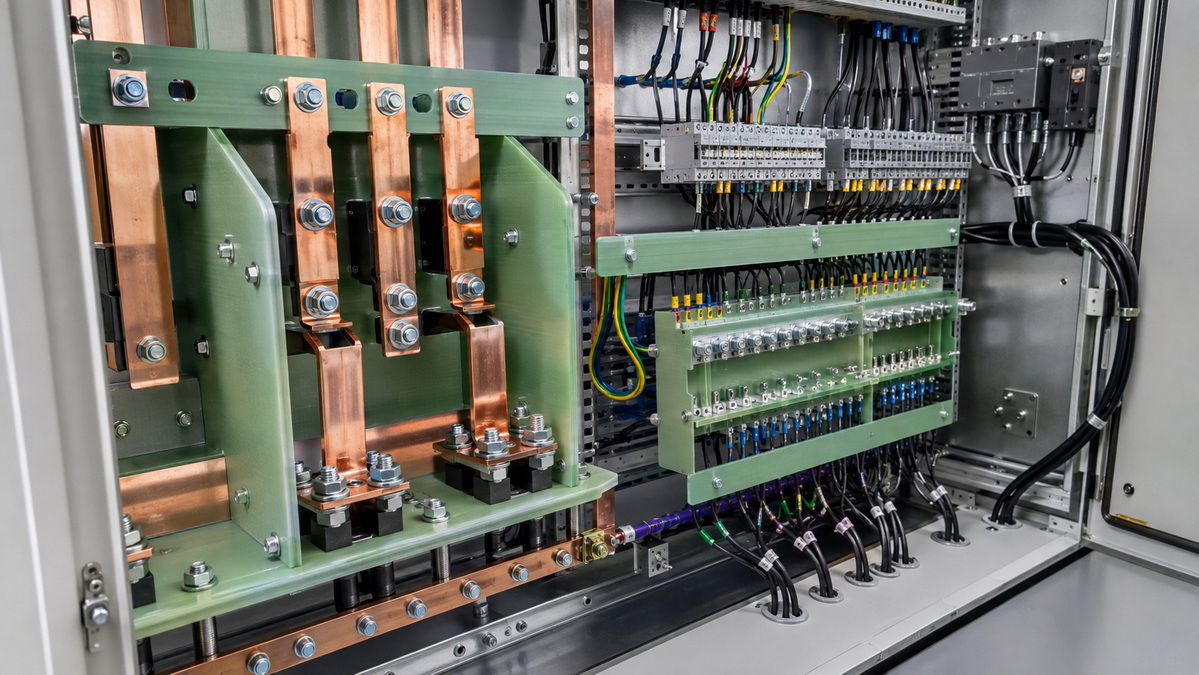
FR4 is commonly associated with flame-retardant performance that can help reduce the spread of fire in electrical equipment. This is important in enclosed assemblies where cables, terminals, transformers, relays, power modules, and other energized components are located close together.
Applications that often require flame-retardant insulation include:
- Electrical control panels
- Switchgear systems
- Power distribution equipment
- Battery insulation structures
- Terminal blocks and terminal boards
- PCB fixtures and assembly supports
- Industrial electrical cabinets
- High-voltage insulation barriers
It is important to confirm the required flame classification before purchasing. Different thicknesses, formulations, and production standards may affect the final material performance.
FR4 epoxy fiberglass sheet is widely used as an electrical insulation material because it can resist electrical current flow and help separate conductive parts inside equipment.
Typical FR4 insulation components include:
- Busbar supports
- Insulating washers
- Transformer spacers
- Motor insulation parts
- Electrical mounting plates
- Terminal board supports
- High-voltage insulation panels
- Switchgear barriers
- Electrical jigs and fixtures
The electrical performance of FR4 can be influenced by several factors, including thickness, humidity, temperature, surface condition, resin system, and the shape of the finished part.
For this reason, material selection should consider the complete working environment instead of only reviewing room-temperature performance.
The woven fiberglass reinforcement gives FR4 sheet strong mechanical properties. It can resist bending, compression, vibration, and repeated assembly loads better than many standard insulating plastics.
This strength makes FR4 suitable for parts that need to perform both electrical and structural functions.
For example, an FR4 support plate may electrically isolate a busbar from a metal enclosure while also holding the busbar in a stable position during vibration and temperature changes.
FR4 is frequently used in:
- Mechanical supports
- Insulating brackets
- Structural spacers
- Fixture plates
- Precision mounting boards
- Mold and tooling components
- Wear-resistant electrical insulation parts
- Industrial machine components
The material can be manufactured into thin sheets, thick sheets, flat panels, rods, and custom-machined shapes depending on project requirements.
FR4 is a thermoset laminate. Once cured, it remains rigid and stable. This makes it useful for components that require accurate dimensions after cutting, drilling, or CNC milling.
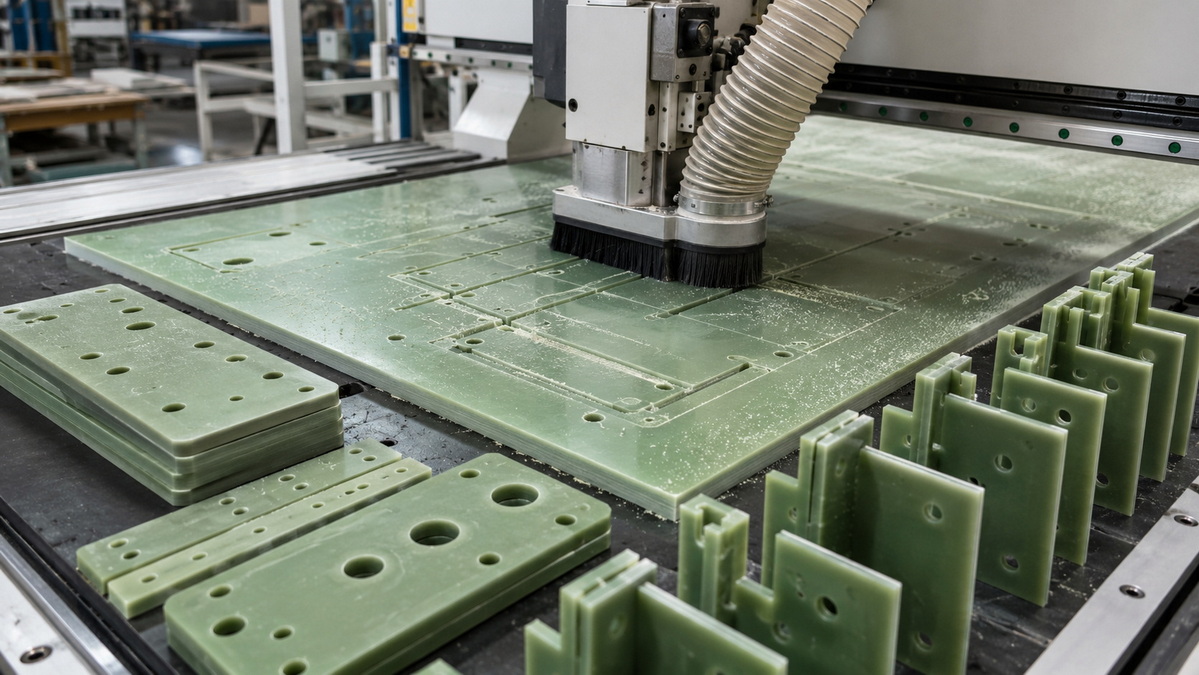
A well-produced FR4 sheet can be machined into parts with holes, slots, chamfers, grooves, counterbores, and custom profiles.
Common processing methods include:
- CNC routing
- CNC milling
- Drilling
- Saw cutting
- Punching
- Grinding
- Edge finishing
- Engraving
- Surface marking
Because fiberglass is abrasive, FR4 machining requires suitable cutting tools and controlled processing parameters. Proper machining reduces the risk of delamination, rough edges, excessive burrs, cracking, and dimensional inconsistency.
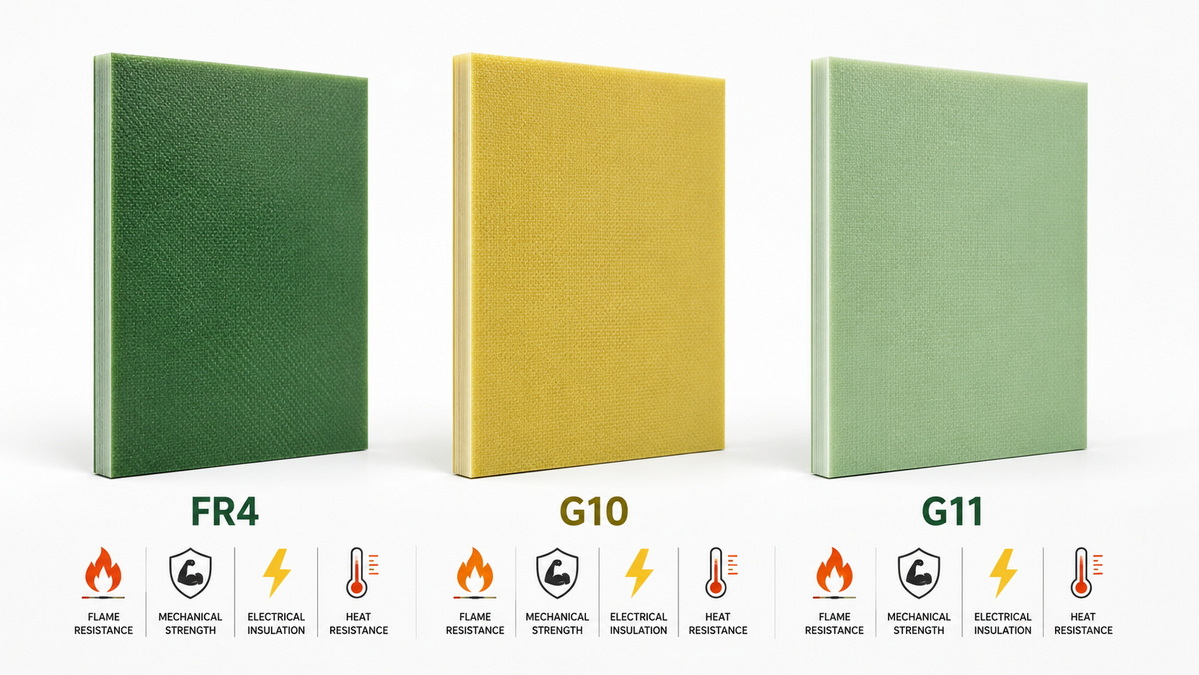
FR4, G10, and G11 are all fiberglass-reinforced epoxy laminate materials. However, they are designed for different priorities and should not automatically be used as substitutes for one another.
The correct choice depends on whether the project places more importance on flame resistance, standard mechanical strength, elevated-temperature performance, or a combination of these factors.
| Property | FR4 Epoxy Fiberglass Sheet | G10 Epoxy Glass Sheet | G11 Epoxy Glass Sheet |
|---|---|---|---|
| Base material | Fiberglass cloth and flame-retardant epoxy resin | Fiberglass cloth and standard epoxy resin | Fiberglass cloth and higher-temperature epoxy resin |
| Flame performance | Flame-retardant grade | Usually not flame-retardant | Depends on grade and formulation |
| Electrical insulation | Good | Good | Good |
| Mechanical strength | High | High | High |
| Heat resistance | Suitable for many general electrical applications | Suitable for standard-temperature applications | Better suited for elevated-temperature environments |
| Machinability | Good with proper tools | Good with proper tools | Good with proper tools |
| Typical applications | Electrical panels, terminal boards, switchgear, PCB fixtures | Mechanical fixtures, insulation parts, structural supports | Motors, transformers, high-temperature electrical systems |
FR4 is often the preferred material when flame retardancy is required. It provides a good balance of electrical insulation, mechanical strength, and practical processing performance.
Choose FR4 when the application includes:
- Electrical safety requirements
- Flame-retardant material expectations
- Electrical cabinets or enclosed power systems
- PCB-related tools and fixtures
- Switchgear and terminal insulation parts
- Structural electrical insulation components
- CNC-machined insulating parts with stable dimensions
G10 is also a fiberglass-reinforced epoxy laminate. It can provide high mechanical strength and good electrical insulation. However, it generally does not include the same flame-retardant resin system as FR4.
G10 may be a suitable option for applications where mechanical strength, machinability, and insulation are important, but flame-retardant performance is not a mandatory requirement.
Typical G10 applications include:
- Mechanical fixtures
- Structural insulating parts
- Industrial machine components
- Wear-resistant components
- General insulation supports
- Custom-machined composite parts
G10 should not be substituted for FR4 simply because the sheets look similar. The final decision should be based on the technical requirement of the product.
G11 epoxy fiberglass sheet is designed for applications that require stronger performance at elevated temperatures. It is often selected for electrical and industrial environments where standard FR4 or G10 may not provide sufficient long-term thermal stability.
G11 can be considered for:
- Motor insulation components
- Transformer insulation structures
- High-temperature electrical equipment
- Heat-resistant spacers and supports
- Power-generation equipment
- Industrial heating systems
- Electrical assemblies with continuous thermal exposure
For high-temperature projects, buyers should confirm the expected operating temperature, thermal cycling conditions, and the specific material grade before making a final selection.
FR4 sheet should be selected based on the actual application, not only by material name. A detailed specification helps reduce sourcing errors and supports stable performance in production.
Before ordering, clarify the electrical environment of the finished part.
Important questions include:
- What voltage will the part withstand?
- Will the component be used in a high-voltage or low-voltage system?
- Is the surface exposed to dust, moisture, or oil?
- Does the part require high dielectric strength?
- Will it be installed close to energized conductors?
- Does the product require insulation after thermal cycling?
For example, a simple electrical spacer may need basic insulation. A switchgear barrier, transformer support, or battery insulation plate may require more detailed evaluation of electrical clearance, moisture exposure, and long-term reliability.
Temperature is one of the most important factors in epoxy glass laminate selection.
Buyers should define:
- Continuous operating temperature
- Maximum short-term temperature
- Thermal cycling conditions
- Nearby heat sources
- Expected service life
- Requirement for high-temperature resin systems
- Need for FR4, high-Tg FR4, or G11
A material may perform well at room temperature but become less stable when exposed to heat over a long period. This is why high-temperature applications should be evaluated carefully before production.
The final part may need to support weight, resist vibration, hold electrical conductors, or maintain a precise position during use.
Consider:
- Bending load
- Compression load
- Vibration exposure
- Impact risk
- Fastening force
- Hole and slot geometry
- Thickness requirement
- Required dimensional tolerance
A thick FR4 busbar support may need different properties from a thin insulation washer. Both may use epoxy fiberglass sheet, but their processing and design requirements will be very different.
Custom insulation components are often more valuable than raw sheets because they are ready for assembly.
For a machining quotation, prepare the following information:
- Part drawing or sample
- Material grade
- Thickness
- Length and width
- Hole size and location
- Slot, groove, and chamfer details
- Surface finish requirements
- Edge quality expectations
- Quantity per order
- Packaging requirements
Providing clear drawings helps avoid misunderstandings and improves manufacturing efficiency.
Choosing FR4 epoxy fiberglass sheet becomes easier when the process starts with the actual operating condition.
Identify the voltage, temperature, humidity, flame requirement, mechanical load, chemical exposure, and expected service life of the finished component.
This information helps determine whether FR4, G10, G11, or another insulation material is the best option.
Choose the material based on the project's most important requirement.
If flame resistance is the priority, FR4 may be the most suitable option. If standard mechanical strength is the main requirement and flame retardancy is not necessary, G10 may be considered. If long-term elevated-temperature performance is critical, G11 may be more appropriate.
Confirm sheet thickness, tolerance, sheet size, color, flatness, machining requirements, and inspection standards before production begins.
For precision components, it is useful to review the complete part drawing and determine whether any design feature may affect machining quality.
For important projects, prototype samples should be checked before mass production. The finished part should be evaluated for dimensions, fit, insulation performance, surface quality, and performance under expected working conditions.
This helps identify issues before they affect full-scale assembly or shipment.
A high-quality insulation component depends on more than the material name printed on the purchase order. The resin system, fiberglass construction, curing process, density, thickness consistency, moisture control, and machining quality all influence final performance.
The finished part should be evaluated as a complete system.
The material must provide suitable electrical and mechanical properties. The machining process must minimize burrs, delamination, cracks, and edge damage. The design must include enough insulation distance and physical support. The final equipment must operate within the temperature and electrical limits of the selected material.
This is particularly important for industrial projects involving international specifications, custom drawings, and export applications. A reliable material supplier should understand both raw material properties and the practical challenges of converting sheets into finished insulation parts.
Guangdong Weishi New Materials Co., Ltd. specializes in high-performance epoxy insulation sheets and composite materials for industrial applications. We provide FR4 epoxy fiberglass sheets, G10 sheets, G11 sheets, and customized machined insulation components for customers in electronics, electrical equipment, machinery, mold manufacturing, and industrial production.
Our capabilities include:
- FR4, G10, G11, and epoxy fiberglass laminate materials
- Customized thickness, dimensions, and colors
- CNC-machined insulation parts based on drawings or samples
- Drilling, routing, milling, cutting, and edge finishing
- Support for prototypes, small batches, and volume orders
- Controlled production processes and stable material quality
- Export-oriented communication and project coordination
Whether you need raw epoxy fiberglass sheets or finished insulation components, the right material choice can improve product safety, manufacturing efficiency, and long-term reliability.
Share your drawing, material requirement, operating environment, and quantity needs with Guangdong Weishi New Materials to identify a suitable FR4, G10, or G11 solution for your project.
FR4 epoxy fiberglass sheet is a strong and versatile insulation material for electrical and industrial applications. Its combination of flame-retardant performance, electrical insulation, mechanical strength, dimensional stability, and machinability makes it suitable for switchgear, transformers, terminal boards, electronic fixtures, industrial machinery, and custom insulation parts.
The best material choice depends on the real operating environment. FR4 is often selected for flame-retardant electrical insulation. G10 can be suitable for standard mechanical and insulation applications. G11 is often preferred for higher-temperature environments.
For reliable results, material selection should consider temperature, voltage, humidity, mechanical load, dimensional tolerance, machining requirements, and long-term service conditions.
No. FR4 is a composite laminate material. It contains woven fiberglass cloth, but it also uses flame-retardant epoxy resin to create a rigid, electrically insulating sheet.
The main difference is flame-retardant performance. FR4 is commonly made with flame-retardant epoxy resin, while G10 generally uses a standard epoxy resin system without the same flame-retardant designation.
Yes. FR4 can be cut, drilled, routed, milled, and finished into custom insulation parts. Because the fiberglass reinforcement is abrasive, suitable cutting tools and dust-control methods are important.
FR4 is suitable for many electrical insulation applications. However, for long-term high-temperature environments, high-Tg FR4 or G11 may be more appropriate depending on the required operating conditions.
No. Flame performance can vary depending on the resin formulation, sheet thickness, production method, and certification status. Buyers should confirm the specific material requirement before ordering.
Provide the thickness, sheet dimensions, tolerance, color, quantity, material grade, operating environment, flame requirement, machining drawing, and shipping destination.
1. International Electrotechnical Commission. [IEC 60893-3-1: Insulating Materials—Industrial Rigid Laminated Sheets Based on Thermosetting Resins for Electrical Purposes]
2. National Electrical Manufacturers Association. [Industrial Laminated Thermosetting Products]
3. American National Standards Institute. [NEMA LI 1-1998 (R2011)]
4. United States Environmental Protection Agency. [Flame Retardants in Printed Circuit Boards]
5. Plastics International. [G-10/FR-4 Glass Epoxy Laminate]
6. Ready Plastics. [NEMA FR4 Flame-Retardant Glass-Epoxy Laminate]
7. Ready Plastics. [NEMA G10 vs FR4, G11, G7, and G9 Laminates]
8. International Electrotechnical Commission. [IEC 60893-2:2023—Methods of Test]


