
Views: 254 Author: Weishi Sheets Publish Time: 2026-11-23 Origin: Site
Content Menu
● What Is 3240 Epoxy Glass Sheet?
>> Why a rigid pack insulator is not a battery cell separator
● Where Can 3240 Epoxy Board Be Used in a Battery Pack?
● How to Read a 3240 Epoxy Sheet Datasheet
>> Dielectric strength is a test result, not a working voltage
>> Thermal index, moisture resistance, and strength answer different questions
● 3240 vs. FR4, G10, and G11 for Battery Pack Insulation
● How to Qualify a Machined Battery Insulation Part
● What to Include in a Request for Quote
● Request a Drawing Review for Your Battery Pack Insulation Part
>> Can 3240 epoxy sheet replace the separator inside a lithium-ion cell?
>> What thickness of 3240 epoxy sheet should I use for a battery pack?
>> Is 3240 epoxy board flame-retardant?
>> Can FR4 replace 3240 in an existing insulation part?
>> Is G11 always better than 3240 near a heat source?
>> Can 3240 epoxy sheet be machined to a custom drawing?
A 3240 epoxy sheet can be specified for rigid electrical insulation in a lithium-ion battery pack. It is a candidate for barriers near busbars, insulating spacers, and brackets where a part must retain its shape as well as provide electrical isolation. It is not the porous separator inside a battery cell, and a sheet datasheet alone does not establish that a finished part is suitable for a particular pack.
From a laminate manufacturer's perspective, the first question is not "How many kilovolts can this sheet withstand?" It is "What does this part need to isolate, and under what conditions?" The answer determines whether 3240 belongs on the shortlist and what evidence you need before ordering production quantities.
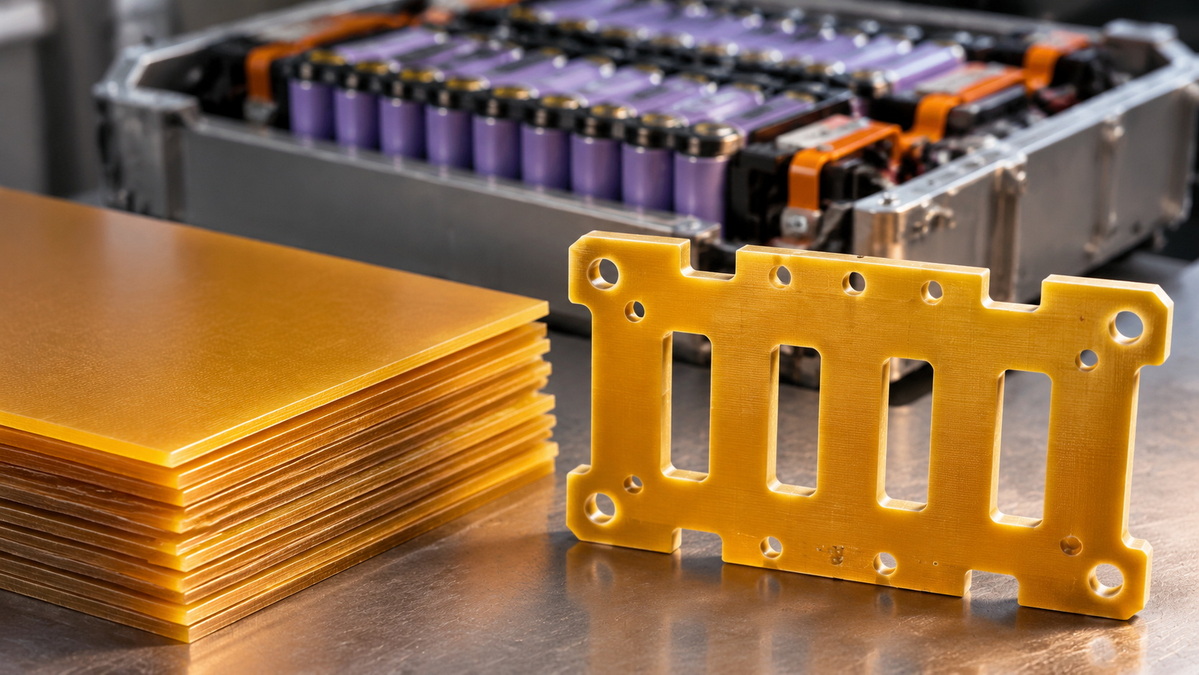
3240 is a rigid electrical laminate made from woven glass cloth bonded with a cured epoxy-phenolic resin system. The glass reinforcement provides stiffness and strength; the resin binds the layers and contributes to the material's electrical insulation. The sheet can be machined into plates, strips, spacers, and profiles with mounting holes or slots.
Some suppliers cross-reference 3240 to EPGC201. Treat that cross-reference as a prompt to check the actual specification, not as proof that two sheets are interchangeable. A purchase specification should identify the applicable material standard, the supplier grade, the thickness tolerance, and any required inspection records. Color is not a reliable way to identify a laminate grade.
A lithium-ion cell separator keeps the positive and negative electrodes physically apart while allowing ions to move through electrolyte-filled pores. Standard 3240 epoxy glass sheet is a dense structural laminate. It is not designed for that ion transport function.
On drawings and purchase orders, use a part name that states the actual job, such as "busbar insulating barrier" or "module mounting spacer." The phrase "battery separator plate" can mean different things to a cell engineer and a mechanical buyer. A precise name makes it easier to specify and inspect the right part.
The applications below are starting points for design review, not blanket approvals. In each case, evaluate the finished part in its mounting position and under the expected electrical, mechanical, and environmental conditions.
| Candidate application | What the part does | What to verify before approval |
|---|---|---|
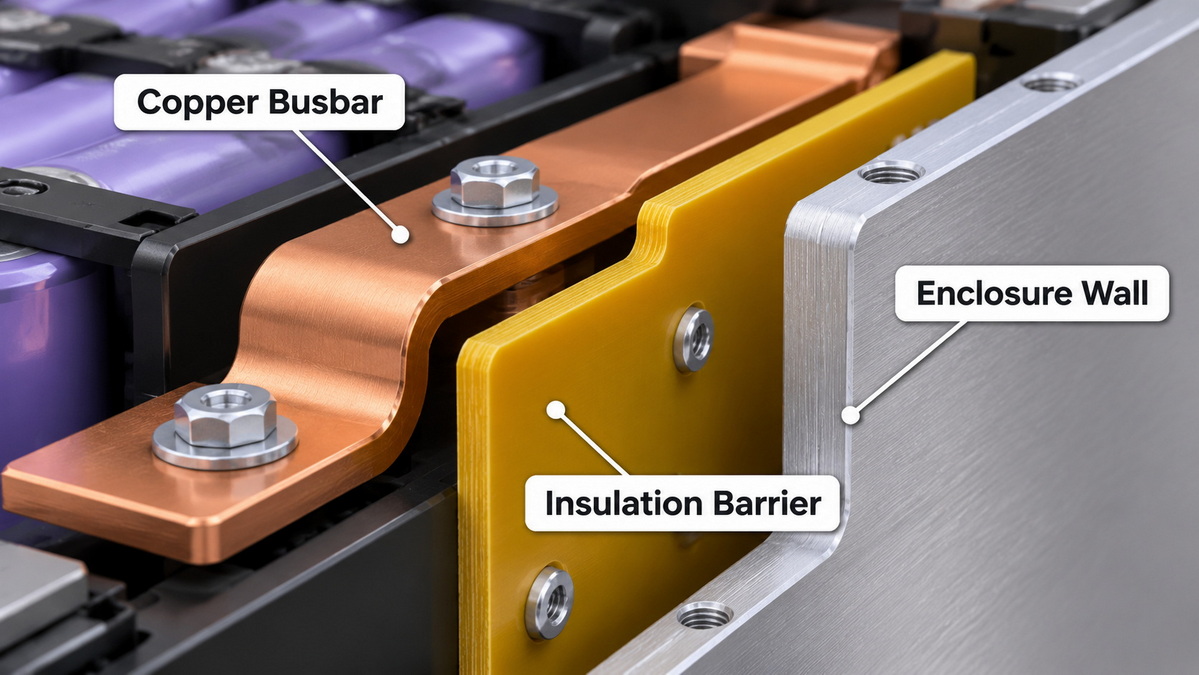
| Busbar insulating barrier | Separates a current-carrying conductor from adjacent hardware or a metal enclosure | Clearance around edges, fastener position, cutout tolerances, and the assembled electrical test |
| Module mounting spacer | Maintains a defined gap while providing insulation at the mounting interface | Thickness tolerance, clamp load, and dimensional stability after temperature cycling |
| Terminal-area insulating plate | Provides a rigid barrier near terminals or interconnects | Edge geometry, hardware access, and whether movement or contamination could compromise isolation |
| Insulating support bracket | Supports a component where the mounting path also needs electrical isolation | Load direction, hole placement, vibration, and the condition of machined edges |
A rigid plate is useful when the insulation must hold a defined shape. If the task is only to cover a tight, curved surface, a qualified flexible insulation system may fit better. Likewise, a rigid plate should not be treated as a cushioning pad for cell expansion unless the module designer has specifically validated the arrangement.
One published 3240 datasheet lists a minimum perpendicular dielectric strength of 14.2 kV/mm for a 1 mm specimen tested in transformer oil at 90°C. The same datasheet lists a minimum parallel breakdown voltage of 35 kV under its stated oil test conditions. The numbers describe different test directions and use different units. Neither is a voltage rating for a machined part installed in air.
In a pack, an electrical path may run through the laminate, through air around an edge, or along a surface. Creepage is the shortest path along an insulating surface between conductive parts; clearance is the shortest path through air. A mounting screw, a slot, or a metal enclosure lip can affect those paths even when the sheet itself is unchanged. Do not multiply a datasheet value in kV/mm by sheet thickness and use the result as the pack's allowable voltage.
The same supplier lists a thermal index of 130°C and a minimum flexural strength of 340 MPa under its stated test conditions. These are examples from one supplier's published data, not universal 3240 values or specifications for Guangdong Weishi material. A thermal index concerns long-term thermal endurance. It does not, by itself, establish how much load a finished bracket can carry when hot or whether a barrier can delay thermal runaway propagation.
For a humid enclosure, ask how insulation resistance and water absorption were measured. Compare results obtained with similar sample thicknesses and conditioning. If the part may contact coolant, cleaning agents, or another fluid, ask for compatibility data for that specific fluid. A water immersion result is not evidence of compatibility with every liquid the component might encounter.
The best grade is the one that meets the drawing and qualification requirements with the clearest supporting evidence. Similar-looking glass laminates should not be substituted without review.
| Grade | When to shortlist it | What to ask the supplier for |
|---|---|---|
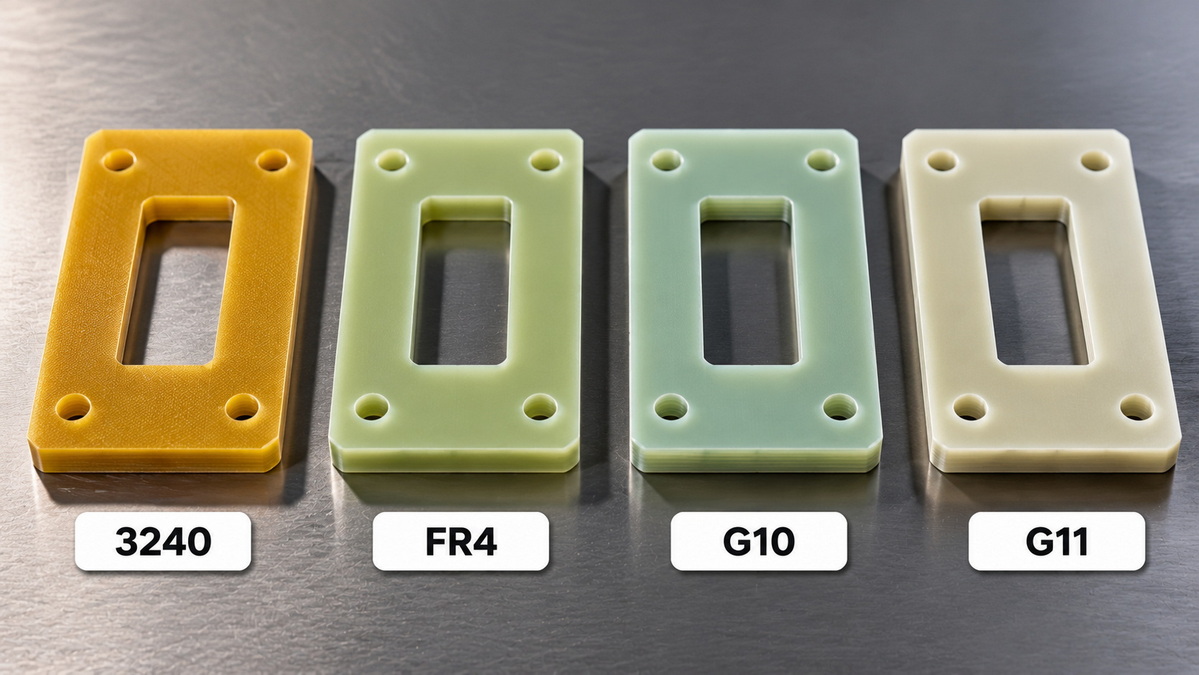
| 3240 | You need a rigid, machinable electrical insulator and the exact grade meets the application requirements | Material specification, electrical test conditions, thickness tolerance, and any required flammability evidence |
| FR4 | You need a flame-retardant glass-epoxy laminate | Documentation for the exact product and thickness; confirm the classification required by the pack specification |
| G10 | You need rigid glass-epoxy insulation and do not rely on a flame-retardant designation | Mechanical and electrical data and confirmation that the offered grade matches the drawing |
| G11 | The part must retain useful mechanical properties at elevated temperatures | Data at the expected temperature and load, plus separate flammability evidence if required |
Flame retardancy and heat endurance are separate requirements. Do not infer a flammability classification from a 3240 or G11 grade name. Likewise, a flammability result for a laminate is not a battery-system safety approval. IEC 62619, for example, specifies safety requirements and tests for secondary lithium cells and batteries used in industrial applications, including stationary applications. The relevant battery qualification still applies regardless of which laminate is selected.
1. Define the job at the assembly level. Identify the conductors and grounded or accessible hardware the part separates. Record the operating environment, mounting load, and relevant electrical acceptance criteria before specifying a grade.
2. Review the production geometry. Check how screws, washers, cutouts, and surrounding metal affect the insulation path. Specify critical dimensions and the required edge condition. For example, if a slot locates the barrier next to a busbar, its position may matter more than the tolerance on a nonfunctional outer edge.
3. Inspect representative first articles. Check thickness, flatness, hole locations, and fit. Look for cracks, lifted layers, and loose fibers around machined features. Ask for material identification and lot traceability if the approved grade must remain consistent across repeat orders.
4. Validate the assembled part. Have the responsible team perform the relevant electrical and mechanical checks using production-representative hardware. Where the service environment calls for it, reassess the part after conditioning, such as humidity exposure, temperature cycling, or vibration. Define the pass criteria before testing.
Consider a hypothetical busbar barrier that passes an incoming sheet inspection. During assembly, a washer overhangs the barrier's edge, shortening the surface path to nearby metal. A thicker sheet alone may not solve that problem. The team needs to review the washer, barrier outline, and mounting geometry together. This is why incoming material inspection and assembly validation are separate steps.
A useful request for quote tells the manufacturer which features determine fit and electrical isolation. Send the following information so competing quotes cover the same requirements:
- Project and material: the intended part function, specified grade, and whether alternatives are allowed for review.
- Drawing and geometry: a dimensioned PDF and, if available, a CAD file; include the revision, thickness, tolerances, holes, slots, and critical edges.
- Service conditions: expected temperature range, moisture or fluid exposure, mounting loads, and any relevant electrical or flammability requirements.
- Quality documentation: the technical datasheet, certificate of conformity, lot traceability, or first-article inspection report required for acceptance.
- Order details: prototype quantity, estimated production volume, packaging requirements, and delivery destination.
If the grade is still open, ask for separate quotes for 3240 and the most relevant alternative against the same drawing. Compare documentation, machining tolerances, and inspection scope as well as unit price. That gives engineering and purchasing a common basis for deciding what to sample.
Send your drawing, target thickness, service conditions, and prototype quantity to Guangdong Weishi New Materials Co., Ltd. for a material and machining review. Specify whether 3240 is mandatory or whether you want FR4, G10, or G11 evaluated as alternatives. Request a quotation that separates prototype pricing, production pricing, and any required inspection documentation.
No. A cell separator must permit ion transport while keeping the electrodes apart. Standard 3240 sheet is a rigid laminate for electrical insulation, not a substitute for an ion-permeable separator membrane.
There is no universally correct thickness. Evaluate mechanical deflection, tolerance stack-up, electrical spacing, and the assembled part's test requirements. More thickness can improve rigidity, but it does not necessarily correct an inadequate surface path around a fastener or an edge.
Do not assume it is. If the project calls for a particular flammability classification, require documentation for the exact grade and thickness. An assertion that the board is heat-resistant does not answer the flammability question.
Potentially, but treat it as a material change. Verify fit, tolerances, electrical performance, mechanical behavior, and required documentation. Follow the pack manufacturer's change-control process before releasing the replacement into production.
No. G11 is worth reviewing when elevated-temperature mechanical performance matters, but the choice depends on the temperature at the actual part, its load, exposure duration, and any flammability requirement. Compare grade-specific data under relevant conditions.
Yes. It can be machined into rigid plates, spacers, and other profiles. Identify the features that control fit and insulation, particularly slots near conductors and holes near edges, so they can be checked on first articles.
1.[James Yang, JingHong — "Application of 3240 Epoxy Sheet in Lithium Battery"] — Original article reviewed for its application claims and content gaps. [blog.jhd-material]
2.[Lagadec, Zahn and Wood, *Nature Energy* — "Characterization and performance evaluation of lithium-ion battery separators"] — Peer-reviewed explanation of porous separator membranes and their role in ion transport. [nature]
3.[ZTelec Group — "3240 Epoxy Sheet"] — Supplier-specific composition, test conditions, dielectric values, flexural strength, and thermal index. [ztelecgroup]
4.[Xinxing Insulation — "3240 Epoxy Phenolic Fiberglass Laminated Sheet"] — Supplementary supplier data on EPGC201 cross-referencing, test direction, and moisture conditioning. [xx-insulation]
5.[Norplex-Micarta — "Grades"] — Manufacturer grade descriptions used to distinguish glass-epoxy laminate families. [norplex-micarta]
6.[Atlas Fibre — "G-11 Material Specification Data Sheet"] — Example of grade-specific elevated-temperature and flammability data. [atlasfibre]
7.[International Electrotechnical Commission — IEC 62619:2022] — Scope of safety requirements and tests for industrial secondary lithium cells and batteries. [webstore.iec]


