

Views: 263 Author: Weishi Sheets Publish Time: 2026-08-08 Origin: Site
Content Menu
● Introduction: Why Insulation Material Choice Matters
● What Is Epoxy Resin Sheet in Transformer Insulation?
>> Key Characteristics of Epoxy Resin Sheet
● What Is Phenolic Board for Transformer Applications?
>> Key Characteristics of Phenolic Board
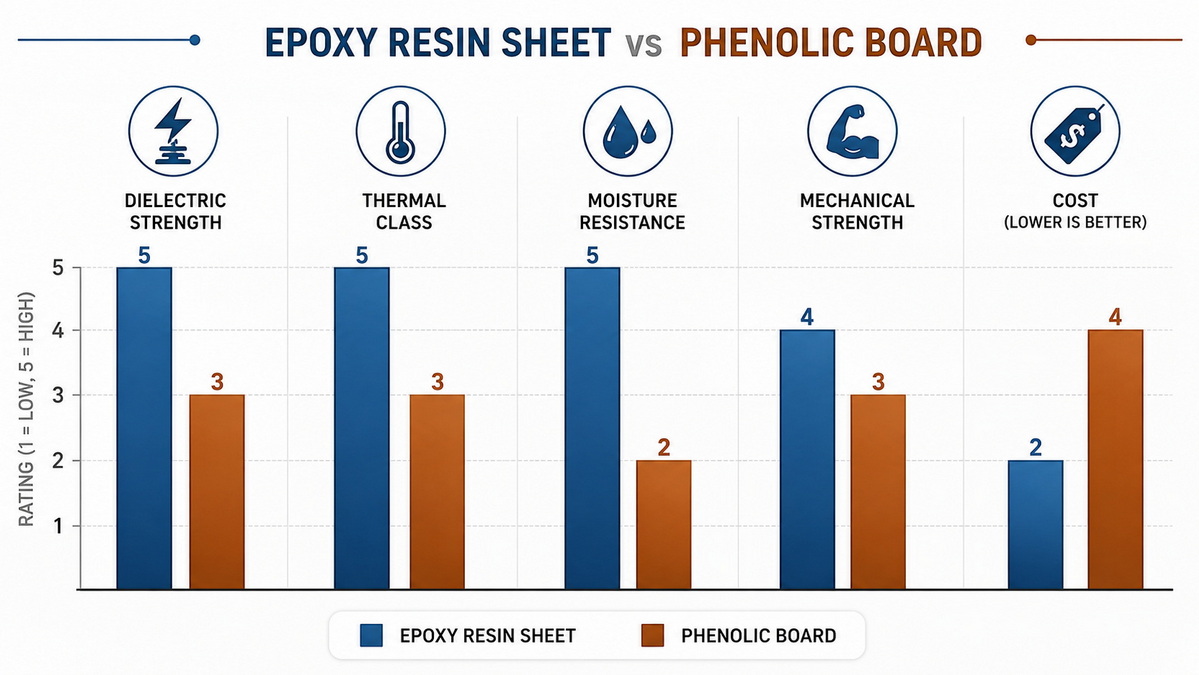
● Direct Comparison: Epoxy Resin Sheet vs Phenolic Board
>> Performance Table for Oil-Immersed Transformers
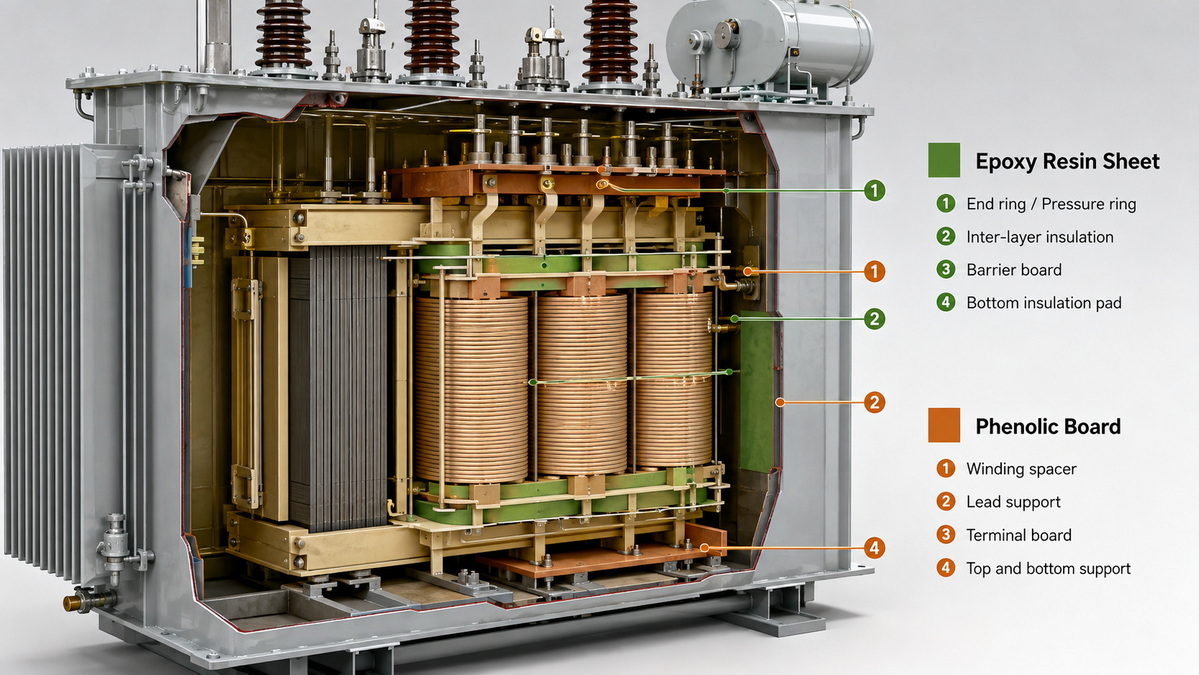
● Application Scenarios Inside Oil-Immersed Transformers
>> Typical Uses of Epoxy Resin Sheet
>> Typical Uses of Phenolic Board
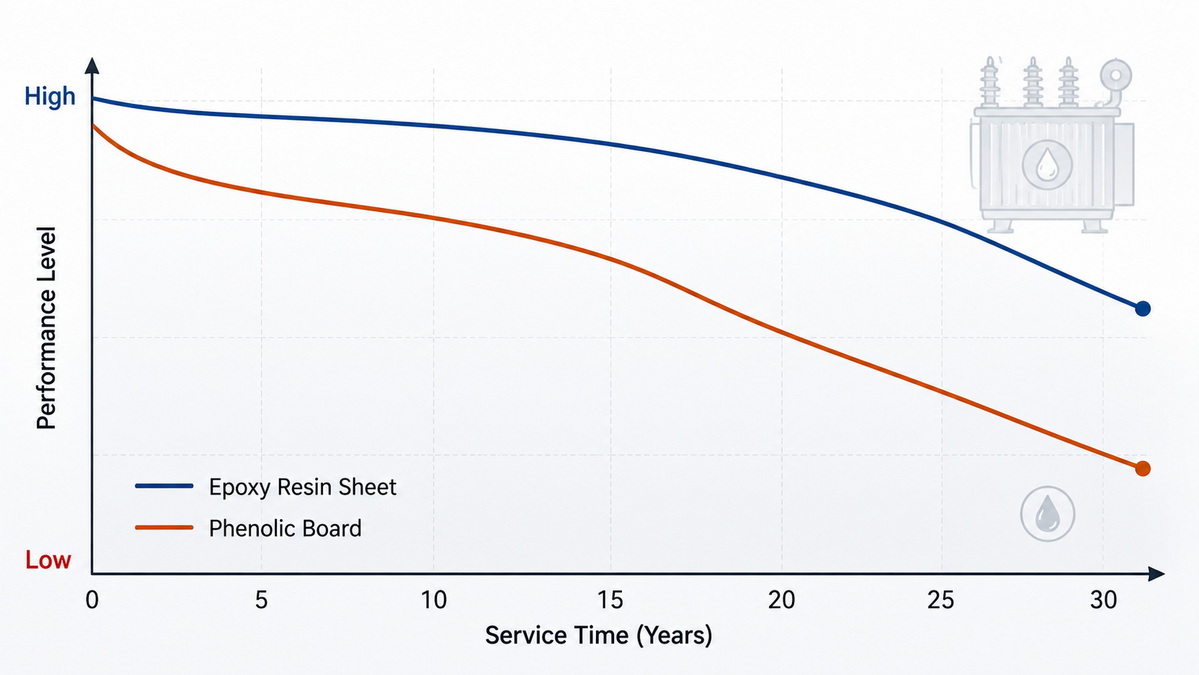
● Long-Term Reliability and Material Behavior
>> Service Life Considerations
● Practical Selection Guide for Design Engineers
>> Step-by-Step Decision Process
● Industry Trends Favoring High-Performance Laminates
>> Higher Thermal Classes and Compact Designs
● Combining Epoxy Resin Sheet and Phenolic Board in One System
>> Hybrid Insulation Strategies
In oil-immersed transformers, solid insulation materials protect windings, cores, and structural components from electrical stress while maintaining mechanical stability over decades of operation. The decision between epoxy resin sheet (typically epoxy fiberglass laminates such as FR4, G10, G11) and phenolic board (phenolic paper or cloth laminates) is not just a matter of price. It directly affects dielectric strength, thermal endurance, moisture resistance, mechanical integrity, and overall service life.
From an industrial manufacturing perspective, many transformer OEMs have begun to refine their insulation systems by combining traditional phenolic pressboards with higher-performance epoxy glass laminates, especially in high-voltage and high-power designs. As a specialized supplier of epoxy fiberglass boards and composite materials, Guangdong Weishi New Materials Co., Ltd. focuses on delivering materials that align with these evolving technical requirements.
Epoxy resin sheet used in electrical equipment is usually a rigid laminate made from glass fiber cloth impregnated with epoxy resin, then cured under heat and pressure. Common grades include FR4, G10, and G11, all known for their combination of electrical, thermal, and mechanical performance.
Epoxy resin sheet offers a range of properties that make it suitable for critical parts inside oil-immersed transformers:
- High dielectric strength suitable for high-voltage insulation barriers and structural components.
- Thermal endurance often reaching Class F or Class H, enabling reliable performance at elevated operating temperatures.
- Excellent mechanical strength and rigidity, with high flexural and tensile strength for mechanical supports, spacers, and clamping elements.
- Low water absorption and strong moisture resistance, maintaining insulation performance even in humid environments.
- Good chemical and oil resistance, especially when formulated with oil-resistant epoxy systems tailored to mineral oil immersion.
In practical design, epoxy resin sheets are frequently used for winding supports, spacer blocks, barrier plates, and structural insulation components that must withstand combined electrical and mechanical loads without deformation.
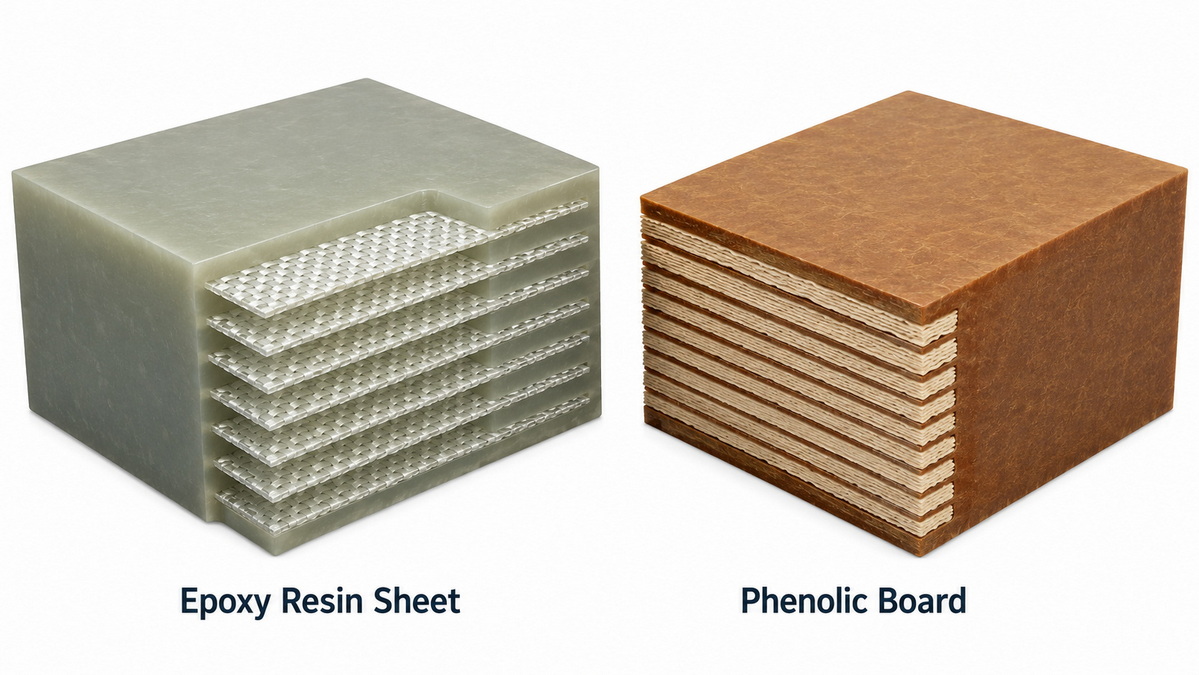
Phenolic board is a laminate formed by phenolic resin bonded to reinforcement materials such as paper, cotton fabric, or cloth, then hot-pressed into rigid sheets. Typical products include phenolic paper laminates, Bakelite-type boards, and phenolic cotton laminates.
Phenolic board has been a workhorse material in oil-immersed transformers and general electrical equipment for many years, thanks to its balanced performance and cost profile:
- Stable electrical insulation performance in mineral oil, widely used in pressboards and laminated sheets.
- Adequate mechanical strength for many support and barrier applications, such as plates, spacers, and tubes.
- Low water absorption compared with cellulose-based materials, helping maintain dielectric properties in service.
- Fire-resistant and non-flammable behavior, with limited smoke and toxicity in many formulations.
- Cost-effective manufacturing and broad availability, making it suitable for standard transformer designs and high-volume production.
Phenolic board is commonly used for bulk insulation barriers, support plates, and pressboard components in medium-voltage and standard-temperature transformer configurations.
| Criteria | Epoxy Resin Sheet (FR4, G10, G11) | Phenolic Board (Paper/Cloth Laminates) |
|---|---|---|
| Dielectric strength | Very high, suitable for high-voltage barriers and critical insulation parts. | High, proven in pressboards and laminates, but generally lower than premium epoxy glass laminates. |
| Thermal class | Typically in higher thermal classes, suitable for hot spots and elevated temperatures. | Usually appropriate for standard operating temperatures; less suited for extreme hot zones. |
| Moisture resistance | Superior, low water absorption and stable dielectric performance under humidity. | Good, with low water absorption compared with paper, but less robust than high-grade epoxy laminates. |
| Mechanical strength & rigidity | Very high mechanical strength and dimensional stability under load and thermal cycling. | Adequate for many support functions, but lower mechanical performance; more suited to non-critical structural roles. |
| Oil compatibility | Requires oil-compatible epoxy systems and validation; once qualified, delivers excellent performance. | Long-established compatibility with mineral transformer oils; widely used and well understood. |
| Chemical resistance | Strong resistance to oils and many industrial chemicals. | Good resistance to mineral oils and common environments. |
| Cost & availability | Higher material and processing cost; used where performance is critical. | More economical and widely available; preferred for standard designs and large-volume components. |
In modern transformer design, a hybrid approach is often adopted: phenolic board is used for standard barriers and bulk insulation, while epoxy resin sheet is reserved for critical areas where higher mechanical strength, thermal endurance, and dielectric margin are required.
Epoxy resin sheets are particularly suitable for high-demand applications such as:
- High-voltage insulation barriers between windings and core, where stress levels are elevated.
- Spacers, rods, and blocks subjected to strong mechanical clamping forces and thermal cycling.
- Structural components in compact, high-power transformers where thin yet strong insulation parts are essential.
- Zones exposed to moisture or aggressive atmospheres, including coastal or industrial installations that benefit from improved moisture and chemical resistance.
Phenolic board remains a preferred choice for:
- Medium-voltage and standard-temperature designs, including many distribution transformers.
- Bulk insulation barriers and pressboard components where large surface coverage is needed.
- Support plates, tubes, and panels in electrical equipment where stability and cost control are both important.
- Applications where fire performance and low smoke generation are valuable, such as certain auxiliary panels and housings.
One of the most important questions in transformer design is how the insulation material behaves after years of operation in hot, oil-filled environments under continuous electrical and mechanical stress.
Practical experience and material evaluations indicate that:
- Epoxy resin sheets maintain strong moisture resistance, high dielectric strength, and stable dimensions throughout long service periods. This reduces the risk of cracking, warping, or loss of insulation margin in critical components.
- Phenolic boards have demonstrated consistent electrical behavior and high breakdown resistance in oil, especially in pressboard laminates, offering dependable performance in more conventional operating windows.
For high-value assets and export markets, many manufacturers are shifting toward higher-performance laminates in critical locations, while retaining phenolic materials in less demanding areas to balance performance and cost.
When choosing between epoxy resin sheet and phenolic board for oil-immersed transformer insulation, consider the following framework:
1. Define operating conditions
Clarify maximum temperature, hot-spot temperature, voltage levels, and expected load profile (steady, cyclic, or frequent overloads).
2. Identify critical insulation components
Determine which parts face the highest combination of electrical, thermal, and mechanical stress: high-voltage barriers, winding supports, clamping structures, and interfaces exposed to humidity or contamination.
3. Assign materials based on stress level
Use epoxy resin sheet for high-stress and high-voltage components where mechanical rigidity and dielectric margin are essential. Use phenolic board for standard barriers and support plates within conventional operating envelopes.
4. Verify oil compatibility and testing
Confirm that epoxy laminates have been tested for oil absorption, dimensional stability, and dielectric strength in the specific insulating oil. Ensure phenolic boards meet recognized mechanical and electrical requirements.
5. Evaluate life-cycle performance and cost
Compare material costs against expected service life, outage risks, maintenance demands, and overall system value. In critical grid equipment, long-term reliability is often given higher weight than initial material savings.
Recent developments in transformer technology are driving changes in insulation material choice:
- Higher thermal classes are used to improve efficiency and manage higher load densities.
- Compact designs place stronger electrical and mechanical demands on solid insulation in reduced physical space.
- More demanding environmental conditions, such as coastal corrosion, industrial pollution, and higher humidity, require materials with enhanced moisture and chemical resistance.
These trends increase the attractiveness of epoxy resin sheets like FR4, G10, and G11, which provide higher dielectric strength, better moisture resistance, and stable mechanical properties in compact, high-stress environments. Phenolic board continues to serve reliably in more traditional configurations, but high-performance laminates play an increasingly important role in advanced designs.
Many transformer manufacturers now adopt hybrid insulation systems that leverage the strengths of both materials:
- Epoxy resin sheets are used for critical structural and high-voltage insulation components where mechanical integrity, dimensional stability, and thermal endurance are paramount.
- Phenolic boards are used for bulk barriers, general support plates, and non-critical structural elements, contributing to cost control and proven compatibility with transformer oil.
With strong capabilities in epoxy fiberglass boards and composite laminates, Guangdong Weishi New Materials Co., Ltd. is positioned to support such strategies. Customized machining, flexible processing, and tailored grades can help transformer designers align material choices with specific technical and performance requirements.
Epoxy resin sheet and phenolic board both have important roles in oil-immersed transformer insulation. Epoxy resin sheet offers higher dielectric strength, greater moisture resistance, better mechanical performance, and higher thermal endurance, making it ideal for critical and high-stress components. Phenolic board provides proven electrical behavior, good mechanical strength, solid fire performance, and attractive cost and availability for standard insulation barriers and support parts.
Design engineers can achieve balanced performance by combining these materials within a single insulation system. By aligning material choice with voltage level, thermal class, mechanical load, and expected service life, manufacturers can build transformers that remain stable, safe, and reliable under real-world conditions.
1. Roechling Group – "More reliable transformer thanks to phenolic-glued pressboard."
2. Roechling Group – "Fasteners made from laminated pressboard with phenolic resin bonding."
3. Youdainsulation – "The Role of Epoxy Sheet in Transformer Insulation Systems."
[https://www.youdainsulation.com/the-role-of-epoxy-sheet-in-transformer-insulation-systems/]
4. JingHong Insulation – "Insulation and Isolation of Epoxy Boards in Transformers."
[https://www.jhd-material.com/knowledge/insulation-and-isolation-of-epoxy-boards-in-transformers]
5. ZTelec Group – "Applications of FR4 Epoxy Sheets in Dry-Type and Oil-Immersed Transformers."
[https://www.ztelecgroup.com/zt-industry-news/1067.html]
6. ZTelec Group – "Comprehensive Guide to Insulation Materials for Oil-Immersed Transformers."
7. JingHong Insulation – "The Importance of Insulation Sheets in Transformers: Key Applications and Benefits."
8. Yilong Insulation – "Epoxy Fiberglass Board VS Phenolic Cotton Board."
[https://www.yilonginsulation.com/news/epoxy-fiberglass-board-vs-phenolic-cotton-board]
9. ZTelec Group – "What are the properties of phenolic board?"
[https://www.ztelecgroup.com/zt-technical-article/441.html]
10. Daelim Belefic – "Basic Guide To Oil Immersed Transformer."


