

Views: 226 Author: Weishi Sheets Publish Time: 2026-09-19 Origin: Site
Content Menu
● Why Insulation Materials Matter in Induction Heating Equipment
>> Main Benefits of Mica Sheet
● What Is Epoxy Laminate Sheet?
>> FR4 Sheet for General Electrical Insulation
>> G10 Sheet for Mechanical Strength
>> G11 Sheet for Elevated-Temperature Applications
● Mica Sheet vs Epoxy Laminate Sheet: Main Differences
● Thermal Performance Near the Induction Coil
>> Why Mica Sheet Performs Well in Hot Zones
>> Why Epoxy Laminate Must Be Positioned Carefully
● Electrical Insulation Performance
>> Mica Sheet as Electrical Insulation
>> Epoxy Laminate Sheet as Electrical Insulation
● Mechanical Strength and Structural Stability
>> Where Epoxy Laminate Sheet Has an Advantage
>> When Mica Needs Structural Backup
● Machinability and Custom Processing
>> Common Processing Methods for Epoxy Laminate Sheet
>> Mica Sheet Processing Considerations
● Practical Material Selection Guide
● A Better Design Strategy: Use Materials Together
● Key Questions Before Ordering Insulation Materials
>> 1. Can mica sheet be used directly around an induction coil?
>> 2. Is G11 sheet better than FR4 sheet for induction heating equipment?
>> 3. What is the main difference between G10 and G11 epoxy laminate sheet?
>> 4. Can epoxy laminate sheet replace mica sheet in a high-temperature coil area?
>> 5. Which material is best for an induction coil support plate?
>> 6. Can FR4, G10, and G11 sheets be CNC machined?
>> 7. Can mica sheet and epoxy laminate sheet be used together?
Choosing the right insulation material for induction heating equipment affects more than electrical safety. It influences coil reliability, thermal protection, mechanical stability, production efficiency, maintenance intervals, and the long-term operating cost of the machine.
Mica sheet and epoxy laminate sheet are both widely used electrical insulation materials. Yet, they are designed to solve different engineering challenges. Mica sheet is often preferred where high radiant heat, direct thermal exposure, or coil-side protection is the main concern. Epoxy laminate sheet, including FR4, G10, and G11 grades, is usually selected for rigid insulation components that require machining precision, structural strength, stable dimensions, and reliable dielectric performance.
For many industrial induction heating systems, the most reliable solution is not to choose only one material. A layered design can combine mica sheet near the hot zone with G11, G10, or FR4 epoxy laminate sheet in structural and electrical support areas.
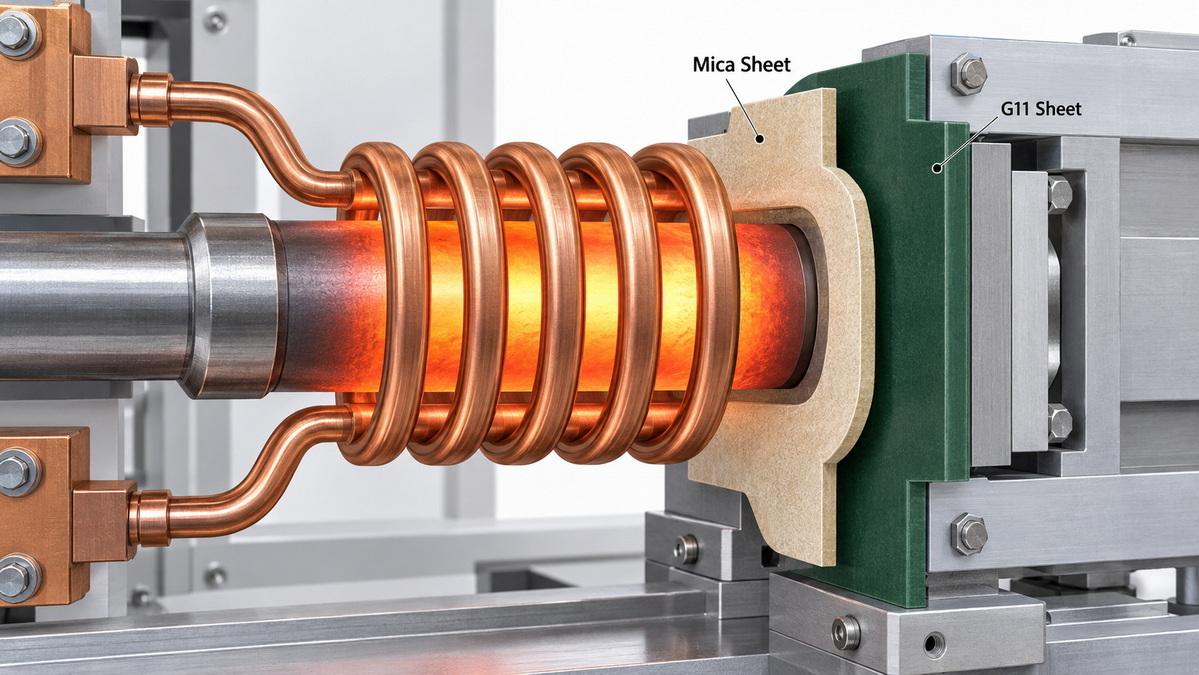
Induction heating uses an alternating electromagnetic field to generate heat inside a conductive workpiece. The process is efficient, fast, controllable, and widely used for metal hardening, brazing, melting, forging, annealing, shrink fitting, and other industrial heating processes.
However, the induction coil and surrounding machine structure must be properly insulated. The coil must remain electrically separated from metal fixtures, brackets, housings, terminals, workpieces, and nearby conductive components.
The selected insulation material must handle several demands at the same time:
- Electrical insulation
- Thermal protection
- Mechanical support
- Vibration resistance
- Dimensional stability
- Moisture resistance
- Machining requirements
- Repeated heating and cooling cycles
A material that performs well in a low-temperature electrical cabinet may fail rapidly when installed near a high-power induction coil. Likewise, a material that survives extreme heat may not provide enough strength for a rigid mounting plate or precision-machined fixture.
The correct material selection begins by understanding the position of the part inside the equipment.
Mica sheet is a high-temperature insulation material made from mica minerals. It is available in several forms, including rigid mica board, flexible mica sheet, mica paper laminate, mica tape, and reinforced mica composite materials.
Mica is valued because of its natural layered mineral structure. It provides excellent electrical insulation and can remain stable under temperatures that would damage many conventional resin-based insulation materials.
In induction heating equipment, mica sheet is commonly placed close to the coil, workpiece, furnace chamber, or other high-radiation zones. It can act as a thermal barrier while also preventing electrical contact between components.
Industrial mica products can be manufactured from different mica materials and binder systems. Common options include:
- Muscovite mica sheet
- Phlogopite mica sheet
- Rigid mica board
- Flexible mica sheet
- Glass-fiber-reinforced mica sheet
- Ceramic-paper-reinforced mica composite
- Silicone-bonded mica sheet
- Epoxy-bonded mica sheet
Phlogopite mica is frequently chosen for high-temperature environments because it can withstand more severe heat exposure than many muscovite-based materials.
Mica sheet can offer important performance advantages in demanding thermal applications.
- High heat resistance for coil-side and furnace-side insulation
- Excellent dielectric insulation in high-temperature environments
- Good flame resistance
- Low thermal conductivity in many mica insulation constructions
- Stable performance under thermal cycling
- Useful for direct radiant-heat protection
- Available in flexible and rigid forms
- Suitable for cutting, punching, stamping, and forming
For induction heating equipment, mica sheet is especially valuable where the temperature is too high for standard epoxy laminate materials to maintain their long-term properties.
Although mica sheet performs very well under severe heat, it has limitations.
- Rigid mica board may be brittle
- Edge chipping can occur during drilling or machining
- It may not be ideal for heavily loaded structural parts
- Mechanical strength can vary by mica type and binder system
- Precision CNC machining can be more difficult than with glass epoxy laminate
- Material quality depends strongly on manufacturing consistency
Mica sheet is usually the right choice when heat resistance is the primary requirement. It is less suitable when a part must carry high clamping force, hold bolts under repeated vibration, or maintain precision geometry under mechanical load.
Epoxy laminate sheet is a rigid composite insulation material. It is normally made by impregnating woven glass fabric with epoxy resin, then curing the material under controlled heat and pressure.
The glass fabric gives the sheet strength and rigidity. The epoxy resin provides bonding, electrical insulation, and resistance to many industrial environments.
Common epoxy laminate grades include:
- FR4 sheet
- G10 sheet
- G11 sheet
- EPGC201
- EPGC202
- EPGC203
- Glass fiber epoxy laminate board
- High-temperature epoxy insulation sheet
These materials are widely used in electrical equipment, industrial machinery, switchgear, transformers, insulation fixtures, coil supports, terminal plates, and precision-machined insulation components.
For induction heating equipment, epoxy laminate sheet is often used farther away from the most severe heat source. It provides a strong and stable base for structural insulation parts.
FR4 sheet is one of the most widely used epoxy glass laminate materials. It combines electrical insulation, flame-retardant performance, mechanical rigidity, and practical machining capability.
FR4 sheet is commonly used for:
- Electrical insulation panels
- Terminal boards
- Mounting plates
- Insulating barriers
- Electrical enclosures
- Support strips
- Machined washers
- Spacer blocks
- Fixture components
FR4 is a practical choice when the operating temperature is controlled and the part is not directly exposed to extreme radiant heat.
G10 sheet is another glass-reinforced epoxy laminate. It is known for high strength, good dielectric properties, low water absorption, and stable machining performance.
G10 can be a good option for:
- High-strength insulation spacers
- Coil support blocks
- Tooling fixtures
- Electrical separators
- Structural insulation plates
- Insulation brackets
- Wear-resistant machined parts
- Industrial jig components
G10 sheet is particularly useful when a component must resist mechanical load, bolt pressure, vibration, and repeated assembly.
However, G10 is usually selected for applications with less demanding temperature requirements than G11.
G11 sheet is a higher-temperature glass epoxy laminate grade. It is generally manufactured with a heat-resistant epoxy resin system that provides better mechanical and electrical performance at elevated temperatures.
G11 sheet is often selected for:
- High-temperature coil support plates
- Induction heating insulation frames
- Electrical support brackets
- Terminal support boards
- High-temperature fixture plates
- Precision-machined insulation components
- Transformer insulation structures
- Switchgear support parts
Compared with standard G10 sheet and many standard FR4 sheet grades, G11 sheet is better suited to applications where heat exposure is higher and where the component must remain rigid under thermal stress.
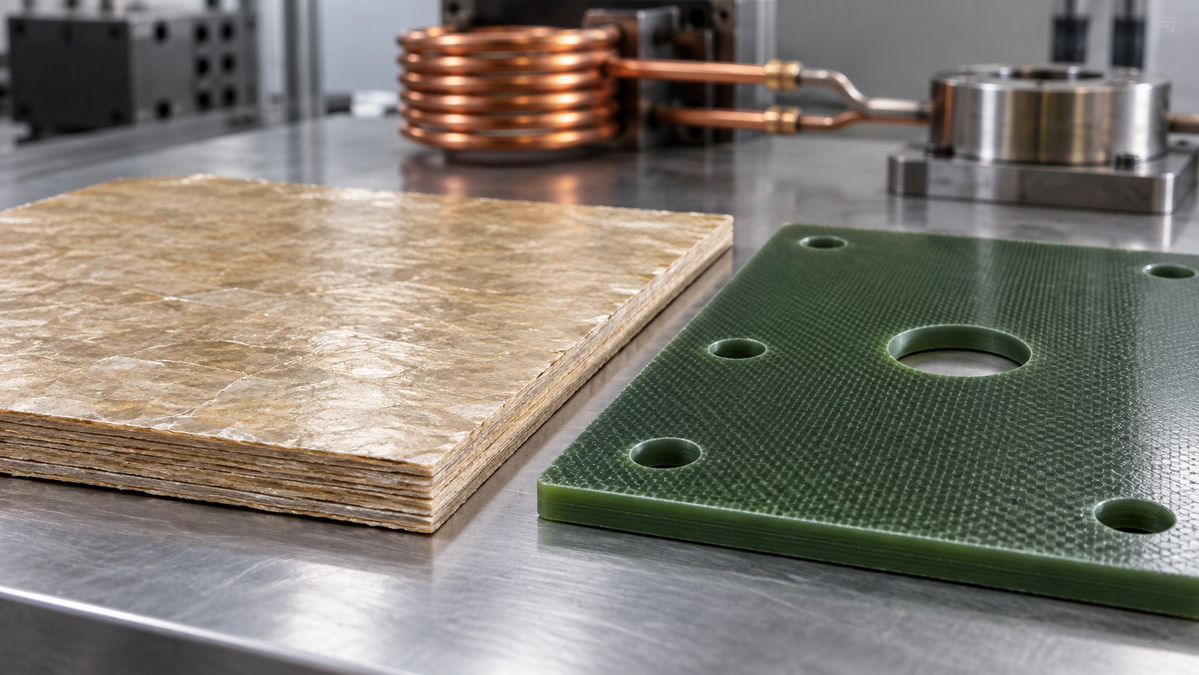
Mica sheet and epoxy laminate sheet both provide electrical insulation. The major difference is how they behave under heat, mechanical load, machining conditions, and long-term service stress.
| Property | Mica Sheet | FR4 / G10 Epoxy Laminate Sheet | G11 Epoxy Laminate Sheet |
|---|---|---|---|
| Main advantage | High-temperature thermal insulation | Electrical insulation and mechanical strength | High-temperature structural insulation |
| Heat resistance | Very high | Moderate to high | High |
| Electrical insulation | Excellent | Excellent | Excellent |
| Mechanical strength | Moderate; may be brittle | High | High |
| Structural support | Limited for heavy loads | Very suitable | Very suitable |
| Machinability | Can be cut and punched; careful drilling required | Excellent for CNC machining | Excellent for CNC machining |
| Dimensional stability | Good, depending on construction | Very good | Very good |
| Flame resistance | Strong | Grade dependent | Grade dependent |
| Thermal barrier ability | Excellent | Moderate | Moderate |
| Moisture resistance | Depends on binder and reinforcement | Generally good | Generally good |
| Common equipment location | Near coil or high-radiation zone | Cooler support and electrical zones | Elevated-temperature support areas |
| Typical component type | Coil insulation, heat shields, liners | Spacers, panels, supports, fixtures | Coil brackets, support plates, high-temperature barriers |
The comparison shows why material location matters.
Mica sheet is normally selected for direct thermal protection.
FR4 and G10 sheet are commonly selected for mechanical insulation parts in controlled-temperature zones.
G11 sheet is often selected when a component needs both rigidity and improved heat resistance.
Thermal resistance is one of the most important selection factors in induction heating equipment.
The area around the induction coil can be exposed to heat from several sources:
- Direct radiant heat from the heated workpiece
- Heat transferred through nearby metal parts
- High-frequency electrical losses
- Hot gases from adjacent processes
- Reduced cooling efficiency
- Sudden process interruptions
- Abnormal coil temperature rise
A material may appear suitable during short laboratory testing but fail during continuous industrial operation. Repeated heating and cooling cycles can cause resin aging, cracking, warping, loss of mechanical strength, and reduction in insulation performance.
Mica sheet is commonly used close to the induction coil because it can tolerate high temperatures and resist direct heat exposure.
It can help protect the coil from:
- Radiant heat
- Localized hot spots
- Electrical arcing risks
- Heat transfer from the workpiece
- Thermal stress during long production cycles
A mica insulation layer may also be used in combination with ceramic fiber, refractory materials, or other high-temperature insulation products.
Epoxy laminate sheet contains an epoxy resin matrix. This resin can gradually lose mechanical performance if it is exposed to temperatures above its intended service range for extended periods.
FR4 and G10 are generally appropriate for support structures located away from the highest-temperature region. G11 is more suitable when the support part operates in a hotter environment but still requires mechanical strength.
The practical engineering rule is clear:
1. Place mica sheet closest to the high-heat source.
2. Add thermal insulation layers where necessary.
3. Position G11 sheet behind the thermal barrier for rigid support.
4. Use FR4 or G10 sheet in lower-temperature areas.
5. Test the full insulation assembly under real operating conditions.
Electrical insulation is essential in induction heating systems because the coil operates with high-frequency alternating current. The equipment may include high voltage, strong electromagnetic fields, water-cooled copper conductors, metal fixtures, and closely spaced electrical components.
Both mica sheet and epoxy laminate sheet can provide dependable insulation. However, performance should be evaluated under real conditions rather than by a single electrical value.
Important considerations include:
- Working voltage
- Frequency
- Insulation thickness
- Creepage distance
- Clearance distance
- Humidity level
- Cooling-water exposure
- Surface contamination
- Thermal aging
- Mechanical stress
- Installation pressure
Mica has been used in high-temperature electrical insulation for many years. It remains valuable because it combines dielectric properties with heat resistance.
Mica sheet is often used where conventional polymer insulation may soften or degrade. It can be a strong choice for coil wraps, heat barriers, electrical separators, and high-temperature insulation layers.
However, the exact performance depends on the sheet construction. A flexible mica sheet, rigid mica board, glass-reinforced mica laminate, and silicone-bonded mica composite will not perform in exactly the same way.
FR4, G10, and G11 sheets provide strong electrical insulation while also offering a rigid, machinable structure.
This makes them ideal for parts requiring:
- Bolt holes
- Slots
- Precision cutouts
- Threaded insert locations
- Tight-tolerance mounting surfaces
- Electrical separation walls
- Rigid terminals
- Repeated assembly and disassembly
For industrial equipment manufacturers, the combination of electrical insulation and precision machining is often the strongest reason to choose epoxy laminate sheet.
Induction heating equipment is not only exposed to heat. It also experiences mechanical stress from clamps, fixtures, coils, cooling lines, workpiece movement, vibration, and maintenance operations.
In most structural applications, epoxy laminate sheet provides better mechanical support than mica sheet.
Glass epoxy laminate sheets are reinforced with woven glass fabric. This reinforcement gives the material high flexural strength, compressive strength, impact resistance, and dimensional stability.
FR4, G10, and G11 sheets are suitable for:
- Coil support brackets
- Insulation frames
- Mounting boards
- Locating plates
- Spacer blocks
- Machined insulation strips
- Support arms
- Electrical barriers
- Fixture components
- Terminal boards
A well-designed G10 or G11 part can withstand bolt pressure and mechanical vibration more effectively than a standard mica board.
Mica sheet may need support when it is used in a mechanically demanding position.
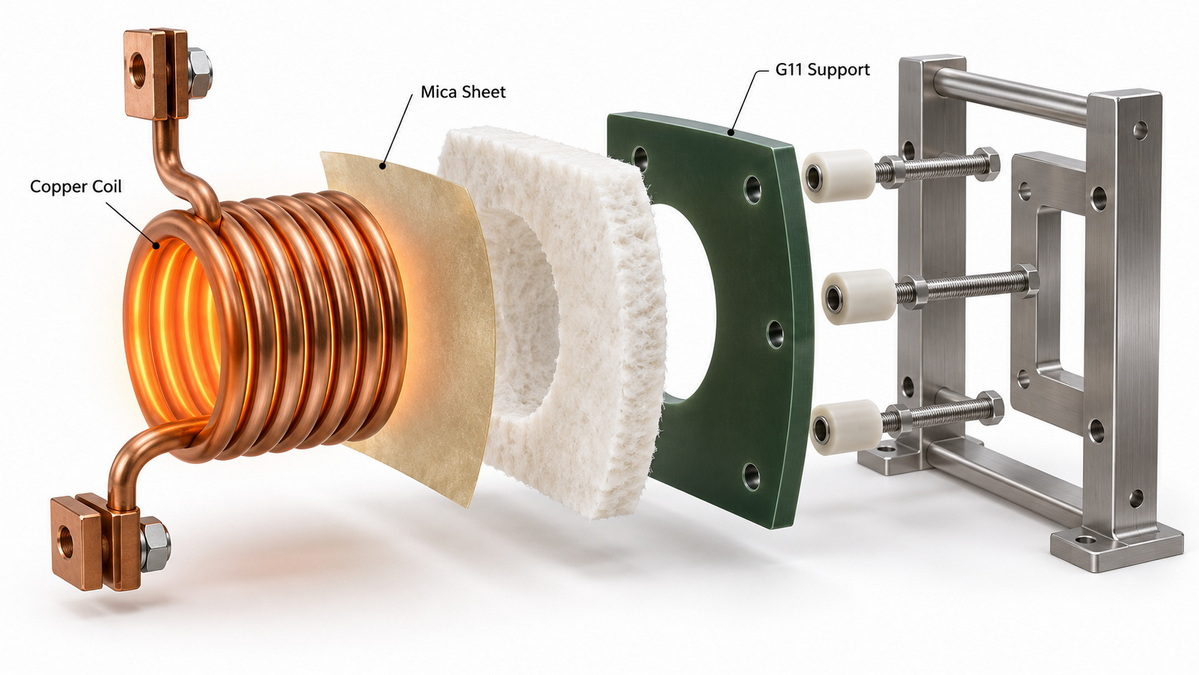
For example, a coil heat shield can use a mica sheet facing the heat source. A G11 support plate can be installed behind the mica sheet to provide rigidity and stable mounting.
This design gives each material a clear function:
- Mica sheet manages heat
- G11 sheet carries structural load
- Metal components remain farther from the electrical and thermal risk zone
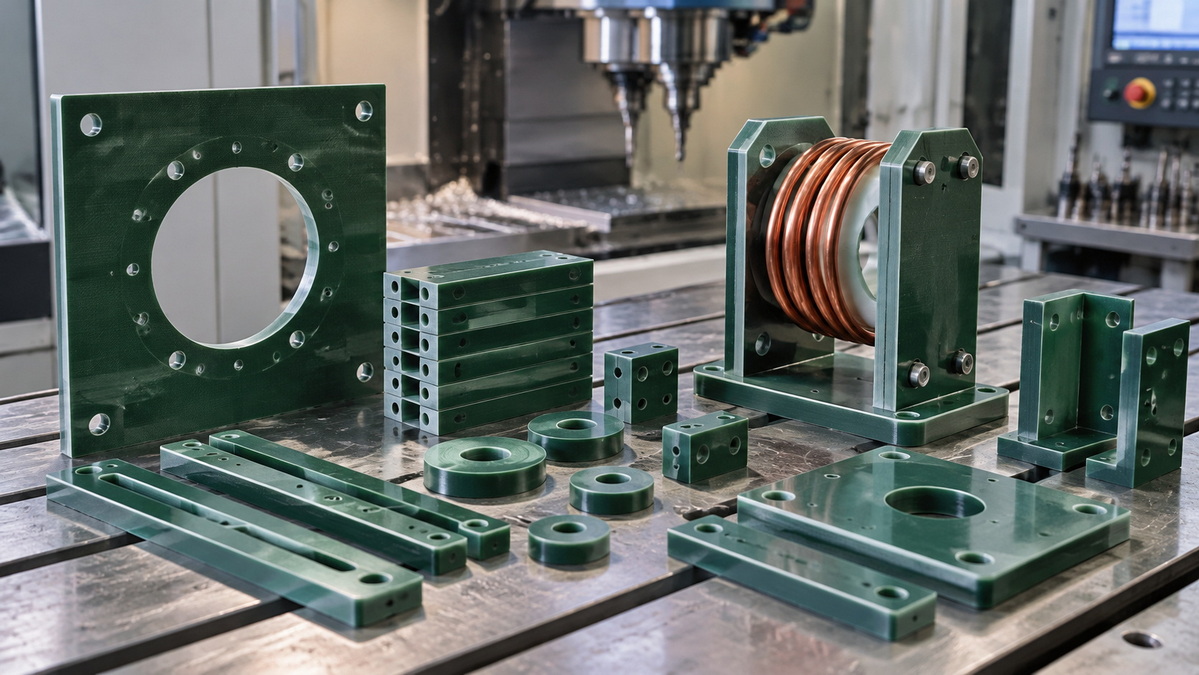
Machinability is an important factor for equipment manufacturers. Insulation material often needs to be converted into a finished component with holes, slots, profiles, cutouts, chamfers, and accurate dimensions.
Epoxy laminate sheet has a major advantage in this area.
FR4, G10, and G11 sheets can be processed into custom insulation parts through:
- CNC milling
- CNC drilling
- Saw cutting
- Slotting
- Routing
- Surface grinding
- Punching
- Chamfering
- Engraving
- Thickness cutting
- Custom profiling
These materials can be made into repeatable production parts for industrial equipment.
Guangdong Weishi New Materials Co., Ltd. supplies high-performance epoxy insulation sheets and custom-machined insulation components. Materials such as FR4, G10, and G11 can be processed according to customer drawings, samples, dimensions, and application requirements.
Mica sheet can also be cut, stamped, punched, and formed. Flexible mica sheet is particularly useful for wrapping and shaped insulation applications.
However, rigid mica board may require more careful handling during machining.
Potential challenges include:
- Edge chipping
- Cracking near drilled holes
- Delamination in poor-quality sheet
- Reduced strength in narrow sections
- Higher breakage risk during assembly
If the part requires complex geometry, multiple mounting holes, narrow bridge sections, or high bolt load, G11 epoxy laminate sheet may be a more practical choice.
The best material selection starts with the actual conditions of the part.
Mica sheet is generally the best choice when the part requires:
- Direct high-temperature resistance
- Coil-side thermal protection
- Furnace-side insulation
- Strong electrical insulation under heat
- Flame-resistant insulation
- Low heat transfer
- Flexible wrapping or formed heat barriers
FR4 sheet is generally suitable when the part requires:
- Flame-retardant electrical insulation
- Economical structural insulation
- Good machining performance
- Electrical mounting plates
- Terminal boards
- Moderate operating temperatures
- Low-to-medium mechanical load
G10 sheet is generally suitable when the part requires:
- High mechanical strength
- Reliable electrical insulation
- Precision machining
- Low water absorption
- Structural spacers
- Support blocks
- Fixture parts
- Stable industrial insulation components
G11 sheet is generally suitable when the part requires:
- Higher-temperature structural insulation
- Reliable rigidity under thermal stress
- High-strength coil support parts
- Precision-machined electrical barriers
- Insulating brackets near heated zones
- Elevated-temperature fixture components
- Long-term dimensional stability
Many equipment failures occur because one material is expected to perform every function. A single insulation product may not provide the best balance of heat resistance, strength, machinability, and cost.
A multi-layer insulation design can provide better overall performance.
A typical induction heating insulation stack may include:
1. Mica sheet near the induction coil or hot workpiece.
2. Ceramic fiber or thermal barrier material for additional heat reduction.
3. G11 epoxy laminate sheet as a rigid support layer.
4. FR4 or G10 components in cooler structural or electrical sections.
5. Metal frames and fasteners positioned outside the main insulation area.
This approach improves thermal protection while maintaining stable mounting geometry.
It can also reduce maintenance requirements, extend coil service life, and improve the reliability of custom induction heating equipment.
Before ordering mica sheet, FR4 sheet, G10 sheet, or G11 sheet, prepare the following information:
- Maximum continuous operating temperature
- Peak temperature and heating cycle
- Distance from the induction coil
- Workpiece material and heating process
- Required electrical insulation level
- Mechanical load and clamping force
- Thickness requirement
- Drawing or sample dimensions
- Required machining features
- Quantity requirement
- Environmental conditions
- Moisture or cooling-water exposure
- Flame-retardant requirement
- Surface finish requirement
- Packaging and shipping requirements
Providing these details helps the supplier recommend the most suitable material grade and processing method.
Mica sheet and epoxy laminate sheet both play important roles in induction heating equipment. Their strengths are different, and the best choice depends on the component's working position.
Mica sheet is the preferred material for high-temperature thermal insulation close to the coil, workpiece, or furnace zone. It provides strong electrical insulation while resisting severe radiant heat.
FR4 sheet is a practical material for general flame-retardant electrical insulation and machined support components in controlled-temperature areas.
G10 sheet provides strong mechanical performance and reliable electrical insulation for industrial support parts, spacers, fixtures, and precision-machined components.
G11 sheet offers a stronger solution for structural insulation parts exposed to elevated temperatures. It is particularly suitable for induction heating coil supports, high-temperature brackets, insulation frames, and machined electrical components.
For demanding induction heating equipment, combining mica sheet with G11 epoxy laminate sheet can create a more durable and balanced insulation system. Mica controls heat exposure, while G11 provides the mechanical support and machining precision required for stable long-term operation.
Guangdong Weishi New Materials Co., Ltd. provides FR4, G10, G11, and glass epoxy laminate solutions for electrical insulation and industrial equipment applications. Material selection can be customized according to drawings, operating temperature, thickness, machining requirements, and production quantity.
Yes. Mica sheet is often used close to induction coils because it provides strong electrical insulation and high-temperature resistance. It can act as a thermal barrier between the coil, heated workpiece, and nearby structural components.
G11 sheet is generally more suitable than standard FR4 sheet when the part will experience elevated temperatures. It offers better heat resistance while maintaining strong mechanical and electrical performance. FR4 remains suitable for lower-temperature electrical insulation components.
The main difference is temperature capability. G11 sheet typically uses a higher-temperature epoxy resin system and provides better performance under elevated heat. G10 sheet is still highly suitable for strong mechanical and electrical insulation parts in less demanding thermal conditions.
Not always. Epoxy laminate sheet may lose mechanical properties if it is exposed to temperatures beyond its intended operating range. For direct high-temperature protection near an induction coil, mica sheet is often the safer option. G11 can be used behind mica as a structural support material.
G11 epoxy laminate sheet is often an excellent choice for an induction coil support plate because it combines electrical insulation, mechanical strength, dimensional stability, and improved heat resistance. If the plate is very close to the heat source, mica sheet can be added as a thermal barrier.
Yes. FR4, G10, and G11 sheets are commonly CNC machined into insulation plates, spacers, support blocks, terminal boards, washers, brackets, and custom industrial components. Proper tooling and dust extraction should be used during machining.
Yes. Using mica sheet and epoxy laminate sheet together is often the most practical solution. Mica sheet can provide heat protection near the coil, while G11, G10, or FR4 sheet can provide rigid mechanical support and precise mounting capability.
1. [Okabe Mica Co., Ltd. — Mica for Induction Furnace]
Information on mica composite insulation materials for electric induction furnaces, including coil protection, thermal insulation, and vibration-related applications.
2. [HighMica — Flexible Mica Sheet]
Product overview of flexible mica sheet materials used in high-temperature insulation applications.
3. [HighMica — Flexible Mica Sheets for Thermal Insulation]
Technical discussion of mica sheet thermal insulation properties and industrial heat-resistant applications.
4. [NEMA — Industrial Laminated Thermosetting Products]
Standard reference for industrial laminated thermosetting materials and insulation grades.
5. [Ready Plastics — NEMA G11 Glass-Cloth Epoxy High-Temperature Laminate]
Material overview for G11 glass epoxy laminate, including heat resistance and structural insulation characteristics.
6. [XX Insulation — NEMA G10 Technical Data Sheet]
Technical data for G10 epoxy glass laminate material properties.
7. [XX Insulation — NEMA G11 Technical Data Sheet]
Technical data for G11 epoxy glass laminate material properties.
8. [ACC Insulations — Fiber Glass Epoxy Laminates]
Information about glass epoxy laminate grades, including FR4, G10, and G11 products.


