
Views: 264 Author: Weishi Sheets Publish Time: 2026-11-20 Origin: Site
Content Menu
● FR4 vs G10: Understanding the Material Difference
>> FR4 vs G10 Comparison for Battery Insulation Components
● Where FR4 and G10 Fit in Battery Energy Storage Systems
● Why Flame Retardancy Matters—and What It Does Not Prove
>> Flame Retardancy Is Not Thermal-Runaway Protection
● Electrical Insulation: Look Beyond Dielectric Strength
>> Creepage, Clearance, and Surface Tracking
>> Why Thickness Alone Cannot Establish Safety
● Temperature Capability: Separate Three Different Questions
● Mechanical Strength and Machining Quality
>> Machining Details That Influence Reliability
● A Practical FR4 vs G10 Qualification Workflow
>> Step 1: Define the Component's Duty
>> Step 2: Establish the Required Evidence
>> Step 3: Compare Like-for-Like Data
>> Step 4: Test Production-Representative Parts
>> Step 5: Control Subsequent Changes
● Worked Selection Scenario: A Busbar Support Plate
● Purchasing for Reliability Rather Than Sheet Price
>> Is FR4 better than G10 for battery energy storage systems?
>> Can G10 replace FR4 in a battery cabinet?
>> Is FR4 a thermal-runaway barrier?
>> What thickness should an FR4 battery insulation plate have?
>> Does FR4 always have a higher operating temperature than G10?
>> What documents should a battery insulation supplier provide?
Choosing between FR4 and G10 for battery energy storage systems starts with the component's function. Both are glass-reinforced epoxy laminates that can provide electrical insulation and mechanical support. The main distinction is that FR4 is a flame-retardant grade, while conventional G10 does not provide the same flame-retardant designation.
For busbar supports, terminal barriers, and insulating mounting plates, FR4 is often the more practical starting point when a verified flammability classification is required. G10 remains a candidate where the approved specification permits it.
However, neither material should be selected by grade name alone. The decision must account for operating temperature, electrical stress, humidity, mechanical loading, and the finished assembly's safety requirements.
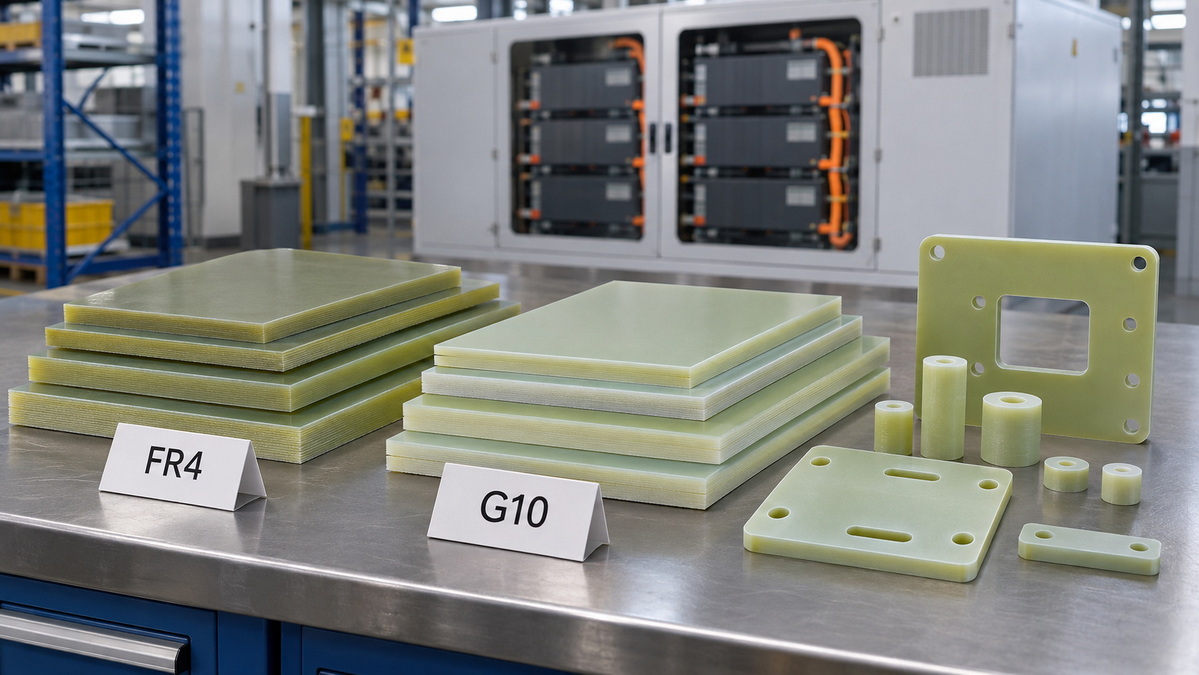
FR4 and G10 combine woven glass fabric with a cured epoxy resin system. The glass reinforcement supplies strength and stiffness, while the resin binds the structure and contributes electrical and environmental performance.
FR4 incorporates a flame-retardant resin formulation. Conventional G10 is generally specified for its mechanical and electrical properties without an equivalent flame-retardant requirement.
Commercial terminology can be confusing. Suppliers sometimes describe flame-retardant products as "G10/FR4" because their applications overlap. That label should not replace an exact grade designation and supporting documentation.
From a manufacturing perspective, the useful question is not simply, "Which material is better?" It is, "Which documented material satisfies this component's requirements?"
| Selection factor | FR4 epoxy glass laminate | Conventional G10 laminate |
|---|---|---|
| Material construction | Woven glass fabric and flame-retardant epoxy | Woven glass fabric and epoxy |
| Flammability | Commonly available with documented UL 94 V-0 performance | Commonly listed with an HB classification |
| Electrical insulation | Strong candidate; verify the specific grade | Strong candidate; verify the specific grade |
| Mechanical support | Suitable for many rigid insulating components | Suitable for many rigid insulating components |
| Temperature capability | Depends on formulation and supporting data | Depends on formulation and supporting data |
| Typical selection priority | Insulation with a flame-retardant requirement | Insulation where the approved specification permits G10 |
| Main purchasing risk | Assuming all FR4 products share identical ratings | Assuming G10 is interchangeable with FR4 |
These are selection tendencies, not guaranteed properties for every supplier's product.
Battery energy storage systems contain components with different insulation duties. A battery-management electronics bracket does not experience the same conditions as a heavily loaded busbar support.
Potential applications for machined epoxy glass laminates include:
- Busbar support plates and spacers.
- Terminal separation barriers.
- Insulating washers and mounting brackets.
- Electrical distribution assembly supports.
- Protective covers around energized connections.
- Structural insulation in battery racks and cabinets.
For each part, establish whether its primary role is electrical separation, mechanical support, protection against accidental contact, or a combination.
A rigid FR4 plate should not automatically be treated as a compliant thermal interface, a cell-compression pad, or a thermal-runaway barrier. Those functions require different performance evidence.
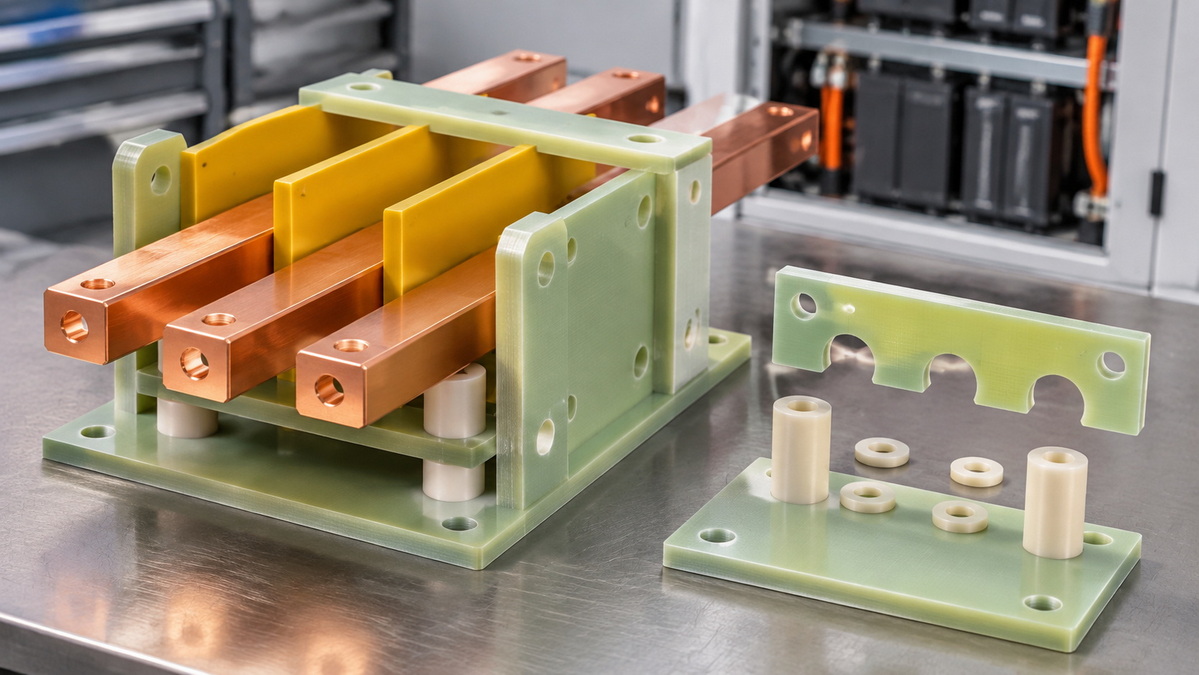
UL 94 evaluates how materials respond to specified small-scale ignition conditions. A V-0 classification addresses controlled burning behavior, including afterflame performance and restrictions on flaming particles.
The classification is associated with defined test conditions and specimen thickness. A rating demonstrated on a thicker specimen should not automatically be applied to a thinner finished component.
For purchasing, request:
1. The exact manufacturer and material designation.
2. The applicable flammability classification.
3. The tested or recognized thickness range.
4. Documentation matching the supplied formulation.
5. Confirmation that the finished part remains within the documented conditions.
A generic statement such as "FR4 is V-0" is not sufficient evidence for a production drawing.
UL 94 V-0 does not establish that a laminate will stop a battery thermal-runaway event.
Battery failure can expose surrounding components to heat, vent gases, flame, and other severe conditions. UL 9540A addresses thermal-runaway fire propagation in battery energy storage systems; it evaluates a different hazard from small-scale material flammability.
Consequently, FR4 may satisfy an insulating component's flammability requirement without qualifying as a cell-to-cell propagation barrier.
Where propagation resistance is necessary, evaluate a purpose-designed barrier system and validate it within the relevant battery assembly. Do not substitute a laminate datasheet for system-level evidence.
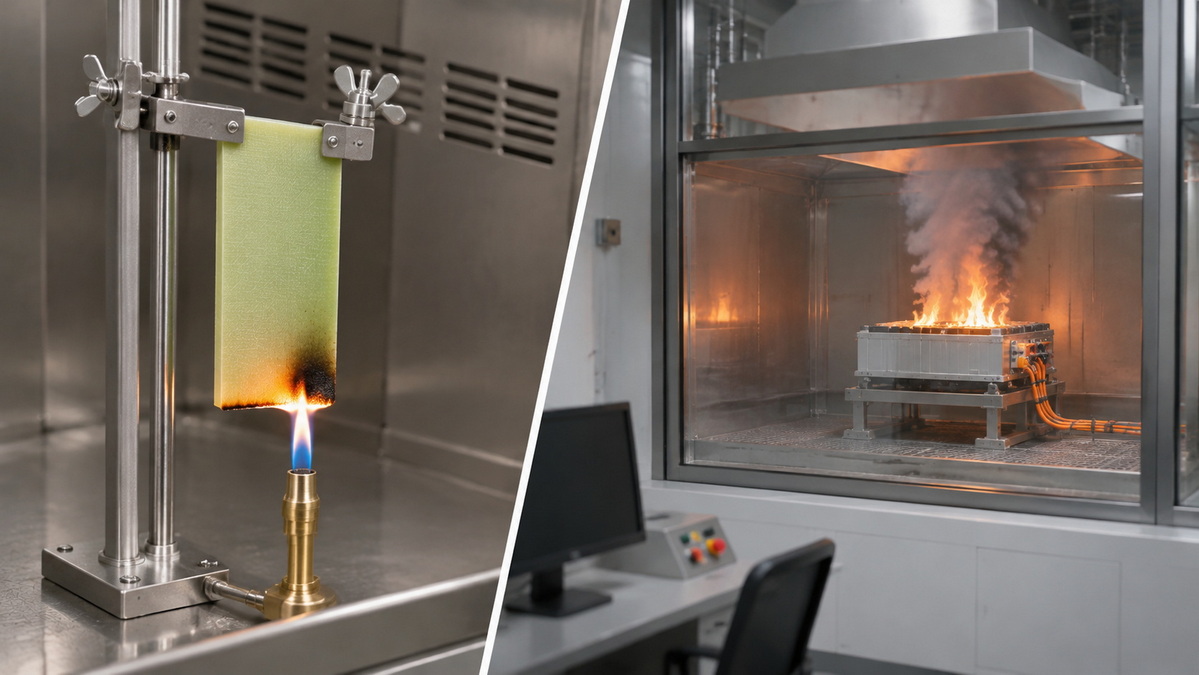
Both materials can provide useful dielectric performance. However, a laboratory dielectric-strength value is not a ready-made voltage rating for a machined battery component.
The finished design must address several distinct insulation paths:
- Solid insulation through the laminate.
- Clearance through air between conductive parts.
- Creepage along the material surface.
These paths can fail differently and require separate consideration.
Creepage design depends on factors such as working voltage, contamination conditions, and the material's comparative tracking index, or CTI.
Clearance also requires consideration of electrical transients and the applicable installation conditions.
For outdoor cabinets, the assessment should address whether condensation or contamination can occur inside the enclosure—not merely whether the cabinet is described as weather-resistant.
Request grade-specific tracking data where the insulation design requires it. Neither a green appearance nor an FR4 designation establishes a particular CTI.
Machined edges, nearby metal fasteners, and accumulated contamination also deserve attention because the actual insulation path follows the assembled geometry.
Increasing laminate thickness may improve one aspect of solid insulation, but it does not necessarily increase creepage or clearance.
A thicker plate with a metal fastener close to an energized terminal can still have an inadequate insulation path.
The practical approach is to review the complete component drawing and assembly, then verify electrical performance under the required conditioning and test procedures.
Temperature selection becomes more reliable when three concepts remain distinct:
| Thermal consideration | What it tells the designer |
|---|---|
| Glass-transition temperature | Where the resin's behavior changes significantly |
| Long-term thermal capability | Suitability for sustained exposure under defined conditions |
| Abnormal heat exposure | Response during a fault or other exceptional event |
A high glass-transition temperature does not, by itself, establish a long-term service rating.
Likewise, a published maximum operating temperature should not be treated as proof that a loaded support will retain acceptable stiffness throughout its intended life.
Measure or estimate temperature at the insulation component, particularly near electrical connections. Average cabinet air temperature may not describe the hottest part.
If standard FR4 or G10 lacks sufficient thermal margin, evaluate a higher-temperature laminate. G11 may be worth investigating, but its thermal performance and flammability characteristics require separate verification.
FR4 and G10 are valued for combining electrical insulation with structural capability. Nevertheless, material strength does not eliminate the need for component-level mechanical design.
For busbar supports and mounting plates, review:
- Sustained loading and fastener preload.
- Hole spacing and edge distances.
- Local bearing pressure beneath washers.
- Thermal expansion within the assembly.
- Vibration and transport loading.
- Potential relaxation or deformation during service.
A datasheet strength value cannot directly determine a safe bolt torque.
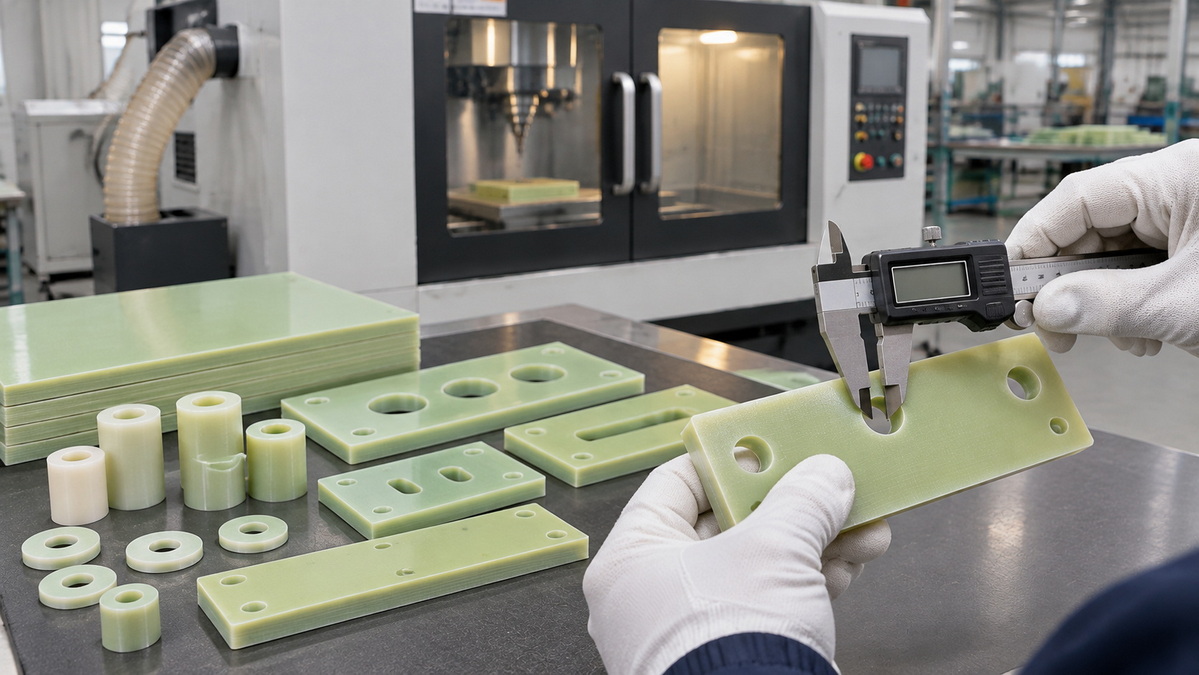
Glass-reinforced laminates can be demanding to machine. Tooling, support, and cutting conditions should limit edge chipping, fiber breakout, and delamination.
Inspection should cover more than overall dimensions. Critical features may include:
- Hole diameter and location.
- Flatness and thickness consistency.
- Edge condition around electrical paths.
- Counterbore quality.
- Cleanliness before assembly.
Dust extraction and suitable worker protection are also necessary during processing. Any cleaning or edge-treatment method should remain compatible with the approved material and insulation design.
Record the operating voltage, temperature exposure, mechanical loads, environmental conditions, and expected service life.
Identify whether the part provides basic insulation, additional insulation, structural support, or another defined function.
Create a checklist covering:
- Material identity and traceability.
- Flammability classification at the relevant thickness.
- Electrical properties and test conditions.
- Thermal capability.
- Mechanical properties.
- Environmental and chemical compatibility.
Keep mandatory requirements separate from desirable characteristics.
Compare properties using equivalent test methods, conditioning, specimen thicknesses, and loading directions wherever possible.
A dry electrical result and a moisture-conditioned result should not be treated as directly equivalent. The same caution applies to mechanical results measured in different laminate directions.
Use samples with the intended thickness, holes, fasteners, and machining process.
As required by the component specification, evaluate dimensional stability, electrical withstand, insulation resistance, loading, and environmental exposure.
Define acceptance criteria before testing. A test without a clear acceptance threshold provides limited purchasing guidance.
Record the approved grade, manufacturer, drawing revision, and inspection requirements.
Changes in resin formulation, thickness, supplier, or processing may require review. Similar appearance is not evidence of equivalent performance.
Consider a hypothetical battery-cabinet busbar support requiring electrical isolation, bolted mounting, and documented V-0 performance.
FR4 is the logical starting candidate because conventional G10 does not inherently satisfy that flame-retardant requirement.
However, qualification still needs to confirm:
1. The supplied grade supports the required classification at the finished thickness.
2. Temperature near the connection remains within the validated operating envelope.
3. Fasteners do not compromise creepage or clearance.
4. The plate withstands assembly loads and environmental conditioning.
5. Machining quality meets the drawing requirements.
If the part must also delay thermal-runaway propagation, that becomes an additional qualification task—not an assumed benefit of choosing FR4.
This is a selection example, not a reported customer installation or independently verified company case study.
A lower sheet price does not necessarily produce a lower qualified-component cost.
Include machining yield, inspection, documentation, prototype testing, rejected parts, and the consequences of material substitution in the comparison.
There is no universal rule that G10 will always cost less than FR4. Thickness, formulation, tolerances, processing requirements, and order quantity can change the result.
Guangdong Weishi New Materials Co., Ltd. develops, manufactures, and supplies epoxy fiberglass insulation materials, including FR4 and G10/G11 boards, with customized processing capabilities.
For a focused material discussion, send your component drawing, operating voltage, temperature range, thickness, quantity, and required test documentation. Ask for a proposed grade, available supporting data, and production-representative samples before approving bulk supply.
FR4 is generally the stronger starting candidate when the component requires documented flame-retardant performance. G10 can remain suitable where the approved specification permits it. Neither is universally better across all mechanical, thermal, and electrical requirements.
Not automatically. If FR4 was selected to satisfy a flammability requirement, a conventional G10 substitution may remove that required characteristic. Review the original specification and requalify the proposed replacement.
Not by designation alone. Its flame-retardant characteristics do not establish resistance to battery fire propagation. A thermal-runaway barrier requires evidence appropriate to its intended function and assembly.
There is no universal thickness. Selection depends on electrical stress, mechanical loading, geometry, manufacturing tolerances, and applicable requirements. Verify both the finished assembly's insulation performance and the material's documented flammability thickness range.
No. Temperature capability depends on the specific resin system and supporting data. Compare the actual grades rather than assuming that flame retardancy establishes a higher continuous operating temperature.
Request the material datasheet, grade identification, relevant flammability evidence, dimensional inspection requirements, and batch traceability. Add electrical, thermal, environmental, or chemical test evidence according to the component specification.
1. [Boedeker Plastics — G-10 Glass Epoxy Laminate]. Material construction, typical applications, machining considerations, and representative G10 property data. Published values describe the listed product, not every G10 laminate. [boedeker]
2. [Boedeker Plastics — G-10 FR-4 Glass Epoxy Laminate Natural]. Flame-retardant epoxy glass construction, typical insulation applications, and representative product properties. [boedeker]
3. [UL Solutions — Combustion (Fire) Tests for Plastics]. Explanation of UL 94 classifications, controlled laboratory testing, and the relevance of specimen thickness. [ul]
4. [UL Solutions — Understanding UL 94 Rating Certifications and Limitations]. Scope and limitations of small-scale plastic flammability classifications. [code-authorities.ul]
5. [UL Solutions — UL 9540A Test Method for Battery Energy Storage Systems]. Thermal-runaway fire-propagation evaluation and the distinction between material flammability and battery-system fire behavior. [ul]
6. [UL Solutions — Effects of High Frequency Voltage Stress on Air Insulation and Solid Insulation]. Insulation coordination, clearance, creepage, electrical stress, and environmental considerations. [code-authorities.ul]
7. [Atlas Fibre, hosted by Boedeker Plastics — Safety Data Sheets: Glass Grades]. Processing hazards, dust control, ventilation, and protective measures for glass-reinforced laminates. [boedeker]


