
Views: 259 Author: Weishi Sheets Publish Time: 2026-11-18 Origin: Site
Content Menu
● FR4 vs Epoxy Fiberglass Sheet: What Is the Difference?
>> How FR4, G10, and G11 Compare
● Why Insulation Material Matters in Industrial Sensors
>> Separate Structural Insulation from the Sensing Function
● Comparing the Properties That Affect Sensor Performance
>> Electrical Insulation and Moisture Exposure
>> Temperature Resistance: Tg Is Not a Service Rating
>> Mechanical Strength and Dimensional Stability
● Selecting FR4, G10, or G11 for Different Sensor Applications
>> Sensors Inside Electrical Cabinets
>> Sensors Near Elevated-Temperature Machinery
>> Capacitive and High-Frequency Sensors
● An Application Example: A Sensor Plate Near a Heated Housing
● Machining Epoxy Fiberglass Sheet for Sensor Components
>> Define Functional Dimensions Clearly
>> Inspect Features That Can Become Failure Points
● A Practical Qualification Workflow
>> Step 1: Define the Operating Envelope
>> Step 2: Specify the Material Precisely
>> Step 3: Compare Like-for-Like Data
>> Step 4: Test the Finished Assembly
>> Step 5: Control Production Changes
● What to Include in an RFQ for Sensor Insulation Parts
>> Is FR4 the Same as Epoxy Fiberglass Sheet?
>> Is FR4 Always Better Than G10 for Industrial Sensors?
>> Can G11 Replace FR4 in a Sensor Assembly?
>> Does a Higher Tg Mean a Higher Continuous Operating Temperature?
>> Can Epoxy Fiberglass Sheet Affect Sensor Accuracy?
>> What Documents Should a Supplier Provide?
Choosing between FR4 vs epoxy fiberglass sheet for industrial sensors begins with an important clarification: FR4 is itself a type of epoxy fiberglass laminate. The practical decision is not between two unrelated materials. It is between a specified flame-retardant grade and a broader material family that includes G10, G11, FR4, and other formulations.
For sensor manufacturers, that distinction affects more than purchasing terminology. The selected sheet can influence electrical isolation, mounting stability, thermal performance, and machining quality.
At Guangdong Weishi New Materials Co., Ltd., our approach to material selection starts with the application requirements rather than the material name alone. This guide explains how to compare grades, interpret technical data, and specify insulation components for industrial sensors without relying on misleading generalizations.
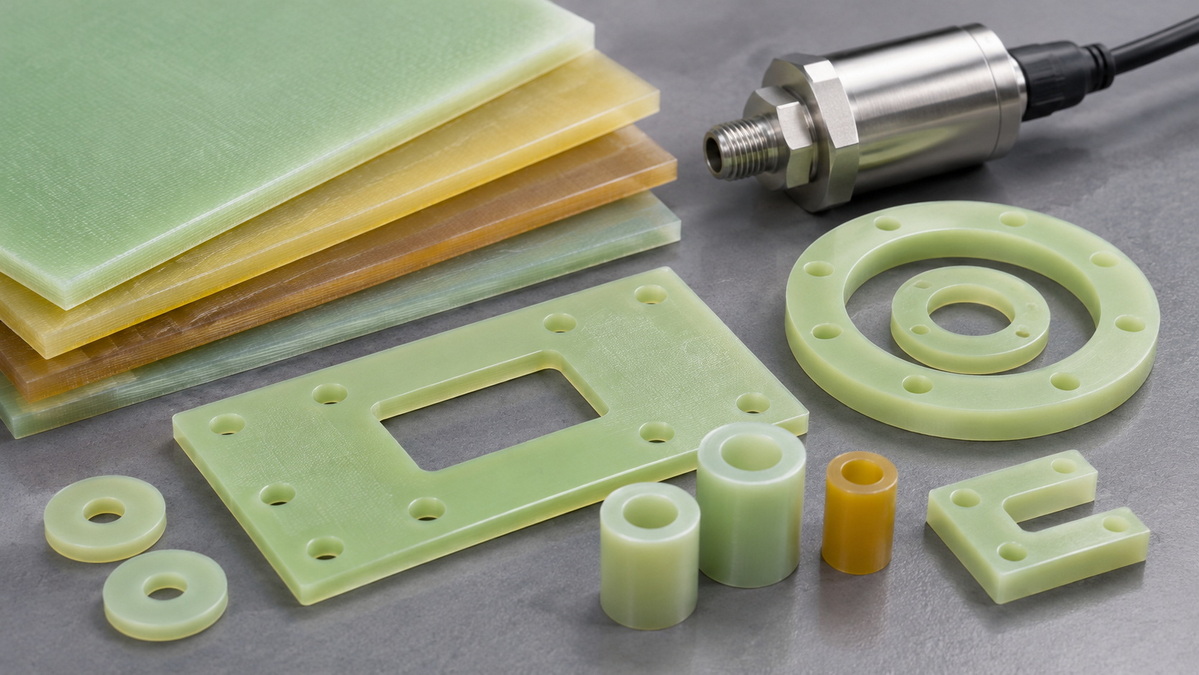
Epoxy fiberglass sheet consists of glass-fabric reinforcement bonded with a cured epoxy resin system. Different resin formulations and laminate constructions produce different performance profiles.
FR4 identifies a flame-retardant epoxy-glass grade. "Epoxy fiberglass sheet," however, does not identify one standardized performance level.
An unspecified epoxy fiberglass sheet might be suitable for a structural spacer but lack the documentation required for a flame-rated electrical assembly.
| Material designation | General description | Potential sensor application | Important qualification |
|---|---|---|---|
| FR4 | Flame-retardant epoxy-glass laminate | Insulating barriers, electronic supports, mounting plates | Confirm the actual product's flame classification and thickness |
| G10 | Epoxy-glass laminate without the FR4 flame-retardant designation | Structural spacers and insulating supports | Do not assume FR4-equivalent flame performance |
| G11 | High-temperature epoxy-glass laminate | Supports exposed to elevated temperatures | Confirm grade-specific thermal and mechanical data |
| Generic epoxy fiberglass sheet | Broad commercial description | Depends on the actual formulation | Require an identifiable grade and technical datasheet |
My starting recommendation is simple: compare documented products, not product labels. Two quotations using similar wording may describe materials with substantially different qualification limits.
Industrial sensors combine sensitive measurement functions with practical mechanical constraints. Their insulating components may sit between conductors, support electronic assemblies, or maintain separation from a metal housing.
Typical components include:
- Insulating mounting plates.
- Terminal barriers and spacers.
- Internal support frames.
- Machined rings and washers.
- Electronics carrier plates.
- Fixture components used during assembly and calibration.
The laminate does not determine sensor accuracy by itself. However, movement, contamination, or insulation deterioration can undermine the stability of the complete assembly.
A mounting plate and a measurement-sensitive dielectric require different selection priorities.
For a structural spacer, flatness, strength, and dimensional tolerances may dominate. For material positioned within a capacitive sensing field, dielectric behavior becomes directly relevant to the measurement.
This distinction prevents a common specification mistake: selecting a laminate for mechanical strength while overlooking its interaction with the sensing principle.
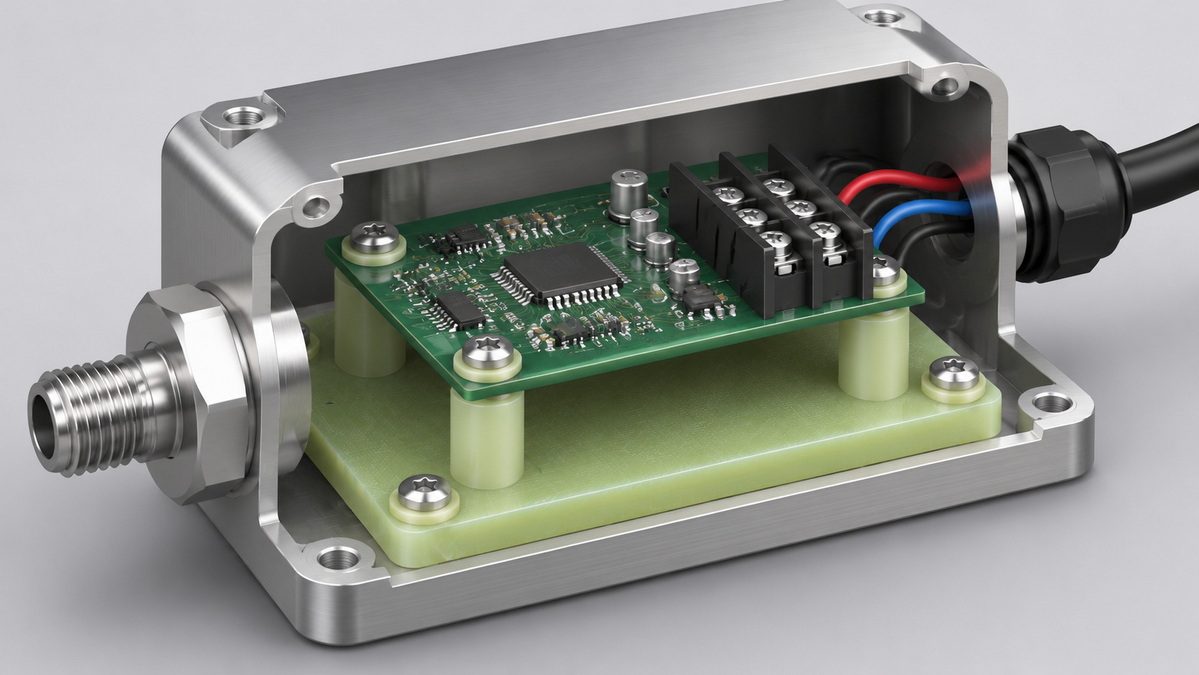
Dielectric strength and insulation resistance describe different aspects of electrical behavior. Neither should be reduced to a single universal "insulation quality" score.
Compare supplier data using equivalent:
- Test methods.
- Specimen thicknesses.
- Conditioning procedures.
- Temperatures.
- Electrode arrangements, where applicable.
Dry laboratory results alone do not establish performance in a humid enclosure. Surface contamination, condensation, and finished-part geometry also require attention.
When specifying epoxy fiberglass sheet for industrial sensors, request moisture-conditioned electrical data when available. Then validate the machined component under representative assembly conditions.
Glass transition temperature, or Tg, describes a transition in resin behavior. It is not automatically the maximum continuous operating temperature of a finished part.
A useful published example is Isola FR408HR, a high-performance FR4 system developed for printed circuit boards. Its datasheet reports:
| Property | Published typical value | Interpretation |
|---|---|---|
| Tg by DSC | 190°C | A resin-transition measurement |
| Tg by DMA | 230°C | A result obtained using a different measurement method |
| Relative Thermal Index | 130°C | A separate thermal-aging classification |
| Moisture absorption | 0.061% | A product-specific result under the stated test method |
These figures illustrate why test methods matter. They are not specifications for every FR4 sheet, nor for Guangdong Weishi products.
For a sensor support, evaluate local temperature, exposure duration, mechanical loading, and electrical requirements together. A high Tg alone does not establish suitability.
A strong laminate can still perform poorly if the component bends, cracks around a fastener, or changes position during thermal cycling.
Review:
- Flexural strength and stiffness.
- Sheet thickness and flatness.
- Hole spacing and edge distances.
- Fastener loading.
- Reinforcement orientation.
- Dimensional changes across temperature.
Glass-reinforced laminates can behave differently along different directions. When a component has tight alignment requirements, the drawing should identify critical dimensions and the supplier should explain how material orientation is controlled.
FR4 is a logical starting point when flame retardancy is required, but the grade name is not a substitute for product documentation.
Verify the relevant flame classification, tested thickness, and recognition details for the supplied material.
Also distinguish a material-level classification from approval of the complete sensor. An insulating plate does not independently establish the fire performance of its housing, wiring, adhesives, or assembled electronics.
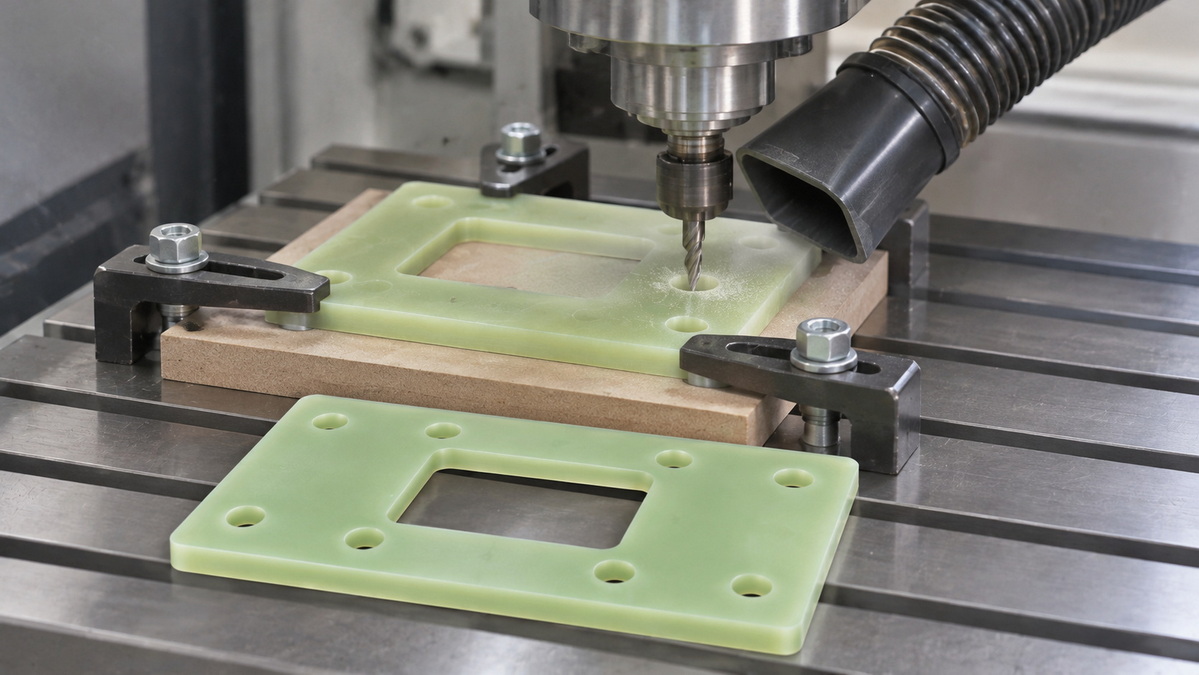
For an insulating carrier or terminal barrier inside an electrical cabinet, documented FR4 may offer a practical combination of mechanical support, electrical insulation, and flame performance.
Selection should still account for nearby heat sources and the required electrical separation. A flame-retardant designation does not replace creepage, clearance, or assembly-level verification.
When a mounting component operates near a sustained heat source, compare temperature-qualified FR4 with an appropriate G11 product.
For context, Norplex-Micarta describes its NP511 G11 laminate as using woven glass fabric and a high-temperature epoxy system, with a stated continuous operating temperature of 175°C.
That figure belongs to NP511. It should not be assigned automatically to all G11 sheets or transferred to another manufacturer's material.
For capacitive sensing, material permittivity and its stability can matter alongside mechanical properties. High-frequency designs may also require attention to dielectric loss.
A datasheet value measured at one frequency does not necessarily describe behavior at another.
If the laminate lies within the active sensing field, ask for relevant frequency-dependent data and assess the assembled sensor. If that information is unavailable, prototype testing becomes particularly important.
Consider a hypothetical sensor mounting plate installed near a heated metal housing. It must maintain alignment, isolate electronics, and tolerate occasional condensation.
This is an illustrative selection exercise, not a reported customer project.
A useful evaluation sequence would be:
1. Measure the plate's local operating temperature.
2. Establish acceptable movement at the sensor's reference points.
3. Identify any mandatory flame requirement.
4. Compare documented FR4 and G11 candidates.
5. Machine samples using the intended production geometry.
6. Test alignment and insulation after representative environmental exposure.
The outcome may favor FR4 if its documented performance satisfies every requirement. It may favor G11 if elevated-temperature mechanical performance is the controlling factor.
The lesson is not that one grade always wins. It is that the dominant failure risk should guide the comparison.
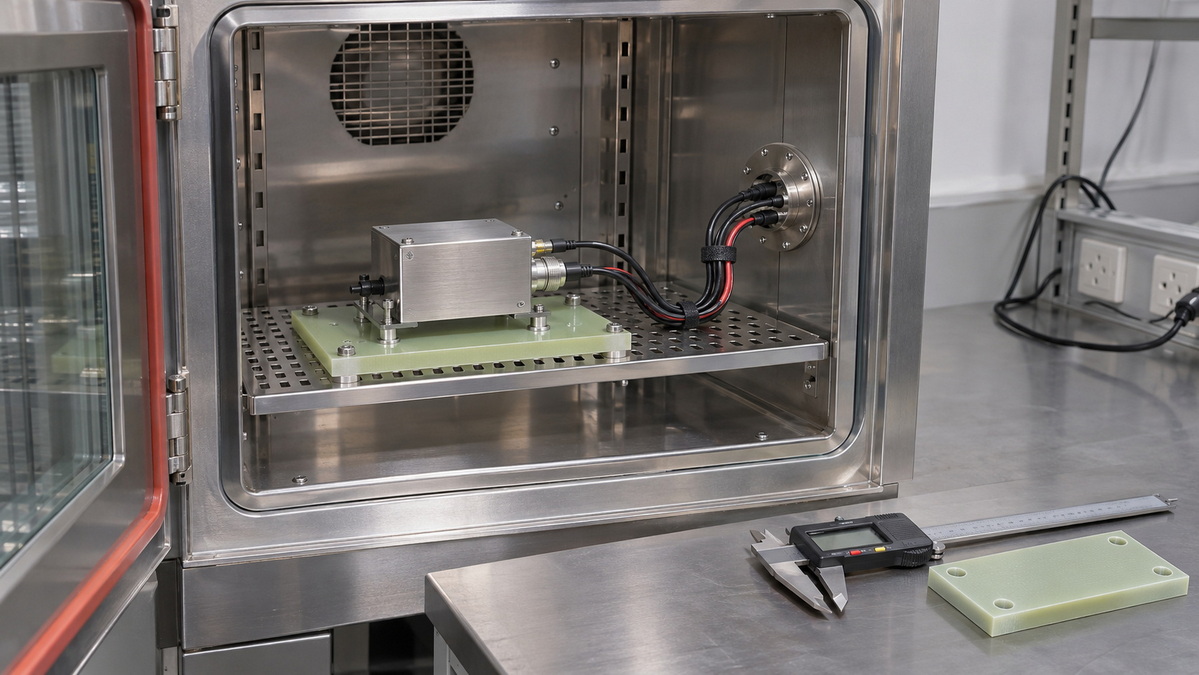
Material selection and machining quality must be evaluated together. A suitable laminate can become an unsuitable component through edge damage, poor hole quality, or uncontrolled tolerances.
Avoid applying unnecessarily tight tolerances to every feature. Instead, identify dimensions that control sensor performance:
- Mounting-hole position.
- Distance between locating surfaces.
- Flatness of the mounting face.
- Insulation-barrier thickness.
- Fit around electrical terminals.
Separate these from noncritical outer profiles. This helps focus inspection effort and supports more meaningful quotations.
Machined edges, countersinks, and narrow sections deserve particular attention.
Specify acceptable limits for visible delamination, chipped edges, and exposed damage around holes. Where cleaning or edge treatment is proposed, confirm compatibility with the assembly rather than assuming every component requires sealing.
Because glass-reinforced laminates generate machining dust and wear cutting tools, production planning should also follow the material's safety guidance and appropriate dust-control practices.
A documented workflow makes supplier comparisons more useful than a simple price-per-sheet exercise.
Record normal and peak temperatures, humidity, condensation, chemical exposure, voltage, vibration, and expected service life.
Distinguish measured conditions from estimates.
Include the grade, thickness, required properties, test methods, and any applicable recognition requirements.
Do not approve an unspecified "equivalent epoxy board" without reviewing its supporting documentation.
Check whether values are typical results, minimum requirements, or guaranteed acceptance limits.
A typical datasheet value should not automatically become a contractual minimum.
Evaluate insulation, dimensional stability, and sensor output before and after relevant exposure.
Testing the assembled sensor is important because fasteners, adhesives, housings, and surface contamination introduce conditions absent from a flat-sheet datasheet.
Maintain material identification, inspection records, and an agreed process for reviewing substitutions.
Changes in resin system, thickness, or machining practice may require renewed evaluation.
A useful request for quotation should contain:
| RFQ item | Why it matters |
|---|---|
| Material grade and supporting requirements | Prevents ambiguous substitutions |
| Drawing and revision number | Establishes the controlled geometry |
| Critical dimensions and tolerances | Directs machining and inspection |
| Operating environment | Supports appropriate grade selection |
| Flame or electrical documentation | Identifies required evidence |
| Prototype and production quantities | Improves quotation relevance |
| Inspection and traceability requirements | Defines acceptance expectations |
Guangdong Weishi New Materials Co., Ltd. develops, manufactures, and supplies epoxy fiberglass insulation materials, including FR4 and G10/G11 products, with customization capabilities.
Send your drawing, operating conditions, required grade, and documentation needs to Guangdong Weishi for an application-focused quotation. Ask the team to identify the proposed material and available supporting data before approving samples.
FR4 belongs to the epoxy fiberglass sheet family. However, the broader term does not guarantee FR4 flame performance or identify a specific grade.
No. FR4 is relevant when flame retardancy is required. G10 may be considered for other structural and insulation applications, provided its documented properties satisfy the design.
Not automatically. G11 may offer suitable elevated-temperature performance, but substitution requires checking flame requirements, electrical properties, dimensions, and assembly compatibility.
No. Tg and long-term thermal capability describe different characteristics. Compare the relevant thermal-aging information and validate the component under its actual loading conditions.
It can, depending on its role. Dimensional movement may affect alignment, while dielectric behavior can influence designs in which the material interacts with the sensing field.
Request a grade-specific technical datasheet, applicable test or recognition information, and agreed conformity documentation. The required package depends on the application and purchasing specification.
1. National Electrical Manufacturers Association. *Industrial Laminated Thermosetting Products*. Standard scope covering the manufacture, testing, and performance of thermosetting laminate sheets, rods, and tubes. [nema]
2. Norplex-Micarta. *NEMA LI 1-1998: Electrical Industry Standards*. Grade descriptions distinguishing FR4 flame-retardant epoxy glass, G10 epoxy glass, and G11 high-temperature epoxy glass. [norplex-micarta]
3. Isola Group. *FR408HR Laminate and Prepreg Technical Datasheet*, Revision F, September 17, 2025. Product-specific thermal, moisture, electrical, and flammability data. These figures are illustrative and do not characterize all FR4 materials. [isola-group]
4. Isola Group. *FR408HR Laminate and Prepreg*. Product description and technical property tables, including the distinction between DSC and DMA glass-transition measurements. [isola-group]
5. Norplex-Micarta. *NP511*. G11 product description, stated temperature capability, relevant material standards, and discussion of G10/G11 versus FR4/FR5 formulations. [norplex-micarta]


