

Views: 233 Author: Weishi Sheets Publish Time: 2026-09-04 Origin: Site
Content Menu
● Why EV Battery Pack Insulation Plates Matter
● The Main Difference: Flame Retardancy
● Electrical Insulation Performance
● Mechanical Strength and Structural Support
>> Machining Considerations for FR4 and G10
● Thermal Performance in Battery Applications
● When to Choose FR4 for EV Battery Insulation Plates
● A Practical Material Selection Process
>> Step 1: Define the Part Function
>> Step 2: Identify the Installation Location
>> Step 3: Establish Material Requirements
>> Step 4: Review the Finished Part
>> Step 5: Validate in the Real Assembly
● Summary
>> Is FR4 better than G10 for EV battery pack insulation plates?
>> Can G10 be used for EV battery insulation?
>> Are FR4 and G10 mechanically strong?
>> What is the best thickness for an EV battery insulation plate?
>> Can FR4 be CNC machined into custom battery insulation parts?
>> Should I choose FR4 or G11 for high-temperature battery applications?
Selecting the right insulation plate is a critical part of EV battery pack design. FR4 and G10 are both high-performance glass epoxy laminates used for electrical insulation, structural support, and precision-machined components. However, they are not identical materials, and choosing the wrong grade can affect fire safety, thermal performance, long-term reliability, and project qualification.
For many high-voltage battery pack applications, FR4 insulation plates are the preferred option because they combine strong electrical insulation and mechanical stability with flame-retardant properties. G10 remains useful for selected structural and electrical insulation applications, especially where flame-retardant performance is not a mandatory requirement.
This guide compares FR4 vs G10 for EV battery pack insulation plates, helping battery manufacturers, engineers, and sourcing teams make a more informed material decision.
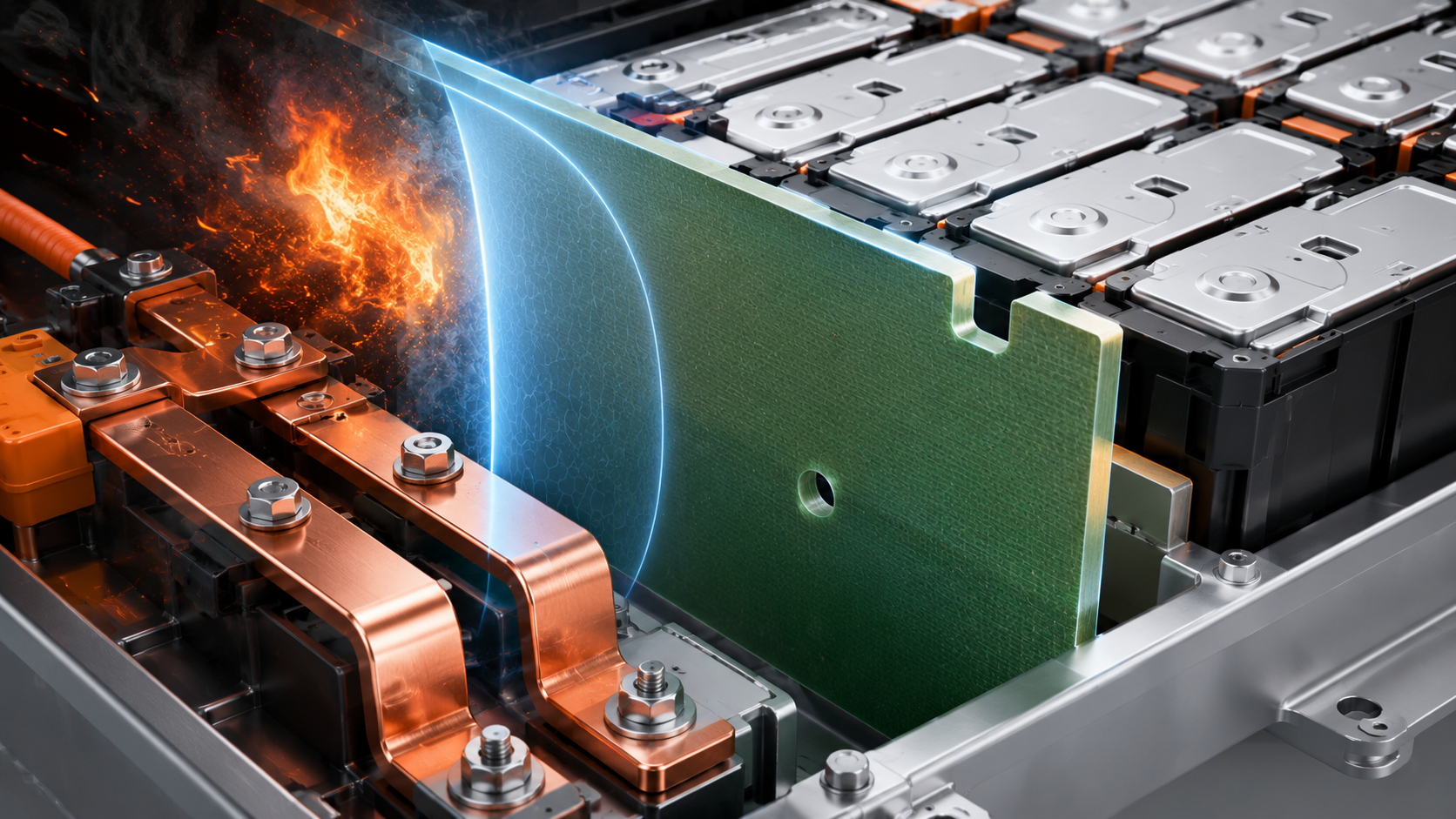
An EV battery pack operates in a demanding environment. It may be exposed to high voltage, vibration, temperature changes, humidity, coolant leaks, mechanical stress, and potential thermal events.
Insulation plates help separate conductive parts and reduce the risk of unintended electrical contact. Depending on the design, they can be installed between battery modules, below busbars, around high-voltage terminals, near contactors, or between the battery assembly and metal enclosure.
A well-designed EV battery insulation plate may need to provide:
- Electrical isolation between energized components and conductive structures
- Dielectric strength to resist electrical breakdown
- Flame resistance during abnormal thermal conditions
- Mechanical rigidity for module support and spacing
- Thermal stability under operating and peak temperatures
- Dimensional stability after cutting, drilling, and assembly
- Moisture resistance in humid environments
- Chemical resistance against coolant, electrolyte exposure, and industrial contaminants
The insulation material is not only a passive barrier. In many battery packs, it is also a structural part that contributes to spacing control, component positioning, vibration resistance, and assembly consistency.
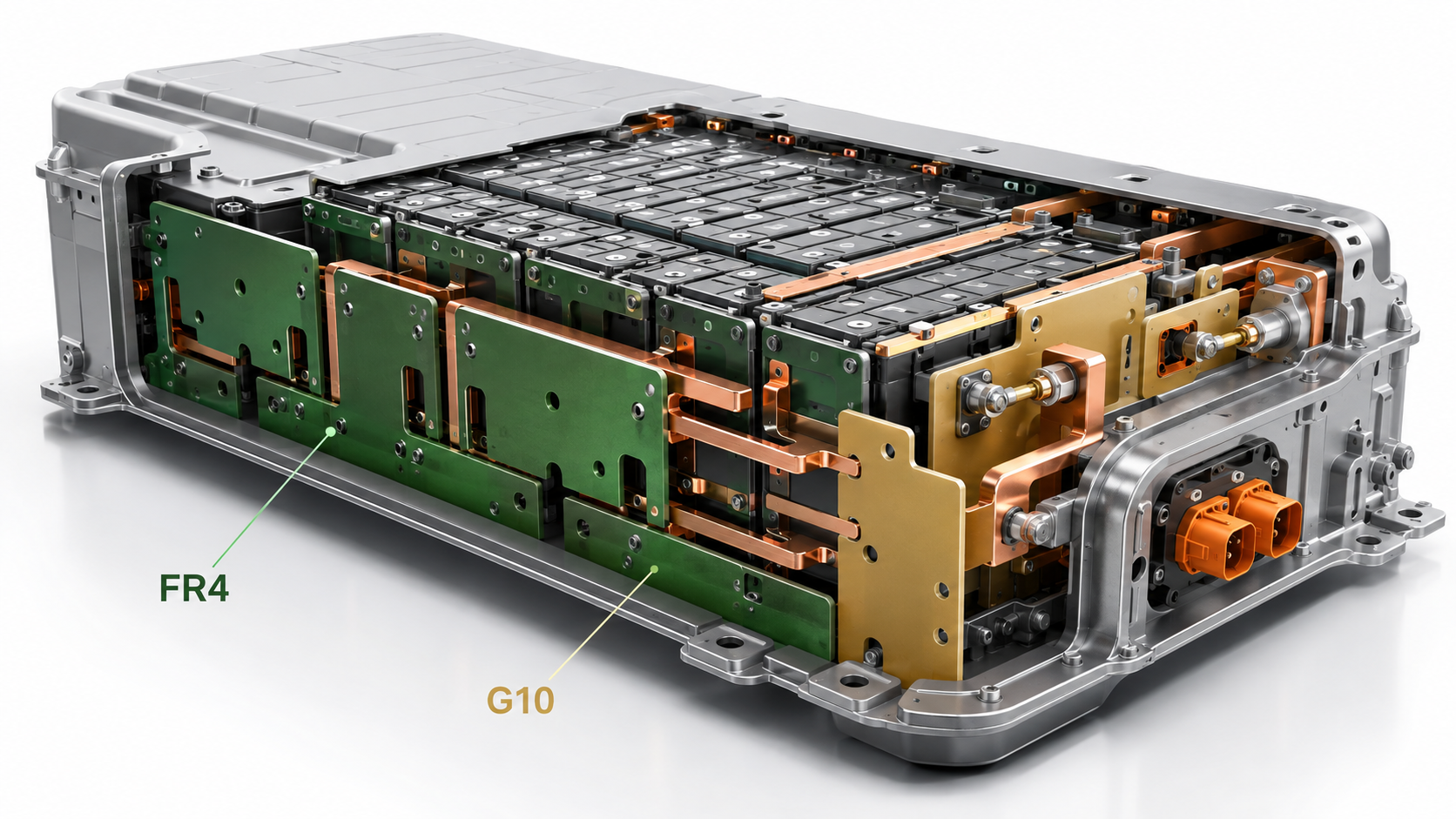
G10 is a rigid glass epoxy laminate made from woven fiberglass cloth and epoxy resin. The fiberglass reinforcement gives the material high mechanical strength, while the cured epoxy resin provides electrical insulation and chemical resistance.
G10 has long been used in electrical and mechanical industries because it offers a balanced combination of strength, stiffness, insulation performance, and machinability.
Common G10 applications include:
- Electrical insulation spacers
- Terminal boards
- Transformer components
- Structural support parts
- High-strength mechanical fixtures
- CNC-machined industrial components
- Insulation barriers in electrical equipment
- Tooling and production jigs
For battery-related applications, G10 can be used for structural insulation parts, module supports, spacers, and other components where rigidity and dielectric performance are important.
However, standard G10 is not automatically designed as a flame-retardant material. This is the main issue that must be considered before using G10 in a high-voltage EV battery pack.
FR4 is also a woven glass fiber and epoxy resin laminate. Its structure is similar to G10, but the epoxy resin system contains flame-retardant additives or chemistry.
The term "FR" refers to flame retardancy. As a result, FR4 is commonly selected for applications where electrical insulation, mechanical strength, and improved fire behavior are all required.
FR4 insulation sheets are widely used in:
- Printed circuit board substrates
- Electrical insulation panels
- High-voltage barriers
- Switchgear insulation components
- Transformer insulation parts
- Busbar supports
- Battery pack insulation plates
- Industrial electrical cabinets
- CNC-machined insulating parts
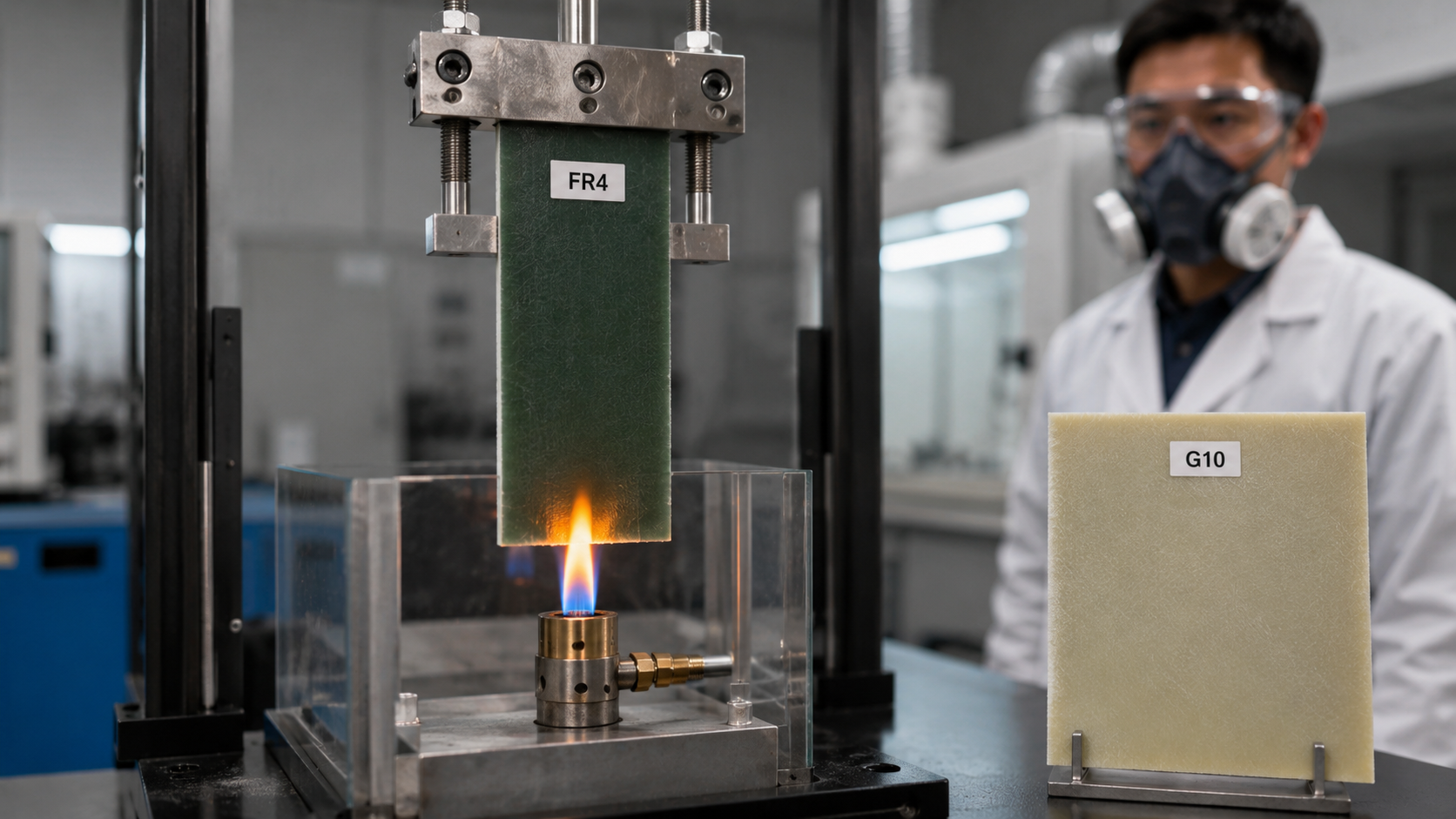
Many FR4 grades are manufactured to meet UL 94 V-0 flammability performance requirements at specified thicknesses. This makes FR4 especially relevant for EV battery packs, where engineers often need to consider fire safety alongside electrical and mechanical performance.
FR4 and G10 share many basic characteristics because both are glass-reinforced epoxy laminates. They can both offer high strength, good electrical insulation, low moisture absorption, and stable dimensions.
The most significant difference is flame-retardant performance.
| Property | FR4 Insulation Plate | G10 Insulation Plate | Importance for EV Battery Packs |
|---|---|---|---|
| Base material | Woven fiberglass cloth and epoxy resin | Woven fiberglass cloth and epoxy resin | Both provide a rigid insulation structure |
| Flame resistance | Flame-retardant epoxy formulation | Standard epoxy formulation | FR4 is generally preferred in fire-sensitive areas |
| Typical flammability position | Often available in UL 94 V-0 grades | Often lacks V-0 classification unless specially formulated | Important for battery pack safety requirements |
| Electrical insulation | Excellent dielectric performance | Excellent dielectric performance | Both can isolate high-voltage components |
| Mechanical strength | High strength and stiffness | High strength and stiffness | Useful for spacers, barriers, and structural supports |
| Moisture resistance | Low water absorption | Low water absorption | Supports stable performance in humid conditions |
| Dimensional stability | Good stability after machining | Good stability after machining | Important for holes, slots, and precision assembly |
| CNC machinability | Suitable for drilling, routing, milling, and punching | Suitable for drilling, routing, milling, and punching | Both can be made into custom battery insulation parts |
| Cost | Usually slightly higher | Often lower for standard grades | Cost should be evaluated against performance requirements |
| Recommended battery use | High-voltage, flame-sensitive, structural insulation positions | Controlled or lower-risk insulation and structural positions | Selection depends on application risk and specifications |
The comparison shows that FR4 and G10 are close in mechanical and dielectric performance. The decision usually depends on whether the application requires a flame-retardant insulation plate.
In EV battery pack design, fire behavior is a major material-selection factor.
FR4 is designed to resist flame spread and self-extinguish more effectively than standard G10. For this reason, FR4 is often chosen for insulation plates located close to high-voltage busbars, terminals, fuses, contactors, battery module connections, and power distribution components.
A flame-retardant insulation material can provide an additional layer of protection in situations involving:
- Electrical arcing
- Short circuits
- Overheating
- Localized hot spots
- Thermal runaway propagation risks
- Fault conditions near high-voltage terminals
- Fire exposure from adjacent components
However, flame-retardant material selection should not be confused with complete battery pack safety validation. A material with a V-0 rating may support a safer design strategy, but the complete battery pack must still be assessed through electrical, thermal, mechanical, and environmental testing.
FR4 can support fire-conscious battery pack design, but it is only one part of a complete safety system.
Both FR4 and G10 are widely used for electrical insulation because they combine epoxy resin with fiberglass reinforcement. Their dielectric performance makes them suitable for separating conductive components in high-voltage systems.
In an EV battery pack, insulation plates may be used to isolate:
- Battery module terminals
- Copper or aluminum busbars
- High-voltage connectors
- Contactors and relays
- Battery management system assemblies
- Metal battery enclosures
- Cooling plates and conductive structures
- Mounting hardware and fasteners
The actual electrical performance of FR4 or G10 depends on the specific material grade. It can vary based on resin composition, fiberglass construction, thickness, curing process, moisture content, and production quality.
For this reason, material names alone are not enough. A purchasing team should review the exact technical data sheet for the proposed insulation plate.
Important electrical properties to compare include:
- Dielectric strength
- Volume resistivity
- Surface resistivity
- Dielectric constant
- Dissipation factor
- Comparative tracking behavior
- Moisture absorption
- Electrical performance after humidity conditioning
- Electrical performance after thermal aging
An EV battery insulation plate often needs to function as a structural component. It may support the battery module, maintain spacing between conductive parts, resist vibration, or reinforce areas around mounting holes.
FR4 and G10 both offer strong mechanical properties because of their woven fiberglass reinforcement.
Typical structural insulation applications include:
- Battery module separators
- End plates
- Busbar support plates
- Terminal barriers
- Fastener isolation washers
- Electrical mounting panels
- Cell-holder reinforcement components
- Battery enclosure isolation plates
- High-voltage component supports
When selecting a laminate for structural use, engineers should evaluate more than simple tensile strength. The part geometry, load direction, hole locations, vibration profile, fastening method, and temperature range can all influence long-term performance.
Glass epoxy laminates are anisotropic materials. Their mechanical properties may differ based on the direction of the woven fiberglass layers. This is especially important for narrow parts, drilled holes, long slots, thin walls, and complex CNC-machined geometries.
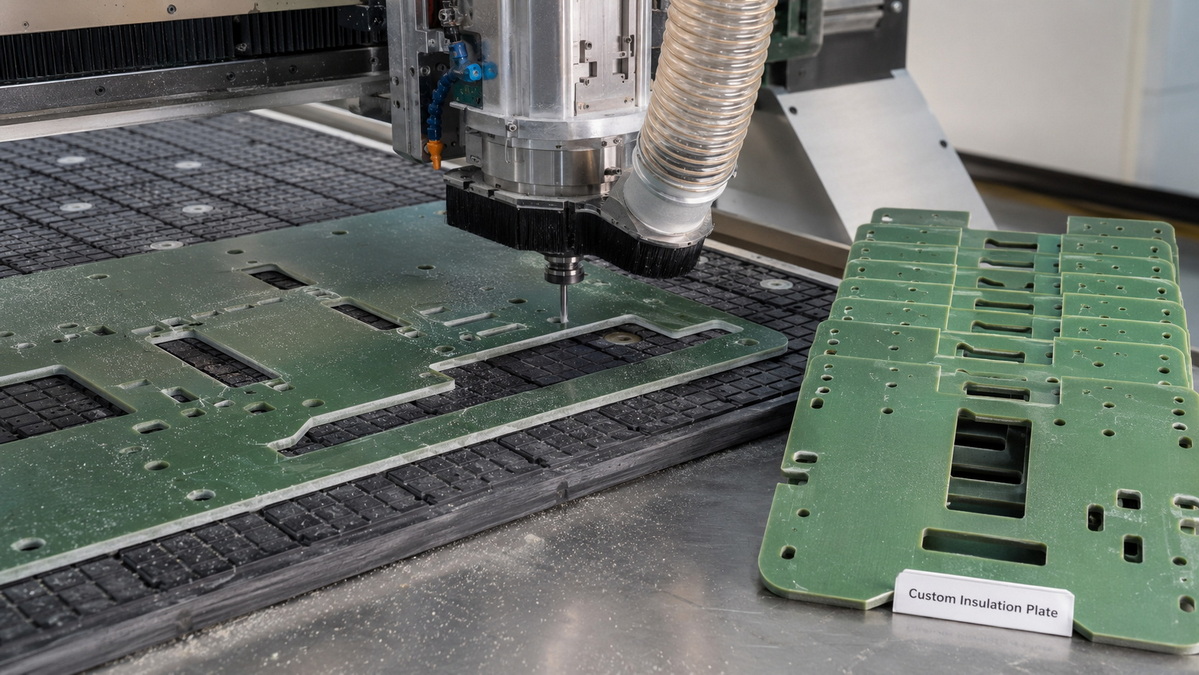
Both FR4 and G10 can be CNC machined into customized insulation parts. Common processing methods include:
- CNC routing
- CNC milling
- Drilling
- Punching
- Waterjet cutting
- Saw cutting
- Grinding
- Edge finishing
For EV battery pack insulation plates, precision machining may include:
- Busbar slots
- Cable openings
- Mounting holes
- Counterbores
- Terminal clearances
- Complex contours
- Module positioning features
- Ventilation openings
- Electrical separation ribs
Machining quality matters because poor edge finishing can create burrs, fiber breakout, cracks, delamination, or dimensional inconsistency. These defects may complicate assembly or create undesirable stress points.
For this reason, buyers should validate the finished machined part rather than approving only the raw FR4 or G10 sheet.
Thermal performance is another important consideration when selecting FR4 or G10 insulation plates.
Standard FR4 and G10 grades are commonly suitable for moderate-temperature electrical insulation applications. However, an EV battery pack can contain localized heat sources, especially near busbars, contactors, fuses, terminals, power electronics, and high-current connections.
Potential thermal challenges include:
- Continuous operating heat
- Rapid thermal cycling
- Localized hot spots
- Charging and discharging heat
- Heat transfer from adjacent metal components
- Abnormal overheating conditions
- Thermal event exposure
When the operating temperature exceeds the capability of standard grades, a higher-temperature laminate may be necessary. G11 or high-temperature flame-retardant glass epoxy materials can be considered where additional heat resistance is required.
The correct material decision should be based on the actual temperature profile of the finished battery pack, including both continuous operating temperature and short-term peak exposure.
FR4 is generally the better choice when the battery insulation plate is installed in an electrically sensitive, thermally demanding, or flame-conscious position.
Choose FR4 when:
- The project requires flame-retardant insulation material
- The part is located near high-voltage busbars or terminals
- The application involves contactors, fuses, relays, or power distribution components
- The battery manufacturer requests UL 94 V-0 material performance
- The insulation plate provides both electrical and structural support
- The component is located in a high-risk thermal area
- The product is intended for automotive, energy-storage, or industrial high-voltage equipment
- The customer requires detailed material qualification documents
- The application needs stable CNC-machined insulation parts
For many EV battery pack designs, FR4 offers a more balanced solution because it combines insulation, strength, machinability, and flame-retardant performance.
G10 may still be suitable for certain applications where flame-retardant performance is not required and the component is placed in a controlled environment.
Possible G10 applications include:
- Assembly fixtures
- Battery manufacturing jigs
- Structural alignment components
- External electrical equipment
- Low-risk spacer parts
- Controlled industrial battery applications
- Non-critical support plates outside the main traction battery enclosure
G10 may also be considered when a project requires the strength and rigidity of glass epoxy laminate but has no flame-retardant material requirement.
However, G10 should not be selected purely because of its lower cost. If the battery design later requires a flame-retardant material, replacing G10 with FR4 may require new samples, revised drawings, validation testing, and supplier requalification.
Choosing between FR4 and G10 should follow a clear engineering process.
Identify the main purpose of the insulation plate.
Is it used for electrical isolation, structural support, flame resistance, spacing control, busbar protection, or module separation?
Many parts perform multiple functions. The selected material must meet the most demanding requirement.
Review where the part is installed inside the EV battery pack.
Consider whether it is close to high-voltage conductors, heat sources, battery cells, cooling systems, metal enclosures, or moving mechanical components.
A part installed below a high-voltage busbar may require a different grade from a spacer used in a low-risk mechanical position.
Create a measurable material specification that includes:
- Material grade
- Required thickness
- Thickness tolerance
- Flame-retardant requirement
- Dielectric performance requirement
- Operating-temperature range
- Moisture-resistance requirement
- Flatness requirement
- CNC machining tolerance
- Surface-quality requirement
- Required inspection documents
- Batch traceability requirements
Inspect the final machined component for:
- Accurate dimensions
- Smooth edges
- Controlled hole sizes
- No burrs
- No delamination
- No major fiber breakout
- Stable flatness
- Clean surfaces
- Correct part identification
The most reliable way to evaluate an insulation plate is inside the actual battery pack or representative test assembly.
The part should be tested under the electrical load, temperature range, vibration condition, moisture exposure, and mechanical stress expected in service.
FR4 and G10 are both strong, durable, and electrically insulating glass epoxy laminates. They can both be machined into precise EV battery insulation plates, busbar supports, module separators, and structural electrical barriers.
The primary difference is flame retardancy.
FR4 is generally the preferred material for EV battery pack insulation plates because it provides electrical insulation, mechanical strength, dimensional stability, and improved flame-retardant performance. It is particularly suitable for high-voltage, fire-sensitive, and structurally demanding battery pack locations.
G10 can be a practical choice for controlled, lower-risk, or non-flame-critical applications. However, it should not be treated as a direct substitute for FR4 without reviewing the full material specification and the actual operating environment.
Guangdong Weishi New Materials Co., Ltd. provides FR4 sheets, G10 sheets, G11 sheets, epoxy fiberglass laminate boards, and customized insulation components for global industrial customers. With stable production quality, flexible processing capabilities, and support for custom drawings and specifications, Weishi helps customers develop reliable insulation solutions for EV battery packs and other high-performance electrical applications.
For custom EV battery insulation plates, prepare your drawing, material grade, required thickness, working temperature, dimensional tolerances, flame-retardant requirements, and expected order quantity before starting the technical evaluation process.
FR4 is generally better for EV battery pack insulation plates when flame-retardant performance is required. It provides strong electrical insulation and mechanical stability while offering improved fire resistance compared with standard G10.
Yes. G10 can be used for some battery insulation and structural support parts when the application does not require flame-retardant material performance. It is important to evaluate the installation location, operating temperature, voltage level, and customer requirements before selection.
Yes. FR4 is designed with flame-retardant epoxy resin chemistry. Many FR4 grades can meet UL 94 V-0 requirements at specified thicknesses. The exact rating should always be verified using documentation for the proposed material grade.
Yes. Both FR4 and G10 have high mechanical strength and stiffness because they are reinforced with woven fiberglass cloth. They are commonly used in structural insulation parts, electrical supports, spacers, and precision-machined industrial components.
The best thickness depends on the electrical voltage, mechanical load, spacing requirements, available installation space, thermal conditions, and part geometry. A material supplier should review the drawing and functional requirements before recommending a thickness.
Yes. FR4 can be CNC machined into holes, slots, contours, terminal barriers, busbar supports, module separators, mounting plates, and other customized battery insulation components. Finished-part inspection is important to control edge quality, tolerance, and flatness.
FR4 is suitable for many standard battery insulation applications. G11 or high-temperature glass epoxy laminate may be more suitable when the application involves higher continuous temperatures or demanding thermal conditions. The final choice should be based on verified thermal, mechanical, and electrical requirements.
1. [UL Standards & Engagement — EVs and Related Equipment]
3. [Plastics International — G-10/FR-4 Glass Epoxy Laminate]
4. [Atlas Fibre — G10 Material Guide]
5. [Ready Plastics — NEMA G10 vs FR4, G11, G7 and G9]
6. [Boedeker Plastics — G-10/FR4 Product Properties]


