

Views: 243 Author: Weishi Sheets Publish Time: 2026-09-14 Origin: Site
Content Menu
● What Is G11 Fiberglass Sheet?
● What Is an Epoxy Resin Sheet?
● G11 Fiberglass Sheet vs Epoxy Resin Sheet: Main Differences
● Why Railway Electrical Systems Require Reliable Insulation Materials
● Thermal Performance in Railway Applications
● Mechanical Strength and Vibration Resistance
>> Example: Busbar Support Selection
● Electrical Insulation Performance
● Moisture Resistance and Environmental Durability
● Fire, Smoke, and Railway Material Requirements
● How to Select the Right Material
>> Step 1: Define the Electrical Requirement
>> Step 2: Define the Thermal Requirement
>> Step 3: Define the Mechanical Requirement
>> Step 4: Define the Environment
>> Step 5: Confirm Material Documentation
● Machining G11 Fiberglass Sheet for Railway Components
>> Is G11 fiberglass sheet the same as epoxy resin sheet?
>> Is G11 suitable for railway electrical systems?
>> Is G11 better than FR4 for high-temperature insulation?
>> Can G11 fiberglass sheet be CNC machined?
>> Can epoxy resin sheet be used for busbar insulation?
>> Does G11 fiberglass sheet resist moisture?
>> What information is needed for a G11 sheet quotation?
Railway electrical systems must operate reliably under demanding conditions. Electrical cabinets, traction systems, transformers, busbar assemblies, terminal boards, and switchgear components may face high temperatures, vibration, humidity, voltage stress, mechanical loading, dust, and chemical exposure.
For these applications, insulation materials do more than separate conductive parts. They must help maintain safe electrical clearance, support mechanical loads, resist deformation, and preserve performance over a long service life.
When comparing G11 fiberglass sheet vs epoxy resin sheet for railway electrical systems, the most important question is not simply which material is stronger or less expensive. The correct question is which material can maintain the required electrical, thermal, mechanical, and environmental performance in the final railway component.
In many high-temperature and mechanically demanding railway applications, G11 fiberglass sheet is the preferred choice. Its woven fiberglass reinforcement and high-temperature epoxy resin system provide a strong balance of electrical insulation, heat resistance, rigidity, and dimensional stability.
However, epoxy resin sheet can also be a practical solution for selected insulation parts. Its suitability depends on the exact resin formulation, reinforcement structure, operating temperature, load conditions, compliance requirements, and fabrication method.
Guangdong Weishi New Materials Co., Ltd. supplies high-performance epoxy insulation materials, including epoxy fiberglass sheets, FR4 sheets, G10 sheets, G11 sheets, and customized machined insulation components. These materials are widely used in electrical equipment, electronics, machinery, mold manufacturing, and industrial systems where stable insulation and mechanical performance are required.
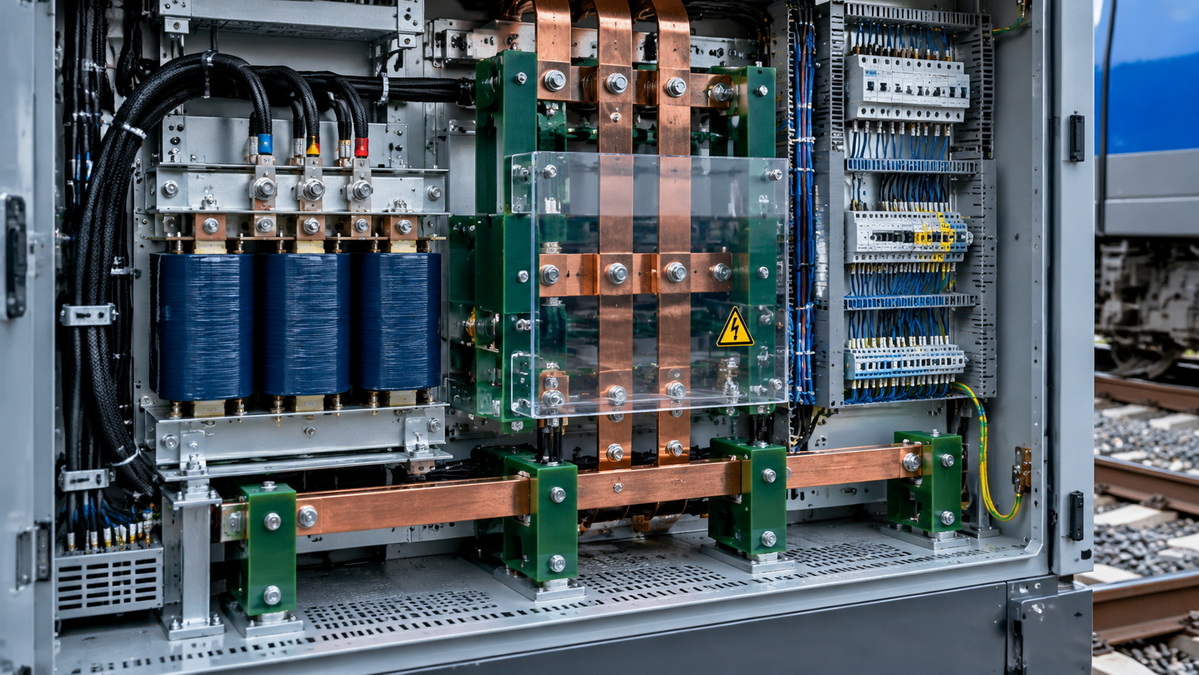
G11 fiberglass sheet is a rigid electrical insulation laminate made from woven glass-fiber cloth and high-temperature epoxy resin. The material is manufactured through a controlled process in which fiberglass fabric is impregnated with epoxy resin, layered, pressed, and cured under heat and pressure.
The woven fiberglass reinforcement gives G11 sheet its structural strength. The epoxy resin matrix provides insulation performance, chemical resistance, moisture resistance, and bonding strength between the fiberglass layers.
G11 is commonly selected when an electrical insulation material must perform under elevated temperature and mechanical stress. It is especially suitable for components that must maintain their shape while carrying loads, resisting vibration, or operating close to heat-generating electrical equipment.
Typical G11 fiberglass sheet applications include:
- Electrical insulation barriers
- Busbar support plates
- High-voltage insulation components
- Transformer insulation parts
- Terminal-board supports
- Switchgear insulation panels
- Electrical mounting plates
- Insulating spacers and washers
- CNC-machined insulation blocks
- Motor and generator insulation parts
- High-temperature industrial fixtures
- Structural insulation components
The main strength of G11 is the combination of high-temperature epoxy resin and woven fiberglass cloth. This structure makes the material more suitable for demanding electrical and mechanical environments than many general-purpose epoxy sheets.
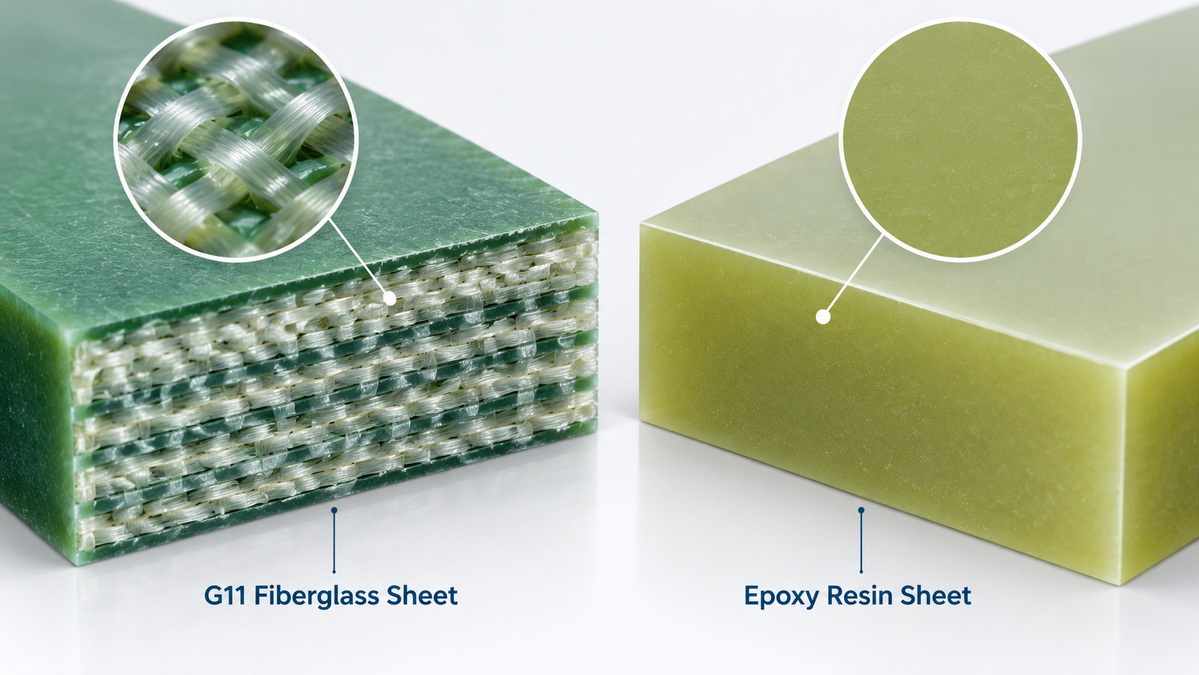
An epoxy resin sheet is a broad material category. It may refer to a rigid sheet made primarily from cured epoxy resin, or a composite sheet containing epoxy resin combined with fillers, glass fiber, mineral additives, paper reinforcement, carbon fiber, or other materials.
Because epoxy resin sheet covers many different constructions, performance can vary significantly from one grade to another.
Some epoxy resin sheets are designed mainly for electrical insulation. Others may be developed for chemical resistance, low-cost panel production, casting, tooling, structural bonding, decorative use, or custom industrial components.
For railway electrical systems, the term "epoxy resin sheet" alone is not enough to determine whether a material is suitable. Buyers and engineers should evaluate the actual technical properties of the selected grade.
Important properties to compare include:
- Dielectric strength
- Insulation resistance
- Continuous operating temperature
- Maximum short-term temperature
- Flexural strength
- Compressive strength
- Water absorption
- Dimensional stability
- Flame-retardant characteristics
- Surface tracking resistance
- Resistance to vibration
- Machining performance
- Thickness tolerance
A general epoxy resin sheet may perform well in a low-stress electrical cover, separator, or barrier. However, it may not provide the same high-temperature rigidity and structural reinforcement as G11 fiberglass sheet.
The following comparison shows how the two materials differ in railway electrical-system applications.
| Property | G11 Fiberglass Sheet | Epoxy Resin Sheet | Importance for Railway Electrical Systems |
|---|---|---|---|
| Material structure | Woven fiberglass cloth reinforced with high-temperature epoxy resin | May be pure epoxy, filled epoxy, or reinforced epoxy | Material construction determines strength, heat resistance, and stability |
| Mechanical strength | High tensile, flexural, and compressive strength | Varies greatly depending on formulation | Important for structural supports and bolted components |
| High-temperature resistance | Generally designed for elevated-temperature service | May range from low to high temperature capability | Important near transformers, resistors, busbars, and traction equipment |
| Dimensional stability | Excellent due to fiberglass reinforcement | Can vary; some grades may creep or deform under heat | Helps maintain electrical clearance and assembly alignment |
| Electrical insulation | Strong dielectric performance for electrical applications | Often good, but depends on grade and filler system | Essential for voltage isolation and insulation reliability |
| Vibration resistance | Usually strong because of reinforced laminate structure | May be lower for non-reinforced grades | Important in rail vehicles and underfloor electrical equipment |
| Moisture resistance | Generally good with suitable resin system and fabrication quality | Varies based on formulation and reinforcement | Relevant in humid, outdoor, and condensation-prone environments |
| CNC machining | Suitable for drilling, milling, routing, and cutting | Usually machinable, but performance can differ | Important for customized railway insulation components |
| Cost level | Usually higher than basic epoxy sheets | Can be lower for standard or non-reinforced grades | Initial cost should be balanced against service life |
| Typical use | Heavy-duty electrical and structural insulation | Covers, barriers, low-load insulation parts, and specialized applications | Final selection should match application requirements |
Railway electrical systems operate in a more complex environment than many stationary industrial electrical systems. Components may be exposed to repeated movement, vibration, sudden temperature changes, humidity, dust, and electrical loading.
A material that performs well in a static indoor control cabinet may not provide the same long-term reliability in a rail vehicle.
Railway insulation components may be installed in:
- Traction converters
- Power-distribution cabinets
- Switchgear assemblies
- Transformer compartments
- Motor-control systems
- Battery systems
- Signal equipment
- Auxiliary power units
- Underfloor electrical enclosures
- Charging and energy-management systems
- High-current busbar systems
In these locations, the insulation material may have to prevent electrical contact while also supporting mechanical loads.
For example, a busbar support plate must electrically isolate conductive copper or aluminum bars. At the same time, it may need to withstand bolt pressure, vibration, thermal expansion, and current-related heating.
If the insulation plate loses rigidity, cracks, warps, absorbs moisture, or shifts under vibration, electrical clearance may be reduced. This can increase the risk of insulation failure, tracking, arcing, or equipment damage.
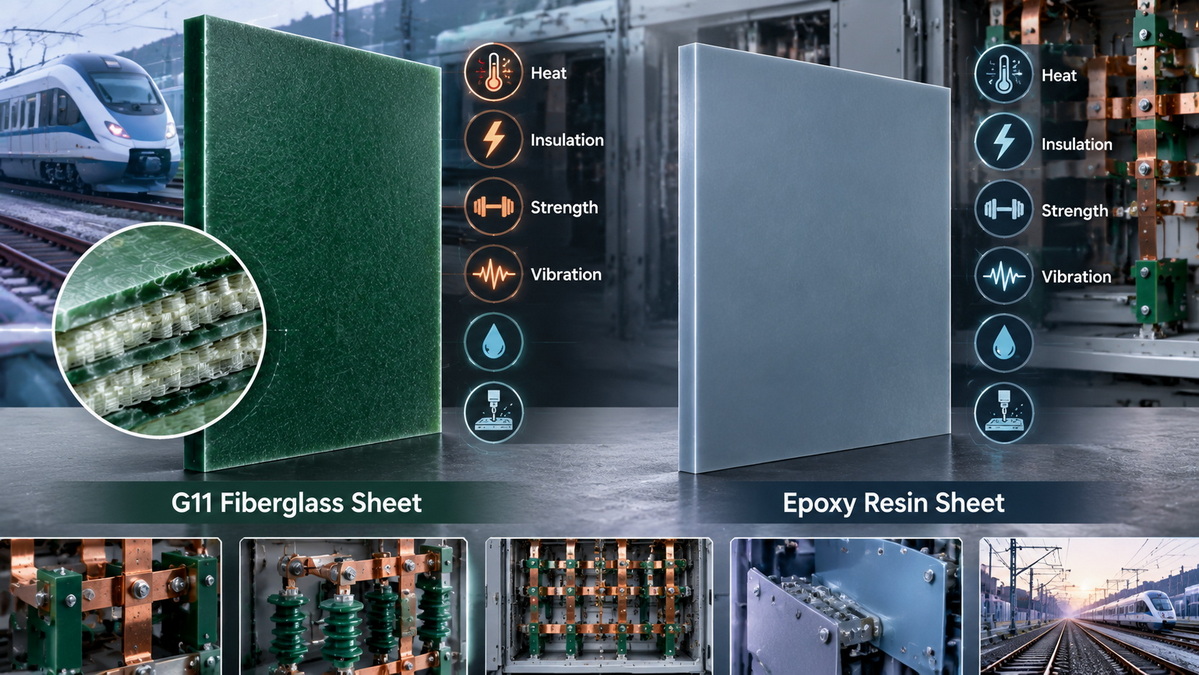
Thermal resistance is one of the most important differences between G11 fiberglass sheet and many general epoxy resin sheet grades.
Railway electrical components can generate heat during continuous operation. Common heat sources include:
- Transformers
- High-current busbars
- Power resistors
- Inverters
- Rectifiers
- Electric motors
- Contactors
- Battery-management systems
- Charging equipment
- Traction power assemblies
G11 fiberglass sheet is commonly used in high-temperature electrical applications because its reinforced structure helps it retain mechanical stability at elevated temperatures.
The fiberglass layers provide a stable framework that resists softening, distortion, and excessive thermal expansion. The high-temperature epoxy resin system supports the electrical insulation performance of the material.
A general epoxy resin sheet may also offer good heat resistance, but its performance depends on the resin formulation. Some grades may be suitable only for moderate operating temperatures. Others may lose stiffness or experience dimensional change when exposed to prolonged heat.
For railway applications near heat-generating equipment, engineers should review:
- Continuous operating temperature
- Short-term temperature resistance
- Thermal index
- Glass-transition temperature
- Thermal expansion behavior
- Mechanical-property retention at elevated temperature
- Electrical-property retention after heat aging
A material should not be selected only based on its room-temperature strength. Its performance after months or years of temperature cycling is often more important.
Railway systems create continuous vibration. Mechanical shock can also occur during braking, acceleration, track transitions, coupling, transport, maintenance, and emergency operating conditions.
This makes mechanical strength especially important for insulation components that have a structural role.
G11 fiberglass sheet is well suited to applications where the material must carry a load while maintaining electrical insulation. The woven fiberglass reinforcement improves tensile strength, flexural strength, and compressive strength.
This can be valuable for:
- Busbar supports
- Insulating mounting plates
- Electrical brackets
- Switchgear panels
- Transformer support components
- Spacer blocks
- Bolt-loaded insulation plates
- Rail electrical cabinet partitions
- Machined structural insulation parts
A standard epoxy resin sheet may be suitable for low-load parts. However, if the material does not contain strong reinforcement, it may be more likely to deform, crack, creep, or lose dimensional stability under continuous stress.
Consider a railway electrical cabinet with copper busbars mounted on insulation supports.
The support material must:
1. Keep the busbars electrically separated.
2. Maintain fixed spacing under vibration.
3. Resist heat from electrical current.
4. Support the weight of the busbars.
5. Withstand compression from bolts and mounting hardware.
6. Avoid deformation over long-term service.
For this type of application, G11 fiberglass sheet is often the better material choice because it can provide both electrical insulation and structural stability.
A non-reinforced epoxy resin sheet may initially meet the insulation requirement. However, if it compresses or deforms over time, the busbar position may change and reduce the intended clearance distance.
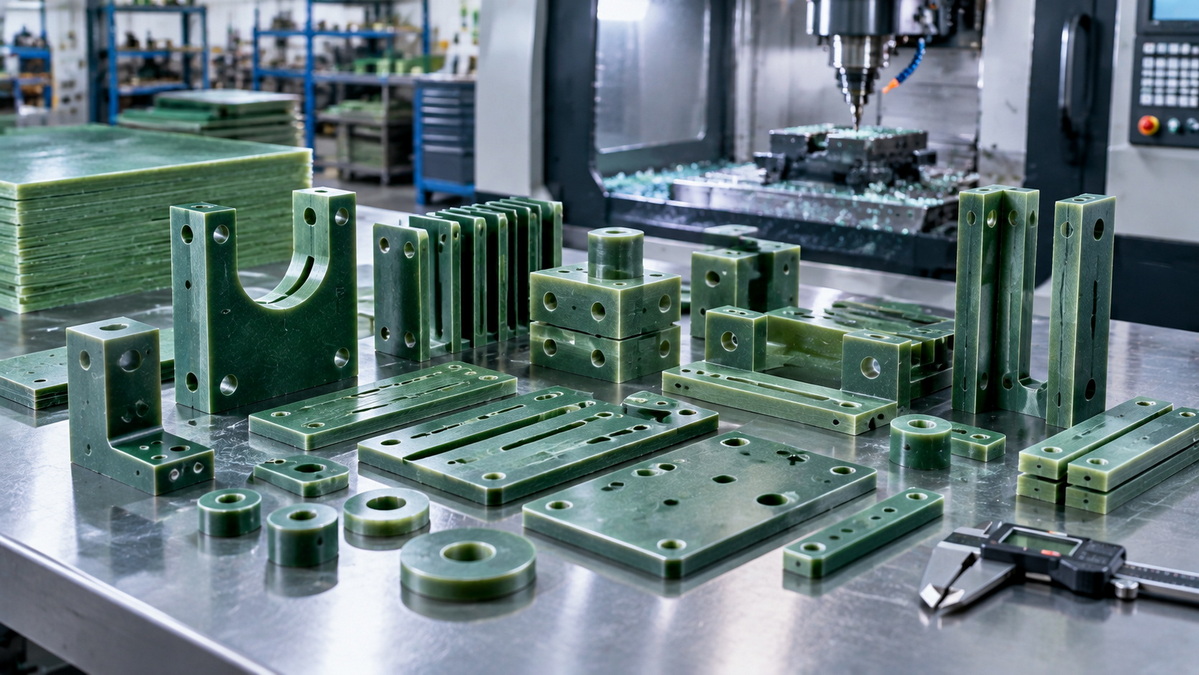
Both G11 fiberglass sheet and epoxy resin sheet can provide electrical insulation. However, their performance must be evaluated under actual operating conditions.
Important electrical properties include:
- Dielectric strength
- Insulation resistance
- Arc resistance
- Surface tracking resistance
- Volume resistivity
- Surface resistivity
- Moisture-conditioned dielectric performance
- High-temperature electrical stability
G11 fiberglass sheet is widely used for electrical insulation because it combines a stable epoxy resin system with glass-fiber reinforcement. It can be manufactured in different thicknesses and machined into insulation parts that fit complex electrical structures.
However, electrical performance is affected by more than the sheet itself. It can also depend on:
- Part thickness
- Surface cleanliness
- Moisture exposure
- Machined edge quality
- Hole design
- Distance between conductive parts
- Assembly pressure
- Contamination from oil or dust
- Long-term thermal aging
For high-voltage railway systems, proper part design is just as important as material selection. A high-quality material should be combined with adequate creepage distance, clearance distance, mounting support, and environmental protection.
Railway electrical systems can operate in humid environments. Condensation may occur when rail vehicles move between different temperature zones. Outdoor equipment, underfloor enclosures, coastal routes, tunnels, and washdown procedures can also increase moisture exposure.
Moisture can affect insulation performance over time. It may contribute to reduced insulation resistance, surface contamination, tracking risk, or dimensional changes.
G11 fiberglass sheet generally provides good moisture resistance when it is produced with a suitable resin system and fabricated correctly. However, cut edges, drilled holes, damaged surfaces, and poorly controlled machining can create potential exposure points.
Epoxy resin sheet performance varies by grade. Some specialty epoxy sheets may be designed for strong moisture resistance. Others may be more appropriate for dry indoor conditions.
For railway applications exposed to humidity, consider:
- Water absorption performance
- Insulation resistance after humidity conditioning
- Surface quality
- Edge-sealing requirements
- Chemical compatibility
- Resistance to cleaning agents
- Resistance to oil and grease
- Temperature cycling behavior
- Resistance to salt mist, where relevant
A material should be selected as part of a complete component design. Good installation practices, protective enclosures, clean assembly conditions, and proper fastener selection can all improve long-term reliability.
Fire safety is a major consideration for railway electrical systems, especially in passenger rail vehicles. Material selection may need to consider flame spread, heat release, smoke generation, and toxic-gas behavior.
G11 fiberglass sheet should not automatically be considered suitable for every railway fire-safety requirement simply because it is a high-performance electrical laminate. The actual result depends on the specific resin system, material thickness, additives, manufacturing process, installation location, and tested configuration.
The same principle applies to epoxy resin sheet.
A railway project may require evaluation of:
- Flame-retardant characteristics
- Smoke density
- Smoke toxicity
- Heat release
- Material thickness
- Hazard classification
- End-use component category
- Installation location
- Customer-specific technical specifications
For rail projects serving European markets, material requirements may be connected to EN 45545-2. Other markets may use different railway fire-safety standards or customer-specific specifications.
Before approving an insulation material for a railway project, buyers should request the relevant technical documentation and testing information for the exact product grade.
The best material-selection process starts with the actual function of the part.
Instead of asking only whether G11 or epoxy resin sheet is better, ask what the component must do during its full service life.
Confirm:
- Operating voltage
- Peak voltage
- Current level
- Required dielectric strength
- Insulation resistance requirement
- Arc exposure risk
- Clearance distance
- Creepage distance
- Location near live conductors
Evaluate:
- Normal operating temperature
- Maximum temperature
- Temperature cycling range
- Distance from heat-generating equipment
- Required thermal aging performance
- Long-term heat exposure
- Emergency overload temperature
Review:
- Continuous load
- Bolt compression
- Vibration level
- Shock loading
- Required stiffness
- Required thickness
- Dimensional tolerance
- Need for drilled holes, slots, threads, or milled features
Consider:
- Humidity
- Condensation
- Dust
- Oil
- Cleaning chemicals
- Salt mist
- UV exposure
- Outdoor exposure
- Underfloor installation
- Maintenance access
Review:
- Technical data sheet
- Material grade
- Electrical test results
- Thermal-performance data
- Mechanical-property data
- Flame-retardant information
- Railway-related test documentation
- Batch traceability
- Machining recommendations
- Thickness tolerance
This process helps engineering teams avoid selecting a material based only on a product name or initial purchase price.
Many railway insulation parts require more than standard flat sheets. They may need to be drilled, milled, routed, cut, punched, shaped, or assembled according to technical drawings.
G11 fiberglass sheet is suitable for customized machining. It can be processed into many component types, including:
- Insulation washers
- Spacer blocks
- Terminal supports
- Busbar support panels
- Electrical mounting boards
- Slotted insulation plates
- High-voltage separation barriers
- Switchgear brackets
- Transformer support components
- Precision-cut cabinet panels
During machining, G11 produces fiberglass dust. This requires suitable dust extraction, protective equipment, and clean processing conditions.
The machining process should also control:
- Tool selection
- Cutting speed
- Feed rate
- Drilling parameters
- Edge smoothness
- Burr removal
- Delamination prevention
- Hole accuracy
- Thickness consistency
- Final inspection
For electrically critical parts, clean machining and consistent dimensions are essential. Rough edges, damaged surfaces, poor-quality drilled holes, or laminate separation can reduce assembly quality and create long-term reliability concerns.
For high-temperature, vibration-prone, or mechanically loaded railway electrical applications, G11 fiberglass sheet is generally the stronger material option.
Its fiberglass reinforcement helps it provide:
- High mechanical strength
- Good dimensional stability
- Strong electrical insulation
- Elevated-temperature capability
- Reliable performance in structural insulation applications
- Good machinability for customized parts
- Suitable rigidity for busbar and transformer support systems
Epoxy resin sheet can be a useful alternative when the application has lower mechanical stress, moderate temperature requirements, or a need for a specialized resin formulation.
The most important requirement is to select the material based on verified technical data and the real operating environment.
For critical railway electrical components, the material should be evaluated according to temperature, voltage, mechanical load, vibration, humidity, fire-safety needs, machining requirements, and final installation conditions.
Guangdong Weishi New Materials Co., Ltd. provides epoxy fiberglass sheets, G10 sheets, G11 sheets, FR4 sheets, and customized insulation components for electrical and industrial applications. With stable material quality, controlled manufacturing processes, and flexible machining capabilities, the company supports customers seeking reliable insulation-material solutions for demanding electrical assemblies.
No. G11 fiberglass sheet is a reinforced epoxy laminate made with woven fiberglass cloth and a high-temperature epoxy resin system. Epoxy resin sheet is a broader category that can include many different resin formulas, fillers, and reinforcement structures.
G11 is commonly suitable for railway electrical parts that require strong insulation, elevated-temperature resistance, mechanical strength, vibration resistance, and dimensional stability. Final suitability should be confirmed based on the specific rail application and material documentation.
G11 is often selected for higher-temperature applications because it generally uses a higher-temperature epoxy system than standard FR4. However, the correct choice depends on the actual temperature range, electrical requirements, mechanical load, and technical properties of the selected grade.
Yes. G11 can be drilled, milled, routed, cut, and fabricated into customized insulation components. Proper tooling, machining parameters, dust extraction, and edge finishing are important during processing.
Yes, some epoxy resin sheets can be used for busbar insulation. However, for busbar supports that must withstand high temperature, vibration, bolt pressure, and mechanical load, G11 fiberglass sheet is often a more reliable choice.
G11 generally provides good moisture resistance, but actual performance depends on the resin system, laminate quality, machining quality, part design, and environmental exposure. Moisture-related properties should be reviewed for the exact material grade.
Useful information includes sheet thickness, dimensions, quantity, color, operating temperature, voltage level, technical drawing, machining requirements, tolerance, target application, certification needs, and shipping destination.
1. [Atlas Fibre — G-11 Material Specification Data Sheet]
2. [Bakelite Sheets — Technical Data Sheet of Glass Epoxy Laminates Grade LPL/G11]
3. [The Gund Company — NEMA G-11 Formable Technical Data Sheet]
4. [ZVEI — Fire Protection in Rail Vehicles According to EN 45545]
5. [Rogers Corporation — EN 45545-2 and 49 CFR 238/NFPA 130 Railway Safety Standards]
6. [Measurlabs — Guide to EN 45545-2 Fire Testing Requirements for Railway Materials]


