

Views: 224 Author: Weishi Sheets Publish Time: 2026-09-12 Origin: Site
Content Menu
>> Key Characteristics of G10 Sheet
● G10 Sheet vs Epoxy Plate: Main Differences
● Electrical Insulation for Lithium Battery Modules
>> Dielectric Strength Is Only One Requirement
>> Creepage Distance and Clearance Distance
● Mechanical Strength and Structural Support
>> Where G10 Offers a Mechanical Advantage
● Flame Retardancy: G10 vs FR4 Epoxy Plate
● Thermal Performance in Battery Modules
>> Why Thermal Cycling Matters
>> High-Temperature Material Selection
● Moisture, Humidity, and Chemical Exposure
>> Environmental Factors to Evaluate
● G10 Sheet vs Epoxy Plate for CNC Machining
>> Important Machining Considerations
● Practical Material Selection Guide
>> Five Questions to Ask Before Buying
● Common Material Selection Mistakes
>> Using "Epoxy Plate" as the Only Specification
>> Assuming G10 and FR4 Are the Same
>> Ignoring Finished-Part Geometry
>> Skipping Assembly-Level Validation
● Summary
● FAQ
>> Is G10 sheet suitable for lithium battery module insulation?
>> What is the difference between G10 sheet and epoxy plate?
>> Is G10 better than FR4 for lithium battery insulation?
>> Can G10 sheet be used near high-temperature battery components?
>> Does a thicker epoxy plate always provide better insulation?
>> Does G10 sheet have flame-retardant properties?
>> What information should be provided when ordering G10 sheet or epoxy plate?
>> Why is CNC machining important for battery insulation parts?
Choosing between a G10 sheet and an epoxy plate for lithium battery module insulation is not simply a matter of selecting a familiar material name. Battery modules combine electrical energy, mechanical pressure, heat, vibration, and tightly controlled spacing. The insulation material must perform reliably in all of these conditions at the same time.
A G10 sheet is a specific fiberglass-reinforced epoxy laminate. An epoxy plate is a broader category that may include G10, FR4, G11, and other epoxy composite materials with different resin systems, reinforcement structures, flame-retardant properties, and temperature capabilities.
For many lithium battery module applications, G10 sheet is a dependable choice when electrical insulation and mechanical strength are both required. However, a flame-retardant FR4 epoxy plate, a high-temperature G11 plate, or a customized glass epoxy composite may be more suitable when the project has stricter safety, heat-resistance, or processing requirements.
This guide explains the key differences between G10 sheet and epoxy plate for lithium battery module insulation. It also provides practical selection criteria for battery manufacturers, module assemblers, engineers, and purchasing teams.
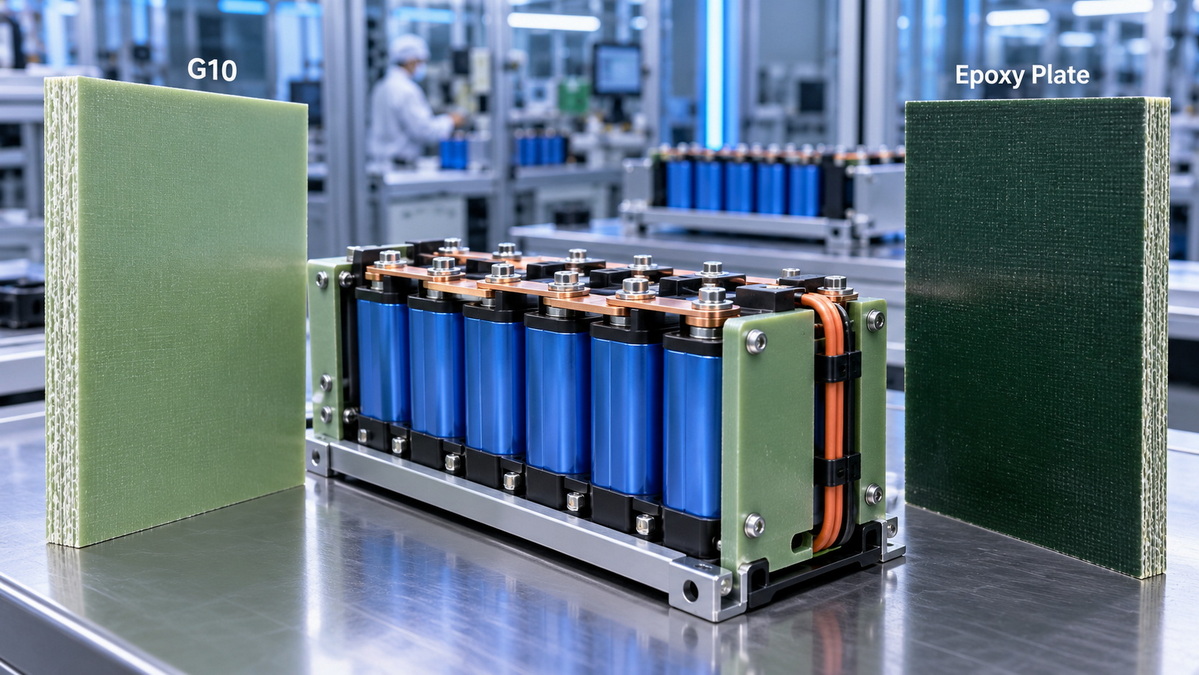
A G10 sheet is a rigid laminated insulation material made from woven fiberglass cloth and epoxy resin. During production, layers of fiberglass fabric are impregnated with epoxy resin, stacked, and cured under controlled heat and pressure.
The finished laminate has a dense, strong, and electrically insulating structure. The woven fiberglass reinforcement gives G10 its rigidity and mechanical strength. The cured epoxy resin provides dielectric insulation, chemical resistance, and stable performance in many industrial environments.
G10 is widely used in electrical equipment, machinery, mold manufacturing, electronic systems, and high-voltage insulation components.
G10 sheet is valued for several important performance features:
- High mechanical strength for load-bearing insulation parts
- Good dielectric insulation for electrical separation
- Strong compression resistance in assembled battery structures
- Good dimensional stability during machining and installation
- Low moisture absorption compared with many conventional insulating materials
- Reliable CNC machinability for holes, slots, rounded corners, and complex profiles
- Resistance to many industrial oils and chemicals
- Lower thermal expansion than many unreinforced plastic insulation boards
For lithium battery modules, G10 can work as both an insulation barrier and a structural support component. This dual function makes it especially useful in compact battery assemblies.
An epoxy plate is a general description for a board or laminate made with epoxy resin. Unlike G10, which refers to a specific type of glass-fabric epoxy laminate, epoxy plate can describe many different material constructions.
For example, an epoxy plate may be made from:
- Woven fiberglass cloth and epoxy resin
- Fiberglass mat and epoxy resin
- Flame-retardant epoxy resin systems
- High-temperature epoxy formulations
- Filled epoxy systems
- Custom composite reinforcement structures
- Epoxy resin combined with glass fabric, paper, cotton fabric, or other substrates
Because "epoxy plate" is a broad term, its performance can vary significantly from one supplier or grade to another.
One epoxy plate may offer excellent flame retardancy but moderate mechanical strength. Another may have high compressive strength but limited high-temperature performance. A third may be designed for low-cost general insulation rather than precision battery module applications.
The most accurate comparison is not G10 versus epoxy chemistry. G10 itself contains epoxy resin. The real comparison is between a defined glass-fabric epoxy laminate grade and a broader family of epoxy-based insulation boards.
| Property | G10 Sheet | General Epoxy Plate |
|---|---|---|
| Material definition | A specific fiberglass-reinforced epoxy laminate grade | A broad category of epoxy insulation materials |
| Reinforcement | Usually woven E-glass fabric | May be fiberglass, filler, paper, fabric, or other reinforcement |
| Mechanical strength | Generally high | Varies by grade and construction |
| Electrical insulation | Consistent when produced to a controlled specification | Can vary widely between products |
| Flame retardancy | Standard G10 is not usually flame retardant | May be standard, flame retardant, FR4, or custom grade |
| Heat resistance | Suitable for many medium-temperature applications | Can range from standard to high-temperature grades |
| Dimensional stability | Strong under compression and machining | Depends on reinforcement and resin formulation |
| Machinability | Excellent for CNC machining and precision parts | Varies based on board structure |
| Best application | Structural electrical insulation components | Custom insulation needs and specialized requirements |
For lithium battery modules, the choice should be based on actual operating conditions rather than material name alone.
Electrical insulation is one of the most important functions of a battery module insulation board. Lithium battery modules contain cells, busbars, terminals, sensing lines, connectors, battery management system components, metal housings, cooling systems, and mounting structures.
The insulation material must prevent unintended electrical contact between conductive components.
A high-quality G10 sheet or properly specified epoxy plate can help isolate:
- Copper busbars from metal housings
- Positive and negative terminals
- Cell groups and electrical connection points
- Module frames and conductive mounting brackets
- High-voltage connection areas
- Sensor assemblies and electronic control components
- Cooling plates and electrical conductors
Dielectric strength is important because it measures a material's ability to resist electrical breakdown. However, a battery insulation design should not rely only on dielectric strength.
A safe battery module design must also evaluate:
- Nominal battery voltage
- Maximum charge voltage
- Transient voltage conditions
- Insulation thickness
- Creepage distance
- Clearance distance
- Surface contamination risk
- Humidity and condensation exposure
- Material tracking resistance
- Sharp-edge locations
- Busbar geometry
- Assembly tolerances
- Long-term thermal aging
A thick insulation board does not automatically create a safe design. Electrical current can travel through air gaps or across contaminated material surfaces. The spacing between conductive components, the quality of the enclosure, and the condition of the insulation surface are all important.
Battery engineers should understand two essential electrical safety concepts.
Clearance distance is the shortest distance through air between two conductive components.
Creepage distance is the shortest path along the surface of an insulating material between two conductive components.
For example, a G10 sheet may have strong dielectric properties, but a short creepage path around a busbar edge can still create an electrical risk. Dust, humidity, electrolyte residue, conductive contamination, and condensation can reduce the reliability of surface insulation.
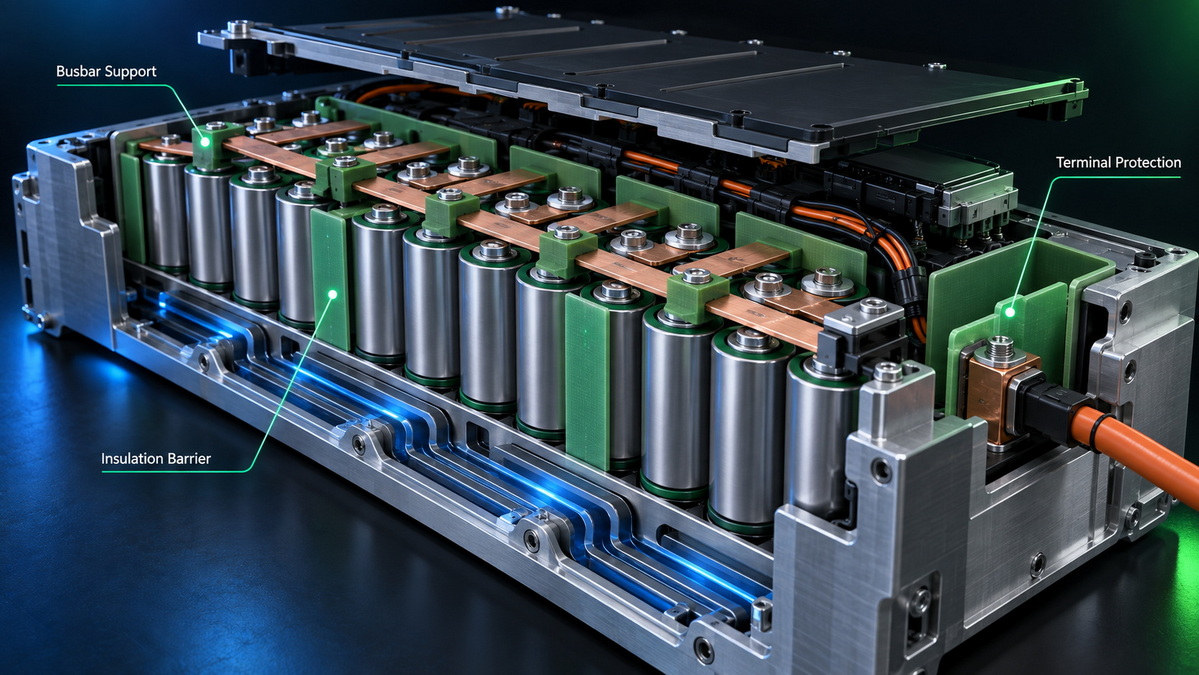
Lithium battery modules are exposed to mechanical stress during manufacturing, transportation, installation, charging, discharging, vibration, and long-term use.
Depending on the battery design, insulation plates may need to support:
- Cell compression force
- Module clamping pressure
- Busbar mounting loads
- Fastener torque
- Vibration and shock
- Assembly fixture pressure
- Thermal expansion stress
- Contact pressure near terminals and connectors
This is one of the main reasons why G10 sheet is commonly selected for demanding insulation applications.
The fiberglass fabric reinforcement gives G10 strong rigidity and compression resistance. Compared with many general-purpose epoxy boards, G10 can maintain its shape more effectively when used as a structural insulation component.
G10 sheet is often a suitable choice for:
- Battery module end plates
- Busbar support panels
- High-voltage terminal insulation boards
- Battery cell separator plates
- Structural insulation spacers
- Electrical mounting brackets
- Insulated support blocks
- Precision-machined insulation parts
- High-load electrical barriers
A general epoxy plate may still be suitable if it has a comparable glass-fiber reinforcement structure and verified mechanical properties. However, material consistency should always be confirmed before production.
Flame retardancy is an important consideration in lithium battery module design. Battery packs can experience elevated temperatures during rapid charging, high-current discharge, abnormal electrical conditions, or thermal events.
Standard G10 and FR4 are closely related materials, but they are not identical.
G10 is generally a glass-fiber-reinforced epoxy laminate without a flame-retardant resin formulation. FR4 is also a fiberglass epoxy laminate, but it is formulated to provide flame-retardant performance.
| Flame Performance Factor | Standard G10 Sheet | FR4 Epoxy Plate |
|---|---|---|
| Fiberglass reinforcement | Yes | Yes |
| Epoxy resin system | Yes | Yes |
| Flame-retardant formulation | Usually no | Usually yes |
| Suitable for standard structural insulation | Yes | Yes |
| Suitable when flame performance is required | Depends on project requirements | Often preferred |
| Material verification needed | Yes | Yes |
| Thickness-specific flame rating | Must be checked | Must be checked |
For battery modules with strict flame-retardancy requirements, FR4 epoxy plate may be a more appropriate option than standard G10.
However, buyers should not assume that every material labeled FR4 will automatically meet a specific flame rating at every thickness. Flame performance can depend on the resin formulation, board thickness, manufacturing process, and applicable test method.
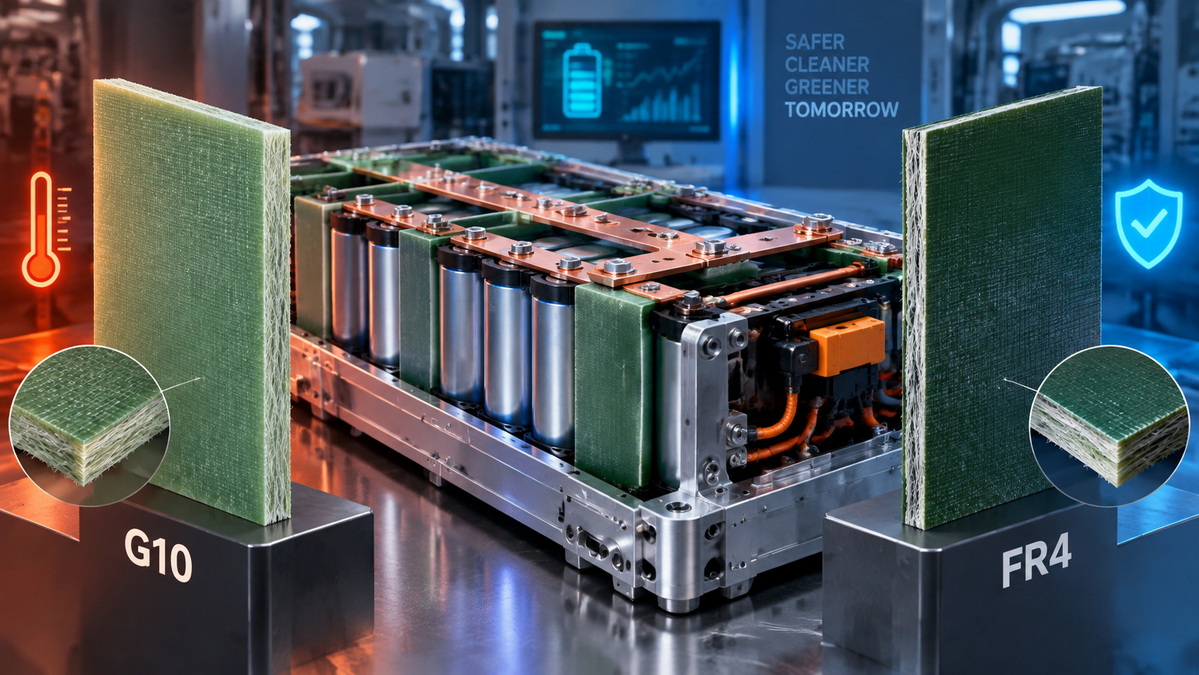
Battery-module insulation materials must perform under continuous temperature exposure and repeated thermal cycling.
Heat can come from several sources:
- Cell charging and discharging
- High-current busbars
- Electrical connectors
- Contact resistance
- Battery management electronics
- External environmental temperatures
- Cooling system imbalance
- Localized overheating
- Abnormal operating conditions
Standard G10 is commonly used in medium-temperature electrical insulation environments. For battery modules with higher thermal demands, a high-temperature epoxy plate such as G11 may be considered.
A battery module may repeatedly heat up and cool down throughout its service life. Each cycle can create expansion and contraction in cells, metal busbars, aluminum housings, steel brackets, adhesives, thermal pads, and insulation boards.
If the insulation material expands too much, softens at elevated temperature, cracks under stress, or loses dimensional stability, it can affect the electrical spacing and mechanical fit of the module.
When evaluating G10 sheet or epoxy plate for a lithium battery application, consider:
- Maximum continuous operating temperature
- Short-term peak temperature
- Number of expected thermal cycles
- Local hot spots near busbars and terminals
- Thermal expansion compatibility with metal components
- Compression load at elevated temperature
- Heat-aging behavior
- Insulation performance after thermal cycling
For standard module designs with controlled thermal conditions, G10 may provide reliable insulation and structural performance.
For more demanding applications, such as high-power energy storage systems, electric vehicle battery assemblies, industrial battery equipment, or modules located near high-temperature electrical components, a higher-temperature epoxy laminate may offer additional safety margin.
Possible material options include:
- FR4 epoxy plate for flame-retardant insulation
- G11 epoxy plate for higher-temperature resistance
- Customized glass epoxy laminate for special mechanical requirements
- Multi-layer composite insulation board for complex module structures
The most suitable material should be selected after reviewing the actual temperature profile of the finished battery module.
Lithium battery modules are often installed inside sealed housings, but environmental exposure should still be considered. Moisture can enter through damaged seals, assembly defects, pressure changes, condensation, storage conditions, or long-term aging.
Humidity can affect electrical insulation performance, especially when contamination accumulates on the surface of an insulation board.
G10 sheet and high-quality epoxy plates are generally valued for their moisture resistance and stable electrical behavior. However, actual performance depends on material quality, resin cure, fiberglass structure, edge condition, and exposure environment.
Battery module insulation materials may be exposed to:
- High humidity
- Condensation
- Dust and fine particles
- Electrolyte residue
- Industrial oils
- Cleaning chemicals
- Adhesive materials
- Thermal interface materials
- Cooling fluids
- Salt spray in outdoor or vehicle applications
- Chemical vapors during manufacturing
For harsh environments, material selection should include chemical compatibility testing. A board that performs well in a dry indoor environment may not provide the same long-term reliability in a humid, contaminated, or chemically exposed battery system.
Lithium battery modules often require customized insulation components rather than standard rectangular sheets. Common parts include busbar support plates, terminal barriers, insulating spacers, cell separators, end boards, sensor supports, and mounting panels.
These components may require:
- CNC drilling
- Precision slotting
- Routing
- Milling
- Countersunk holes
- Rounded corners
- Chamfers
- Terminal openings
- Cable-routing channels
- Complex internal cutouts
- Identification marks
G10 sheet is widely used for precision machining because its fiberglass-reinforced structure provides stable cutting behavior and good dimensional retention.
Although G10 and fiberglass epoxy plates can be machined accurately, the finished-part quality depends on processing experience.
Poor machining can create:
- Rough edges
- Fiber pull-out
- Delamination
- Excessive burrs
- Uneven hole positions
- Cracks around corners
- Incorrect thickness
- Weak edge distances
- Reduced creepage distance
For battery-module insulation parts, accurate machining is not only a visual-quality requirement. It directly affects assembly fit, insulation spacing, vibration resistance, and electrical safety.
A reliable supplier should be able to manufacture parts according to drawings, control tolerances, inspect key dimensions, and provide stable quality across production batches.
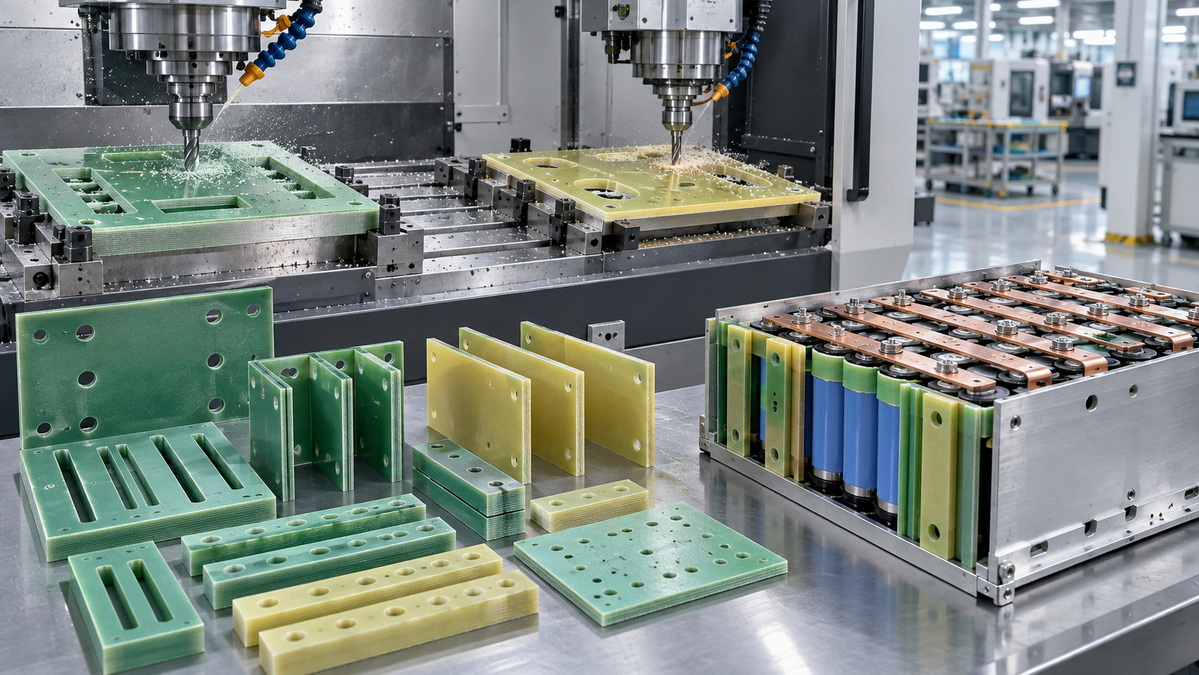
The following comparison can help battery manufacturers choose between G10 sheet and epoxy plate.
| Application Requirement | Recommended Material Direction |
|---|---|
| Structural insulation with strong mechanical loading | G10 sheet or reinforced glass epoxy plate |
| Flame-retardant insulation requirement | FR4 epoxy plate with verified flame classification |
| Higher-temperature operating environment | G11 or a verified high-temperature epoxy laminate |
| Precision busbar support component | G10 sheet or precision-machined FR4 |
| General low-load electrical barrier | Standard epoxy plate with verified insulation data |
| Battery-module end plate or spacer | G10 sheet with suitable thickness and machining tolerance |
| High-voltage terminal insulation | FR4, G10, or G11 based on voltage, heat, and flame requirements |
| Complex customized insulation structure | Custom-machined glass epoxy composite plate |
Before selecting G10 sheet or epoxy plate, ask the following questions:
1. What is the battery module's nominal and maximum voltage?
2. Does the insulation part need flame-retardant performance?
3. Will the part support compression force, fastener torque, or vibration loads?
4. What are the normal and maximum operating temperatures?
5. What machining tolerances, thicknesses, slots, holes, and shapes are required?
Answering these questions early can prevent incorrect material selection, repeated sampling, assembly problems, and unnecessary production delays.
Low-cost epoxy plates may not provide consistent thickness, resin content, electrical insulation, flame performance, or machining quality. A lower material price can create higher costs if the finished parts fail during assembly or testing.
The phrase "epoxy plate" does not define the resin system, reinforcement, flame rating, thermal resistance, thickness tolerance, or mechanical performance.
A clear specification should include the required material grade and key technical requirements.
G10 and FR4 are both fiberglass epoxy laminates, but standard G10 is not normally selected for flame-retardant applications. FR4 is generally the more suitable choice when flame resistance is a critical project requirement.
A high-quality insulation board can still fail in the final module if the part has sharp corners, insufficient creepage distance, poorly located holes, weak edges, or incorrect clearances around busbars and terminals.
A material data sheet is useful, but it does not replace testing in the finished battery module. The final component should be evaluated under realistic electrical, thermal, humidity, compression, vibration, and assembly conditions.
G10 sheet and epoxy plate are both valuable insulation-material options for lithium battery module applications. The best choice depends on the full operating environment and the exact function of the component.
Choose G10 sheet when the application requires strong structural support, reliable dielectric insulation, dimensional stability, compression resistance, and precision machining.
Choose a flame-retardant FR4 epoxy plate when the battery module requires verified flame performance in addition to electrical insulation and mechanical strength.
Choose a high-temperature epoxy plate, such as G11 or a customized composite material, when the application has demanding thermal conditions or specialized performance requirements.
The most reliable battery module insulation design combines the right material grade with appropriate thickness, sufficient creepage and clearance distance, precise machining, controlled assembly, and validation under real operating conditions.
For customized G10 sheets, FR4 plates, G11 insulation boards, and precision-machined battery insulation components, Guangdong Weishi New Materials Co., Ltd. provides material selection support and flexible processing solutions based on drawings, thickness requirements, application conditions, and production needs.
Yes. G10 sheet is suitable for many lithium battery module insulation applications because it combines electrical insulation, mechanical strength, compression resistance, dimensional stability, and good machinability. It is especially useful for structural insulation components such as busbar supports, module end plates, spacers, and terminal barriers.
G10 is a specific type of fiberglass-reinforced epoxy laminate. Epoxy plate is a broader term that can include G10, FR4, G11, and many other epoxy-based insulation boards. The actual properties of an epoxy plate depend on its resin system, reinforcement type, flame performance, and manufacturing process.
G10 is often preferred for strong structural insulation parts, while FR4 is commonly selected when flame-retardant performance is required. The correct choice depends on the battery module's voltage, temperature, mechanical loading, flame requirement, and final application environment.
G10 can be used in many medium-temperature battery applications. However, for high-temperature areas near busbars, terminals, power electronics, or other heat-generating components, a higher-temperature grade such as G11 or a specially designed epoxy laminate may be more appropriate.
Not necessarily. Thickness can improve through-thickness electrical insulation, but overall safety also depends on creepage distance, clearance distance, material tracking resistance, moisture exposure, contamination level, edge quality, and the geometry of the finished insulation part.
Standard G10 sheet is generally not considered a flame-retardant material. If flame performance is required, FR4 or another verified flame-retardant epoxy laminate should be considered.
Provide the material grade, thickness, dimensions, drawing, tolerance, operating temperature, operating voltage, flame requirement, quantity, machining details, application environment, and any required test documents or certifications.
Battery modules often require precise holes, slots, terminal openings, edge distances, and mounting features. Accurate CNC machining helps ensure correct assembly fit, stable insulation spacing, reliable creepage distance, and consistent production quality.
1. International Electrotechnical Commission. [IEC 60664-1:2020—Insulation Coordination for Equipment Within Low-Voltage Supply Systems]
2. EV Engineering Online. [How to Manage Creepage and Clearance in High-Density EV Power Modules]
3. Curbell Plastics. [G10/FR4 Glass Epoxy Composite Material Properties and Uses]
4. Ready Plastics. [NEMA G10 vs FR4, G11, G7, G9 Laminates]
5. Ready Plastics. [NEMA G-10 Glass-Epoxy Laminate Specification Overview]
6. Current Inc. [G-10/FR4 Glass-Epoxy Industrial Laminates]
7. T&N Laboratory. [IEC 60664: Insulation Coordination for Low-Voltage Equipment]


