

Views: 243 Author: Weishi Sheets Publish Time: 2026-09-05 Origin: Site
Content Menu
● Understanding G11 and Mica Sheet Materials
>> What Is G11 Epoxy Glass Laminate?
● G11 vs Mica Sheet: Main Performance Differences
● Why G11 Is Often the Better Material for Busbar Supports
>> High Mechanical Strength for Load-Bearing Support
>> Better Precision for Machining and Assembly
● When Mica Sheet Is the Better Choice
>> Superior Resistance to Extreme Heat
>> Strong Thermal Barrier Performance
>> Suitable for Fire-Resistant Insulation Systems
● G11 and Mica Sheet in Hybrid Busbar Designs
● How to Select the Right Material for Your Application
>> Evaluate the Real Operating Temperature
>> Determine Whether the Part Must Carry Load
>> Consider Machining Requirements
>> Check Fire and Flame Requirements
● Installation Considerations for High-Temperature Busbar Supports
>> Maintain Correct Creepage and Clearance Distances
>> Allow for Thermal Expansion
● Expert Material Recommendation
● Summary
>> 1. Is G11 suitable for high-temperature busbar supports?
>> 2. Can mica sheet replace G11 in a busbar support system?
>> 3. Which material has better high-temperature resistance: G11 or mica sheet?
>> 4. Is G11 suitable for CNC machining?
>> 5. Can G11 and mica sheet be used together?
>> 6. What factors determine the thickness of a G11 busbar support?
>> 7. What information is needed for a custom G11 busbar support project?
Selecting the right insulation material for a high-temperature busbar support is not only about electrical insulation. It directly affects mechanical stability, thermal endurance, assembly safety, dimensional accuracy, and long-term equipment reliability.
In demanding power distribution systems, engineers commonly compare G11 epoxy glass laminate with mica sheet insulation. Both materials can provide strong dielectric separation. However, they serve different primary functions. G11 is generally designed to provide a rigid and machinable structural insulation solution. Mica sheet is often selected for exceptional thermal resistance, fire protection, and localized heat shielding.
For busbar assemblies exposed to elevated temperatures, vibration, heavy conductor loads, and repeated thermal cycling, the correct material choice should consider the complete operating environment. Temperature alone is not enough. The final decision should also account for voltage, busbar weight, short-circuit forces, humidity, flame exposure, mounting method, tolerance requirements, and the expected service life of the equipment.
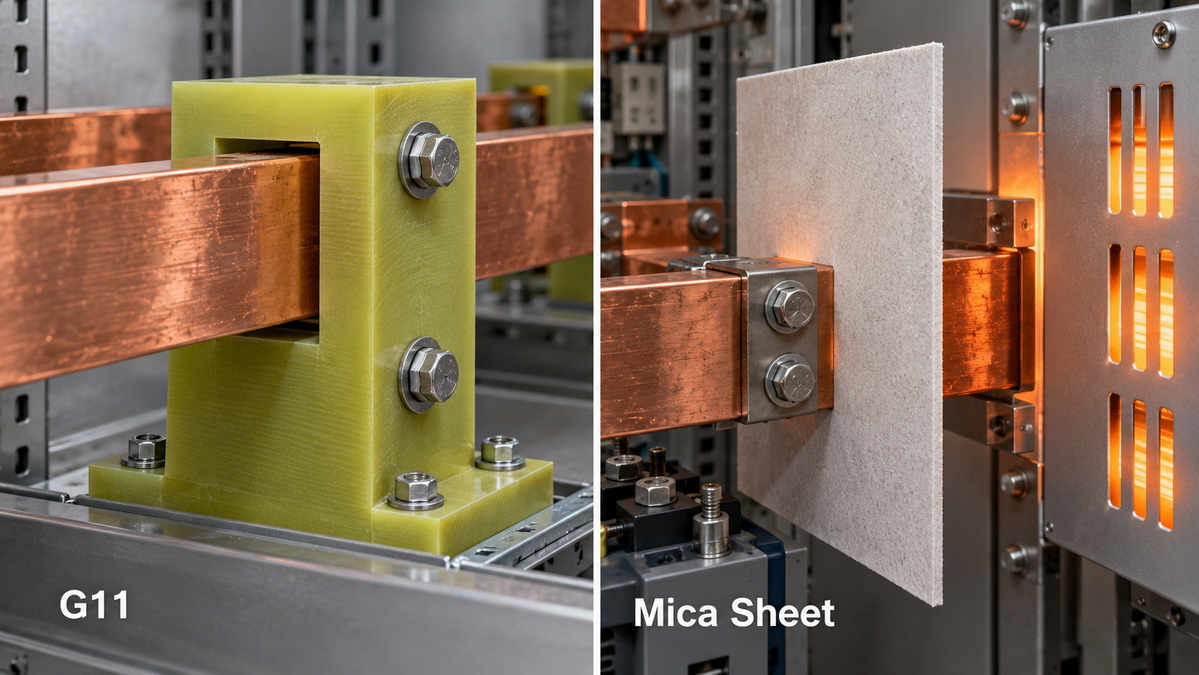
Before comparing G11 and mica sheet for high-temperature busbar supports, it is useful to understand how each material is constructed and why their internal structures influence performance.
G11 is a high-temperature glass-fabric-reinforced epoxy laminate. It is produced by impregnating woven fiberglass cloth with a heat-resistant epoxy resin system. The material is then cured under controlled temperature and pressure to create a rigid, dense, and electrically insulating composite sheet.
The finished material can be supplied in the form of sheets, rods, tubes, washers, spacers, terminal boards, insulation blocks, and custom-machined electrical components.
G11 is often compared with G10 and FR4 because all three belong to the epoxy fiberglass laminate family. However, G11 typically uses a higher-temperature epoxy resin system than standard G10. It is commonly selected where the insulation material must maintain reliable performance under elevated thermal conditions while also carrying mechanical loads.
The core strengths of G11 include:
- High mechanical strength
- Reliable electrical insulation
- Good dimensional stability
- Excellent machinability
- Resistance to elevated temperatures
- Compatibility with custom CNC processing
- Suitability for structural insulation components
For busbar support applications, G11 is valuable because it can function as both an electrical insulator and a rigid structural part.
Mica sheet is an insulation material made from natural mica minerals. The most common types are muscovite mica and phlogopite mica. Depending on the application, mica may be combined with silicone resin, epoxy resin, fiberglass reinforcement, or other binding systems.
Mica has a naturally layered mineral structure. This structure gives it strong dielectric behavior and excellent heat resistance. It can be processed into rigid mica plates, flexible mica paper, mica tape, laminated mica boards, or specialized thermal insulation components.
Mica sheet is commonly used in applications that require high-temperature electrical insulation or fire-resistant protection, including:
- Industrial heating equipment
- Furnace electrical systems
- Heating elements
- Fire-resistant cable systems
- Battery thermal barrier systems
- High-temperature motors and generators
- Electrical coil insulation
- Thermal shields near power electronics
- Electrical barrier layers in high-heat environments
The key advantage of mica is its ability to remain stable under temperatures that would damage many conventional polymer-based insulation materials.
However, extreme heat resistance alone does not make mica the best material for every busbar support. In many installations, the support must carry mechanical load, withstand vibration, maintain precise spacing, and resist fastener pressure. These requirements often favor G11.
The following table compares G11 epoxy glass laminate and mica sheet from the perspective of high-temperature busbar support design.
| Performance Factor | G11 Epoxy Glass Laminate | Mica Sheet | Preferred Material |
|---|---|---|---|
| Material structure | Woven fiberglass reinforced with high-temperature epoxy resin | Layered natural mica with resin or reinforcement system | Depends on the application |
| Continuous heat resistance | Commonly suitable for elevated-temperature electrical applications | Generally stronger in extreme-temperature environments | Mica sheet |
| Mechanical strength | High tensile, compressive, flexural, and impact strength | Usually lower structural strength and more brittle | G11 |
| Load-bearing capability | Excellent for support blocks, spacers, brackets, and mounting plates | Better for barriers and heat shields than heavy structural support | G11 |
| Electrical insulation | High dielectric performance for industrial electrical systems | Excellent dielectric properties, especially in high-heat conditions | Application-dependent |
| Precision machining | Easy to drill, mill, route, cut, and CNC machine | Can be processed, but may chip or crack depending on the grade | G11 |
| Dimensional stability | Strong and consistent for tight assembly tolerances | Varies according to mica type, binder, thickness, and reinforcement | G11 |
| Flame and fire performance | Grade-dependent; special flame-retardant grades may be required | Naturally highly heat-resistant and suitable for fire protection layers | Mica sheet |
| Thermal barrier function | Effective within its specified operating range | Excellent near direct heat sources and radiant heat exposure | Mica sheet |
| Typical role in busbar systems | Structural insulation support | Heat shield, fire barrier, and supplementary insulation layer | Often used together |
The most important difference is simple: G11 is primarily a structural insulation material, while mica sheet is primarily a high-temperature and thermal-barrier insulation material.
A busbar support does more than electrically isolate a conductor. In many power systems, it must hold heavy copper or aluminum bars in the correct position while resisting thermal movement, mechanical stress, vibration, and fault-related forces.
This is where G11 epoxy glass laminate has a clear advantage.
G11 contains woven fiberglass reinforcement. This gives the material strong resistance to flexing, compression, impact, and mechanical deformation.
When a busbar assembly is mounted inside switchgear, a transformer, a power distribution cabinet, an inverter, or an energy storage system, the insulation support may experience several forces at the same time.
These forces can include:
- The static weight of copper or aluminum busbars
- Tightening force from bolts and fasteners
- Mechanical vibration during operation
- Thermal expansion and contraction
- Handling stress during assembly and maintenance
- Electromagnetic forces during short-circuit conditions
- Pressure from cable connections or terminal assemblies
A G11 support block can be designed to carry these loads while maintaining insulation spacing. A mica sheet, on the other hand, may provide strong thermal insulation but can be less suitable as a stand-alone load-bearing component.
For this reason, G11 is commonly selected for:
- Busbar support blocks
- Insulation spacers
- Terminal boards
- Electrical mounting plates
- Transformer support components
- Switchgear insulation parts
- High-voltage structural insulation barriers
- CNC-machined electrical support components
Busbar systems often require custom-shaped insulation components. A flat sheet may not be enough. The final part may need mounting holes, slots, countersinks, rounded corners, cable-routing features, or complex three-dimensional profiles.
G11 is well suited to precision processing. It can be cut, drilled, milled, routed, punched, and CNC machined into detailed components.
Common custom G11 components include:
- Busbar support bases
- Insulating standoffs
- G11 washers
- Threaded insulation parts
- Terminal strips
- High-voltage spacers
- Insulation brackets
- Phase barriers
- Electrical mounting plates
- Rail and guide components
The ability to machine G11 accurately helps manufacturers maintain consistent busbar alignment. It also reduces assembly variation, improves clearance control, and makes installation more efficient.
In high-voltage and high-current applications, maintaining a safe distance between conductors is essential. If an insulation support shifts, bends, cracks, or deforms, the risk of electrical tracking, flashover, arcing, and mechanical loosening can increase.
G11 provides a rigid support platform that helps preserve busbar geometry over time.
This is especially important in:
- Medium-voltage switchgear
- High-voltage power distribution systems
- Industrial electrical panels
- Transformer assemblies
- UPS systems
- Inverter cabinets
- Renewable-energy power systems
- EV charging infrastructure
- Battery energy storage systems
- Rail-transit electrical equipment
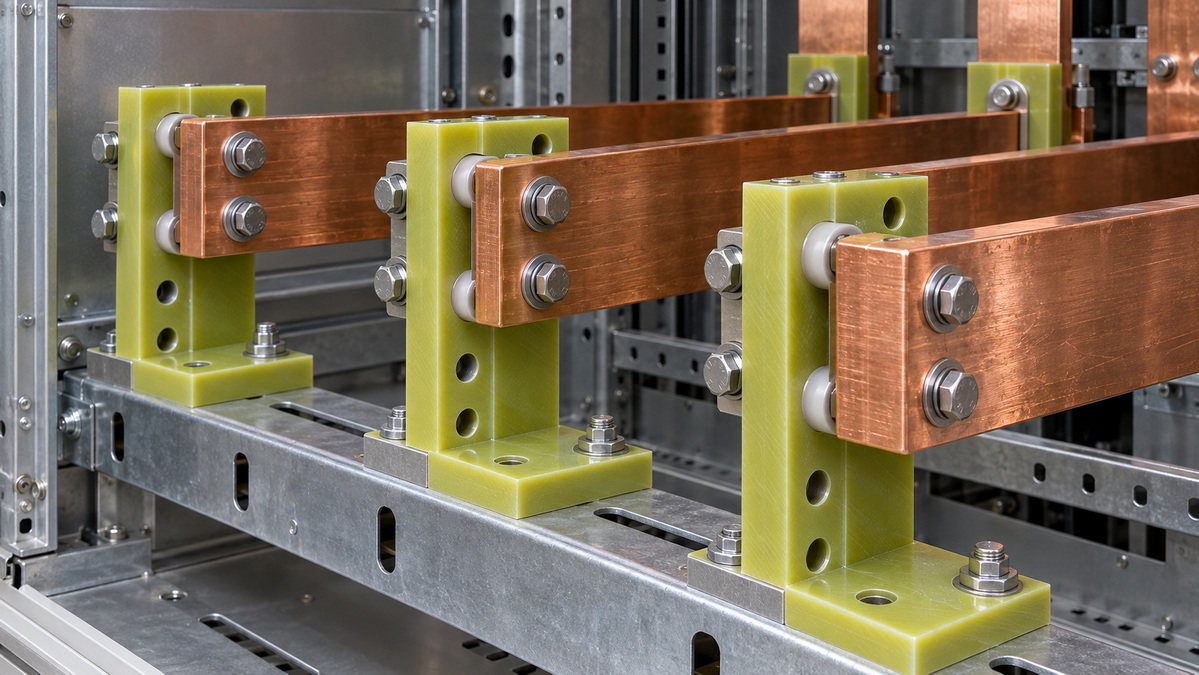
Mica sheet should not be treated as a weaker alternative in every situation. It has unique strengths that make it highly valuable in extreme thermal environments.
Mica is often selected when an electrical insulation system is exposed to temperatures beyond the normal service range of epoxy composites.
In high-temperature environments, mica can retain its thermal and dielectric properties more effectively than many resin-based insulation materials. This makes it useful when the insulation component is located close to heating elements, furnace walls, radiant heat sources, or high-temperature electrical equipment.
Mica can be particularly effective in applications involving:
- Industrial furnaces
- High-temperature heaters
- Electric heating elements
- Heat-treatment equipment
- Fire-resistant electrical barriers
- Battery thermal-runaway protection
- High-temperature motor insulation
- Generator coil insulation
- Thermal shielding around power electronics
A busbar support may be exposed to heat from nearby components rather than from the busbar itself. For example, a power distribution system may be installed near a heating chamber, industrial processing line, inverter heat source, or battery module.
In these cases, mica sheet can be used as a thermal barrier between the heat source and the main structural support.
Mica helps reduce the direct transfer of radiant heat to nearby electrical components. It can also provide a layer of dielectric protection in environments where fire resistance is a major design concern.
Mica is often used in fire-resistant electrical designs because its mineral structure can remain stable under severe heat exposure.
For critical systems, mica can serve as a protective insulation layer that helps maintain electrical separation during abnormal thermal events.
Typical examples include:
- Fire-resistant cable systems
- Emergency power systems
- Battery-pack protection structures
- Electrical enclosures near industrial heat zones
- Safety barriers in high-temperature processing equipment
- Electrical insulation layers for thermal runaway mitigation
However, mica should still be selected carefully. Different mica sheets have different binder systems, reinforcement structures, thicknesses, and mechanical properties. A mica sheet that works well as a thermal shield may not be suitable for heavy mechanical loading or high bolt pressure.
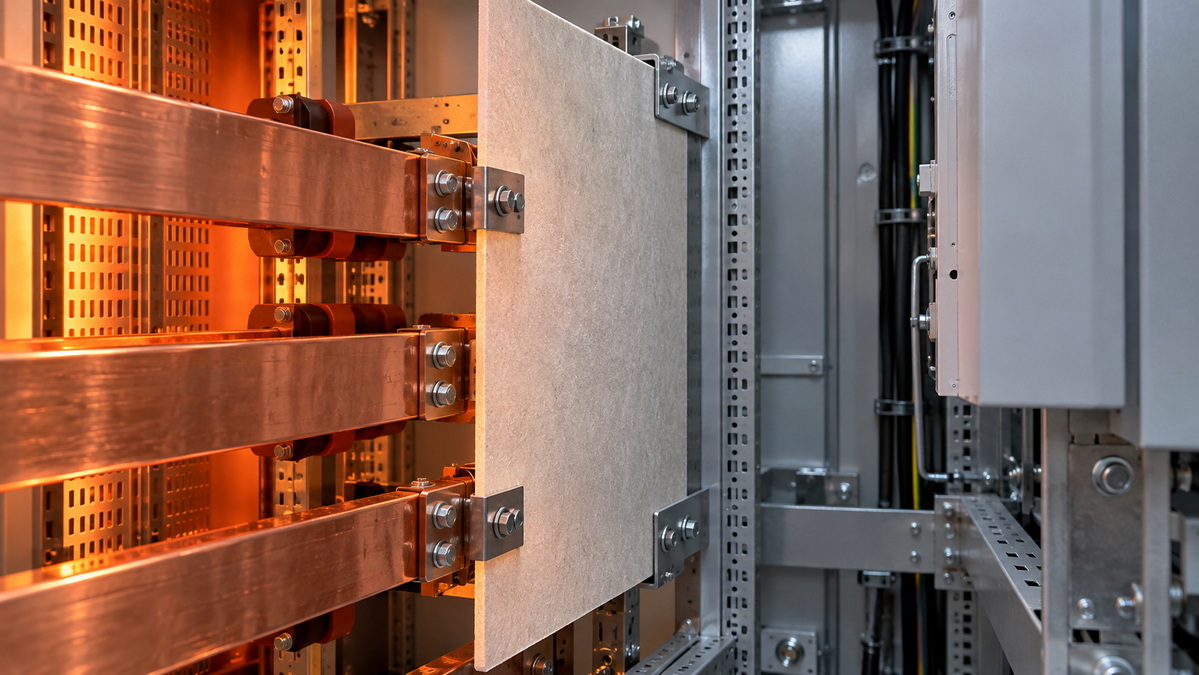
In some high-temperature busbar systems, the best choice is not G11 or mica sheet alone. It is a hybrid insulation design that uses both materials.
This approach allows each material to perform the task it handles best.
A typical hybrid design may include:
1. A mica sheet layer facing the heat source
2. A G11 support block carrying the busbar load
3. An air gap or thermal spacing zone to reduce heat transfer
4. A metal mounting structure positioned away from the electrical insulation area
5. A precision-machined G11 component to maintain conductor spacing
6. A mica barrier to provide added high-temperature protection
This design is useful where the busbar assembly must remain rigid but also needs protection from high radiant heat or potential fire exposure.
For example, an industrial power cabinet installed near a furnace line may use mica sheet as the first thermal-defense layer. Behind the mica, a G11 support block can hold the copper busbar in the correct position. This creates a system that is both structurally reliable and thermally protected.
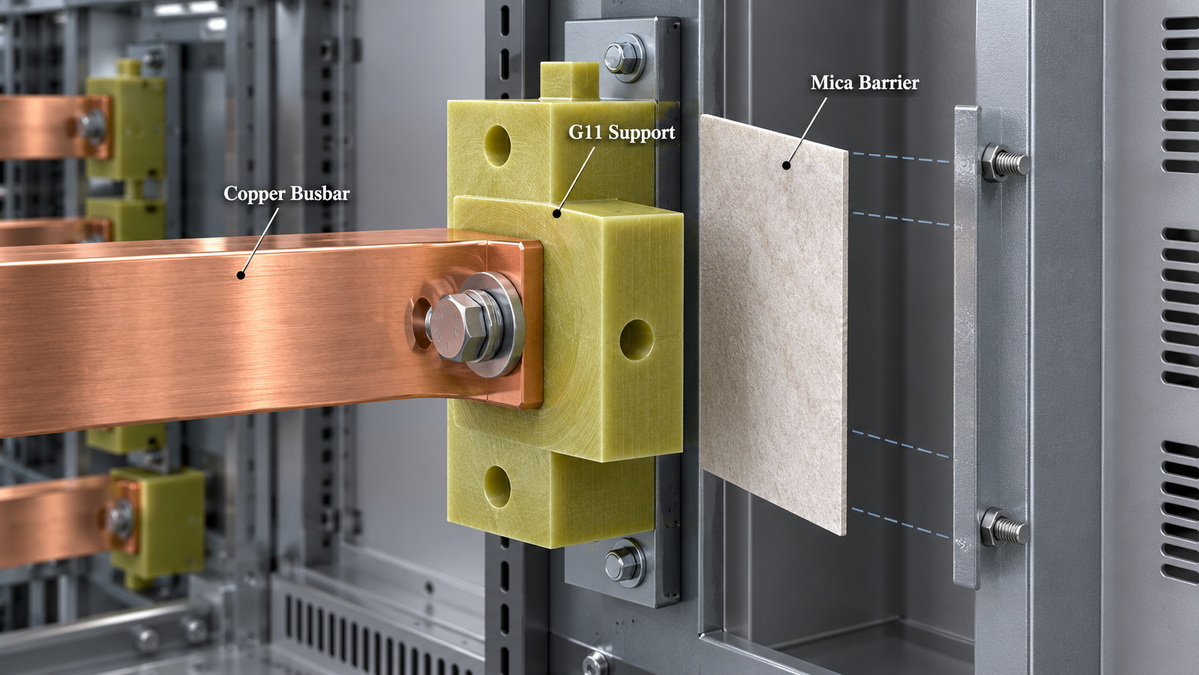
Choosing between G11 and mica sheet should follow a clear evaluation process. Engineers should avoid selecting a material based only on one property, such as maximum temperature resistance.
The most important temperature is the actual temperature at the insulation component.
Do not rely only on the temperature inside the cabinet or the ambient workshop temperature. The insulation part may experience higher temperatures because of:
- Busbar current loading
- Contact resistance at electrical joints
- Heat from nearby transformers
- Heat generated by power electronics
- Radiant heat from industrial equipment
- Poor ventilation inside enclosures
- Localized hot spots
- Emergency overload conditions
A material should be selected based on continuous operating temperature, peak temperature, thermal cycling frequency, and expected service life.
If the insulation component must hold a busbar, resist fastener pressure, support heavy electrical connectors, or withstand vibration, G11 is usually the more appropriate material.
Mica sheet may be suitable when it functions as a flat barrier or heat shield. However, it is generally less suitable for a thick, heavily loaded structural support unless it is specifically engineered and reinforced for that purpose.
If the component needs detailed machining, G11 often provides greater flexibility.
G11 is suitable for parts requiring:
- Precision holes
- Threaded features
- Countersunk holes
- Slots and channels
- Custom mounting profiles
- Complex CNC contours
- Tight dimensional tolerances
- Repeatable mass production
Mica can be cut and fabricated, but it may require more care because certain grades can be brittle or prone to edge chipping.
If the project involves fire safety, emergency operation, rail transportation, energy storage, or other critical systems, identify the specific flame, smoke, toxicity, or fire-survival requirements before selecting the insulation material.
Mica is often favored for high-temperature fire-resistant barriers. G11 can provide strong structural insulation performance, but the exact flame behavior depends on the resin formulation and material grade.
For applications that need both structural strength and fire resistance, a combined G11-and-mica solution may provide a more balanced design.
Choosing the right material is only one part of busbar reliability. Installation and mechanical design also have a major influence on long-term performance.
The busbar support design must provide sufficient electrical spacing between live conductors, grounded components, and adjacent phases.
The required spacing depends on factors such as:
- System voltage
- AC or DC operation
- Pollution level
- Humidity
- Altitude
- Enclosure conditions
- Material tracking resistance
- Transient overvoltage conditions
A high-quality insulation sheet cannot solve a design that has insufficient creepage distance or clearance distance.
Sharp copper or aluminum edges can concentrate electric fields. This can increase the risk of partial discharge, electrical tracking, or insulation breakdown.
Where possible, use rounded busbar corners, smooth hole edges, and carefully finished insulation components.
Excessive bolt torque can damage insulation materials. Over-tightening can crack brittle mica sheets, compress unsupported areas, or create stress concentration around holes.
Use appropriate washers, flat mounting surfaces, recommended torque values, and load-distribution features where necessary.
Copper, aluminum, steel, G11, and mica-based materials expand at different rates when heated.
A busbar system should account for thermal movement. Long busbars may require expansion joints, flexible connectors, sliding mounts, or controlled fastening positions to reduce stress during heating and cooling cycles.
Material specifications are important, but the actual busbar assembly should also be evaluated under realistic conditions.
Useful tests may include:
- Dielectric withstand testing
- Insulation resistance testing
- Temperature-rise testing
- Thermal cycling testing
- Mechanical vibration testing
- Fastener torque-retention testing
- Visual inspection for cracking or discoloration
- Electrical tracking evaluation
- Short-circuit withstand analysis
For most high-temperature busbar support applications, G11 epoxy glass laminate is the preferred primary support material. It provides an effective balance of mechanical strength, electrical insulation, dimensional stability, and machining flexibility.
G11 is especially suitable when the support must carry the weight of copper or aluminum busbars, maintain strict spacing, withstand vibration, and accommodate custom mounting features.
Mica sheet is the stronger choice when the main concern is extreme heat, thermal shielding, fire resistance, or high-temperature dielectric protection. It is highly effective as a barrier layer, especially near heat sources or in systems where fire-survival performance is important.
The most practical approach is to assign each material to the role it performs best:
- G11: Rigid structural support, electrical insulation, spacers, mounting plates, and precision-machined busbar components
- Mica sheet: High-temperature insulation, heat shielding, fire barriers, and supplementary dielectric protection
- G11 plus mica: Advanced busbar assemblies requiring both mechanical strength and thermal protection
Guangdong Weishi New Materials Co., Ltd. specializes in high-performance epoxy insulation materials, including G11 epoxy glass sheets, G10 sheets, FR4 sheets, and customized machined insulation components. With stable material quality, advanced production processes, and flexible fabrication capabilities, the company supports global customers across electrical, electronics, machinery, mold manufacturing, and industrial equipment sectors.
For high-temperature busbar projects, material selection should be based on the actual working environment, mechanical requirements, electrical design, and processing needs. A properly engineered insulation structure can improve safety, extend equipment life, simplify assembly, and reduce maintenance risks.
G11 and mica sheet are both valuable electrical insulation materials for high-temperature busbar systems, but they are designed for different priorities.
G11 epoxy glass laminate is generally the better solution for rigid, load-bearing, and precision-machined busbar supports. It offers high mechanical strength, stable electrical insulation, strong dimensional control, and flexible CNC processing capabilities.
Mica sheet is generally the stronger option for extreme heat resistance, thermal shielding, and fire-resistant electrical barriers. It is especially useful near furnaces, heating elements, battery systems, and high-temperature industrial equipment.
For demanding projects, combining G11 structural supports with mica thermal barriers can create a more reliable and durable insulation design. The final selection should always consider temperature, voltage, mechanical load, assembly method, electrical spacing, and the expected operating life of the system.
Yes. G11 is widely used for high-temperature busbar supports because it offers strong mechanical performance, reliable electrical insulation, and good dimensional stability. It is especially suitable for rigid insulation blocks, spacers, terminal boards, and custom-machined support components.
Mica sheet can replace G11 in certain applications, especially when the material is mainly used as a heat shield or insulation barrier. However, G11 is usually the better option when the part must carry mechanical loads, withstand vibration, support heavy busbars, or maintain precise mounting geometry.
Mica sheet generally offers higher resistance to extreme temperatures than G11. However, G11 provides stronger mechanical support and better machining performance. The better material depends on whether the application prioritizes heat resistance or structural strength.
Yes. G11 can be drilled, cut, milled, routed, and CNC machined into custom insulation components. It is commonly used to manufacture busbar supports, insulating washers, spacers, terminal plates, brackets, and other precision electrical parts.
Yes. Combining G11 and mica sheet is often an effective solution for high-temperature busbar systems. G11 can provide the rigid structural support, while mica sheet can act as a thermal barrier or fire-resistant insulation layer.
The correct G11 thickness depends on busbar weight, electrical voltage, support span, current rating, mounting method, operating temperature, short-circuit forces, required creepage distance, and safety standards. Each application should be evaluated individually.
Useful information includes the busbar drawing, insulation-part drawing, material thickness, operating voltage, continuous temperature, maximum temperature, load condition, mounting-hole dimensions, tolerance requirements, flame requirement, quantity, and application environment.
1. Atlas Fibre. "[G-11 Material Specification Data Sheet]." Provides information on G11 material structure, temperature classifications, mechanical properties, moisture absorption, applications, and machining characteristics.
2. Electrolock. "[Why Mica Sheet Insulation Matters in High-Performance Electrical and Thermal Systems]." Discusses mica insulation, electrical performance, extreme thermal stability, fire resistance, and thermal-barrier applications.
3. Elmelin. "[The Major Advantages of Mica for Industrial Insulation]." Covers muscovite and phlogopite mica, thermal resistance, industrial insulation uses, and high-temperature applications.
4. Ready Plastics. "[NEMA G11 — Glass-Cloth Epoxy High-Temperature Laminate]." Provides a general overview of G11 laminate structure and high-temperature performance.
5. International Electrotechnical Commission. "[IEC 60893: Industrial Rigid Laminated Sheets Based on Thermosetting Resins for Electrical Purposes]." Covers industrial rigid laminated sheets used for electrical insulation applications.
6. National Electrical Manufacturers Association. "[NEMA LI 1: Industrial Laminated Thermosetting Products]." Provides a reference framework for industrial thermosetting laminated products.


