

Views: 254 Author: Weishi Sheets Publish Time: 2026-09-16 Origin: Site
Content Menu
● What Is Epoxy Fiberglass Board?
>> Common Epoxy Fiberglass Board Grades
>> Common Types of Phenolic Board
● Epoxy Fiberglass Board vs Phenolic Board: Quick Comparison
● Mechanical Strength for Heavy-Duty Fixtures
>> Why Epoxy Fiberglass Board Is Stronger for Structural Parts
>> When Phenolic Board Provides Good Mechanical Value
● Heat Resistance and Thermal Stability
>> FR4, G10, and G11 in High-Temperature Fixtures
>> Phenolic Board in Moderate-Temperature Applications
● Moisture Resistance and Humidity Performance
>> Epoxy Fiberglass Board in Moist Environments
>> Phenolic Board and Moisture Considerations
● Electrical Insulation Performance
>> Epoxy Fiberglass Board for Electrical-Mechanical Fixtures
>> Phenolic Board for Electrical Components
● Wear Resistance, Friction, and Vibration Damping
>> Why Fabric Phenolic Is Useful for Wear Parts
>> When Epoxy Fiberglass Board Is Less Ideal for Sliding Contact
● CNC Machining and Fabrication Considerations
>> Machining Epoxy Fiberglass Board
● How to Select the Right Board for Your Fixture
>> 1. Define the Mechanical Load
>> 2. Define the Temperature Range
>> 3. Evaluate Electrical Requirements
>> 4. Review the Operating Environment
>> 5. Consider Machining and Assembly
>> 6. Test the Finished Geometry
● Final Material Selection Summary
>> Is epoxy fiberglass board stronger than phenolic board?
>> Is FR4 suitable for heavy-duty mechanical fixtures?
>> What is the difference between G10 and G11 board?
>> Can phenolic board be used in CNC machining fixtures?
>> Which phenolic board is best for wear-resistant machine parts?
>> Is epoxy fiberglass board suitable for wet environments?
>> Can epoxy fiberglass board replace metal in industrial fixtures?
>> What information is needed for a custom-machined insulation board?
Heavy-duty mechanical fixtures must do more than hold parts in place. They often need to withstand repeated clamping force, vibration, heat, electrical exposure, humidity, machining stress, and long production cycles without losing accuracy.
That is why the material decision between epoxy fiberglass board vs phenolic board matters. Both materials are widely used in industrial tooling, electrical insulation, machine components, mold fixtures, and custom-machined parts. However, their strength, thermal stability, moisture resistance, wear behavior, machining characteristics, and long-term reliability are not the same.
For many demanding fixture applications, epoxy fiberglass board, including FR4, G10, and G11 grades, provides a stronger and more stable solution. Phenolic board remains a valuable choice for cost-sensitive parts, wear components, vibration-damping elements, and applications with moderate mechanical and environmental demands.
Guangdong Weishi New Materials Co., Ltd. manufactures and supplies high-performance epoxy insulation boards and composite materials for industrial customers. Based on practical material-selection experience, the most reliable decision is made by evaluating the fixture's real working conditions rather than selecting material only by price or appearance.
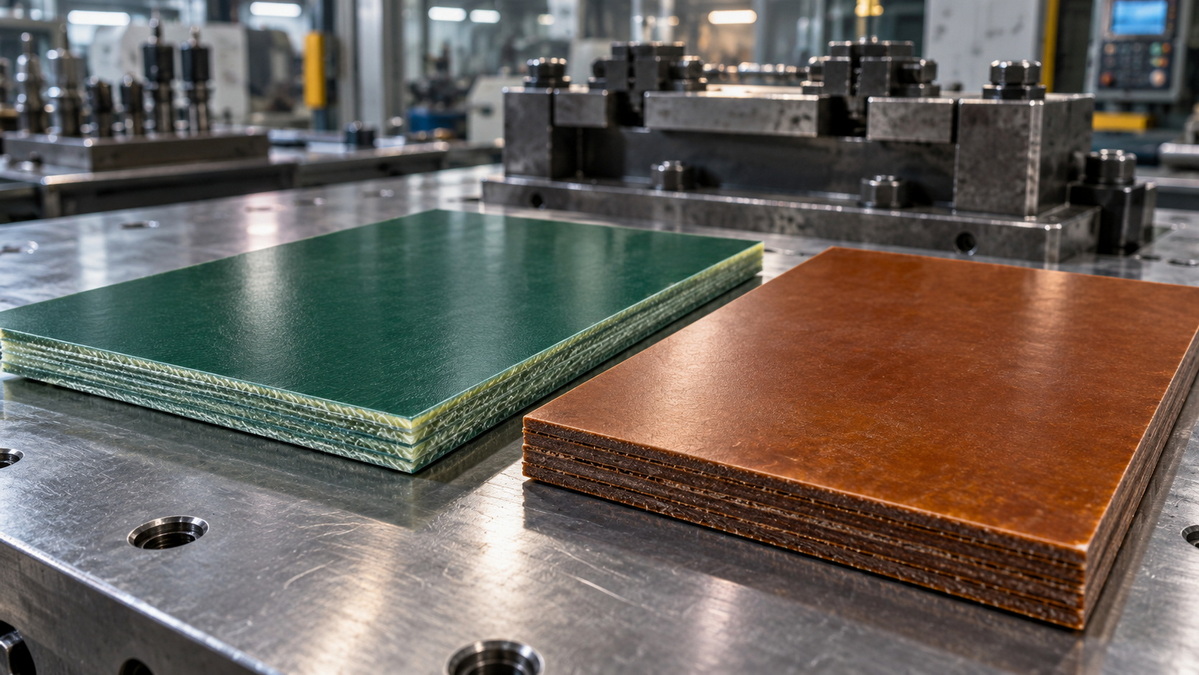
Epoxy fiberglass board is a rigid laminated composite material made by combining woven fiberglass cloth with epoxy resin under heat and pressure.
The fiberglass reinforcement provides mechanical strength, stiffness, and structural support. The epoxy resin bonds the layers together and contributes electrical insulation, moisture resistance, chemical resistance, and thermal stability.
This material family is commonly used for electrical insulation and industrial mechanical parts because it combines a high strength-to-weight ratio with dependable dielectric performance.
Several grades are commonly specified for industrial fixtures and insulating components.
- G10 board: A general-purpose epoxy glass laminate with strong mechanical properties and good electrical insulation
- FR4 board: A flame-retardant epoxy fiberglass laminate widely used in electrical, electronic, and industrial equipment
- G11 board: A higher-temperature epoxy glass laminate designed for demanding heat-resistant applications
- FR5 board: A flame-retardant epoxy fiberglass material with enhanced high-temperature capability
Although these materials are closely related, they should not be treated as identical. The right grade depends on operating temperature, load condition, required electrical properties, thickness, machining design, and environmental exposure.
For example, FR4 is often selected for electrical isolation plates and industrial support parts that need flame-retardant performance. G11 may be a better option when the fixture must retain its properties in a higher-temperature environment.
Phenolic board is another type of rigid laminated composite. It is produced by combining phenolic resin with a reinforcement material such as paper, cotton fabric, linen fabric, canvas fabric, or fiberglass cloth.
The type of reinforcement strongly affects the final performance of the sheet. Therefore, phenolic board is not one single material category. Paper phenolic, linen phenolic, canvas phenolic, and glass phenolic may have very different mechanical, electrical, and machining properties.
- Paper phenolic board: Often used for electrical insulation panels, terminal boards, spacers, and general-purpose insulating parts
- Cotton fabric phenolic board: Often used for wear-resistant components, gears, rollers, and sliding parts
- Linen phenolic board: Known for good machinability, strength, and dimensional consistency
- Canvas phenolic board: Suitable for heavy-duty wear parts, shock absorption, and mechanical components
- Glass phenolic board: Offers improved mechanical strength and heat resistance compared with paper- and cloth-based phenolic grades
Phenolic board is widely used because it is economical, machinable, and suitable for many industrial applications. However, its long-term performance must be matched carefully to moisture, heat, electrical load, and mechanical stress.
| Performance Factor | Epoxy Fiberglass Board | Phenolic Board | Recommended Choice |
|---|---|---|---|
| Main reinforcement | Woven fiberglass cloth | Paper, cotton, linen, canvas, or fiberglass | Depends on application |
| Mechanical strength | High | Moderate to high, depending on grade | Epoxy fiberglass board |
| Rigidity | High | Moderate to high | Epoxy fiberglass board |
| Dimensional stability | Excellent | Good, but more grade-dependent | Epoxy fiberglass board |
| Moisture resistance | Generally strong | Varies by substrate and grade | Epoxy fiberglass board |
| Electrical insulation | Excellent | Good to excellent | Depends on grade |
| Heat resistance | Strong, especially G11 and FR5 | Moderate to strong, depending on grade | G11 or FR5 |
| Flame-retardant grades | Available | Formulation-dependent | FR4 or FR5 |
| Wear resistance | Good | Often excellent in fabric-based grades | Canvas or linen phenolic |
| Vibration damping | Moderate | Often better | Phenolic board |
| Machining difficulty | More abrasive to tooling | Generally easier to machine | Phenolic board |
| Initial cost | Usually higher | Often lower | Phenolic board |
| Long-term heavy-load reliability | Strong | Depends on grade and environment | Epoxy fiberglass board |
The best material is not always the one with the highest individual property. A high-load electrical fixture may need FR4 or G11. A sliding guide block may perform better with canvas phenolic. A low-cost terminal spacer may only require paper phenolic.
Mechanical fixtures are exposed to more than simple static pressure. In real production environments, the material may experience repeated clamping, bolt torque, bending force, vibration, impact, shear stress, thermal expansion, and stress concentration around holes or slots.
For these conditions, epoxy fiberglass board is often preferred.
The woven fiberglass reinforcement inside FR4, G10, and G11 provides a high level of structural support. It helps the material resist flexing, cracking, deformation, and gradual loss of flatness.
This makes epoxy fiberglass board especially suitable for:
- Precision CNC fixture plates
- Electrical isolation plates
- High-load locating blocks
- Insulating brackets
- Machine support pads
- Tooling spacers
- Transformer support components
- Switchgear insulation parts
- Robotic fixture components
- Mold support structures
- High-strength custom-machined components
A major advantage is the ability to maintain accuracy over repeated cycles. In many fixture applications, a material does not fail suddenly. Instead, it gradually loses its original flatness, dimensional stability, or fastening reliability.
When a fixture must repeatedly hold a part in the same position, even a small amount of material movement can affect machining consistency, assembly accuracy, or electrical clearance.
Phenolic board can still be an excellent mechanical material when the correct grade is selected.
Canvas phenolic and linen phenolic are often valued for their combination of strength, toughness, wear resistance, and vibration absorption. They are commonly used in moving mechanical systems rather than highly rigid structural support systems.
Phenolic board may be a good choice for:
- Wear pads
- Sliding guides
- Bushings
- Low-speed gears
- Rollers
- Friction components
- Mechanical spacers
- Vibration-damping parts
- Non-metallic support elements
- General-purpose jigs and fixtures
For example, a sliding guide that contacts a steel surface repeatedly may benefit from a canvas phenolic component. In this case, the material's wear behavior and shock absorption may be more valuable than the maximum rigidity of epoxy fiberglass board.
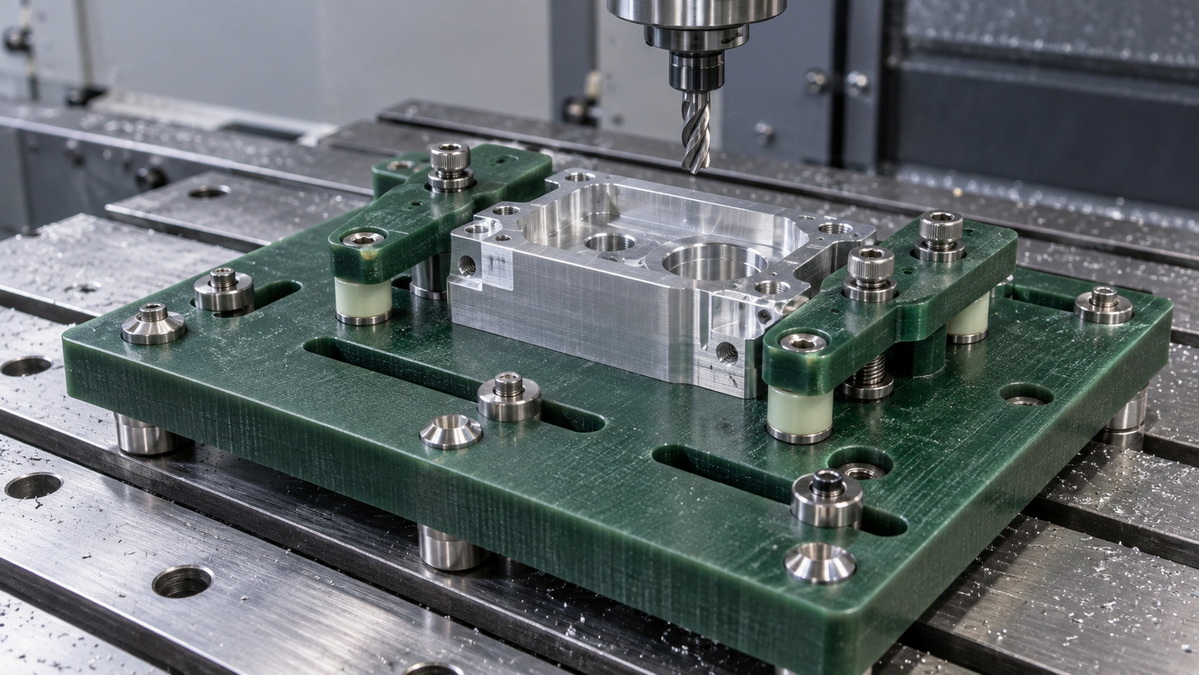
Temperature can change the performance of an insulating fixture dramatically. Heat may come from nearby motors, molds, welding operations, hot electrical components, friction, induction equipment, ovens, or long operating cycles.
A material that performs well at room temperature may lose strength or insulation performance when exposed to sustained heat.
Epoxy fiberglass laminates are commonly used in fixtures that require a combination of mechanical strength and heat resistance.
G10 is suitable for many general industrial conditions. FR4 adds flame-retardant characteristics and is frequently selected for electrical equipment. G11 is often preferred when the operating environment is hotter and the fixture must maintain stronger mechanical and electrical performance.
G11 can be particularly useful for:
- High-temperature electrical insulation
- Motor and generator components
- Transformer supports
- Mold and tooling fixtures
- Thermal barrier plates
- Welding-adjacent equipment
- Industrial heating equipment
- High-load insulating structures near hot machinery
The most important point is to evaluate the complete temperature profile. Engineers should consider normal operating temperature, peak temperature, exposure duration, cooling time, and the frequency of thermal cycling.
A brief exposure to high temperature is very different from continuous operation at elevated temperature.
Phenolic laminates provide useful heat resistance and are suitable for many industrial environments. However, standard paper and fabric phenolic grades generally have more limited long-term thermal capability than G11 or other high-temperature epoxy glass laminates.
Phenolic board can still work well in warm operating conditions when the material is not exposed to prolonged extreme heat, repeated thermal shock, or high electrical stress.
For moderate-temperature fixtures, the benefits of phenolic may include lower cost, easier machining, and good mechanical performance.
However, for high-temperature fixtures that must remain flat, rigid, electrically insulating, and mechanically reliable, G11 epoxy fiberglass board is often the more dependable option.
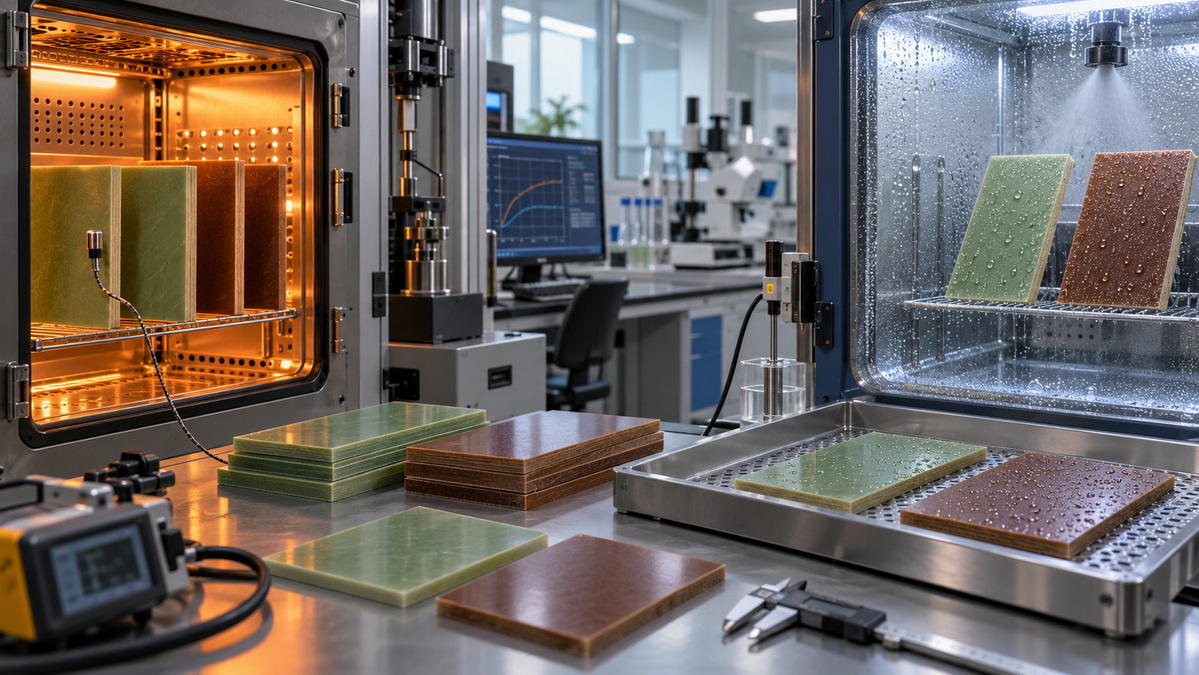
Humidity, coolant mist, cleaning fluid, condensation, water exposure, and storage conditions can affect laminated materials over time.
This is particularly important for mechanical fixtures used in CNC machining centers, electrical cabinets, outdoor equipment, marine-related systems, humid workshops, and industrial cleaning environments.
Epoxy fiberglass board is generally well suited to humid environments because its woven glass reinforcement is less moisture-sensitive than paper and cotton-based substrates.
This can help maintain:
- Electrical insulation resistance
- Dielectric performance
- Fixture flatness
- Hole dimensions
- Slot accuracy
- Fastener stability
- Mechanical strength
- Assembly reliability
For components used near energized conductors, busbars, terminals, sensors, or power equipment, moisture resistance is especially important.
A fixture that is dimensionally stable in dry conditions but changes after humidity exposure can create clearance issues, alignment problems, or reduced electrical safety margins.
Phenolic board performance depends heavily on the reinforcement type.
Paper phenolic and cotton fabric phenolic can absorb more moisture than epoxy fiberglass board. This does not make them unsuitable for all industrial applications, but it means that the environment should be controlled or the grade should be selected carefully.
For dry indoor applications, phenolic board can offer excellent value. For environments involving frequent coolant, washing, condensation, or outdoor storage, epoxy fiberglass board is generally the safer selection.
Material-selection tip: If moisture exposure is expected, request tested information for water absorption, insulation resistance after conditioning, and dimensional change after humidity exposure.
Both epoxy fiberglass board and phenolic board can provide electrical insulation. However, the required level of insulation varies widely between applications.
A simple mechanical spacer may only need to prevent accidental electrical contact. A switchgear support plate may need to maintain dielectric strength, creepage distance, and insulation resistance under heat and humidity.
FR4, G10, and G11 are widely used in electrical-mechanical applications because they combine mechanical strength with dependable insulation performance.
Common applications include:
- Busbar supports
- Transformer insulation parts
- Electrical cabinet panels
- Terminal boards
- Motor insulation components
- Battery pack fixtures
- High-voltage support plates
- Insulating washers
- Electrical barriers
- Power distribution equipment
FR4 is especially common where flame-retardant performance is required. G11 is often selected for electrical insulation parts that also face higher temperatures.
Paper phenolic board is commonly used for lower-cost electrical insulation parts, terminal strips, switch components, and general industrial electrical panels.
In suitable dry conditions, phenolic board can provide good electrical performance. However, electrical requirements should be evaluated together with humidity, temperature, thickness, contamination risk, and operating voltage.
For critical insulation components, the selection should include more than dielectric strength. It should also consider insulation resistance, tracking resistance, arc resistance, flame behavior, and stability after environmental exposure.
Not every fixture component needs maximum stiffness. Some parts need to slide, absorb vibration, reduce noise, tolerate friction, or prevent metal-to-metal contact.
This is where phenolic board can offer an important advantage.
Canvas phenolic and linen phenolic are commonly used for mechanical components that experience repeated sliding or contact pressure.
These grades can be suitable for:
- Guide rails
- Wear strips
- Bushings
- Low-speed gears
- Rollers
- Support pads
- Friction blocks
- Conveyor components
- Impact-resistant spacers
- Vibration-control parts
The fabric reinforcement can provide a combination of toughness and controlled wear. In some mechanical systems, this makes phenolic more suitable than FR4.
For example, a machine fixture may use G11 for its electrically insulating structural base plate while using canvas phenolic for replaceable wear pads. This hybrid design uses each material where it performs best.
Epoxy fiberglass board is durable, but the fiberglass reinforcement can be abrasive. For continuous sliding contact, it may increase wear on mating surfaces if the design does not include suitable lubrication, surface treatment, or replaceable wear layers.
Therefore, epoxy fiberglass board is usually best for rigid support, electrical isolation, precision spacing, and load-bearing structures rather than high-friction moving contact surfaces.
The machining process should be considered before finalizing the material.
Both epoxy fiberglass board and phenolic board can be machined into custom shapes, including drilled holes, milled slots, threaded features, countersinks, insulation washers, complex fixture plates, and precision support components.
FR4, G10, and G11 can be CNC machined accurately. They are suitable for complex custom parts, but fiberglass reinforcement creates higher tool wear than many other industrial laminates.
When machining epoxy fiberglass board, manufacturers should consider:
1. Use carbide, diamond-coated, or other wear-resistant cutting tools.
2. Control cutting heat to reduce edge damage.
3. Use proper dust extraction and workplace protection.
4. Maintain sufficient edge distance around holes and slots.
5. Avoid excessive stress concentration in sharp internal corners.
6. Inspect thickness tolerance after machining.
7. Deburr edges carefully before assembly.
For high-volume projects, machining strategy can affect total cost significantly. Tool life, machining speed, cutting quality, and rejection rate should all be considered.
Phenolic board is generally easier to machine and less abrasive to cutting tools. This can reduce machining cost, improve tool life, and make it attractive for high-volume, moderate-duty components.
Phenolic board can be a strong option for parts with many drilled holes, simple profiles, or frequent replacement requirements.
However, lower machining cost should be balanced against the expected service environment. If the component will be exposed to high heat, moisture, high mechanical stress, or strict electrical insulation requirements, epoxy fiberglass board may offer better long-term value.
The best material choice begins with the working condition of the fixture.
Identify the maximum clamping force, compression load, bending force, bolt torque, vibration level, impact risk, and number of cycles.
A simple flat spacer under compression needs different material properties than a long support plate with holes, slots, and cantilever loading.
Record the normal operating temperature, peak temperature, exposure duration, nearby heat sources, and thermal cycling frequency.
If the fixture must operate near high-temperature machinery, G11 or another high-temperature epoxy glass grade may be more suitable than standard phenolic board.
Determine whether the component is only nonconductive or whether it must provide defined electrical insulation.
Consider voltage, current, dielectric strength, creepage distance, insulation resistance, arc resistance, and flame-retardant requirements.
Consider exposure to water, humidity, coolant, oil, chemicals, cleaning agents, dust, UV exposure, and outdoor transport.
For wet, humid, or electrically demanding environments, epoxy fiberglass board often provides greater confidence.
Review part thickness, hole size, slot geometry, edge distances, fastener locations, tolerance requirements, surface finish, assembly force, and expected replacement cycle.
A well-designed phenolic part can be more economical for wear applications. A well-designed FR4 or G11 part can provide more reliable structural and electrical performance over long production cycles.
For critical projects, test the actual machined part rather than relying only on sheet data.
Evaluate:
- Deflection under working load
- Bolt torque retention
- Hole accuracy
- Flatness
- Thermal stability
- Wear rate
- Electrical insulation resistance
- Moisture-related dimensional change
- Performance after repeated cycles
For most heavy-duty mechanical fixtures, epoxy fiberglass board provides the stronger all-around solution.
FR4, G10, and G11 are particularly suitable when the application requires high mechanical strength, electrical insulation, moisture resistance, reliable dimensional stability, and long-term performance under repeated load.
Choose epoxy fiberglass board when your fixture needs:
- High structural rigidity
- Strong mechanical strength
- Reliable electrical insulation
- Better moisture resistance
- Long-term dimensional stability
- Tight machining tolerances
- Repeated clamping performance
- High-temperature capability
- Flame-retardant material options
Choose phenolic board when your application needs:
- Lower initial material cost
- Easy CNC machining
- Good wear resistance
- Sliding-contact performance
- Vibration absorption
- Shock resistance
- General industrial insulation
- Moderate mechanical loading
- Replaceable mechanical wear components
The most effective fixture designs often use materials strategically. A high-strength FR4 or G11 structural plate can provide insulation and rigidity, while a canvas phenolic insert can provide wear resistance in moving or sliding contact areas.
Guangdong Weishi New Materials Co., Ltd. provides epoxy fiberglass boards, FR4 sheets, G10 laminates, G11 insulation boards, and custom-machined composite components for industrial applications. By matching the material grade to the actual load, temperature, electrical condition, and machining requirement, manufacturers can improve fixture reliability, reduce maintenance, and achieve more consistent production performance.
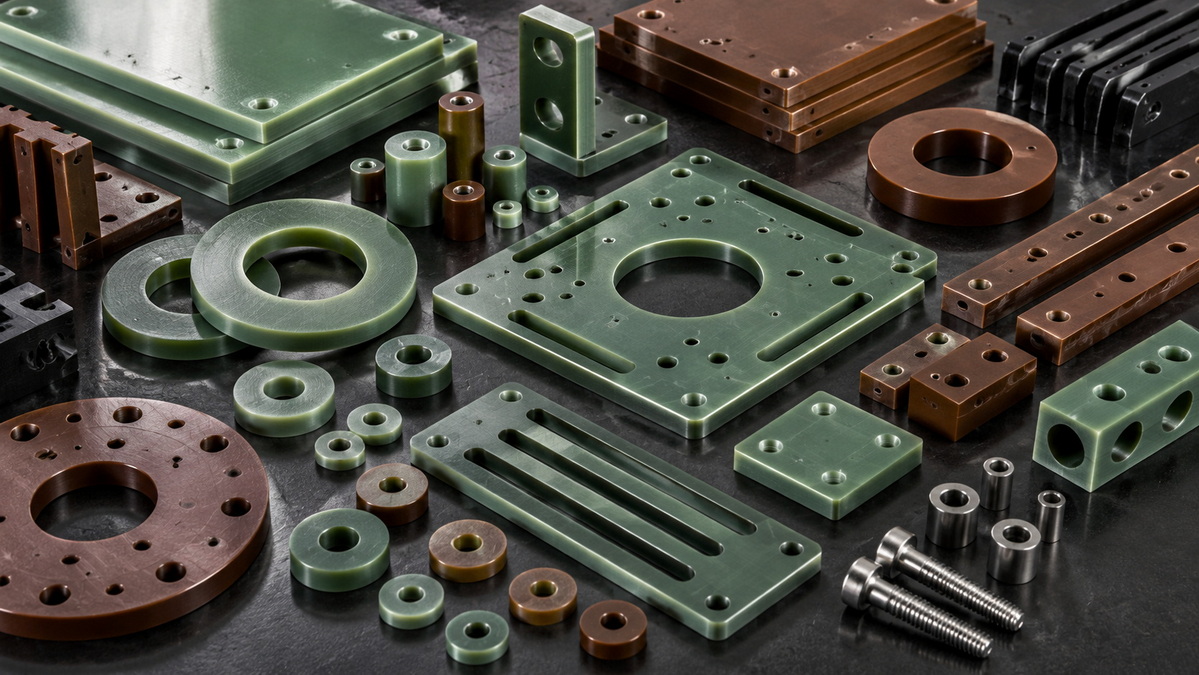
In many heavy-duty structural applications, epoxy fiberglass board provides higher mechanical strength, greater rigidity, better dimensional stability, and stronger moisture resistance than standard paper or fabric phenolic board. However, some canvas and linen phenolic grades can be better for wear, vibration damping, and sliding mechanical parts.
Yes. FR4 is suitable for many heavy-duty mechanical fixtures because it provides a balance of mechanical strength, electrical insulation, flame-retardant performance, and dimensional stability. It is commonly used for insulating fixture plates, electrical supports, machined spacers, and industrial machine components.
G10 and G11 are both epoxy fiberglass laminates. G11 is generally designed for better performance at higher temperatures, making it more suitable for applications involving heat exposure, thermal cycling, and high-temperature electrical insulation.
Yes. Phenolic board can be used in CNC fixtures, especially for moderate-load supports, wear pads, spacers, guides, and low-cost tooling components. Canvas phenolic and linen phenolic are often selected for components that need good machinability and wear resistance.
Canvas phenolic and linen phenolic are commonly used for wear-resistant parts such as bushings, gears, sliding guides, rollers, friction blocks, and wear strips. Their fabric reinforcement helps provide toughness and controlled wear behavior.
Yes. Epoxy fiberglass board is generally more suitable than paper or cotton-based phenolic board for humid or coolant-exposed environments. Its glass reinforcement and epoxy resin system support better dimensional and electrical stability under moisture exposure.
In some applications, yes. Epoxy fiberglass board can replace metal where electrical insulation, corrosion resistance, lower weight, or non-magnetic properties are required. However, fixture design must account for differences in stiffness, fastener behavior, load distribution, and thermal expansion compared with steel or aluminum.
Useful information includes the drawing or CAD file, material grade, thickness, part dimensions, tolerances, holes, slots, threaded features, operating temperature, mechanical load, voltage requirement, moisture exposure, chemical exposure, quantity, and required delivery condition.
1. International Electrotechnical Commission. "IEC 60893-1:2004: Insulating Materials—Industrial Rigid Laminated Sheets Based on Thermosetting Resins for Electrical Purposes." [IEC Webstore].
2. Plastic-Craft. "Phenolic Laminates Technical Data Sheet." [Phenolic Material Properties PDF].
3. Laminated Plastics. "Technical Data Sheet: Paper Phenolic." [Paper Phenolic Data Sheet].
4. Ready Plastics. "Paper Phenolic Properties: Mechanical and Electrical Data." [Paper Phenolic Properties].
5. Quanda Plastic. "Phenolic Laminates." [Phenolic Laminate Performance Data].
6. ZT Aero. "Phenolic Laminated Sheets: Grades, Applications and CNC Machining." [Phenolic Laminates Guide].
7. ISO Material. "Rigid Laminated Sheets Guide: G10, G11, FR4, GPO-3 and 3240." [Rigid Laminated Sheet Guide].


