

Views: 231 Author: Weishi Sheets Publish Time: 2026-10-20 Origin: Site
Content Menu
● What "Fiberglass Sheets" Means in This Guide
>> FR4, G10, and G11: Specify the Requirement, Not Just the Name
● Why Source Fiberglass Sheets from Germany?
>> The Latest Industry Context
● Selection Criteria: How This Shortlist Was Built
● Supplier Comparison: Capacity, MOQ, Certification, and Focus
● 1. Guangdong Weishi New Materials Co., Ltd.
>> Company Profile and Core Strengths
>> OEM/ODM Scope and Qualification Priorities
>> Company Profile and Core Strengths
>> Markets and Technical Focus
>> OEM Scope and Buyer Cautions
>> Company Profile and Core Strengths
>> Markets and Technical Focus
>> OEM/ODM Scope and Buyer Cautions
>> Company Profile and Core Strengths
>> Markets and Technical Focus
>> OEM Scope and Buyer Cautions
● 5. AGK Hochleistungswerkstoffe GmbH
>> Company Profile and Core Strengths
>> Markets and Technical Focus
>> OEM Scope and Certification Caution
● 6. Brandenburger Isoliertechnik
>> Company Profile and Core Strengths
>> Markets and Technical Focus
>> OEM Scope and Buyer Cautions
● Buyer's Guide: How to Qualify a Fiberglass Sheet Supplier
>> 1. Verify the Factory and the Material's Origin
>> 2. Check Certification Scope, Not Just Expiry
>> 3. Separate Management Certification from Product Compliance
>> 4. Approve a Representative Sample
>> 5. Compare Finished-Part Cost
>> 6. Agree on Logistics Before Ordering
● The Insider Pitfall: Cutting Direction and Machining Can Change the Result
● Conclusion: Select for the Application, Then Validate the Supplier
● FAQ
>> 1. How can I verify whether a supplier's ISO certificate is expired or suspended?
>> 2. Can FR4 replace G10 or G11 without another qualification process?
>> 3. Is UL94 V-0 sufficient evidence that a sheet is suitable for high-voltage equipment?
>> 4. How do I know whether a capacity claim is relevant to my order?
>> 5. What should I require when an approved sample passes but production parts fail?
Choosing a fiberglass sheet supplier is not simply a matter of comparing price per kilogram. For electrical insulation, precision fixtures, and load-bearing industrial components, the more important questions concern material consistency, verified test results, manufacturing control, and the supplier's ability to reproduce an approved specification over time.
A useful supplier assessment starts with five practical checks: factory certification and its scope, material-development capability, documented quality-control procedures, delivery reliability, and support for drawing-based customization. These checks help distinguish a suitable long-term partner from a company that can only offer an attractive initial quotation.
Germany remains a significant European sourcing location for reinforced plastics and industrial insulation materials. According to AVK's market report published in 2026, Germany's thermoset composites production reached approximately 180,000 tonnes in 2025, representing 18.9% of the European thermoset market covered by the report. This is broad composites data—not a production estimate for FR4 or epoxy fiberglass sheets alone.
This guide presents five Germany-based manufacturers and suppliers, together with one China-based manufacturing alternative for buyers comparing domestic European sourcing with international production.
Transparency: Guangdong Weishi New Materials Co., Ltd. appears first as the commissioning company and an international sourcing alternative. It is located in China, not Germany. The sequence below is not a performance ranking, and this assessment does not claim independent factory visits, sample testing, or verified delivery-performance audits.
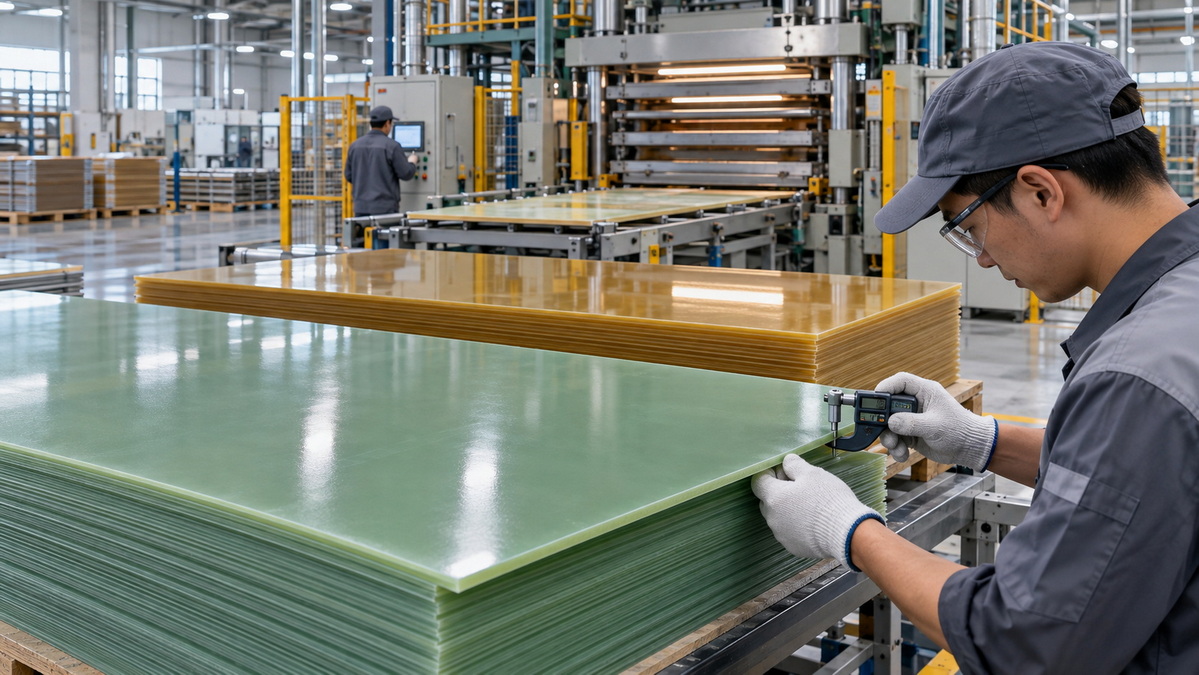
"Fiberglass sheets" can describe several materially different products. This article focuses primarily on rigid glass-reinforced epoxy laminates and related industrial insulation boards, rather than translucent roofing panels or general-purpose construction cladding.
Within industrial procurement, buyers should distinguish:
- Glass-epoxy insulation sheets used for electrical and mechanical components.
- Copper-clad laminates intended for printed circuit board production.
- Specialized composite sheets for soldering fixtures.
- Thermal insulation boards used between heated tools, presses, and machine structures.
These categories may share glass reinforcement, but their resin systems, electrical properties, thermal behavior, and purchasing specifications are not interchangeable. The supplier portfolios discussed below illustrate these differences.
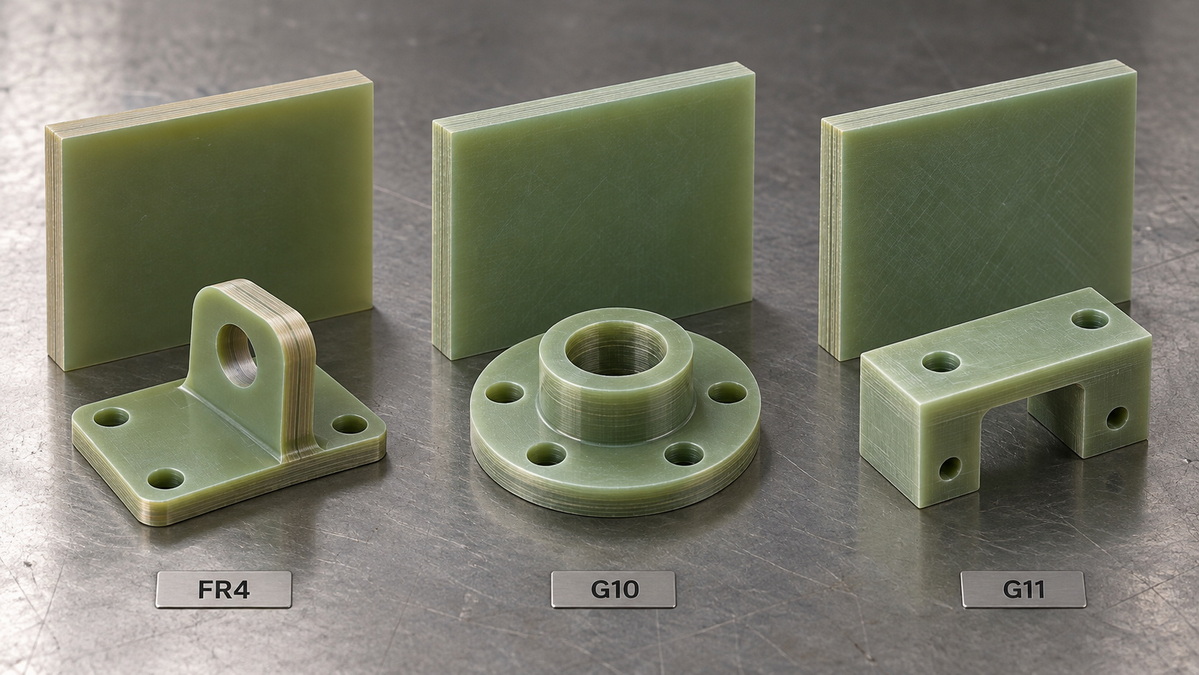
G10 and FR4 are both associated with glass-reinforced epoxy laminates. FR4 adds a flame-retardant requirement; a supplier's combined "G10/FR4" description should therefore be clarified before purchase. An industrial laminate manufacturer notes that material sold commercially as G10 is often actually FR4, demonstrating why the trade description alone is insufficient.
G11 is associated with high-temperature epoxy-glass applications. However, buyers should not assign a universal service temperature to every product carrying that designation. Obtain the particular manufacturer's thermal, mechanical, and electrical data and confirm the applicable material standard.
For all three grades, the purchase specification should identify:
- Applicable material standard and grade.
- Nominal thickness and permissible variation.
- Sheet dimensions and flatness requirements.
- Electrical testing conditions.
- Mechanical properties at the intended operating temperature.
- Flame classification, where required.
- Documentation and batch-traceability requirements.
Germany offers an established network of composite-material manufacturers, insulation specialists, and component processors.
The shortlist reflects several regional industrial concentrations: Krempel operates from Vaihingen/Enz in Baden-Württemberg; Brandenburger is based in Landau in Rhineland-Palatinate; AGK operates in Dortmund in North Rhine-Westphalia; and Dr. Dietrich Müller is based in Ahlhorn in Lower Saxony. These locations demonstrate that the supply base is distributed across multiple industrial regions rather than concentrated in a single fiberglass-sheet manufacturing city.
For procurement managers, the relevant advantage is access to different capabilities:
- Material producers with electrical insulation and composite-development portfolios.
- Processors that convert rigid laminates into drawing-controlled components.
- Specialists in thermal insulation for heated industrial equipment.
- International groups offering multiple composite product families.
Nevertheless, a German sales address does not establish that every quoted sheet was manufactured in Germany. Confirm the actual production location, material producer, and country of origin for each proposed product.
AVK reports that European composites production declined by approximately 3% in 2025, reaching 2.281 million tonnes, compared with 2.351 million tonnes in 2024. Germany remained the largest individual national producer within the report's European thermoset comparison, although its output declined from 187,000 to 180,000 tonnes.
These figures provide market context, not supplier-specific capacity evidence. They do not establish whether an individual manufacturer has available press capacity, stocked inventory, or short lead times.
For buyers, the practical response is to request separate quotations for stocked sheets, made-to-order laminates, and machined components. Each follows a different delivery path.
The companies were selected for their documented relevance to glass-reinforced laminates, electrical insulation materials, composite sheets, or related industrial insulation components.
The assessment uses publicly available company information and relevant industry sources. It does not assign numerical scores where comparable audited data are unavailable.
| Selection criterion | Evidence buyers should request | Why it matters |
|---|---|---|
| Manufacturing or processing role | Factory address, process description, original material producer | Distinguishes sheet production from distribution and machining |
| Quality management | Current certificate, covered legal entity, site, and scope | Prevents reliance on unrelated or expired certificates |
| Technical capability | Grade-specific datasheets and test methods | Supports material selection under actual service conditions |
| Quality control | Inspection plan, traceability procedure, release records | Helps maintain consistency between approved samples and production |
| Capacity and delivery | Grade-specific available output, stock status, lead-time commitment | Measures usable supply capability rather than company size |
| Customization | Drawing review, machining capability, first-article process | Supports OEM parts and repeatable production |
| Regulatory documentation | Applicable substance declarations and product-specific evidence | Avoids treating a generic compliance logo as proof |
A documented manufacturing capability is useful evidence. A production audit, approved sample, and satisfactory pilot order remain necessary before qualification.
"Not disclosed" means no comparable figure was established from the public sources reviewed. It does not mean that the supplier lacks capacity or will reject small orders.
| Supplier | Location and role | Capacity information | MOQ information | Certification or compliance evidence | Main sourcing focus |
|---|---|---|---|---|---|
| Guangdong Weishi New Materials Co., Ltd. | Heyuan, Guangdong, China; composite-material manufacturer | Website states 100+ tonnes monthly output; not independently audited | Request by grade, thickness, and machining scope | Website claims UL94 V-0 performance for its featured FR4 product; obtain grade- and thickness-specific evidence | FR4, G10/G11-related product range, insulation sheets, customized processing |
| Röchling Industrial | Germany-based international industrial plastics group | Relevant sheet-production capacity not established | Product-specific; published stock/MOQ distinctions exist for selected Durostone products | Verify supplying-site certificates; product datasheets identify relevant test standards | Engineered composites and application-specific Durostone materials |
| Krempel | Vaihingen/Enz, Germany; electrical insulation and composites manufacturer | Relevant sheet capacity not disclosed in reviewed sources | Request by material system and format | Company states all group companies are ISO 9001 certified | Electrical insulation, prepregs, composite materials, and customized components |
| Dr. Dietrich Müller GmbH | Ahlhorn, Germany; insulation-material supplier and precision converter | Relevant rigid-sheet processing capacity not disclosed | Request separately for sheets, prototypes, and production parts | Company states ISO 9001 and ISO 14001 certification; UL repackager listing E341377 | Material selection and precision parts from rigid and flexible materials |
| AGK Hochleistungswerkstoffe GmbH | Dortmund, Germany; insulation-material and component specialist | Relevant capacity not disclosed | Drawing- and material-dependent; request quotation | Published quality page states an ISO 9001-based internal system, but no ISO 9001 certification | DuroBest materials and custom electrical/thermal insulation components |
| Brandenburger Isoliertechnik | Landau, Germany; thermal insulation manufacturer | Relevant board capacity not disclosed | Request by board grade and finished geometry | Group states DIN EN ISO 9001 certification | Thermal insulation boards and customized press/mould insulation |
Do not transfer an MOQ or certification claim from one material family to another. For example, Röchling's published stock/MOQ distinctions for Durostone UPM 203 concern a particular glass-reinforced polyester product, not every epoxy-glass sheet in its portfolio.
Guangdong Weishi New Materials Co., Ltd. states that it was founded in October 2007 in Heyuan, Guangdong. Its website reports more than 16,000 square metres of building area, three standard workshops, 10 engineers, more than 60 technical staff, and monthly output exceeding 100 tonnes. These are company-published figures rather than independently verified capacity measurements.
Its published product categories include FR4, G10, G11, FR5, 3240 fiberglass sheets, copper-clad laminates, processing boards, mica sheets, and GPO-3 laminated sheets. The company identifies electronics, electrical equipment, and machinery among its application sectors.
Weishi is an international option for buyers seeking to compare direct manufacturing with Germany-based supply, particularly when a project combines insulation sheets with customized components.
Its potential value for smaller OEM businesses lies in the opportunity to coordinate material selection, processing, and production through one manufacturing contact. That purchasing model can be useful, but buyers should verify commercial flexibility rather than assume a particular low MOQ or response-time guarantee.
The website states that the company can develop a supplied product idea or design and modify it for mass production. This supports consideration for drawing-based projects and design-for-manufacture discussions.
For an initial inquiry, ask Weishi to confirm:
- Available grades and thickness ranges.
- Cut-to-size and machining operations.
- Prototype and production-order quantities.
- Drawing-review turnaround.
- Material and dimensional inspection records.
- Packaging, shipping terms, and repeat-order controls.
The company's stated positioning is global supply, but a geographic sales breakdown was not established from the reviewed homepage. Likewise, a general "quality certification" section should not be treated as evidence of a specific active ISO certificate.
Weishi is best evaluated as a potential cost-conscious, customization-oriented partner—not as a proven lowest-cost supplier. Compare its landed cost, approved-part yield, documentation, and communication performance against the German alternatives.
Röchling's group history dates to 1822, when Friedrich Ludwig Röchling established a coal-trading business. That date describes the group's origins, not the start of epoxy-sheet production. Its history identifies the acquisition of a predecessor to today's engineering plastics business in 1921.
Röchling Industrial offers engineered plastics and composite materials under several product families, including Durostone. The portfolio is relevant to buyers who require application-specific materials rather than a generic fiberglass board.
Published Durostone applications include electrical insulation, transformers, generators, and electronics production. Its international location network supports a global industrial-market profile.
One useful technical example is Durostone EPC 203. Röchling publishes typical flexural-strength values of 450 MPa at room temperature and 230 MPa at 150°C, together with a temperature index of 155 under IEC 60216. These values illustrate why elevated-temperature data can be more informative than room-temperature strength alone. They are not universal properties of all Durostone or G11 materials.
Röchling is a relevant candidate for established OEM programs requiring a defined material specification and application-specific technical documentation.
Ask the supplying entity to identify:
- The precise product designation.
- Manufacturing country and supplying site.
- Available sheet dimensions.
- Machining or conversion arrangements.
- Stocked versus manufactured-to-order availability.
Do not substitute a solder-pallet composite for a general-purpose electrical insulation grade solely because both belong to the Durostone portfolio.
Krempel's published corporate profile gives a founding year of 1871. Its headquarters are in Vaihingen/Enz, Germany, and its portfolio includes electrical insulation materials, prepregs, composites, and customized components.
The company states that all companies within its group are certified to ISO 9001. Procurement teams should still obtain the certificate covering the particular legal entity and production location supplying the order.
Krempel identifies energy, mobility, and industry as principal market segments. Its electrical insulation applications include generators, wind turbines, transformers, and electric drives.
Its composite offering includes epoxy-, phenolic-, and special-resin prepregs, together with other material systems. This breadth is useful for projects in which resin selection and component design must be considered together.
Krempel is a suitable candidate for buyers seeking material-system development or customized composite components.
However, a broad composites portfolio does not establish that every standard FR4 or G10 sheet size is stocked. The request for quotation should distinguish among:
- Finished rigid insulation sheets.
- Prepreg supplied for the buyer's own processing.
- Finished composite components.
- Development work involving a new material system.
Confirm whether the proposed product is a standard catalog material or a project-specific development, because qualification requirements and delivery schedules will differ.
Dr. Dietrich Müller GmbH is based in Ahlhorn, Lower Saxony. A published manufacturing-platform profile lists 1967 as its founding year.
The company describes itself as a global solution provider for electrical insulating materials, thermal interface products, seals, and technical films. It manufactures precision parts from rigid and flexible materials and states that it operates six locations.
Its public profile supports a worldwide industrial customer base, although a country-by-country sales breakdown was not established.
The company states ISO 9001 and ISO 14001 certification and identifies UL repackager listing E341377. That listing should not be interpreted as blanket approval of every finished component or insulation system.
Dr. Dietrich Müller is particularly relevant when the buyer needs finished insulation parts rather than unprocessed sheets.
Potential project discussions include material selection, drawing-based conversion, and precision-component supply, consistent with its published service description.
Ask whether it manufactures the proposed base laminate or sources it from another producer. For critical applications, require identification of both the original material and the conversion process.
A processor can be the most suitable supplier when its inspection, machining, and documentation reduce the buyer's total workload.
AGK operates in Dortmund, Germany. A published supplier profile lists 2001 as its founding year and describes customer-specific manufacture of electrical and thermal insulation components.
Its DuroBest range includes multiple thermoset material systems using different resins and reinforcement types. The range is not exclusively epoxy-glass laminate: AGK also describes paper-, fabric-, and wood-based materials.
AGK identifies machine construction and electrical engineering as relevant applications for DuroBest materials. Its documented strength is matching insulating materials with component geometry and mechanical demands. Geographic sales proportions were not established from the reviewed sources.
AGK is a candidate for drawing-based insulation components and material-selection support.
An important distinction is its certification status. AGK's published quality page explicitly states that it is not ISO 9001 certified, while describing an internal quality-management system based on ISO 9001. Buyers should confirm whether that information remains current.
An internal system "based on ISO 9001" is not equivalent to third-party certification. If certification is mandatory under your procurement policy, resolve this point before technical approval.
Also specify the exact DuroBest grade. A brand name alone does not identify reinforcement, resin chemistry, or suitability for a particular electrical application.
Brandenburger traces its origins to 1939, when Kurt Brandenburger founded the company in Landau. The group states that its quality-management system has been certified to DIN EN ISO 9001 since 1994.
Brandenburger Isoliertechnik develops and manufactures customized thermal insulation solutions, including boards and materials for presses and moulds.
Its principal relevance is industrial equipment exposed to heat and pressure. A published exhibition profile describes customer-specific insulation for heated presses, including piston, frame, and heating-plate insulation in woodworking equipment.
The group describes a global market presence in technical thermal insulation.
Brandenburger is a strong candidate for machine-specific thermal barriers and insulation components where thermal isolation and compressive loading are central design requirements.
It is not automatically the appropriate source for an interchangeable FR4 electronics fixture board. Ask the supplier to establish the proposed material's electrical suitability if the component must perform both thermal and electrical insulation functions.
Its inclusion illustrates an important sourcing principle: choose the supplier around the component's function, not around the broad phrase "fiberglass sheet."
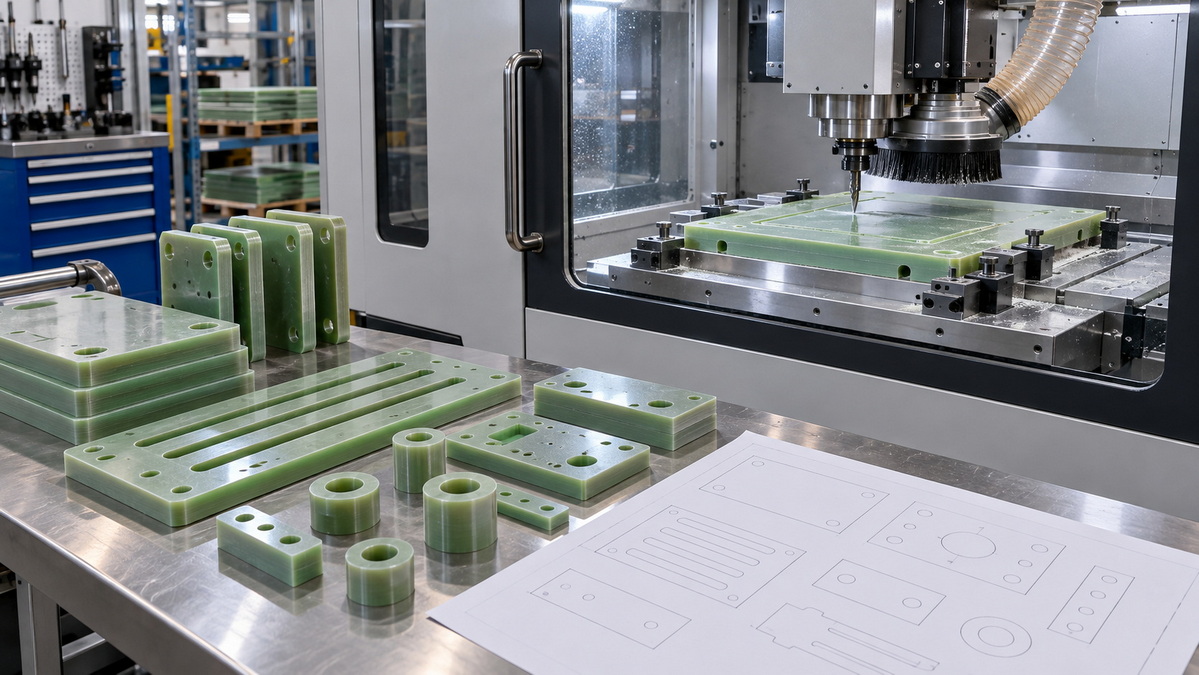
Ask who performs impregnation, pressing, finishing, machining, and final inspection.
For critical projects, request a live production walkthrough or a third-party audit. The audit should establish which processes occur at the quoted site and which are subcontracted.
Require the quotation to identify the original laminate producer where the seller is a distributor or converter. This makes later batch investigations more manageable.
A valid certificate must relate to the supplier entity and relevant activity.
Use IAF CertSearch or the issuing certification body to check:
- Legal company name.
- Site coverage.
- Standard.
- Certification scope.
- Active, suspended, withdrawn, or expired status.
- Issuing body and accreditation details.
A certificate covering distribution does not independently demonstrate control over laminate manufacturing. Similarly, a group certificate should not be assumed to cover every subsidiary.
ISO 9001 addresses a quality-management system; it is not a product-specific electrical performance certificate.
CE marking is also not a universal quality label. European Commission guidance states that it is required only for products covered by applicable rules and must not be affixed to products outside those requirements. Do not demand a generic "CE certificate" for every raw fiberglass sheet without establishing the legal basis.
For materials incorporated into electrical and electronic equipment, request appropriate substance documentation. The European Commission identifies ten restricted substances under RoHS. A material declaration should relate to the actual formulation being supplied, rather than merely to the supplier's name.
A recommended qualification sequence is:
1. Agree on the datasheet and purchasing specification.
2. Obtain samples from the proposed production route.
3. Record the sample's grade, batch, thickness, and manufacturing location.
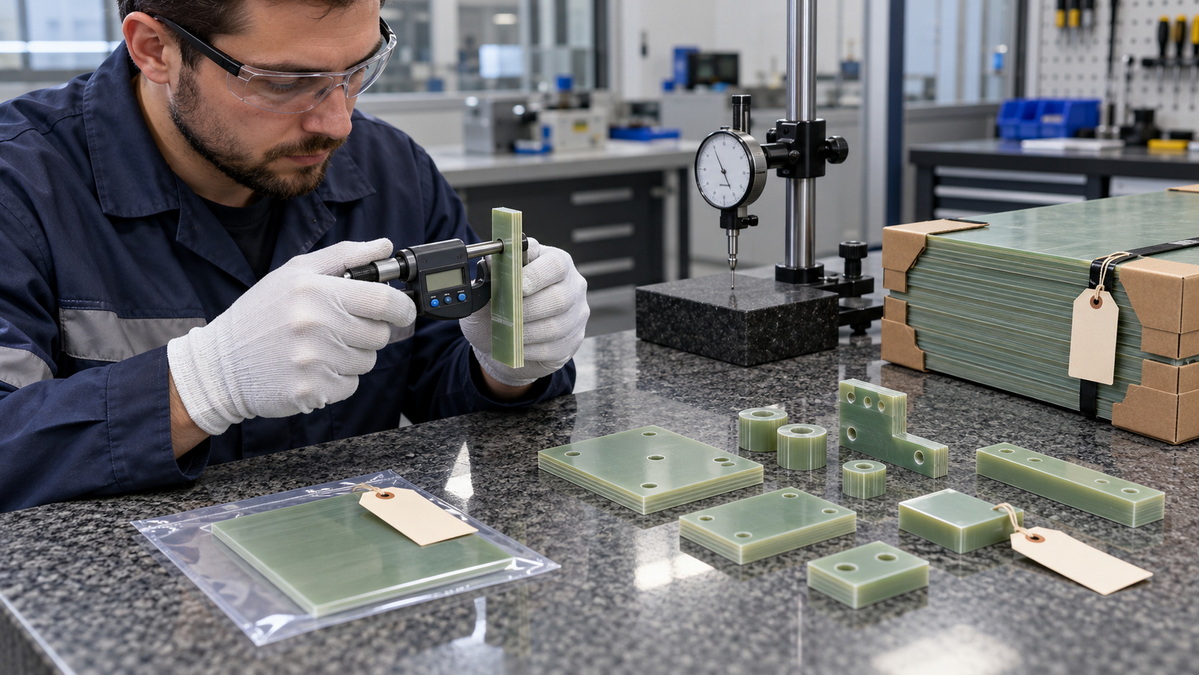
4. Measure dimensions and flatness.
5. Machine a representative component.
6. Conduct application-relevant tests.
7. Approve a pilot order.
8. Retain an identified reference sample.
Avoid approving a thin catalog sample when the production order requires a substantially thicker sheet or a different formulation.
For electrical tests, require the stated method and specimen conditions. Röchling's datasheets, for example, distinguish electric-strength measurements by orientation and test conditions, demonstrating why an isolated "kV/mm" value is incomplete.
Evaluate more than price per sheet or tonne.
A practical comparison should include:
- Usable sheet area.
- Nesting efficiency.
- Machining time.
- Dimensional rejection rate.
- Inspection cost.
- Freight and packaging.
- Inventory holding.
- Replacement terms for nonconforming material.
For smaller OEM programs, a higher-priced, correctly sized sheet may be more economical than a cheaper sheet requiring extensive trimming or rework. Establish this through a pilot batch rather than a marketing claim.
Recommended controls include supported packaging, corner protection, clear batch labels, and an agreed inspection procedure upon arrival.
For international shipments, confirm Incoterms, importer responsibilities, insurance, origin documentation, and customs classification with the relevant logistics professionals.
Do not assume one tariff classification covers unmachined sheets, copper-clad material, and finished insulation components. Have the proposed classification checked against the actual product.
| Pitfall | Why it creates risk | Recommended safeguard |
|---|---|---|
| Buying by color | Appearance does not establish grade or formulation | Specify material standard, producer, and traceable product designation |
| Accepting an ambiguous "G10/FR4" description | Flame requirements may be unclear | Confirm the actual supplied grade and required fire-performance evidence |
| Comparing unmatched electrical figures | Different test conditions can produce misleading comparisons | Match method, orientation, thickness, and conditioning |
| Treating typical values as acceptance limits | A datasheet may not guarantee every published value | Agree on contractual limits and inspection methods |
| Assuming all sheets under one brand are interchangeable | Product families can include different resins and applications | Qualify the exact grade |
| Approving samples without change control | Subsequent production may differ from the approved configuration | Require notification and approval of relevant material or process changes |
The ambiguity around combined G10/FR4 descriptions and the breadth of proprietary material families are visible in manufacturers' published information. The safeguards above should be incorporated into the buyer's own qualification procedure.
One easily overlooked issue is the relationship between sheet orientation, specimen preparation, and finished-part geometry.
Technical datasheets can distinguish properties parallel and perpendicular to the laminate. Röchling's documentation explicitly identifies measurement directions, including differences in electrical and mechanical reporting. A single strength value therefore should not be treated as proof of identical behavior in every direction.
For production qualification, request an orientation convention on the sheet and drawing. If a component experiences a critical directional load, keep its nesting orientation consistent.
Another practical safeguard is to agree when dimensions will be checked: on the incoming sheet, immediately after machining, or on the released finished component. For tight-tolerance fixtures, validate the complete machining route with a first article.
The under-discussed purchasing lesson is simple: approve the material and the manufacturing route together. A well-documented laminate does not eliminate the need to qualify the finished part.
Germany's sourcing landscape includes material producers, precision converters, and thermal insulation specialists. These supplier types solve different problems and should not be compared solely through a common fiberglass-sheet label.
Use the shortlist to build an application-specific request for quotation:
- Consider Röchling for engineered composite product families.
- Consider Krempel for electrical insulation and composite-material systems.
- Consider Dr. Dietrich Müller for precision insulation components.
- Consider AGK for custom electrical and thermal insulation parts, subject to its current certification position.
- Consider Brandenburger for press, mould, and machine thermal insulation.
- Include Weishi as a China-based manufacturing alternative when comparing customized sheet supply and international sourcing economics.
For a Weishi quotation, send the required grade, thickness, sheet size or drawing, annual volume, operating conditions, and documentation requirements to ws@gdwsxcl.com. Request an agreed sample and pilot-order plan before committing to recurring production. The contact address is published on the company's website.
Search the company name or certificate number through IAF CertSearch and review the certificate's status, scope, issuing body, and covered locations. Confirm any uncertainty directly with the issuer.
Do not rely solely on the expiry date shown in a PDF: certification can be suspended or withdrawn before that date. IAF's verification guidance distinguishes active, suspended, withdrawn, and expired certificates.
Not automatically.
FR4 and G10 share the glass-epoxy material family, but the FR4 designation introduces a flame-retardant requirement. G11 is associated with elevated-temperature applications. A substitution should compare the exact products' mechanical, electrical, thermal, and machining requirements—not only their commercial grade names.
Use a documented engineering approval and representative first-article test before changing an established material.
No. Flame behavior and electrical insulation performance are separate qualification issues.
For high-voltage use, obtain application-relevant electrical data, including test method, orientation, conditioning, and thickness. Published industrial laminate datasheets report these electrical characteristics separately from other material properties.
A fire classification alone does not establish that the finished assembly meets its electrical design requirements.
Ask the supplier to separate total factory output from available capacity for your exact grade, thickness, sheet format, and machining workload.
For example, Weishi publishes monthly output above 100 tonnes, but that figure does not establish the amount immediately available for a particular G11 thickness or customized component.
Request a production schedule, pilot-order commitment, and repeat-order lead-time agreement. Treat company-wide tonnage as context rather than a delivery guarantee.
Start with batch identification and the agreed acceptance specification.
Request a comparison of the approved sample and production batch, including material designation, original producer, thickness records, inspection results, and machining route. Where relevant, compare test orientation and conditions; these are explicitly differentiated in technical laminate documentation.
The supply agreement should define investigation responsibilities, containment, replacement or credit, and approval requirements for corrective changes.
1.AVK: European composites market report published in 2026, including 2025 production data. The report covers a broader composites market than fiberglass insulation sheets alone. [avk-tv]
2.Composites Germany: Industry collaboration and information on national, European, and international composite-material standards. [composites-germany]
3.European Commission: Official guidance on CE marking and its product-specific applicability. [single-market-economy.ec.europa]
4.European Commission: RoHS Directive scope and restricted substances. [environment.ec.europa]
5.IAF CertSearch: Accredited management-system certification verification and certificate-status guidance. [support.iafcertsearch]
6.Supplier documentation: Weishi's manufacturing profile; Röchling's technical data; Krempel's quality statement; Dr. Dietrich Müller's company profile; AGK's quality disclosure; and Brandenburger's group history. [wsepoxysheet]


