
Views: 254 Author: Weishi Sheets Publish Time: 2026-10-29 Origin: Site
Content Menu
● How We Evaluate a G10 Epoxy Sheet Supplier
● Why Source G10 Epoxy Sheet from Italy?
>> An Established Industrial Supply Network
>> What the Latest Market Figures Actually Show
● Understanding G10 Epoxy Sheet Before Comparing Suppliers
>> G10, FR4, and G11 Are Related—but Not Interchangeable
>> Standards and Compliance: Ask the Right Questions
● Supplier Comparison: Capacity, MOQ, and Documentation
>> 1. Guangdong Weishi New Materials Co., Ltd.
>>> China-Based Alternative for Customized Factory Supply
>>> Core Strengths and Customization Scope
>> 2. MDT Srl
>>> Italian Manufacturing for Large and Non-Standard Laminates
>>> Core Strengths and OEM Scope
>> 3. RCN
>>> Composite-Laminate Manufacturing with a Long Operating History
>>> Core Strengths and OEM Scope
>>> Insulation-Material Supply with Drawing-Based Processing
>>> Core Strengths and OEM Scope
>> 5. Uciesse
>>> Precision Components and European Delivery
>>> Core Strengths and OEM Scope
● Buyer's Guide: How to Qualify a G10 Epoxy Sheet Supplier
>> 1. Verify the Legal Entity and Actual Production Role
>> 2. Build a Complete Material Specification
>> 3. Approve Samples in Three Stages
>> 4. Compare Finished-Part Cost, Not Only Sheet Price
>> 5. Agree on Packaging and Logistics
● Insider Pitfall: A Machined Component Can Fail Even When the Incoming Sheet Passes
● Conclusion: Choose the Supply Model That Matches the Risk
● FAQ
>> 1. How Can I Check Whether a Supplier's ISO Certificate Is Expired or Invalid?
>> 2. Can a Supplier Substitute FR4 for G10 Without Asking?
>> 3. What Evidence Should Support a RoHS or REACH Declaration?
>> 4. How Can I Establish Whether Published Production Capacity Is Available for My Orders?
>> 5. What Should I Do When a Supplier's Temperature Rating Conflicts with Another Supplier's G10 Data?
Italy offers several credible sourcing routes for G10 epoxy sheet, from laminate manufacturers to precision machining specialists and electrical insulation distributors. For procurement teams, the challenge is not simply finding a company that lists G10. It is identifying a supplier that can consistently deliver the correct grade, documented material properties, dependable machining quality, and commercially workable lead times.
This guide examines five Italy-based manufacturers and suppliers, alongside Guangdong Weishi New Materials Co., Ltd., a China-based manufacturing alternative for buyers comparing local supply with direct factory sourcing.
The companies are presented by purchasing relevance rather than independently audited market share. Guangdong Weishi appears first as the featured international alternative—not as an Italian manufacturer.

A credible supplier assessment starts with traceability: the ability to connect every delivered sheet or machined component to an identifiable material grade, production batch, inspection record, and approved specification.
For this selection, the main assessment dimensions are:
- Manufacturing role: whether the company manufactures laminates, machines purchased sheets, distributes materials, or combines these activities.
- Technical capability: published evidence of G10, glass-epoxy laminates, electrical insulation products, or related processing.
- Quality control: availability of technical data sheets, inspection documentation, batch identification, and relevant certification.
- Development support: capability to evaluate drawings, recommend materials, and support application-specific requirements.
- Customization: cut-to-size supply, CNC machining, special dimensions, and drawing-based production.
- Delivery reliability: realistic production scheduling, stock visibility, packaging, and replenishment arrangements.
- Commercial suitability: transparent quotations, workable order quantities, and responsiveness to smaller industrial customers.
Company descriptions below draw on public company information. Production volumes, minimum order quantities, current certificate validity, and delivery performance require direct verification before supplier approval.
Italy's insulation-material supply chain connects laminate production with electromechanical engineering, industrial machinery, precision machining, and component conversion.
The companies reviewed illustrate several regional sourcing connections: La Misolet originated in Milan, Uciesse began in Turin, and Texpack operates in Adro, in the province of Brescia. These locations place suppliers within northern Italy's broader industrial manufacturing network. However, they should not be interpreted as a separately measured, G10-only production cluster.
For buyers, the practical attraction is access to both materials and downstream processing. A local converter may be more useful than a large laminate producer when the requirement is a small batch of finished insulating components rather than full sheets.
Grand View Research's Italy composites market outlook reports revenue of USD 3,280.8 million in 2025 and forecasts USD 5,841.7 million by 2033. These figures cover the broader composites market—not G10 epoxy sheets alone—and should not be used to claim a specific Italian G10 market size.
The industry also benefits from organized technical exchange. Assocompositi represents companies, professionals, research institutions, and other participants across the Italian composites sector. JEC Forum Italy's 2025 edition further demonstrates the country's active composites supply network. Neither association participation nor event attendance, however, substitutes for a factory audit or product qualification.
G10 epoxy sheet consists of woven glass fabric bonded with an epoxy resin system. Manufacturers consolidate the impregnated layers under heat and pressure to produce rigid laminates with useful electrical insulation and mechanical properties.
Buyers should distinguish the following material families:
| Material | General purchasing distinction | What to verify |
|---|---|---|
| G10 | Glass-epoxy laminate for mechanical and electrical insulation | Exact grade, conditioned properties, temperature limitations |
| FR4 | Flame-retardant glass-epoxy laminate | Actual flammability classification, tested thickness, and supporting documentation |
| G11 | Glass-epoxy grade selected for improved elevated-temperature performance | Strength retention at operating temperature and grade-specific data |
| FR5 | Flame-retardant, higher-temperature glass-epoxy family | Grade-specific thermal and flame-performance evidence |
Italian suppliers commonly use the term "vetronite" for glass-reinforced insulating laminates. The word alone is not a complete purchasing specification: it can cover several grades with materially different performance.
Do not accept "G10/FR4" as an automatic declaration that both specifications are satisfied. A supplier may genuinely offer a dual-qualified material, but that needs explicit documentary support.
Likewise, temperature figures require context. MDT describes its G10 material for use up to 130°C, while other suppliers publish different values for particular products. Such figures may reflect different formulations, definitions, or test conditions; they are not interchangeable guarantees of continuous service life.
Supplier literature may reference NEMA LI 1, IEC/EN 60893 classifications, or legacy DIN designations. Request the exact standard, grade, edition where relevant, and test conditions instead of relying on a general "international standard" claim. La Misolet, for example, publishes several standard designations for its glass-epoxy materials.
Compliance documentation also needs careful interpretation:
- ISO 9001 concerns a quality management system; it does not prove that every G10 batch meets your drawing.
- RoHS addresses restricted substances in electrical and electronic equipment. Material declarations and appropriate test evidence can support downstream compliance.
- REACH is a separate chemical regulatory framework with different obligations.
- CE marking is not a universal quality certificate for raw insulating sheets. It applies only where specific legislation requires it.
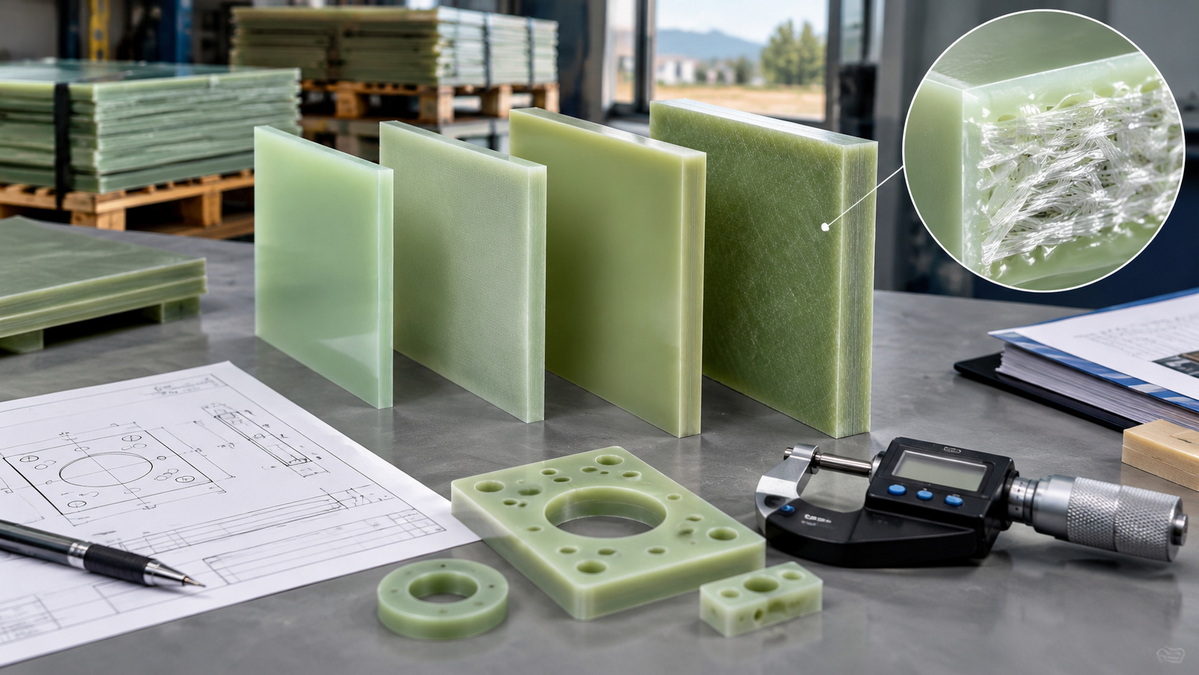
The table distinguishes published facts from information that must be requested. "Not publicly stated" does not mean a supplier lacks capability; it means buyers should not rely on an invented figure.
| Company | Location and supply role | Published capacity or dimensional capability | MOQ | Certification and documentation position |
|---|---|---|---|---|
| Guangdong Weishi New Materials Co., Ltd. | China; composite-sheet manufacturer and processing supplier | Website reports 100+ tonnes/month overall output and over 16,000 m² building area; G10-only capacity not separated | Request by grade, thickness, and processing scope | Obtain current certificates, grade-specific reports, and batch documentation |
| MDT Srl | Italy; epoxy-laminate manufacturer and CNC processor | Publishes press capability for plates up to 4,200 × 1,600 mm; annual tonnage not stated | Not publicly stated | Publishes technical product information; request current certificates and inspection scope |
| RCN | Italy; prepreg and composite-laminate manufacturer | Annual G10 capacity not publicly stated in reviewed information | Not publicly stated | Publishes a G10 product description and referenced specifications; verify current supporting reports |
| La Misolet | Italy; insulating-material supplier and machining specialist | CNC processing and custom sheet cutting; annual throughput not stated | Not publicly stated | Publishes material classifications and technical data; verify current management-system certification |
| Uciesse | Italy; semi-finished-material supplier and precision component processor | CNC machining capability; annual G10 throughput not stated | Not publicly stated | Product page includes general material claims; request exact grade and any applicable listing details |
The manufacturing and processing capabilities above are based on the companies' published information, not independent capacity audits.
Guangdong Weishi New Materials Co., Ltd. states that it was established in October 2007 in Heyuan, Guangdong. Its website reports a building area exceeding 16,000 m², ten engineers, more than 60 technical staff, and monthly production exceeding 100 tonnes across its product portfolio. These are company-reported figures rather than independently verified G10-specific output.
Its published range includes FR4, G10, G11, other fiberglass laminates, copper-clad materials, phenolic boards, and processed insulation products. The company also states that it can work from customer product ideas and designs and adapt them for production.
For small and medium-sized industrial buyers, Weishi is worth evaluating when the project combines sheet supply with customized processing.
Its relevant purchasing proposition includes:
- A broad insulation-material portfolio.
- Published engineering resources.
- Production and processing within one supplier relationship.
- Support for customer drawings and product-development discussions.
- An alternative to purchasing through multiple distribution layers.
For OEM work, buyers should request written confirmation of achievable dimensions, tolerances, machining operations, inspection requirements, and packaging. For ODM-style development, define who owns the design, who validates the material selection, and who approves changes.
Cost competitiveness, communication efficiency, and order flexibility should be tested through a real quotation and pilot order—not treated as established merely because a supplier offers direct manufacturing.
The company identifies electronics, electrical equipment, and machinery as application areas. Its reviewed homepage does not disclose audited geographic sales shares or confirm a dedicated Italian operation.
It is therefore most relevant as an international sourcing alternative for buyers able to manage import logistics and qualify a direct manufacturing partner.
Founded in 2011, MDT states that it was established to produce large epoxy laminates for electrical insulation, serving industrial customers in Italy and abroad. It subsequently added CNC machining to supply finished components.
One particularly useful published capability is its press configuration for insulating plates up to 4,200 × 1,600 mm. This is a dimensional capability, not evidence that every grade and thickness is available at that size.
MDT is a relevant candidate for projects involving:
- Oversized insulating plates.
- Non-standard sheet dimensions.
- Thick laminate requirements.
- CNC-finished components.
- Applications combining material selection with machining advice.
Its website identifies electronics, oil and gas, electromechanical, and railway applications. Its G10 page specifically describes a non-self-extinguishing glass-epoxy material, which helps buyers distinguish it from flame-retardant alternatives.
For OEM procurement, ask whether the quotation covers laminate manufacture, finish machining, or both. Confirm usable dimensions after trimming and the inspection method for large-sheet flatness.
RCN states that it was founded on March 15, 1979, by Franco Noé and partners Rossetti and Cantella. It describes its activities as the production of prepregs, composite laminates, and electrical insulating materials.
Its published G10 product page identifies glass fabric and epoxy resin and references NEMA G10 and other specifications. The company lists application sectors including industrial, railway, aeronautical, construction, and other composite-material markets.
RCN is relevant when buyers want to discuss laminate properties with a producer rather than only order stock material.
Potential qualification topics include:
- Application-specific laminate selection.
- Custom laminate requirements.
- Required specification cross-references.
- Mechanical-property documentation.
- Repeatability between qualification samples and production deliveries.
RCN's broader composite expertise should not be interpreted as automatic approval for a regulated end application. Aerospace, railway, or defense-related use may require project-specific qualification beyond the supplier's general industry experience.
Its reviewed public information does not establish geographic sales proportions, current G10 production capacity, or standard MOQ. Obtain these directly during the quotation stage.
La Misolet's company history states that it was founded in Milan in 1983. Its published material range includes G10, FR4, G11, and FR5 glass-epoxy products in forms such as sheets, tubes, and rods.
The company describes CNC machining to customer designs, blanking, turning, milling, cut-to-size service, and assembly. It also advertises ready-to-deliver material availability, although actual grade, thickness, and stock quantities must be confirmed for each order.
La Misolet is a practical candidate for buyers who need material converted into usable components.
Its relevant strengths include:
- Multiple insulating-material options.
- Technical grade information.
- Custom panel cutting.
- Drawing-based machining.
- Support for electromechanical and electronic applications.
The main procurement distinction is between material production and conversion. Ask which upstream manufacturer supplies the selected laminate and whether that source remains fixed for repeat orders.
Its reviewed pages do not provide quantified geographic market shares. Buyers planning cross-border supply should confirm export documentation, delivery terms, and after-sales arrangements.
Uciesse states that it began in Turin in 1987 as a reseller of industrial technical products. It now describes its business as the supply and processing of semi-finished plastics and electrical insulating materials.
Its glass-epoxy component page explicitly lists G10, G11, FR4, and FR5 and offers delivery throughout Europe.
Uciesse is particularly relevant for buyers seeking finished parts rather than laminate manufacturing.
Its published focus includes CNC production of precision components from plastic materials and processing to customer requirements. This makes it a candidate for drawing-based OEM parts, replacement insulators, and repeat machined-component supply.
However, general references to flame ratings or UL listings on a product-family page should not be treated as certification of every offered grade. Request the exact manufacturer, material designation, applicable listing, and tested thickness.
Its documented national coverage and European delivery are useful purchasing indicators, but neither establishes guaranteed stock nor a fixed lead time.
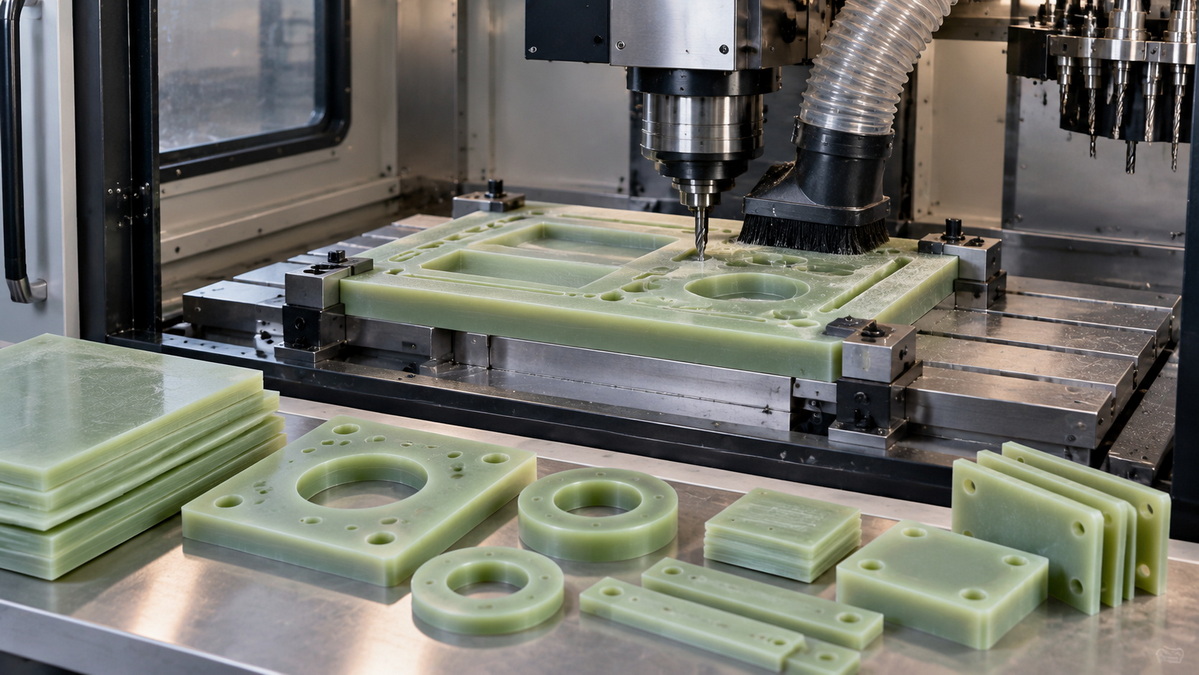
Before requesting a production quotation, establish:
1. The contracting company's legal name and registered address.
2. The manufacturing location.
3. Whether lamination, cutting, and machining are internal or subcontracted.
4. Whether the supplier can identify the upstream laminate producer.
5. Which organization is responsible for inspection and nonconformance resolution.
A distributor can be an excellent partner. The risk is not distribution itself; it is undisclosed substitution or unclear accountability.
A purchase order should define more than "green G10 sheet."
Include:
- Required grade and applicable standard.
- Sheet dimensions and thickness tolerances.
- Flatness and surface condition.
- Electrical and mechanical acceptance requirements.
- Operating environment and temperature.
- Flame-performance requirements, if applicable.
- Drawing revision and machining tolerances.
- Batch identification and inspection documents.
- Rules governing material or process changes.
Color is an identification aid—not proof of grade.
Use a qualification sequence that reflects the actual application:
1. Material coupon: check identity, thickness, appearance, and agreed properties.
2. Machined first article: inspect critical dimensions, hole quality, edges, and assembly fit.
3. Pilot production batch: evaluate consistency, packaging, delivery, and documentation.
A hand-selected sample proves less than a traceable sample taken from the intended production route.
For critical applications, agree on independent laboratory testing and acceptance criteria before placing the order.
A low sheet price may be offset by poor nesting yield, excessive machining allowance, rejected parts, or expensive freight.
Compare:
- Delivered material cost.
- Usable area after trimming.
- Cutting and machining yield.
- Tooling and inspection charges.
- Packaging and transport.
- Import administration where applicable.
- Replacement cost and production disruption risk.
For imported supply, obtain a landed-cost breakdown. For local supply, check whether quoted speed depends on actual stock or an upstream replenishment order.
Large or thin sheets need packaging designed to limit bending, edge damage, and movement during transport.
Specify flat support, protective interleaving where appropriate, corner protection, moisture protection, and labels that preserve batch identity. For machined parts, require packaging that prevents abrasion and allows receiving staff to match each package to its inspection record.
Confirm the named delivery location, agreed Incoterm, insurance responsibility, and damage-claim procedure before shipment.
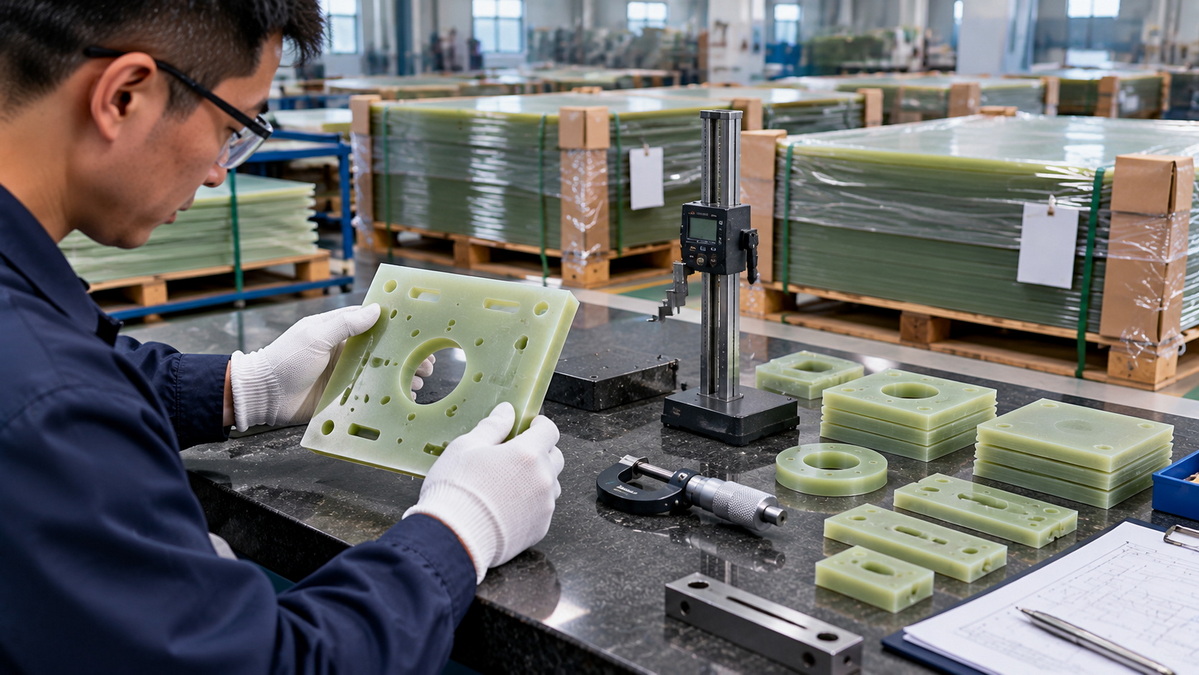
A less visible sourcing risk arises when a supplier qualifies the full sheet but does not evaluate what happens after machining.
Glass-epoxy laminates have a layered structure. Removing substantial material from one side, producing thin sections, or machining complex pockets may expose dimensional behavior that was not apparent during incoming sheet inspection.
The practical safeguard is to qualify the finished geometry—not only the parent sheet.
For demanding parts, require the supplier to:
- Identify laminate orientation where it affects the design.
- Inspect flatness after machining rather than only before it.
- Agree on inspection timing and conditioning.
- Preserve the approved material source and processing route.
- Obtain approval before changing laminate manufacturer or formulation.
This is especially important when moving a successful prototype into recurring production. An apparently equivalent replacement sheet may alter machining yield or dimensional performance even when its commercial grade description looks similar.
Italy offers distinct sourcing options rather than one uniform supplier category.
MDT and RCN are relevant starting points for laminate-manufacturing discussions. La Misolet and Uciesse offer useful routes for material conversion and drawing-based components. Guangdong Weishi provides a China-based factory alternative for buyers evaluating customized production and international sourcing.
The right choice depends on verified material performance, usable capacity, documentation, finished-part consistency, and total delivered cost—not the supplier's position in a list.
To evaluate Guangdong Weishi for your next project, submit the required grade, sheet dimensions, annual demand, application conditions, and machining drawings. Request a written technical proposal, sample plan, inspection package, and delivery quotation before approving production.
Request the complete certificate, including its certificate number, legal entity, site address, scope, issuing certification body, and validity dates.
Then verify its status directly with the issuing body. Check whether it remains active and whether the scope covers the relevant manufacturing or processing activity. A valid certificate for an associated trading office is not equivalent to certification of the production site.
Also ask about suspensions, scope changes, and the latest surveillance status. A certificate image alone is insufficient evidence.
Not when the purchase specification requires a defined material and has not authorized substitutions.
FR4 and G10 can share useful characteristics, but differences in formulation and flame performance may matter to the application. Require the supplier to identify the proposed replacement and submit comparative data before approval. A material explicitly documented as meeting both required specifications is a different case from an undocumented substitution.
Ask for documentation tied to the exact material grade and identifiable manufacturer, not a generic company statement.
Check the declaration date, regulatory scope, referenced restrictions or substance lists, and supporting test coverage where appropriate. RoHS and REACH address different requirements; one document does not automatically establish compliance with both.
Separate total factory output from capacity for your specific grade, thickness, sheet size, and processing route.
Ask about scheduled utilization, bottleneck operations, reserved capacity, raw-material availability, and the share of work that is subcontracted. Validate the answer through a pilot order and realistic replenishment plan.
A factory reporting high monthly tonnage may still have limited availability for a particular resin system or machining operation.
Ask both suppliers to define the rating: continuous service, short-term exposure, thermal classification, or a specific test result.
Then compare the actual properties needed at your operating temperature, including mechanical performance and electrical behavior under relevant conditioning. Published G10 temperature figures vary across supplier offerings, so the grade name alone cannot resolve the discrepancy.
1.Guangdong Weishi New Materials Co., Ltd. — company background, reported facilities, product portfolio, and customization services. [wsepoxysheet]
2.MDT Srl — establishment, laminate production, CNC services, and published plate dimensions. [mdtlaminati]
3.MDT — G10 material description and stated application temperature. [mdtlaminati]
4.RCN — company history and manufacturing background. [rcncompositi]
5.RCN — G10 glass-epoxy product description and referenced specifications. [rcncompositi]
6.La Misolet — company history. [misolet]
7.La Misolet — G10, FR4, G11, FR5, technical classifications, and processing services. [misolet]
8.Uciesse — company history and supply activities. [uciesse]
9.Uciesse — glass-epoxy components and European delivery. [uciesse]
10.Grand View Research — Italy Composites Market Size & Outlook, including the 2025 revenue estimate. [grandviewresearch]
11.Assocompositi — Italian composites industry association and membership network. [assocompositi]
12.JEC — 2025 Italian composites industry event information. [jeccomposites]
13.European Union, Your Europe — official CE-marking applicability guidance. [europa]
14.European Commission — official RoHS Directive information. [environment.ec.europa]
15.European Chemicals Agency — official explanation of REACH. [echa.europa]


