
Views: 231 Author: Weishi Sheets Publish Time: 2026-11-14 Origin: Site
Content Menu
● Identify Your Fiberglass Sheet Before Cutting
● What Is the Best Tool for Cutting Fiberglass Sheet?
>> Choose Carbide or Diamond Tooling for Rigid Laminates
>> Use a Jigsaw for Shapes, Not Guaranteed Precision
● How to Cut Fiberglass Sheet Safely
>> Capture Dust at the Cutting Point
>> Select Protection for the Actual Task
● How to Cut Fiberglass Sheet Step by Step
>> 1. Define the Finished-Part Requirements
>> 2. Inspect and Mark the Sheet
>> 3. Support the Sheet and Offcut
>> 4. Check the Machine and Tooling
>> 5. Make a Representative Trial Cut
>> 6. Cut With a Controlled Feed
>> 7. Finish, Clean, and Inspect
● How to Prevent Chipping, Fraying, and Delamination
● A Better Production Approach: Validate Before Cutting the Batch
● Cutting Fiberglass Insulation Parts: What Buyers Should Specify
● Request Material and Cutting Support From Weishi
>> Can I cut fiberglass sheet with a utility knife?
>> What blade should I use to cut FR4 board?
>> Can I cut G10 with a circular saw?
>> How do I cut fiberglass sheet without splintering?
>> What speed should I use for cutting fiberglass sheet?
>> Can I laser-cut FR4 or G10?
To understand how to cut fiberglass sheet cleanly, start with three essentials: identify the material, choose tooling designed for abrasive composites, and support the sheet throughout the cut. For rigid epoxy glass boards such as FR4, G10, and G11, carbide or diamond tooling is generally more suitable than ordinary woodworking blades.
The right approach also depends on your goal. Cutting a rough blank for further machining differs from producing a finished electrical insulation component with controlled dimensions and clean edges.
At Guangdong Weishi New Materials Co., Ltd., our focus is high-performance epoxy insulation boards and composite materials. This guide approaches cutting from that application perspective: not simply separating a sheet, but preparing a usable component while controlling dust, edge damage, and dimensional error.

"Fiberglass sheet" describes several products. Treating them as interchangeable can lead to unsuitable tool choices and disappointing results.
| Material | Typical characteristics | Cutting priority |
|---|---|---|
| Thin decorative FRP panel | Often flexible, sometimes textured | Follow the panel manufacturer's instructions |
| FR4 epoxy glass board | Rigid glass-reinforced epoxy insulation laminate | Control abrasive wear and edge damage |
| G10 epoxy glass board | Rigid woven-glass epoxy laminate | Maintain support and dimensional accuracy |
| G11 epoxy glass board | Epoxy glass grade commonly specified for elevated-temperature applications | Confirm grade-specific machining guidance |
| Copper-clad laminate | Composite sheet with bonded copper foil | Manage both laminate cutting and copper burrs |
FR4 and G10 belong to the glass-epoxy laminate family, but their grade requirements are not identical. Do not infer flame-retardant performance, temperature capability, or electrical suitability from appearance alone.
Before cutting, check the material designation, thickness, technical data sheet, and safety data sheet. For critical components, confirm the drawing requirements as well.
There is no single best tool for every thickness, shape, and production volume. Choose a method that balances edge quality, equipment capability, dust control, and repeatability.
| Tool or process | Suitable work | Main limitation |
|---|---|---|
| Guided circular or panel saw | Straight cuts and rectangular blanks | Requires compatible composite-cutting tooling and extraction |
| Table saw | Repeated straight cuts in a properly equipped workshop | Kickback and guarding require careful control |
| Jigsaw with a suitable carbide blade | Curves, openings, and occasional cuts | Blade deflection can affect accuracy |
| Bandsaw with compatible tooling | Rough profiles and curved blanks | Finished edges may need additional machining |
| CNC router | Repeated profiles, slots, and precision components | Requires secure workholding and validated parameters |
| Abrasive waterjet | Specialist profile cutting | Taper, piercing damage, moisture, and cleanliness require evaluation |
Glass reinforcement is abrasive. Ordinary blades may lose their cutting edge quickly, increasing cutting force and reducing finish quality.
For rigid epoxy glass sheets, select tooling specifically approved by its manufacturer for glass-reinforced composites. Carbide can suit shorter runs, while polycrystalline diamond tooling can be worth evaluating for sustained production.
Blade geometry, diameter, tooth configuration, and operating speed must match the machine and laminate. A blade described only as "fine-tooth" is not automatically suitable.
A jigsaw can be practical for occasional curved cuts, but the blade may bend, especially through thicker material.
Use a blade specified for fiberglass or abrasive composites. Keep the base supported, avoid forcing the blade sideways, and leave finishing allowance when dimensions matter. Follow the tool manufacturer's guidance on orbital action.
Cutting creates a combination of airborne particles, sharp edges, noise, and moving-tool hazards. Dust control should be part of the setup—not an afterthought.
Glass-containing dust can irritate skin, eyes, and the respiratory tract. Its composition also depends on the resin, fillers, coatings, and other constituents in the particular product.
Use local extraction positioned to collect particles where they are generated. A room fan does not replace source capture and may spread contamination.
For cleanup, use a suitable industrial vacuum with appropriate filtration, preferably HEPA filtration for fine dust. Avoid blowing dust from clothing, components, or benches with compressed air.
Keep dust away from nearby assembly areas and electrical equipment.
The protective equipment assessment should consider:
- Safety glasses or goggles for flying particles.
- Hearing protection appropriate to the machine and exposure.
- Clothing that limits skin contact without creating entanglement hazards.
- Suitable respiratory protection where required by the exposure assessment.
- Gloves for handling rough sheets and offcuts, where safe.
Do not wear gloves near moving machinery when they could be caught. Follow the machine's operating instructions.
A loose face covering is not a substitute for an appropriately selected respirator. Where workplace respiratory protection is required, applicable requirements may include medical evaluation, training, and fit testing.
The following workflow applies primarily to straight cuts in rigid epoxy glass laminates. Adapt it to your equipment, material documentation, and approved workshop procedures.
Identify the required dimensions, tolerances, edge condition, and any subsequent machining.
Decide whether the saw cut will be the finished edge or merely produce a blank. This distinction determines how much machining allowance to leave.
For electrical insulation parts, also review cleanliness requirements, hole positions, and any restrictions on edge treatments.
Check for visible cracks, damaged corners, or existing layer separation.
Mark the cut using a suitable pencil or approved marking method. Low-tack tape may improve line visibility, but test it first if surface cleanliness matters.
Tape is not a substitute for sharp tooling or proper backing.
Support the material close to the cutting path without obstructing the blade, guard, or extraction system.
Use compatible backing where needed to reduce breakout. Secure the work without excessive clamping pressure.
Plan what happens at the end of the cut. An unsupported offcut can drop, tear the remaining fibers, or pinch the blade.
With power isolated, inspect the blade or cutter, mounting arrangement, guards, and extraction connections.
Confirm that the tooling is suitable for the material and rated for the machine's operating speed. For table-saw work, use the required guarding and kickback-control provisions.
Never remove a safety device simply to accommodate an improvised setup.
Test an offcut of the same grade and thickness before cutting valuable material.
Inspect both faces and the cut edge. Look for fraying, chipping, discoloration, dimensional error, and signs of blade deflection.
Change one variable at a time so the result is meaningful.
Feed steadily without forcing the tool. Follow the machine and cutter manufacturer's starting recommendations.
Feeding too aggressively can increase breakout or deflection. Feeding too slowly can produce rubbing and localized heating.
Stop if the tool binds, the sheet shifts, extraction fails, or abnormal heat develops. Isolate the machine before investigating.
After the tool stops, remove the part safely and deburr using an appropriate abrasive or finishing tool with dust control.
Avoid unnecessary rounding of critical edges. Remove residue using a cleaning method compatible with the laminate and end-use requirements.
Inspect the finished dimensions only after the part has returned to a stable temperature.
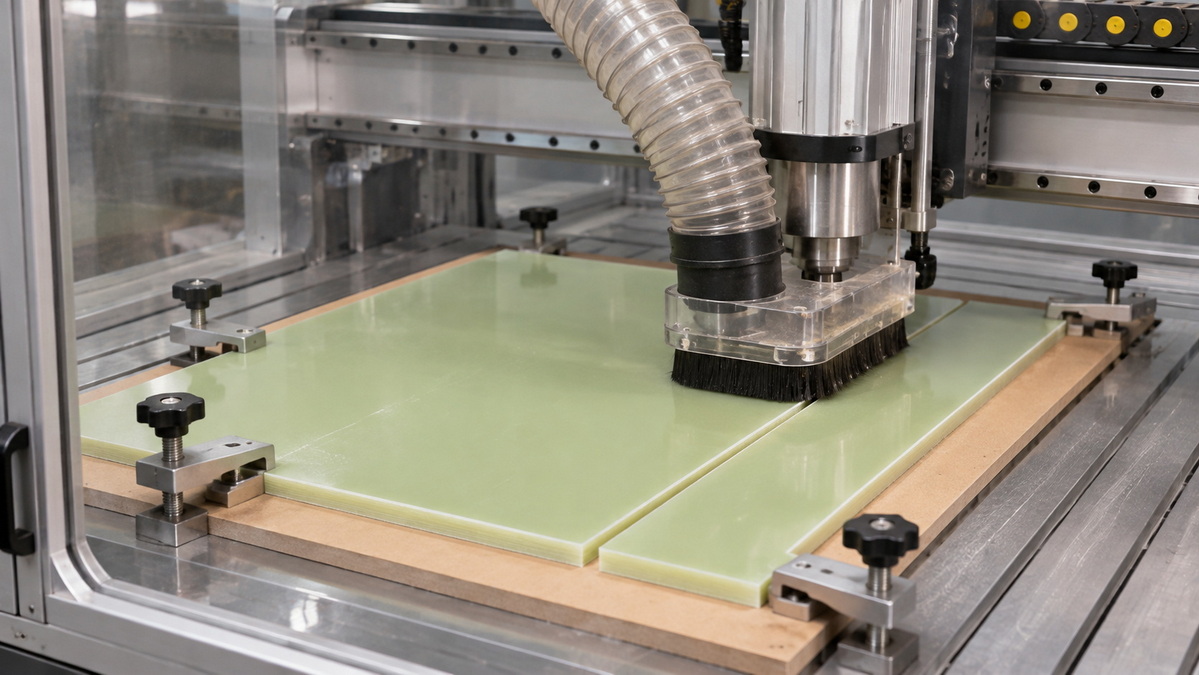
A clean edge results from the complete cutting system: tooling, support, feed, workholding, and material condition.
| Problem | Possible contributors | Practical checks |
|---|---|---|
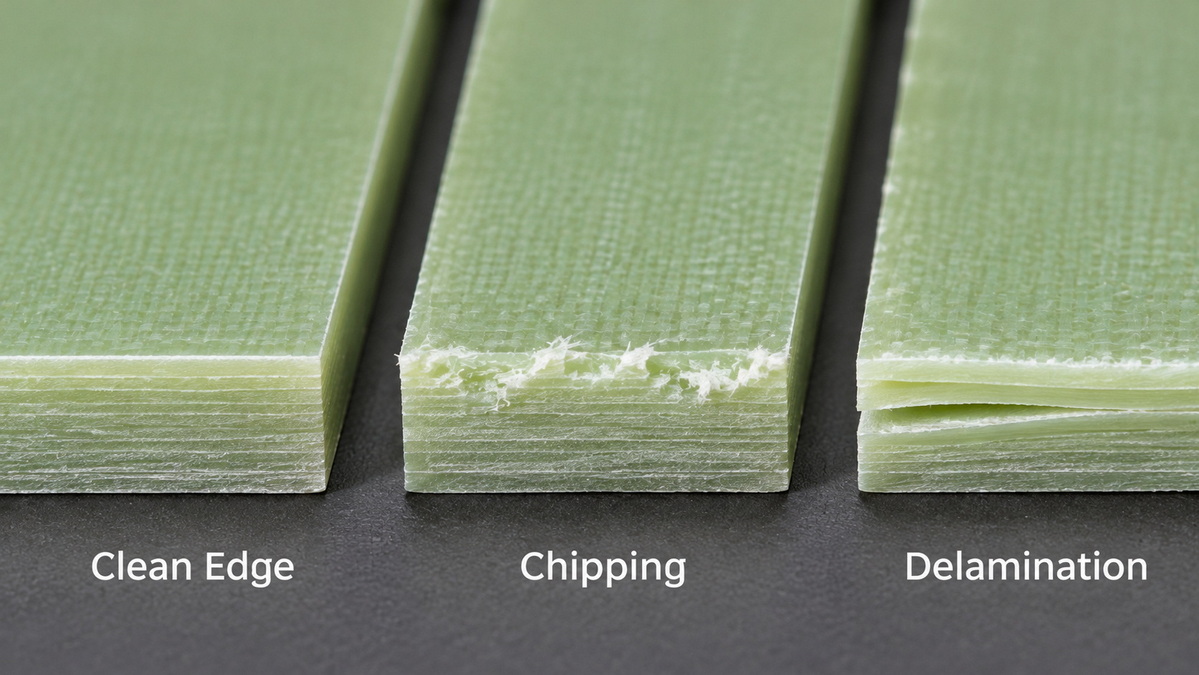
| Frayed fibers | Worn tooling or inadequate support | Inspect the cutting edge and backing |
| Exit-side chipping | Unsupported fibers at tool exit | Improve support and trial the cutting orientation |
| Layer separation | Excessive force, vibration, or existing damage | Review workholding, tooling, and sheet condition |
| Darkened edge | Rubbing or excessive localized heat | Check sharpness and cutting parameters |
| Angled cut | Blade deflection or alignment error | Verify guides, tooling stiffness, and feed |
| Variable dimensions | Movement, wear, or measurement conditions | Check fixturing and inspection consistency |
Do not attempt to repair structural delamination simply by sanding away visible damage. Determine whether the affected area remains acceptable for its intended function.
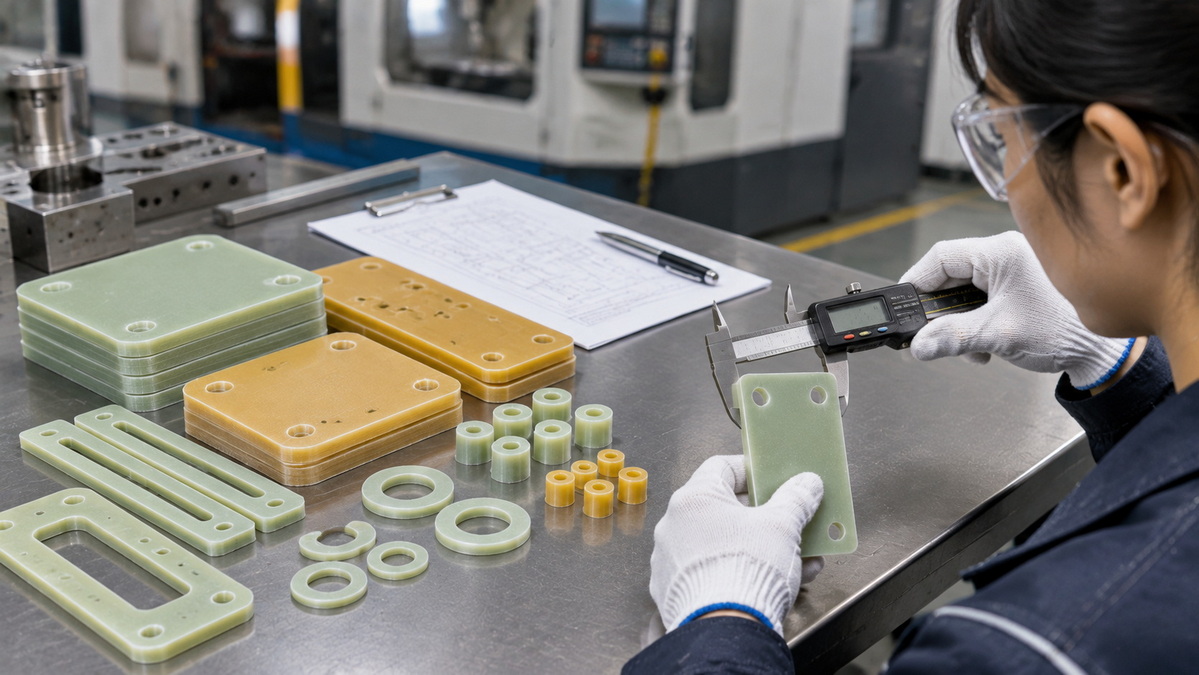
For repeat work, a successful trial should become a documented process rather than an operator's memory.
Record:
1. Material grade, batch identification, and thickness.
2. Machine and tooling identification.
3. Cutting parameters and workholding arrangement.
4. Measured dimensions and edge-quality results.
5. Tool-condition observations.
6. Cleaning and inspection requirements.
This creates a useful first-article inspection record and makes future troubleshooting more efficient.
For example, an insulation spacer may look acceptable yet fail assembly because the profile is tapered or a mounting hole is misplaced. Visual inspection alone cannot establish dimensional conformity.
This is a planning example, not a reported customer case.
Wet cutting may help control heat and airborne dust in equipment specifically designed for it. However, water is not an automatic solution.
Before choosing wet cutting, evaluate:
- Whether the machine and electrical installation permit wet operation.
- Compatibility of the fluid with the laminate and application.
- Slurry collection and disposal.
- Drying and cleaning requirements.
- Residues that could affect subsequent bonding or electrical service.
Never add water to a dry-use handheld power tool.
Likewise, do not transfer coolant recommendations for general plastics directly to every epoxy laminate. Confirm suitability with the material and equipment suppliers.
A cut-to-size request should describe more than length and width.
For a useful manufacturing quotation, provide:
- Material grade and thickness.
- Drawing or CAD file.
- Quantity and expected repeat demand.
- Dimensional tolerances and hole requirements.
- Acceptable edge condition.
- Surface cleanliness and packaging needs.
- Relevant electrical, mechanical, or temperature requirements.
Distinguish nominal cut blanks from finished machined parts. They represent different levels of processing and inspection.
Also avoid applying unnecessarily tight tolerances to every feature. Identify the dimensions that control assembly or performance, then discuss practical manufacturing limits.
Guangdong Weishi New Materials Co., Ltd. develops, manufactures, and supplies epoxy glass insulation boards, including FR4, G10, and G11 materials, with customizable processing options.
Send your material specification, thickness, drawing, quantity, and application requirements to our team. We can discuss whether full sheets, cut blanks, or custom-machined components best match your project.
For insulation applications, include the operating environment and required performance criteria—not just the part dimensions.
Some thin panel products permit scoring methods under their manufacturer's instructions. Do not assume this applies to rigid FR4, G10, or G11 boards. Precision parts generally require appropriate cutting or machining equipment.
Choose a blade specifically rated for glass-reinforced epoxy composites and compatible with your machine. Carbide or diamond tooling is generally preferable to ordinary woodworking blades, but geometry and operating conditions still matter.
Yes, when the saw, tooling, guarding, work support, and dust extraction are suitable. Make a trial cut first. If the required edge quality or tolerance exceeds the setup's capability, use a more controlled machining process.
Use sharp, suitable tooling, support both the sheet and offcut, and maintain a controlled feed. Trial the cut orientation and backing arrangement. Tape may help marking, but it cannot guarantee a chip-free edge.
There is no universal setting. Speed and feed depend on cutter diameter, geometry, sheet thickness, reinforcement, and machine rigidity. Start with the tooling manufacturer's recommendations and validate them on representative material.
Laser cutting is not the default recommendation for epoxy glass insulation boards. Thermal effects, decomposition products, and edge condition require specialist assessment. Consider mechanical cutting first unless a qualified provider has validated the laser process for your specific material and application.
1. Boedeker Plastics. [G-10 FR-4 Glass Epoxy Laminate Natural]. Material composition, reinforcement orientation, and machining limitations. [boedeker]
2. Boedeker Plastics. [Guide to Machining Plastics]. Tooling selection, support, heat management, and fabrication guidance. General guidance must be adapted to the specific laminate. [boedeker]
3. National Institute for Occupational Safety and Health. [Evaluation of Styrene and Dust Exposures and Health Effects at a Wind Blade Manufacturing Plant]. Dust exposure during composite trimming, local extraction, and HEPA-vacuum cleanup recommendations. Its measured exposures should not be treated as values for FR4 machining. [stacks.cdc]
4. National Institute for Occupational Safety and Health. [Health Hazard Evaluation Report: Active Industries]. Fibrous-glass irritation and occupational evaluation of electrical-insulation processing. [stacks.cdc]
5. Occupational Safety and Health Administration. [Respiratory Protection: Overview]. Respirator selection principles and links to workplace respiratory-protection requirements. [osha]
6. NIOSH-hosted publication. [Saw Safety]. Saw guarding, kickback controls, safe work practices, and keeping hands clear of moving blades. [stacks.cdc]


