

Views: 271 Author: Weishi Sheets Publish Time: 2026-10-03 Origin: Site
Content Menu
● FR4 Epoxy Sheet vs G10 Sheet: Key Differences
● Why Material Selection Matters for Electronics Fixtures
● Flame Resistance Is the Main Selection Factor
>> Choose FR4 Epoxy Sheet When
● Electrical Insulation Performance in Test Fixtures
● Mechanical Strength and Fixture Accuracy
>> Key Checks Before Production
● Temperature Exposure and Long-Term Stability
● The Hidden Procurement Risk: Material Substitution
>> Questions to Ask Before Ordering
● CNC Machining FR4 and G10 Sheets
>> Recommended Processing Practices
● Practical Application Examples
>> PCB Functional Test Fixture Base Plate
>> Power Electronics Assembly Fixture
>> High-Temperature Test Support
● How to Choose the Right Material
>> Is FR4 epoxy sheet the same as G10 sheet?
>> Which material is better for PCB test fixtures?
>> Can FR4 epoxy sheet be CNC machined?
>> Can G10 sheet be used near electrical components?
>> How can I verify that a supplier provides genuine FR4 sheet?
>> What thickness should I choose for a precision electronics fixture?
>> When should I select G11 epoxy sheet?
For engineers, fixture designers, and procurement teams, choosing between FR4 epoxy sheet vs G10 sheet for precision electronics fixtures is not simply a matter of choosing the lowest-cost laminate.
Both materials are built from woven glass fabric and epoxy resin. Both can provide strong mechanical support, dependable electrical insulation, good moisture resistance, and reliable CNC machinability. However, the application environment may require more than these basic qualities.
A fixture that supports PCB testing, power-module assembly, electronic inspection, soldering-related processes, or energized components may need flame-retardant performance. A structural alignment block or insulation spacer may instead prioritize machining accuracy, stiffness, and cost efficiency.
The correct choice depends on the actual working conditions.
At Guangdong Weishi New Materials Co., Ltd., we support customers who need reliable epoxy insulation sheets and machined composite components for electronics, electrical equipment, industrial machinery, mold manufacturing, and customized fixture projects. The goal is not only to supply material, but to help customers select a workable solution for long-term production.
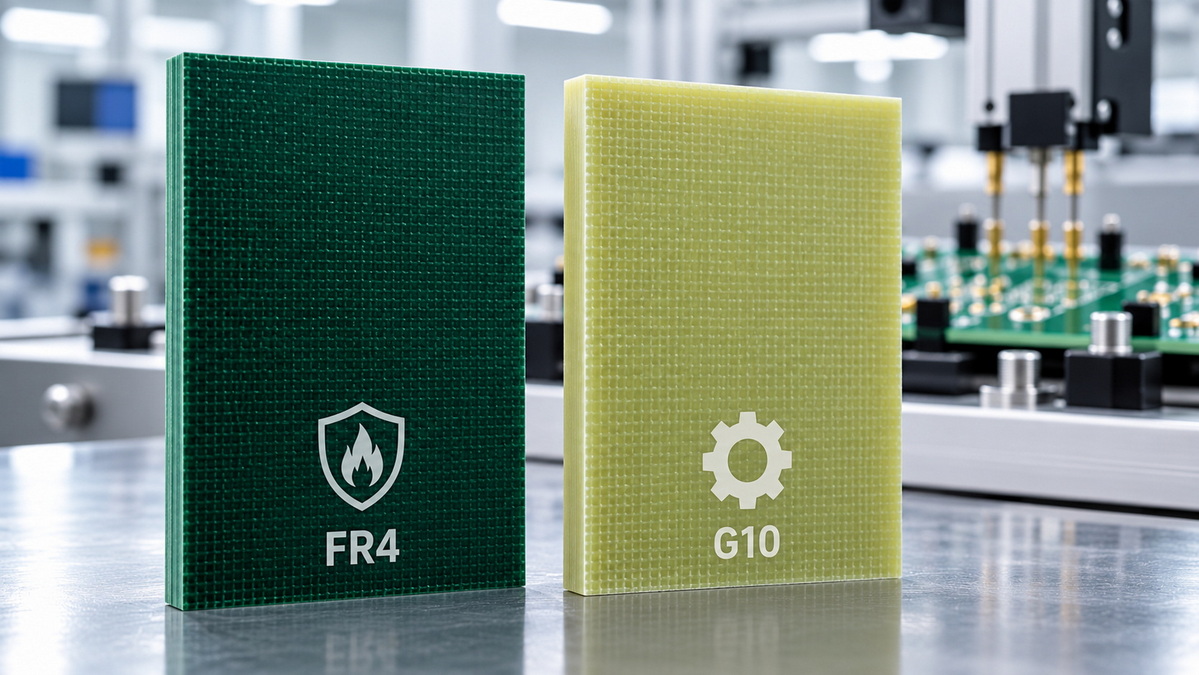
FR4 epoxy sheet is a glass-fiber-reinforced epoxy laminate with flame-retardant properties. It is commonly used in electrical insulation components, electronic fixtures, PCB-related equipment, relay barriers, transformer parts, switchgear insulation, test jigs, and precision-machined industrial parts.
The material is manufactured by impregnating woven glass fabric with epoxy resin, then curing the layered structure under controlled heat and pressure. The result is a rigid composite sheet with useful dielectric strength, mechanical strength, dimensional stability, and resistance to moisture.
The "FR" in FR4 refers to its flame-retardant performance. This is the most important distinction between FR4 and conventional G10 material.
Typical characteristics of FR4 epoxy sheet include:
- High electrical insulation performance
- Strong mechanical strength
- Good stiffness and dimensional stability
- Low moisture absorption
- Flame-retardant behavior
- Good resistance to many industrial chemicals
- Suitability for CNC drilling, routing, milling, and cutting
- Stable performance in many electrical equipment environments
FR4 is widely selected for applications where electrical isolation and material safety are both important.
G10 sheet is also a glass-fiber-reinforced epoxy laminate. Like FR4, it is made from layers of woven glass fabric bonded with epoxy resin under heat and pressure.
G10 is known for its combination of strength, rigidity, dielectric performance, and machining flexibility. It is used in electrical insulation parts, structural support plates, industrial spacers, guide blocks, mechanical fixtures, support brackets, and precision-machined composite components.
However, traditional G10 is generally considered a non-flame-retardant glass epoxy laminate.
This does not mean G10 is unsuitable for electronics fixtures. It can perform very well in many applications. The key point is that engineers should not specify G10 for an application that requires flame-retardant performance unless the supplied grade clearly confirms that requirement.
Typical characteristics of G10 sheet include:
- High mechanical strength
- Good rigidity
- Reliable dielectric properties
- Low moisture absorption
- Good wear resistance
- Stable performance in many industrial environments
- Good machinability for custom parts
- Useful performance for mechanical and insulation components
G10 may be an efficient option for applications where flame resistance is not required and the fixture operates in a controlled environment.
The following comparison helps engineers and buyers understand how the two materials differ in real fixture applications.
| Property | FR4 Epoxy Sheet | G10 Sheet | Impact on Precision Fixtures |
|---|---|---|---|
| Material structure | Woven glass fabric with epoxy resin | Woven glass fabric with epoxy resin | Both provide rigid composite support |
| Flame performance | Flame-retardant | Traditional G10 is generally non-flame-retardant | Important for electrical safety and controlled equipment environments |
| Electrical insulation | Excellent | Excellent | Supports electrical isolation in jigs, test fixtures, and barriers |
| Mechanical strength | High | High | Helps resist clamping force and repeated loading |
| Dimensional stability | Good | Good | Supports accurate drilling, routing, and component positioning |
| Moisture resistance | Good | Good | Helps reduce performance changes in humid workshops |
| CNC machining | Good | Good | Supports drilling, milling, slotting, and routing |
| Typical application | Electrical fixtures, PCB production equipment, insulation barriers | Mechanical supports, non-critical insulation parts, alignment blocks | Selection depends on project requirements |
| Documentation focus | Flame performance and grade verification | Grade confirmation and application suitability | Helps prevent purchasing errors |
The two materials may look very similar. Their actual performance requirements may be very different.
For this reason, the purchase order should never rely only on a general label such as "epoxy board" or "glass fiber board."
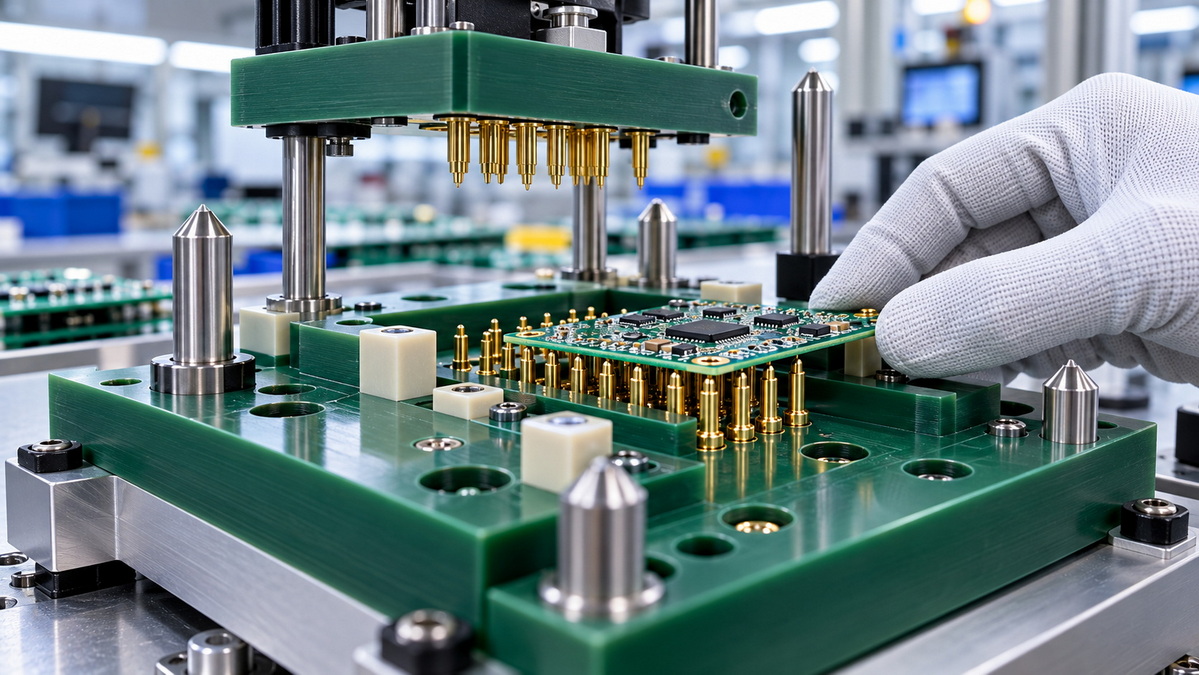
Precision electronics fixtures are often exposed to repeated force, electrical fields, heat, vibration, moisture, chemicals, and frequent handling. These conditions can gradually affect fixture accuracy and service life.
A typical fixture may include:
- Probe pins
- PCB locating pins
- Metal clamps
- Vacuum channels
- Wiring paths
- Pneumatic parts
- Insulating barriers
- Alignment slots
- Test connectors
- Grounding components
The fixture base must maintain stable dimensions while also providing reliable electrical isolation. If the sheet warps, delaminates, absorbs excessive moisture, or develops damaged edges around drilled holes, the entire fixture may lose accuracy.
This can lead to:
- Incorrect probe positioning
- False test results
- PCB damage
- Electrical leakage risk
- Higher maintenance costs
- Shorter fixture service life
- Rework during production
- Delayed deliveries
Material quality affects fixture repeatability. A low-cost sheet with poor flatness or inconsistent resin distribution may create more manufacturing cost than it saves.
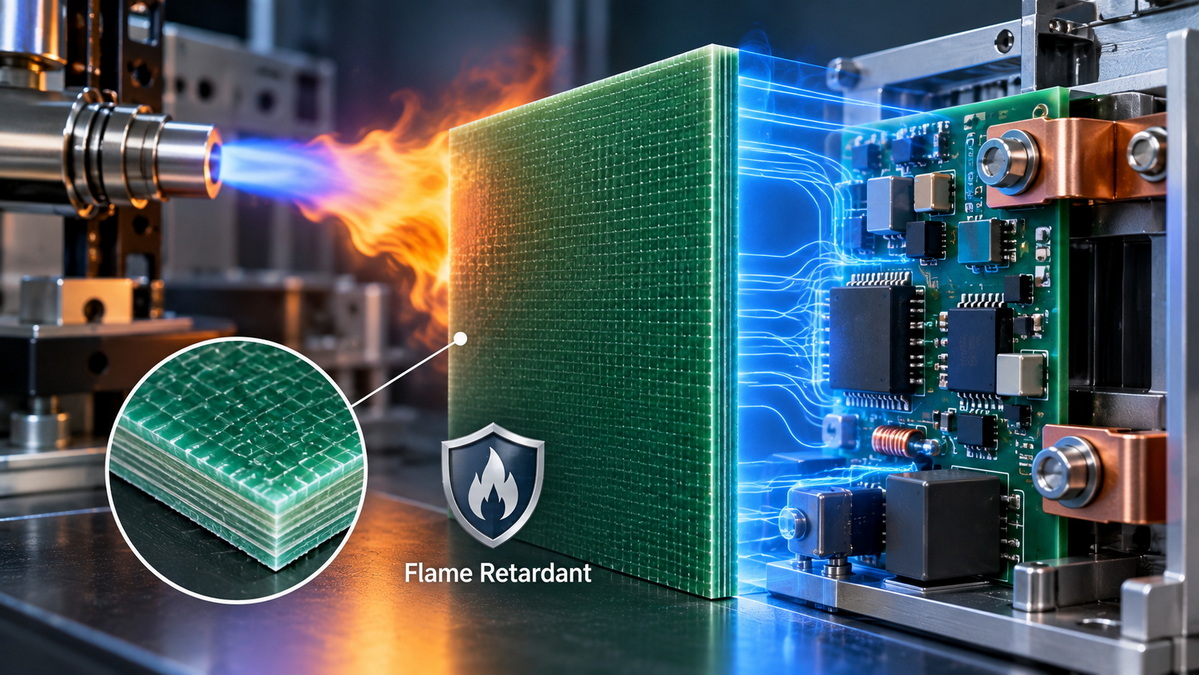
For many electronics fixture projects, flame resistance is the main reason to select FR4 instead of G10.
FR4 is designed to resist continued burning after the ignition source is removed. This makes it more suitable for many electrical and electronics applications where safety requirements are important.
G10 can offer strong mechanical and electrical performance. However, a conventional G10 sheet may not be the best choice when the application is near energized components, heat sources, power systems, or equipment with defined flame-performance requirements.
- The fixture is used near energized electrical components
- The application requires flame-retardant insulation material
- The fixture supports PCB functional testing
- The fixture is used in electronics assembly equipment
- The equipment handles power modules, transformers, relays, or switchgear
- The customer requires documented material properties
- The fixture will be supplied for industrial electrical equipment
- The project requires stronger safety consideration
- Flame-retardant performance is not required
- The fixture is mainly a mechanical support component
- The application needs a rigid and machinable composite material
- The part is used as an alignment block, spacer, or guide plate
- The operating environment is controlled
- The application does not involve defined fire-performance requirements
- The budget prioritizes functional mechanical insulation performance
The material decision should be based on real working conditions rather than the assumption that all glass epoxy laminates are interchangeable.
Both FR4 epoxy sheet and G10 sheet are commonly used for their dielectric properties. They can help separate conductive elements and reduce the risk of unintended current paths.
In precision electronics fixtures, electrical insulation performance matters for:
- PCB functional test fixtures
- High-voltage inspection fixtures
- Probe pin support plates
- Terminal barriers
- Switchgear insulation parts
- Transformer assembly tools
- Battery module test platforms
- Power electronics production fixtures
- Automated electrical inspection equipment
The material itself may not carry current, but it may be located close to live components, energized connectors, test needles, charged circuits, or conductive supports.
For this reason, designers should define:
- Working voltage
- Potential surge voltage
- Clearance distance
- Creepage distance
- Humidity exposure
- Contamination level
- Expected temperature
- Fixture maintenance cycle
A suitable laminate should support the insulation design instead of becoming the weak point in the assembly.
Precision electronics fixtures often rely on exact hole positions and stable support surfaces. A small change in flatness or hole location can affect test accuracy.
Both FR4 and G10 offer useful mechanical strength. However, actual performance may vary between suppliers because of differences in raw materials, glass cloth construction, resin systems, pressing conditions, curing cycles, and quality-control processes.
A sheet may look acceptable before machining but reveal problems after drilling or routing.
Potential problems include:
- Uneven thickness
- Poor flatness
- Internal voids
- Surface resin inconsistency
- Fiber breakout around drilled holes
- Delamination near routed edges
- Excessive burrs after machining
- Warping after stress release
- Reduced strength in narrow sections
For high-precision fixture production, the material should be evaluated as both a sheet product and a machined component material.
- Sheet thickness tolerance
- Sheet flatness
- Surface smoothness
- Resin distribution
- Glass fabric consistency
- Delamination resistance
- Hole-wall quality after drilling
- Edge quality after milling
- Dimensional stability after machining
- Batch-to-batch consistency
A supplier that can provide technical support, test samples, custom cutting, and CNC machining can reduce the risk of fixture-development delays.
Temperature is another critical consideration when comparing FR4 epoxy sheet vs G10 sheet for precision electronics fixtures.
Many fixtures operate in moderate environments. Others are installed near heat-generating components, soldering processes, power modules, transformers, automated equipment, or heated tooling.
Heat can influence epoxy laminate performance over time. As temperature increases, a material may experience changes in stiffness, thermal expansion, dimensional stability, insulation behavior, and long-term mechanical strength.
Common heat sources include:
- Reflow-adjacent production areas
- Wave-soldering support processes
- Power electronic modules
- Transformer production equipment
- Motor assembly stations
- Battery testing systems
- Heated clamping tools
- Long-cycle automated production lines
Before selecting FR4 or G10, buyers should confirm:
- Continuous operating temperature
- Maximum short-term temperature exposure
- Thermal expansion requirement
- Required stiffness during heat exposure
- Heat-related dimensional tolerance
- Need for high-temperature laminate performance
If the fixture operates continuously at elevated temperatures, G11 epoxy sheet may be a more appropriate choice. G11 is designed for higher-temperature electrical insulation applications and can retain useful properties under more demanding heat conditions.
One of the most common procurement risks is material substitution.
A quotation may state "FR4 sheet," but the material delivered may not provide the expected flame-retardant performance. Another supplier may describe a material as "G10/FR4" without explaining which grade is actually being supplied.
This problem is especially serious because the sheets may appear visually similar. Buyers may not discover the difference until a customer audit, safety review, production failure, or material test.
1. Is the supplied material FR4, standard G10, G11, or another glass epoxy laminate grade?
2. Does the sheet have flame-retardant performance?
3. Can the supplier provide a current technical data sheet?
4. Can the supplier provide a certificate of conformity for the supplied lot?
5. What thickness tolerance can be guaranteed?
6. What flatness level can be achieved?
7. Can the material be supplied in custom-cut dimensions?
8. Can the supplier machine the parts according to drawings?
9. Can a first-article sample be approved before volume production?
10. How is material traceability maintained after cutting and machining?
This verification process is especially valuable for suppliers of electrical equipment, precision fixtures, automation systems, and export products.
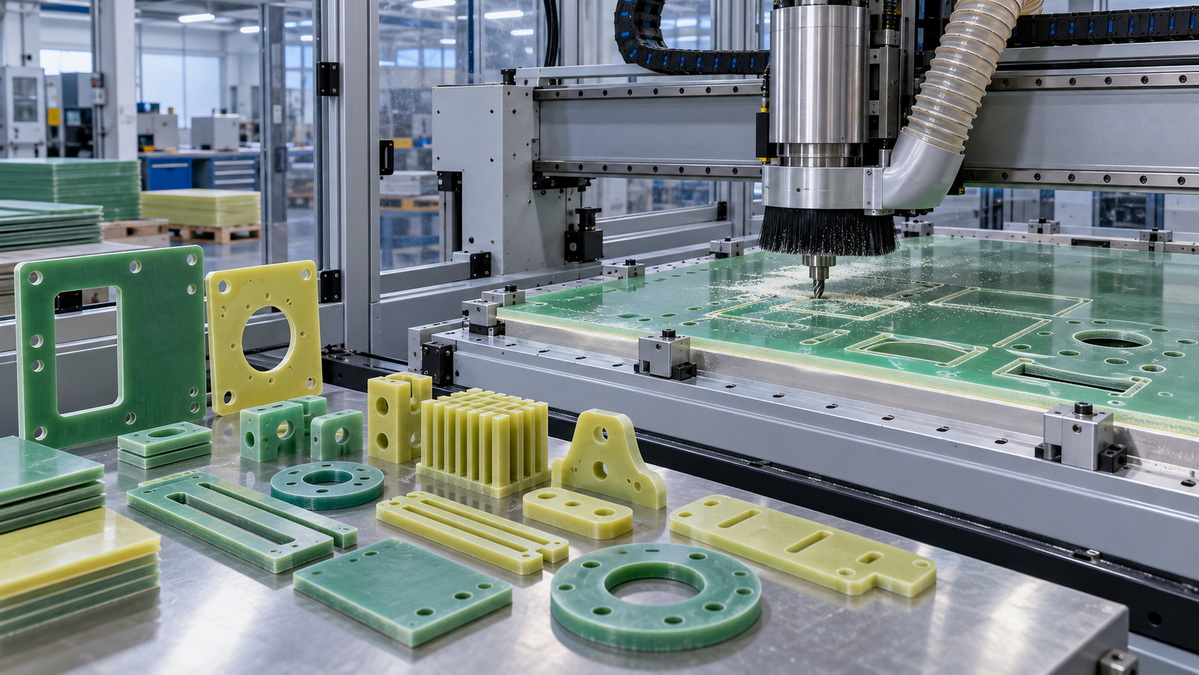
FR4 and G10 are both suitable for CNC machining. They can be drilled, milled, routed, saw-cut, ground, and shaped into custom insulation parts.
However, both materials contain glass fibers. The glass reinforcement makes the sheet abrasive and can accelerate tool wear.
Professional machining helps maintain part quality and reduce processing problems.
- Use carbide or diamond-coated cutting tools
- Select suitable spindle speed and feed rate
- Use stable sheet clamping to reduce vibration
- Apply effective dust collection during machining
- Avoid overheating narrow sections
- Reduce aggressive cutting conditions near thin walls
- Deburr machined edges carefully
- Inspect holes for fiber breakout
- Confirm finished dimensions after machining
- Package parts carefully to prevent edge damage
For complex fixture parts, customers can reduce production steps by ordering custom-machined FR4 epoxy sheet or G10 sheet components instead of purchasing standard boards for in-house processing.
Guangdong Weishi New Materials Co., Ltd. can provide sheet cutting, CNC drilling, milling, routing, slotting, customized thickness, and drawing-based machining support for insulation material projects.
A PCB functional test fixture needs accurate probe alignment, strong insulation, and stable dimensions. In many cases, FR4 epoxy sheet is the preferred choice because it combines electrical insulation, mechanical support, and flame-retardant properties.
A production line may use a rigid non-conductive alignment block to position a component during assembly. If flame resistance is not required, G10 sheet can be a practical choice because of its strength, stiffness, and machining performance.
A fixture used near power modules, electrical terminals, transformers, or high-current components should prioritize electrical safety and material documentation. FR4 epoxy sheet is often the stronger choice for this type of environment.
A test support exposed to elevated temperatures may require stronger thermal performance than standard FR4 or G10 can provide. In this case, G11 epoxy sheet may be more suitable.
Use the following process before placing an order.
1. Define the application environment
Confirm whether the fixture is used for low-voltage testing, high-voltage inspection, PCB assembly, mechanical positioning, power electronics, or heated equipment.
2. Identify safety requirements
Determine whether flame-retardant material performance is required.
3. Confirm the temperature range
Evaluate continuous operating temperature and possible short-term heat exposure.
4. Review dimensional requirements
Define thickness tolerance, flatness, hole position tolerance, edge finish, and overall part accuracy.
5. Consider the machining method
Confirm whether the sheet will be drilled, routed, milled, waterjet cut, or processed into complex shapes.
6. Request technical documentation
Ask for material information, grade confirmation, and relevant quality records.
7. Approve a sample before full production
Evaluate machining quality, flatness, hole accuracy, and actual assembly performance.
8. Select a supplier with processing capability
A supplier that can provide both sheets and custom-machined parts can improve communication, reduce transit damage, and shorten the fixture development cycle.
The decision between FR4 epoxy sheet vs G10 sheet for precision electronics fixtures should be based on actual performance requirements rather than material appearance or a general product name.
Both materials can provide high strength, electrical insulation, moisture resistance, and good machining performance. However, FR4 epoxy sheet is generally the stronger option when flame-retardant performance, electrical safety, documentation, and electronics-related operating conditions are important.
G10 sheet remains a practical solution for many mechanical and electrical insulation parts when flame resistance is not required. It can provide reliable stiffness, machinability, and dielectric performance for controlled industrial applications.
For high-accuracy fixture projects, define the material grade, working environment, required thickness tolerance, flatness, machining requirements, and performance expectations before production begins. This approach helps reduce sourcing risk, improve fixture consistency, and support stable long-term operation.
For custom FR4 epoxy sheet, G10 sheet, G11 sheet, glass fiber epoxy laminate, or CNC-machined insulation components, share your drawings, dimensions, application environment, and quantity requirements with Guangdong Weishi New Materials Co., Ltd. to receive a suitable material and processing solution.
FR4 and G10 are closely related glass epoxy laminates, but they are not always the same grade. Both use woven glass fabric and epoxy resin. The main difference is that FR4 has flame-retardant properties, while standard G10 is generally non-flame-retardant.
FR4 epoxy sheet is often preferred for PCB test fixtures because it provides electrical insulation, mechanical strength, dimensional stability, and flame-retardant performance. G10 can also be suitable when flame resistance is not required.
Yes. FR4 epoxy sheet can be CNC drilled, milled, routed, slotted, cut, and shaped into custom insulation components. Because it contains glass fibers, proper tools, cutting parameters, and dust collection are important.
Yes. G10 provides useful electrical insulation and can be used near electrical components when the voltage, temperature, safety requirements, and application conditions are appropriate. However, FR4 should be considered when flame-retardant performance is required.
Ask for a technical data sheet, grade confirmation, flame-performance information, certificate of conformity, batch traceability, and material sample. For critical projects, inspect thickness, flatness, surface quality, and machining behavior before mass production.
The correct thickness depends on fixture size, load, hole density, clamping method, supported components, and required stiffness. Thin sheets may work for insulation barriers, while thicker boards may be required for fixture bases and support structures.
G11 epoxy sheet is often selected when the application requires better high-temperature performance than standard FR4 or G10. It can be suitable for heated fixtures, power electronics equipment, transformer-related tooling, and other elevated-temperature insulation applications.
FR4 has relatively low moisture absorption compared with many common plastics. However, moisture exposure can still affect electrical and dimensional performance over time. Proper storage and grade verification are important for sensitive electronics applications.
1. National Electrical Manufacturers Association. [NEMA Standards Publication LI 1: Industrial Laminated Thermosetting Products]
2. Norplex-Micarta. [NEMA LI 1 Electrical Materials Standards and Grade References]
3. IPC. [IPC-4101 Specification for Rigid and Multilayer Printed Board Base Materials]
4. Ready Plastics. [G10 Grades: NEMA G10 vs FR4, G11, G7 and G9 Laminates]
5. Ready Plastics. [FR4 Specifications, IPC-4101 and NEMA Material Guidance]
6. Current Composites. [G-10 and FR-4 Glass Epoxy Industrial Laminates]
7. Proto Express. [How to Choose PCB Laminates Based on IPC Standards]
8. Isola Group. [IS410 High-Performance FR-4 Epoxy Laminate and Prepreg System]
9. Guangdong Weishi New Materials Co., Ltd. [FR4 Epoxy Sheet, G10 Sheet and Insulation Material Solutions]


