

Views: 231 Author: Weishi Sheets Publish Time: 2026-10-19 Origin: Site
Content Menu
● FR4 vs G10: Understanding the Material Difference
>> G10: Glass-Epoxy Laminate Without a Flame-Retardant Requirement
>> FR4: Flame-Retardant Glass-Epoxy Laminate
● FR4 vs G10 Comparison for Precision SMT Fixtures
● Start With the SMT Fixture's Actual Process
>> Solder Paste Printing and Assembly Supports
>> Inspection and Electrical Test Fixtures
>> Reflow Carriers and Solder Pallets
● Thermal Performance: Separate Tg, Decomposition, and Service Life
>> Glass Transition Temperature Is Not a Maximum Operating Temperature
>> Decomposition Temperature Does Not Guarantee Precision
>> Qualify the Finished Fixture
● Dimensional Stability: Build a Thermal Tolerance Budget
>> An Illustrative Expansion Calculation
>> Consider Relative Movement, Not Just Fixture Expansion
● CNC Machining: What Actually Controls Fixture Accuracy?
>> Control Dust and Inspect After Unclamping
● Electrical Insulation and Static Control Are Different Requirements
● A Practical Qualification Plan Before Production
>> Step 1: Define the Application
>> Step 2: Compare Identified Grades
>> Step 3: Machine Representative Features
>> Step 4: Run Representative Process Exposure
>> Step 5: Release a Controlled Specification
● Compare Total Fixture Cost, Not Sheet Price
● Selecting Materials With Guangdong Weishi New Materials Co., Ltd.
>> Is FR4 Better Than G10 for Precision SMT Fixtures?
>> Can Standard FR4 Be Used for Reflow Carriers?
>> Is G10 Easier to Machine Than FR4?
>> Are FR4 and G10 Antistatic?
>> What Should a Precision Fixture Drawing Specify?
>> When Should a Dedicated Solder-Pallet Composite Be Considered?
Choosing FR4 vs G10 for precision SMT fixture manufacturing starts with the fixture's actual job. Both materials offer strong electrical insulation, useful stiffness, and excellent machinability when processed correctly. However, flame resistance, temperature exposure, dimensional stability, and electrostatic requirements can change the selection.
For room-temperature assembly supports and inspection fixtures, either material may work. When documented flame resistance is required, FR4 is generally the more appropriate starting point. For fixtures that repeatedly enter a reflow oven, neither a generic FR4 nor a generic G10 designation provides enough information.
My recommendation is to select the verified material grade first, then qualify the finished fixture under its actual operating conditions. The following comparison explains how to make that decision without confusing familiar material names with guaranteed performance.
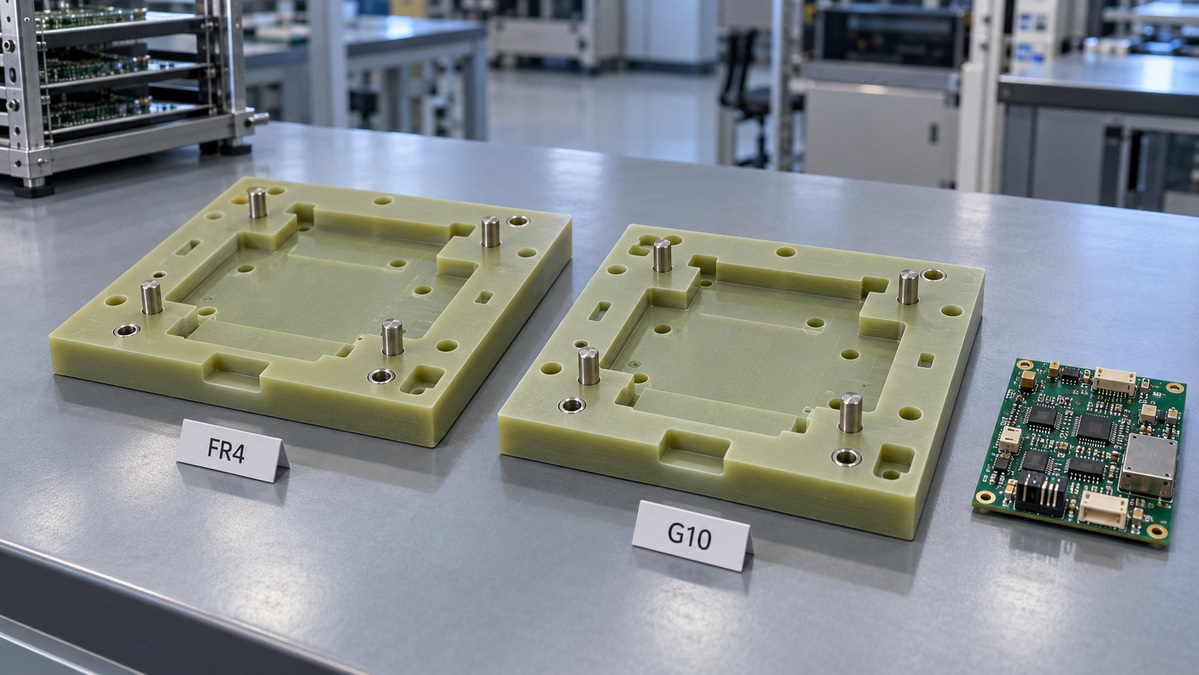
FR4 and G10 are glass-reinforced epoxy laminates. Manufacturers impregnate woven glass fabric with epoxy resin and consolidate the layers under heat and pressure.
The resulting sheets combine mechanical strength with electrical insulation. They can be machined into PCB support plates, locating nests, assembly carriers, and test-fixture components.
G10 is commonly selected for insulating mechanical components that need stiffness, strength, and dimensional stability.
Typical applications include:
- PCB assembly support plates.
- Inspection and positioning fixtures.
- Electrical isolation components.
- Machined spacers and structural supports.
The G10 designation does not establish the flame-retardant performance expected from FR4. If a project requires a specific flammability classification, an undocumented G10 sheet is not an appropriate substitute.
FR4 adds flame-retardant performance to the glass-epoxy material family. It is widely associated with printed circuit boards, but unclad FR4 sheet also serves mechanical and insulating applications.
Its practical advantage is documented fire performance, not an automatic improvement in machining accuracy or heat resistance.
For procurement, request the exact manufacturer, grade, applicable flammability documentation, and thickness coverage. A material label alone does not establish that every supplied sheet meets the required classification.
| Selection factor | FR4 | G10 | Practical implication |
|---|---|---|---|
| Basic construction | Woven glass and epoxy, with flame-retardant performance | Woven glass and epoxy | Both are reinforced laminates |
| Flame resistance | Relevant classification must be verified | Not established by the G10 designation | Prefer verified FR4 when required |
| Mechanical performance | Strong and stiff; grade-dependent | Strong and stiff; grade-dependent | Compare actual datasheets |
| Electrical insulation | Generally excellent | Generally excellent | Neither is automatically static-dissipative |
| Machining | Abrasive; requires suitable tooling | Abrasive; requires suitable tooling | Process control strongly affects accuracy |
| Thermal capability | Depends on resin system and grade | Depends on resin system and grade | Do not infer reflow suitability from the name |
| Dimensional stability | Depends on temperature, orientation, and construction | Depends on temperature, orientation, and construction | Validate critical dimensions |
| Cost | Depends on grade, thickness, and documentation | Depends on grade, thickness, and availability | Compare finished-part cost |
There is no universal winner for precision. A well-controlled G10 fixture can outperform a poorly specified FR4 fixture, and the reverse is equally possible.
"SMT fixture" describes several different tools. Their operating conditions are not interchangeable.
These fixtures support the PCB during printing or component handling. Important requirements include support-plane flatness, locating accuracy, component clearance, and sufficient stiffness under process loads.
If the fixture stays outside the oven, repeated high-temperature exposure may not be the deciding factor. FR4 or G10 can be evaluated primarily on dimensional consistency, machining quality, insulation, and cost.
Inspection nests prioritize repeatable positioning. Electrical test fixtures additionally require appropriate insulation around probes, conductors, and hardware.
For these applications, moisture conditioning, locating-pin wear, and contact geometry can matter more than the flame-retardant distinction.
Fixtures entering an oven require a different assessment.
Evaluate the complete temperature profile, exposure duration, mechanical loading, cleaning chemistry, and required service life. Do not approve a generic epoxy sheet simply because it survives one heating cycle.
Dedicated high-temperature solder-pallet composites should also be considered when repeated thermal exposure and static-dissipative performance are central requirements.
The most consequential mistake in an FR4 vs G10 comparison is treating "temperature resistance" as one number.
Glass transition temperature, or Tg, indicates a change in the resin's behavior. Above this transition, stiffness and thermal expansion behavior can change significantly.
Tg does not mean immediate decomposition. It also does not guarantee that a loaded fixture will maintain its original accuracy.
Test method matters. For example, Isola's FR408HR datasheet reports a Tg of 190°C by differential scanning calorimetry and 230°C by dynamic mechanical analysis. These values describe the same resin system using different methods.
The same datasheet reports a decomposition temperature of 360°C at 5% weight loss.
That figure is not a recommended fixture operating temperature. A component can lose useful stiffness, distort, or become unsuitable for precise positioning long before reaching that measurement endpoint.
Similarly, published PCB reflow capability does not establish long-term durability for a thick, machined carrier with pockets, inserts, and clamping loads.
For repeated heating, assess:
1. The measured fixture temperature profile.
2. Flatness before and after exposure.
3. Critical hole spacing and pocket dimensions.
4. Surface damage, cracking, and delamination.
5. Retention of inserts and locating hardware.
6. Performance after representative cleaning.
A material datasheet narrows the shortlist. Finished-part validation determines suitability.
Precision SMT fixture manufacturing requires more than achieving tight dimensions at room temperature.
The useful question is whether the fixture locates the PCB correctly throughout the process.
Assume a 300 mm locating span, a temperature increase of 100°C, and an in-plane expansion coefficient of 16 ppm/°C.
The coefficient comes from a specific FR408HR datasheet. This is an illustrative calculation, not a universal FR4 or G10 value, and it should not be extrapolated beyond the relevant material conditions.
Its significance is practical: room-temperature machining accuracy can be much smaller than operating-temperature movement.
The PCB, fixture, inserts, and supporting frame may expand differently.
A useful tolerance budget therefore includes:
- Material expansion in the relevant directions.
- Temperature variation across the fixture.
- PCB dimensional variation.
- Locating-pin clearance.
- Machining and inspection uncertainty.
- Wear over the intended service life.
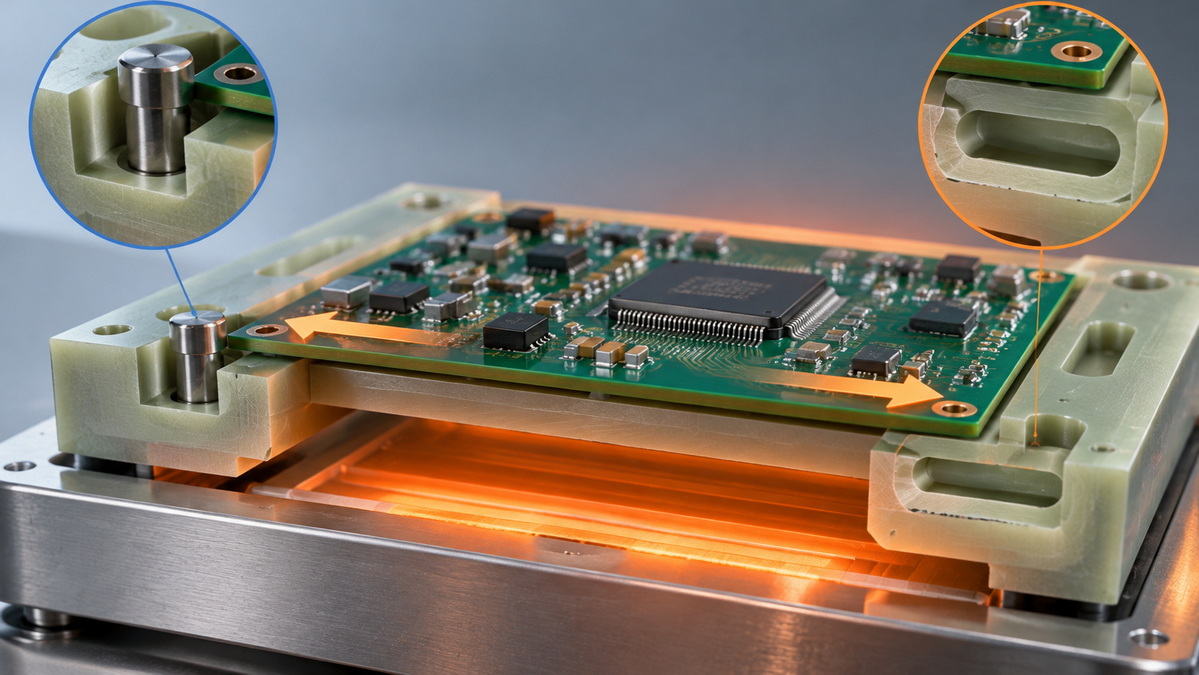
Where the assembly permits it, a fixed datum combined with a relief feature can accommodate expansion without forcing the PCB between multiple rigid locating points.
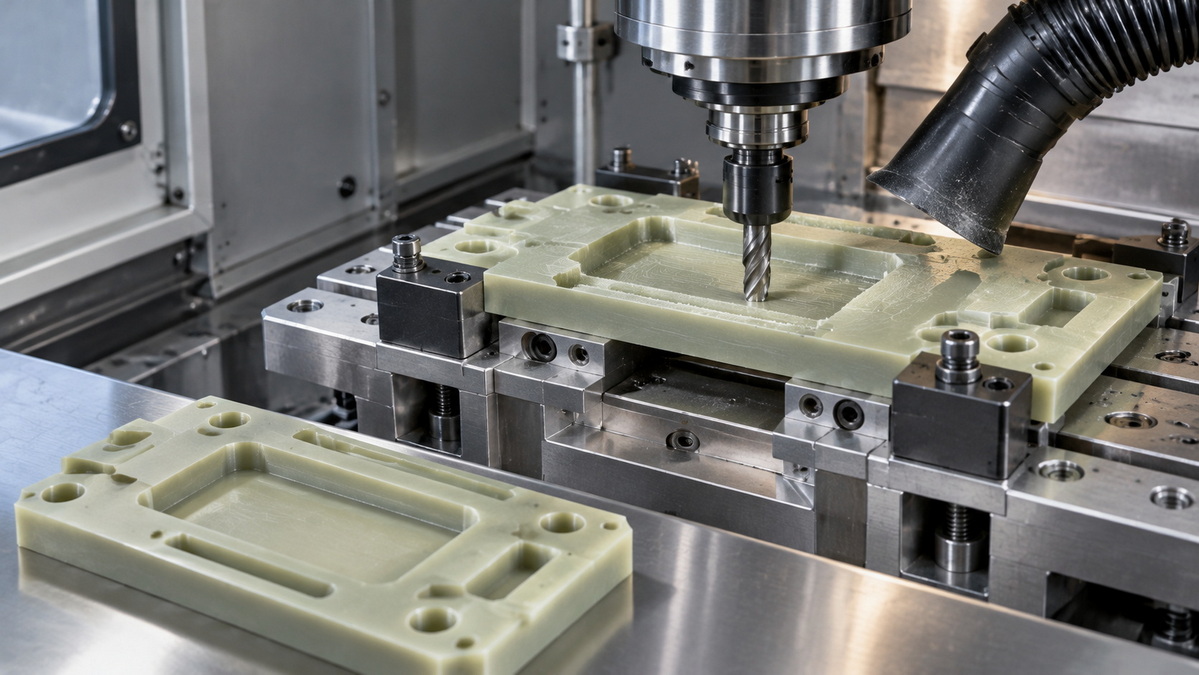
FR4 and G10 contain abrasive glass reinforcement. Both require suitable tooling and controlled cutting conditions.
The grade name alone does not determine edge quality, pocket accuracy, or tool life.
Carbide tooling is a common starting point. Diamond-coated or polycrystalline diamond tooling may be worth evaluating for production quantities.
Typical machining concerns include:
- Fiber breakout at hole exits.
- Fraying around thin walls.
- Local delamination.
- Heat accumulation.
- Increasing tool wear.
- Distortion caused by workholding.
Support the material at breakthrough locations, maintain sharp cutting edges, and validate cutting parameters on the actual laminate.
Avoid copying spindle speeds or feed rates from an unrelated grade without checking tool geometry, sheet thickness, and machine capability.
Glass-epoxy machining generates fine dust. Use suitable extraction, follow the material's safety documentation, and prevent contamination of assembly areas.
Inspection should occur after the part is released from machining restraints. Otherwise, clamping can temporarily conceal deformation.
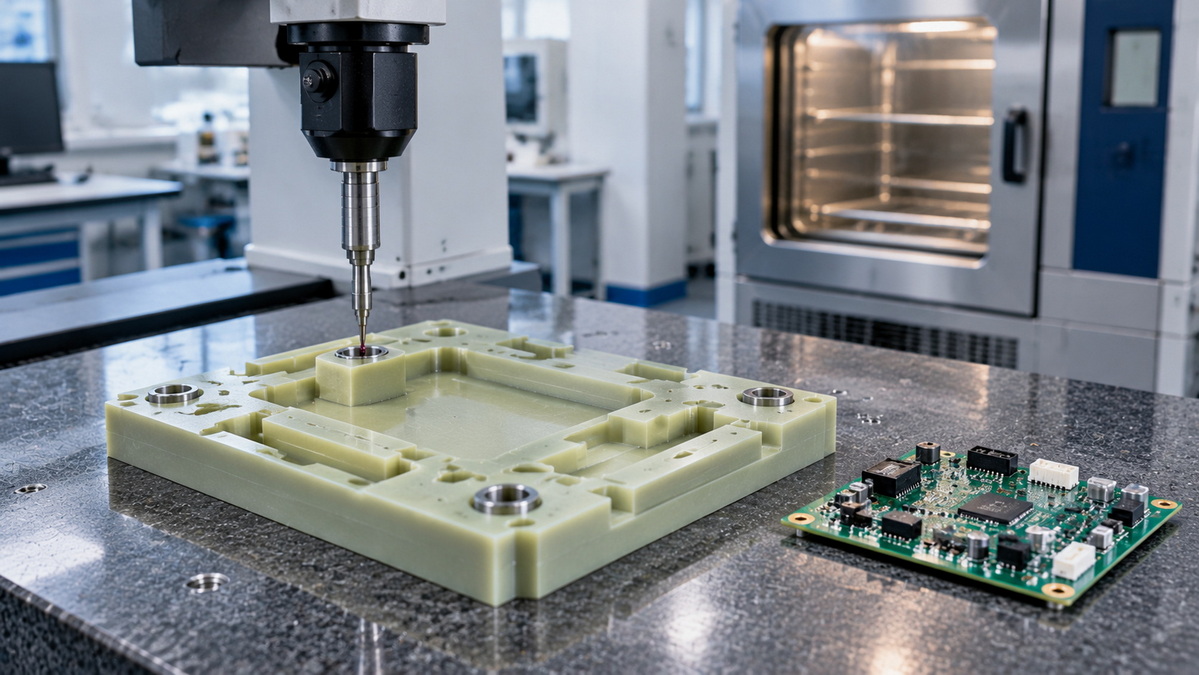
For critical fixtures, measure support-plane flatness, hole position, pocket depth, parallelism, and edge condition. Define the inspection temperature and conditioning procedure when tolerances are sensitive.
FR4 and G10 are useful electrical insulators. That does not make ordinary versions suitable as static-dissipative surfaces.
This distinction matters when fixtures contact sensitive components or operate within an electrostatic-protected assembly process.
Do not specify "black FR4" as shorthand for antistatic performance. Color does not establish surface resistance.
Instead, define:
- Required electrical behavior.
- The applicable resistance test method.
- Environmental conditions during testing.
- Grounding arrangements.
- Performance after wear and cleaning.
If static dissipation is required, request a specifically engineered material or validated fixture system. Confirm that its electrical behavior remains compatible with any required insulation.
A disciplined comparison is more valuable than declaring one material universally superior.
Record the fixture's role, critical dimensions, process loads, temperature profile, cleaning method, and expected reuse.
Also identify flame-resistance and static-control requirements before requesting quotations.
Ask suppliers for grade-specific technical information.
Prioritize Tg and its test method, directional thermal expansion, mechanical properties, moisture absorption, available sheet tolerances, and relevant electrical documentation.
Produce samples containing the most demanding pockets, holes, thin walls, and locating details.
Use the intended manufacturing process rather than a simplified coupon that avoids the difficult geometry.
Measure the samples before and after thermal cycling, loading, and cleaning.
Set acceptance criteria beforehand. The number of cycles should reflect project risk and intended use, not an arbitrary universal target.
The production drawing should identify the approved material, critical dimensions, inspection conditions, and traceability requirements.
Unapproved substitution between G10 and FR4 can invalidate the qualification, even if the replacement sheet looks similar.
Material price is only one part of the purchasing decision.
Finished-part economics also include machining time, tool consumption, inspection, scrap, cleaning, and replacement frequency.
Neither FR4 nor G10 is always cheaper. Pricing depends on grade, dimensions, availability, and documentation requirements.
For recurring production, compare cost per accepted fixture and replacement frequency under actual use. A lower-priced sheet offers little value if it produces inconsistent locating accuracy or premature replacement.
Guangdong Weishi New Materials Co., Ltd. focuses on the development, manufacture, and supply of epoxy insulating boards and composite materials, including epoxy glass-fiber sheets, FR4, and G10/G11.
For a useful technical discussion, provide the fixture drawing together with its operating conditions. This helps separate material selection from assumptions about the application.
Send Weishi your required thickness, dimensional tolerances, temperature profile, cleaning conditions, annual quantity, and flame-resistance or static-control requirements. Request a grade-specific proposal and machined samples for qualification before approving production.
Not automatically. FR4 is the stronger starting point when documented flame resistance is required. Precision depends on the specific laminate, thermal behavior, machining process, and fixture design.
It should not be approved by name alone. Verify the specific resin system and test the completed carrier under representative temperature profiles, loads, and repeated cycles.
There is no reliable universal advantage. Both contain abrasive glass reinforcement. Tool selection, material construction, workholding, and cutting conditions strongly affect results.
Ordinary grades are insulating, not automatically static-dissipative. Where static control is required, specify verified electrical properties rather than relying on material color or a generic designation.
Include the approved material grade, thickness, datums, flatness, hole positions, pocket depths, edge requirements, and inspection conditions. Add traceability and environmental requirements where relevant.
Consider one when repeated high-temperature exposure, cleaning resistance, and static dissipation are important. Compare its documented properties and qualify the finished design rather than assuming superiority.
1. Curbell Plastics — "G10/FR-4 Glass Epoxy." Material overview supporting the discussion of glass-epoxy construction, stiffness, electrical insulation, creep resistance, and supplier-dependent properties. [curbellplastics]
2. Piedmont Plastics — "G10 vs. FR4: Which Fiberglass Laminate Should You Choose?" Comparative discussion supporting the distinction between flame-retardant FR4 and G10, their similar mechanical characteristics, and abrasive machining behavior. [piedmontplastics]
3. Isola Group — "FR408HR: Lead Free, Mid Loss Laminate and Prepreg," technical datasheet, Revision E, updated April 15, 2021. Source for the grade-specific Tg values, decomposition temperature, in-plane expansion coefficient, flammability rating, and PCB thermal-performance data. These figures are not presented as Weishi product specifications. [isola-group]
4. Pro Plastics — "G-10/FR-4 Glass Epoxy — Properties, Uses and Machining." Technical machining overview supporting the discussion of tooling abrasion, extraction, breakthrough support, edge breakout, and delamination. [proplasticsinc]
5. Datum Alloys — "Solder Pallet Material." Manufacturer information supporting the distinction between ordinary insulating laminates and purpose-engineered, static-dissipative solder-pallet composites. Product-specific claims should not be generalized to FR4 or G10. [datumalloys]


