

Views: 254 Author: Weishi Sheets Publish Time: 2026-08-21 Origin: Site
Content Menu
● What Is a G10 Epoxy Resin Laminate Sheet?
>> How G10 Epoxy Sheets Are Manufactured
>> Key Properties of G10 Laminate Sheet
● G10 vs. Epoxy Resin Laminate Sheet
>> Why Material Terminology Matters
>> G10 vs. FR4
>> G10 vs. G11
● Where Are G10 Epoxy Sheets Used?
>> Electrical and Electronics Applications
>> Mechanical and Industrial Equipment
>> Mold and Tooling Applications
● How to Select the Right G10 Sheet
>> Check the Operating Temperature
>> Evaluate Electrical Conditions
>> Plan Machining Requirements Early
● Practical Quality-Control Considerations
>> Typical Checks Before Production
>> Typical Value vs. Guaranteed Value
● A Material Choice That Supports Long-Term Reliability
>> Is G10 a good electrical insulator?
>> What is the difference between G10 and G11?
>> What information is needed for a G10 quotation?
A G10 epoxy resin laminate sheet is a rigid composite material made from woven fiberglass cloth and epoxy resin. It is widely used in electrical, mechanical, and industrial applications because it combines strong insulation performance with high mechanical strength, low moisture absorption, and reliable machinability.
However, the term "epoxy resin laminate sheet" covers a broader range of products. G10 is one specific grade within this material family. Understanding the difference helps engineers, buyers, and equipment manufacturers choose a material that matches the required temperature resistance, flame performance, electrical properties, and machining needs.
G10 is a glass-reinforced epoxy laminate. Manufacturers produce it by impregnating woven fiberglass cloth with epoxy resin, stacking multiple layers, and curing them under controlled heat and pressure.
The fiberglass fabric provides structural reinforcement. The epoxy resin bonds the layers together and creates a dense, hard, electrically insulating material.
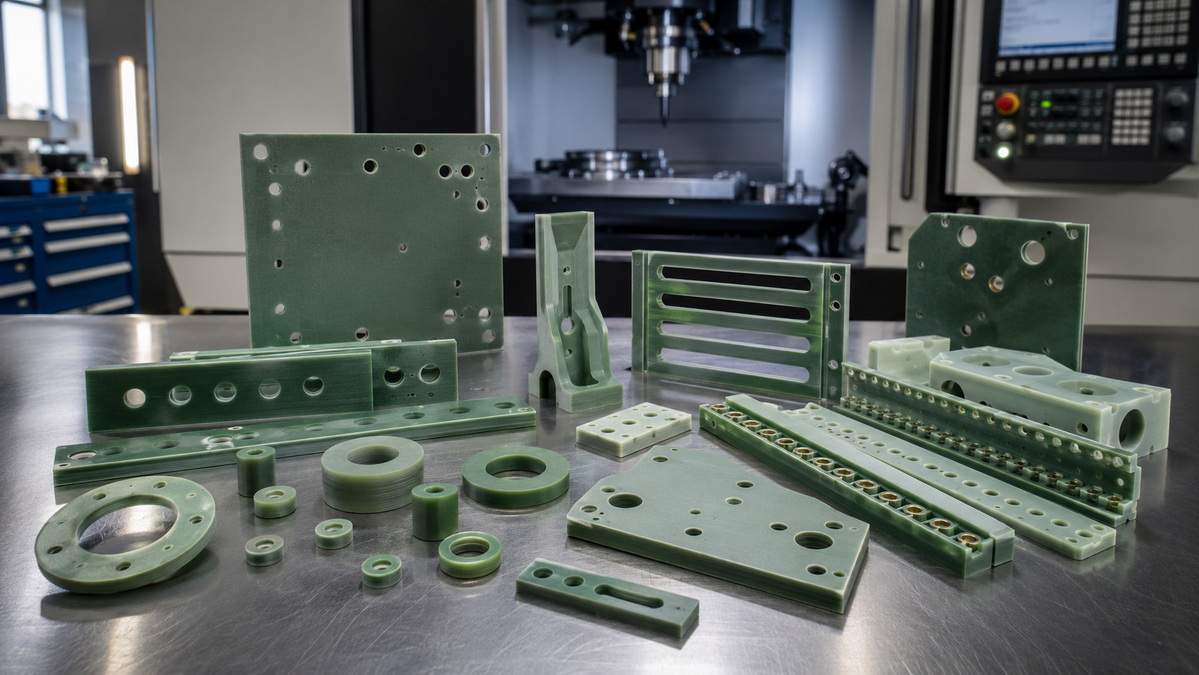
The final G10 sheet is usually rigid, smooth, and dimensionally stable. It can be supplied in full sheets or machined into custom electrical insulation parts, washers, spacers, terminal boards, support plates, and precision industrial components.
The production process has a direct impact on sheet consistency, mechanical strength, and insulation reliability.
A typical manufacturing process includes:
1. Selecting electrical-grade woven fiberglass cloth.
2. Preparing an epoxy resin formulation for impregnation.
3. Saturating the fiberglass fabric with epoxy resin.
4. Drying the impregnated layers to create prepreg material.
5. Stacking the layers to achieve the required thickness.
6. Hot pressing under controlled heat and pressure.
7. Post-curing the laminated sheet.
8. Cutting, inspecting, and machining the finished material if required.
Because G10 is a thermoset laminate, it becomes permanently cured during production. It cannot be softened and reshaped through reheating like many thermoplastics.
This structure gives G10 excellent rigidity and dimensional stability in demanding industrial environments.
G10 is often selected when one material must provide both electrical insulation and structural support.
Its typical advantages include:
- High dielectric strength.
- Good electrical insulation performance.
- High flexural and compressive strength.
- Strong resistance to deformation under load.
- Low water absorption.
- Good resistance to oils and many chemicals.
- Stable dimensions during machining and assembly.
- Good wear resistance.
- Reliable CNC machining performance.
G10 is especially useful when a component must isolate electrical current while also holding a mechanical load.
For example, a switchgear support plate may need to separate energized busbars, resist bolt pressure, withstand vibration, and maintain insulation performance over time. In this type of application, G10 can provide a balanced solution.
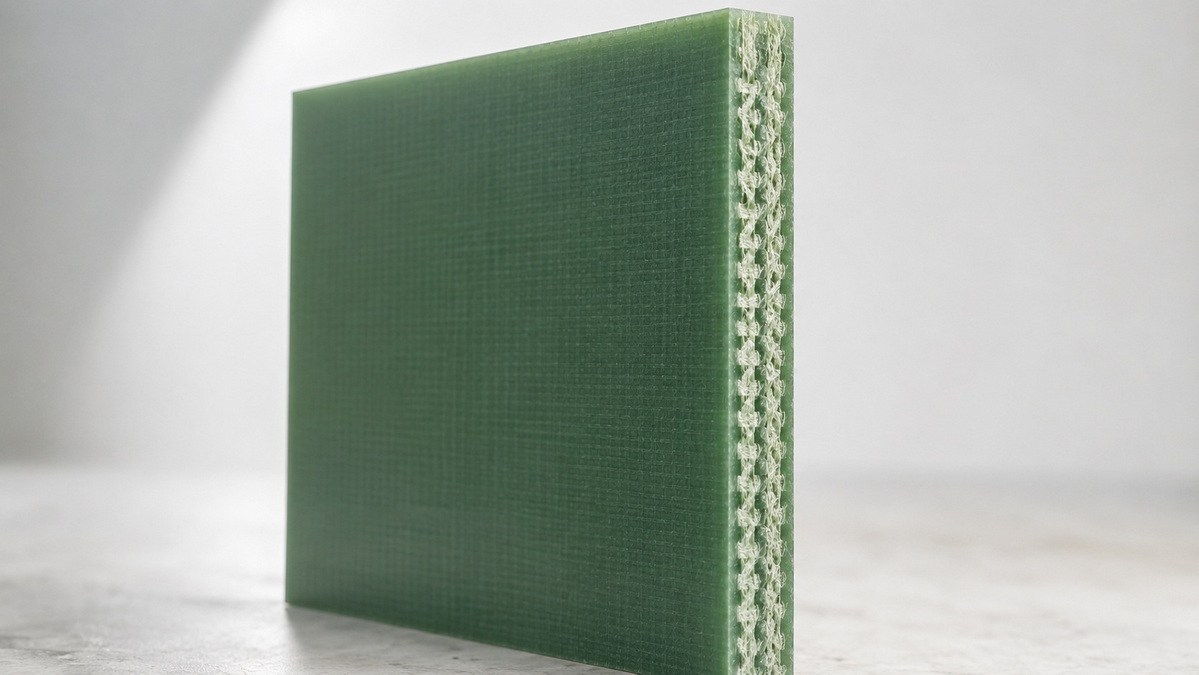
The phrase "epoxy resin laminate sheet" is a broad material description. It can include several grades with different resin systems, reinforcement materials, flame-retardant properties, and operating-temperature capabilities.
G10 is one defined type of epoxy resin laminate sheet. It normally uses woven glass fabric as reinforcement and epoxy resin as the binder.
In other words, every G10 sheet is an epoxy resin laminate sheet, but not every epoxy resin laminate sheet is G10.
| Feature | G10 Epoxy Laminate Sheet | General Epoxy Resin Laminate Sheet |
|---|---|---|
| Material category | A specific glass epoxy laminate grade | A broad family of epoxy-based laminated materials |
| Reinforcement | Usually woven fiberglass cloth | Glass cloth, glass mat, paper, cotton fabric, or other reinforcements |
| Mechanical performance | High rigidity and strength | Depends on resin system and reinforcement type |
| Electrical insulation | Excellent | Varies by material grade |
| Flame performance | Often non-flame-retardant | May be flame-retardant or non-flame-retardant |
| Temperature capability | Suitable for many medium-temperature industrial uses | Can range from standard grades to high-temperature grades |
| Common applications | Electrical insulators, fixtures, spacers, structural components | Depends on the exact laminate type and performance requirement |
Using a general name such as "epoxy sheet" can create confusion during purchasing and production.
Two sheets may look similar in thickness, color, or surface finish but perform differently in a real operating environment. Differences can appear in flame resistance, dielectric strength, heat resistance, moisture absorption, resin content, thickness tolerance, and machining behavior.
For this reason, a technical purchase request should describe more than the material color and thickness.
A more complete specification may include:
- Required grade, such as G10, FR4, or G11.
- Sheet thickness and tolerance.
- Raw sheet dimensions.
- Required flame performance.
- Maximum continuous operating temperature.
- Working voltage or insulation requirement.
- Mechanical load conditions.
- Machined-part drawings.
- Required inspection or compliance documents.
Clear specifications reduce the risk of receiving a material that is visually similar but technically unsuitable.
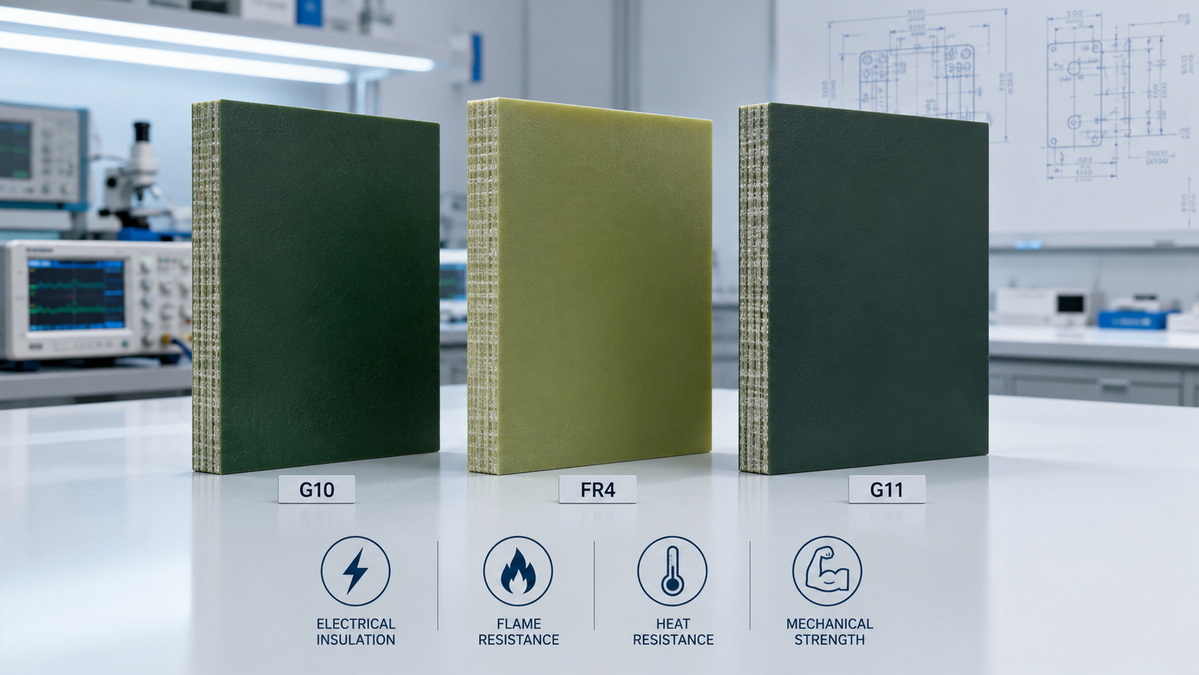
G10, FR4, and G11 are often grouped together because they are glass-reinforced epoxy laminates. However, they are designed for different priorities.
| Material | Main Strength | Typical Limitation | Suitable Applications |
|---|---|---|---|
| G10 | Strong mechanical performance, electrical insulation, and machinability | May not meet flame-retardant requirements | Insulators, fixtures, structural supports, spacers |
| FR4 | Flame-retardant performance and electrical insulation | Exact performance depends on the specific formulation | Electrical panels, PCB-related components, flame-sensitive equipment |
| G11 | Better retention of properties at elevated temperatures | Higher material cost in many applications | Motors, transformers, high-temperature insulation components |
| Custom epoxy glass laminate | Can be matched to specific drawings and working conditions | Requires complete technical communication | OEM electrical systems, custom industrial components |
G10 and FR4 have similar base structures because both commonly use fiberglass cloth and epoxy resin. Their most important difference is flame performance.
G10 is generally used when mechanical strength, insulation properties, moisture resistance, and machining performance are the main requirements.
FR4 is more appropriate when the final product requires a flame-retardant material. This may be important for electrical enclosures, control systems, PCB-related components, and equipment that must meet customer safety requirements.
Material color should not be used to identify the grade. Green sheets are often associated with FR4 or G10, but color alone does not prove flame performance, resin type, or certification status.
Before selecting either material, confirm the required flame rating and request supporting material documentation.
G11 is generally selected for applications that operate at higher temperatures for extended periods.
G10 performs well in many standard industrial conditions. It is suitable for electrical insulation parts, structural spacers, test fixtures, switchgear supports, mechanical jigs, and custom-machined components that do not face continuous extreme heat.
G11 is usually preferred when a component must retain its mechanical and electrical properties under elevated temperature conditions.
Common G11 applications include:
- High-temperature motor insulation.
- Transformer components.
- Thermal equipment supports.
- Electrical barriers near heat sources.
- Components exposed to long-term heat cycling.
The correct choice depends on the actual service environment. Short-term heat exposure is not the same as continuous operation near the maximum temperature limit.
G10 is used across many industries because it performs as both an insulator and a structural composite.
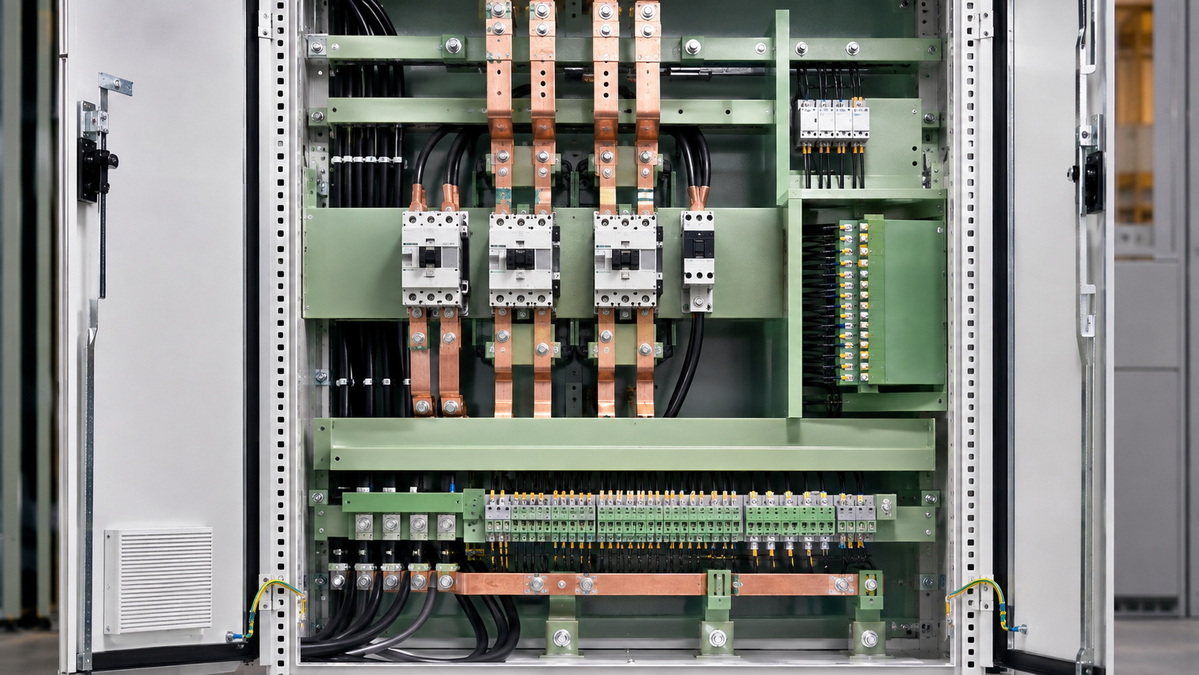
G10 can be used for electrical insulation parts that require strength and dimensional accuracy.
Common examples include:
- Busbar supports.
- Terminal boards.
- Electrical barriers.
- Switchgear insulation plates.
- Transformer spacers.
- Circuit breaker components.
- High-voltage insulation supports.
- Insulating washers and sleeves.
In these applications, G10 helps prevent unintended electrical contact while providing a stable mounting surface.
G10 also performs well in machinery and industrial equipment because of its rigidity, wear resistance, and machinability.
Typical uses include:
- CNC-machined fixtures.
- Drilling templates.
- Positioning jigs.
- Wear strips.
- Precision spacers.
- Structural support plates.
- Mold insulation components.
- Guide blocks.
- Non-metallic machine parts.
Its ability to resist moisture and many industrial chemicals makes it useful in environments where untreated wood, paper laminates, or lower-grade plastics may be less reliable.
In mold manufacturing, insulation materials can help reduce heat transfer between mold components and machinery.
G10 sheets can be machined into thermal insulation plates, structural pads, and custom support components. These parts may help protect machine platens, improve thermal control, and support stable production conditions.
The material should be selected based on mold temperature, pressure, thickness requirement, flatness tolerance, and long-term compression load.
Choosing a G10 epoxy resin laminate sheet should begin with the actual application environment.
A low-cost sheet may not provide the same long-term performance as a controlled industrial-grade laminate. Buyers should review operating temperature, voltage, humidity, chemical exposure, mechanical loads, machining requirements, and documentation needs before finalizing a material choice.
Temperature is one of the most important factors in material selection.
Ask the following questions:
- What is the normal operating temperature?
- What is the highest short-term temperature?
- Will the part face continuous heat exposure?
- Will the assembly experience repeated heating and cooling cycles?
- Does the component need to carry a mechanical load during heating?
If the application operates close to the temperature limit of a standard G10 material, G11 or another high-temperature laminate may be a better option.
Flame performance should be confirmed before the material is ordered.
If the end product requires flame retardancy, G10 may not be the correct default choice. FR4 or another specifically qualified flame-retardant grade should be considered.
This is especially important for products used in electrical cabinets, transportation equipment, power systems, electronic assemblies, and customer-regulated industrial projects.
Electrical insulation performance depends on more than the material's dielectric strength.
A reliable design should also consider:
- Working voltage.
- Frequency.
- Creepage distance.
- Clearance distance.
- Humidity.
- Surface contamination.
- Dust or chemical exposure.
- Sharp-edge design.
- Assembly pressure.
A material with strong laboratory properties may still underperform if the finished component has poor geometry, insufficient spacing, or exposure to conductive contamination.
G10 has strong mechanical properties, but part design remains important.
For a bolted plate, support bracket, fixture, or spacer, consider:
- Compression load.
- Flexural load.
- Bolt torque.
- Hole placement.
- Edge distance.
- Vibration.
- Repeated impact.
- Thermal expansion.
- Long-term creep.
Sharp internal corners and holes placed too close to the sheet edge can create stress concentration. Proper design and machining help improve part reliability.
G10 can be CNC machined into complex parts. It can be drilled, milled, cut, slotted, chamfered, and shaped into custom profiles.
Because fiberglass is abrasive, suitable cutting tools and dust-extraction systems are necessary during machining.
For custom-machined G10 components, provide the manufacturer with:
1. A PDF drawing with dimensions and tolerances.
2. A 2D or 3D CAD file where available.
3. Required material grade and thickness.
4. Quantity per part number.
5. Surface-finish expectations.
6. Hole, slot, thread, counterbore, and chamfer details.
7. Required inspection standards.
Clear drawings make it easier to control manufacturing cost, lead time, and finished-part accuracy.
A reliable G10 sheet should be evaluated as an engineered material rather than a generic board product.
Material quality can be influenced by the fiberglass weave, resin content, curing process, void control, sheet thickness, flatness, surface condition, and moisture management.
For custom insulation components, useful quality checks may include:
- Material grade verification.
- Sheet thickness inspection.
- Flatness inspection.
- Visual surface inspection.
- Dimensional inspection after machining.
- Hole-position verification.
- Burr and edge-condition inspection.
- Packing protection review.
- Lot identification and traceability.
For critical applications, buyers may also require physical-property reports, electrical test information, or compliance documentation.
A material data sheet may show typical performance values. These values are useful for initial design, but they may not be the same as guaranteed production limits.
Before approving a material for a demanding project, clarify:
- Whether a listed value is typical or guaranteed.
- Which test method was used.
- Whether the sample was dry, humid, or conditioned.
- Whether the test applies to the requested thickness.
- Whether lot-level inspection can be provided.
- Whether additional testing is needed for the final application.
This process helps prevent performance assumptions from becoming production problems.
G10 epoxy resin laminate sheet remains a practical choice for industrial applications that need electrical insulation, mechanical strength, low moisture absorption, and precise machining performance.
It is particularly effective for switchgear parts, transformer insulation, CNC fixtures, machine components, mold insulation plates, electrical barriers, and custom structural insulators.
The best material decision comes from matching the grade to the working environment. G10 may be suitable for many medium-temperature and mechanically demanding applications. FR4 may be more appropriate when flame performance is essential. G11 may be the stronger option when long-term elevated-temperature performance is required.
Guangdong Weishi New Materials Co., Ltd. provides G10, FR4, G11, epoxy fiberglass sheets, and custom-machined insulation components for industrial customers worldwide. Share your drawing, material requirement, thickness, operating conditions, and quantity requirements to help identify a suitable insulation-material solution for your project.
No. Both are fiberglass-reinforced epoxy laminates, but FR4 is typically chosen when flame-retardant performance is required. G10 is often selected for its strong balance of insulation, mechanical strength, moisture resistance, and machinability.
Yes. G10 is widely used in electrical insulation applications because it has high dielectric strength and strong mechanical performance. It is commonly used for busbar supports, switchgear plates, insulating barriers, terminal boards, and transformer components.
Yes. G10 can be cut, drilled, milled, slotted, and shaped into custom components. Because the material contains fiberglass, carbide or diamond-coated tools and effective dust extraction are recommended.
G11 generally provides stronger property retention at higher temperatures. G10 is suitable for many standard industrial applications, while G11 is often selected for long-term high-temperature electrical insulation and mechanical support.
G10 has low water absorption and good moisture resistance. However, finished-part performance depends on the application environment, machining details, chemical exposure, assembly design, and long-term operating conditions.
Provide the required grade, thickness, sheet size or part drawing, quantity, tolerances, machining details, operating temperature, electrical conditions, flame requirements, and documentation requirements.
1. International Electrotechnical Commission. [IEC 60893-1: Industrial Rigid Laminated Sheets Based on Thermosetting Resins for Electrical Purposes]
2. Norplex-Micarta. [NEMA LI 1-1998 Industrial Laminated Thermosetting Products]
3. Atlas Fibre. [G-10 Material Specification Data Sheet]
4. Cut & Mor. [NEMA Grade G-10 Glass Epoxy Laminate Data Sheet]
5. Boedeker Plastics. [G-10 Glass Epoxy Laminate]
6. Protolabs. [UL 94 Classification and Flame-Retardant Plastic Materials]
7. Atlas Fibre. [G10 vs. G11: Key Differences Explained]


