
Views: 275 Author: Weishi Sheets Publish Time: 2026-09-23 Origin: Site
Content Menu
● What Is an Epoxy Glass Sheet?
>> Key Properties of Epoxy Glass Sheet
>> FR4, G10, and G11: What Is the Difference?
● Epoxy Glass Sheet vs Mica Sheets: Main Differences
● Temperature Resistance: The Most Important Selection Factor
>> Practical Temperature Zones in an Industrial Oven
● Mechanical Strength and Structural Support
>> When Mica Sheets Are Less Suitable for Structural Parts
● Electrical Insulation Performance
>> Electrical Insulation of Epoxy Glass Sheet
>> Electrical Insulation of Mica Sheet
● Thermal Insulation Performance
>> Why Mica Works Well Near Heating Elements
● Fire Performance and Material Safety
● CNC Machining and Custom Processing
>> Advantages of Machined Epoxy Glass Sheet
>> Machining Considerations for Mica Sheets
● A Practical Industrial Oven Design Example
● How to Choose Between Epoxy Glass Sheet and Mica Sheet
>> Step 1: Identify the Actual Material Temperature
>> Step 2: Define the Part's Main Function
>> Step 3: Confirm Electrical Requirements
>> Step 4: Consider Mechanical Assembly Conditions
>> Step 5: Validate the Final Design
● When to Choose Epoxy Glass Sheet
>> Can FR4 sheet be used inside an industrial oven?
>> Is G11 better than FR4 for high-temperature oven applications?
>> What is the main difference between epoxy glass sheet and mica sheet?
>> Can mica sheets be machined into custom shapes?
>> Which material is better for heating element insulation?
>> Is epoxy glass sheet suitable for CNC machining?
>> Can epoxy glass sheet and mica sheet be used together?
Choosing the right insulation material for an industrial oven is not simply a matter of selecting the product with the highest temperature rating. Engineers, OEM buyers, and maintenance teams need to balance heat resistance, electrical insulation, mechanical strength, machining requirements, and long-term service reliability.
Two materials often considered for these applications are epoxy glass sheet and mica sheets. Both can provide electrical insulation and are widely used in industrial equipment. However, they perform very differently when exposed to heat, mechanical loads, thermal cycling, and direct proximity to heating elements.
In most cases, mica sheets are the stronger choice for high-temperature thermal barriers and heater insulation. Epoxy glass sheets, including FR4, G10, and G11 grades, are often more suitable for structural electrical insulation parts that require high strength, dimensional accuracy, and custom machining.
The most reliable industrial oven designs often combine both materials. Mica protects components in hot zones, while epoxy glass laminates support electrical and mechanical functions in lower-temperature areas.
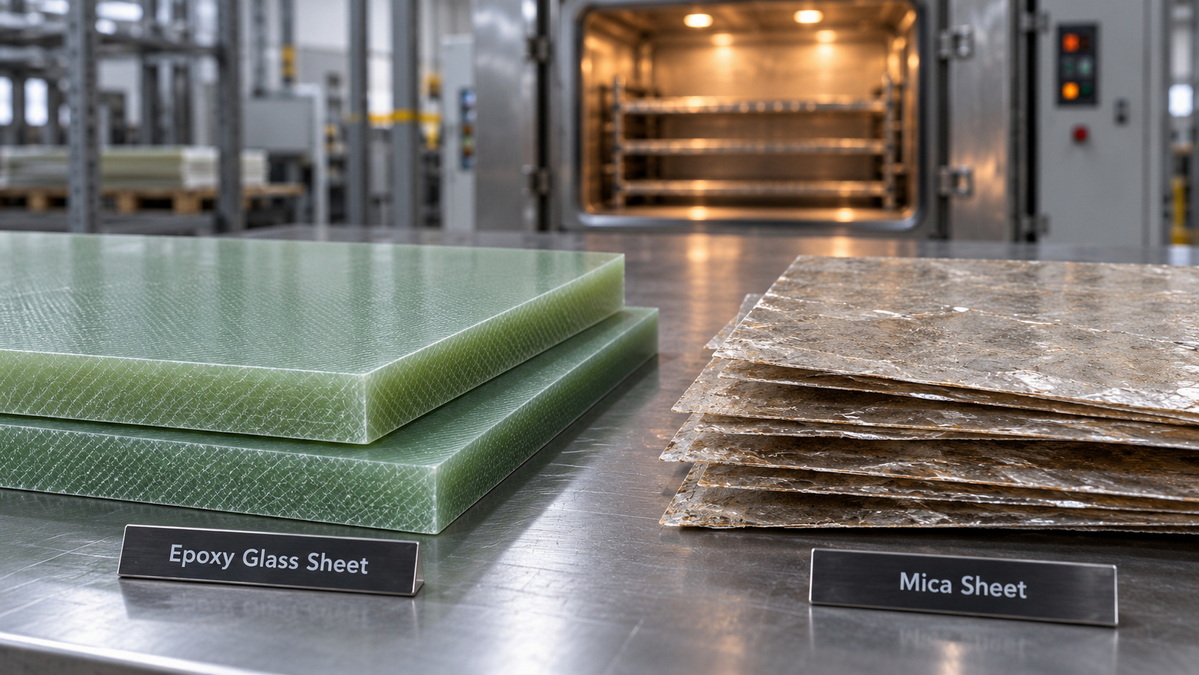
An epoxy glass sheet is a rigid industrial laminate produced by combining woven fiberglass cloth with epoxy resin under controlled heat and pressure. The fiberglass reinforcement gives the material high mechanical strength, while the cured epoxy resin provides electrical insulation, chemical resistance, and dimensional stability.
Epoxy glass sheet is also known by several industrial grades and names, including:
- FR4 sheet
- G10 sheet
- G11 sheet
- Epoxy fiberglass sheet
- Glass epoxy laminate
- Electrical insulation board
- Epoxy glass cloth laminate
These materials are commonly used in electrical systems, industrial machinery, switchgear, transformers, motor components, molds, fixtures, and custom-machined insulation parts.
For industrial equipment manufacturers, epoxy glass sheet is valuable because it can be supplied in a wide range of thicknesses and converted into highly precise components through drilling, CNC milling, routing, sawing, grinding, and punching.
Epoxy glass laminates are widely selected because they combine several useful properties in one rigid material.
- High mechanical strength
- Good electrical insulation
- Low water absorption
- Stable dimensions after machining
- Resistance to oils and many industrial chemicals
- Good wear resistance
- High compressive strength
- Reliable performance in electrical assemblies
- Suitable for custom CNC machining
- Available in flame-retardant FR4 grades
The exact performance depends on the resin system, fiberglass construction, thickness, curing method, and material grade. Buyers should therefore evaluate the data of the exact product rather than relying only on the material name.
Although FR4, G10, and G11 are all epoxy fiberglass laminates, they are designed for different application requirements.
| Material Grade | Main Feature | Typical Application Direction |
|---|---|---|
| G10 sheet | Strong, rigid, and electrically insulating epoxy glass laminate | Electrical insulation components, fixtures, machined support parts |
| FR4 sheet | Flame-retardant epoxy fiberglass laminate | Electrical panels, PCB-related components, switchgear insulation |
| G11 sheet | Higher-temperature epoxy glass laminate with improved thermal endurance | Hot electrical equipment, transformer insulation, oven support parts |
G10 is often selected for general electrical insulation and structural applications where operating temperatures remain moderate.
FR4 is commonly used when flame-retardant performance is important. It is widely recognized in electrical and electronic manufacturing because it combines good insulation performance with flame-retardant epoxy chemistry.
G11 is usually the preferred epoxy glass laminate when the application experiences higher operating temperatures. Compared with standard G10, G11 is designed to maintain better mechanical and electrical properties under elevated heat conditions.
However, even G11 has limitations. It is still based on an epoxy resin system. Therefore, it should not be treated as a direct replacement for mica, ceramic fiber, or refractory insulation in extreme-temperature oven zones.
Mica sheets are high-temperature insulation products made from natural mica minerals or mica paper combined with heat-resistant binder systems. Mica is widely used in industrial heating systems because it provides excellent electrical insulation while maintaining stability at temperatures that would damage many polymer-based materials.
Mica sheets can be supplied as rigid boards, flexible sheets, mica paper laminates, heater insulation plates, shaped components, and layered high-temperature barriers.
They are widely used in:
- Industrial ovens
- Furnaces
- Kilns
- Electric heaters
- Heating coils
- Heating elements
- High-temperature electrical systems
- Induction equipment
- Thermal shields
- Motor insulation systems
- Appliance heating systems
- Fire-resistant industrial assemblies
Two commonly used mica mineral types are muscovite mica and phlogopite mica.
| Mica Type | Main Strength | Common Uses |
|---|---|---|
| Muscovite mica | Strong electrical insulation performance | Electrical heaters, appliances, electrical insulation systems |
| Phlogopite mica | Higher thermal stability under extreme heat | Furnaces, industrial ovens, kilns, high-temperature barriers |
Muscovite mica is often selected where electrical insulation performance is especially important.
Phlogopite mica is often preferred in high-temperature industrial environments because it can maintain stability under more severe thermal exposure.
Mica sheets can also be classified by their physical construction.
| Mica Product Type | Characteristics | Typical Application |
|---|---|---|
| Rigid mica sheet | Strong, flat, stable, and heat resistant | Heater plates, furnace barriers, oven insulation boards |
| Flexible mica sheet | Can bend and conform to curved surfaces | Heater wraps, cable insulation, shaped thermal barriers |
| Mica paper laminate | Thin, layered insulation material | Heating elements, electrical heating systems, thermal shields |
Epoxy glass sheet and mica sheet are both insulation materials, but their strengths are not the same.
Epoxy glass sheet is primarily a structural electrical insulation material. It is strong, rigid, easy to machine, and suitable for precision industrial components.
Mica sheet is primarily a high-temperature thermal and electrical insulation material. It is designed to withstand heat and reduce heat transfer in locations where epoxy resin systems may not be suitable.
| Property | Epoxy Glass Sheet: FR4, G10, G11 | Mica Sheets |
|---|---|---|
| Base material | Fiberglass cloth and epoxy resin | Mica mineral or mica paper with high-temperature binder |
| Main advantage | Strength, rigidity, electrical insulation, precision machining | High-temperature resistance, thermal shielding, electrical insulation |
| Mechanical strength | Very high for structural support applications | Good in rigid grades, but usually selected for thermal insulation |
| Heat resistance | Moderate to high depending on grade | Very high, especially in phlogopite-based grades |
| Direct heater exposure | Usually not recommended in extreme heat zones | Highly suitable for heater and furnace insulation |
| CNC machining | Excellent for holes, slots, grooves, and profiles | Possible but requires careful handling |
| Electrical insulation | Excellent within validated operating temperatures | Excellent, including at elevated temperatures |
| Thermal insulation | Moderate | Strong |
| Flame performance | FR4 grades can provide flame-retardant performance | Mineral-based mica is highly heat resistant |
| Water resistance | Generally low water absorption | Typically good moisture resistance depending on binder |
| Best use in ovens | Electrical supports, structural barriers, terminal boards | Heater insulation, hot-zone barriers, thermal shields |
The correct selection depends on the material's actual location inside the oven system.
The first question should be: What temperature will the material actually experience?
This is different from asking for the oven's set temperature.
For example, an industrial oven may operate at 250°C. However, an electrical support plate mounted outside the heated chamber may remain below 100°C because of an air gap, thermal insulation, cooling airflow, and distance from the heat source.
In this situation, G10, FR4, or G11 may be suitable if the operating conditions are properly evaluated.
However, a component installed close to a radiant heating element can experience a much higher surface temperature than the oven's air temperature. Direct radiation, poor ventilation, metal contact, thermal bridges, and repeated heating cycles can all increase the local heat load.
This is where mica sheets become more suitable.
| Oven Component Location | Recommended Material Direction |
|---|---|
| External electrical panel | FR4 or G10 sheet |
| Electrical terminal support in a cooler area | FR4, G10, or G11 sheet |
| Structural insulation part near moderate heat | G11 epoxy glass sheet |
| Heater terminal barrier near radiant heat | Mica sheet or mica-based insulation system |
| Heating element insulation | Mica sheet |
| Furnace wall insulation | Mica, ceramic fiber, refractory insulation, or multi-layer system |
| High-temperature thermal shield | Rigid mica sheet |
| Extreme heat zone | High-temperature mica or refractory insulation material |
A material should always be selected with a realistic safety margin. Long-term exposure, thermal cycling, electrical voltage, moisture, and mechanical load can all reduce the usable performance margin.
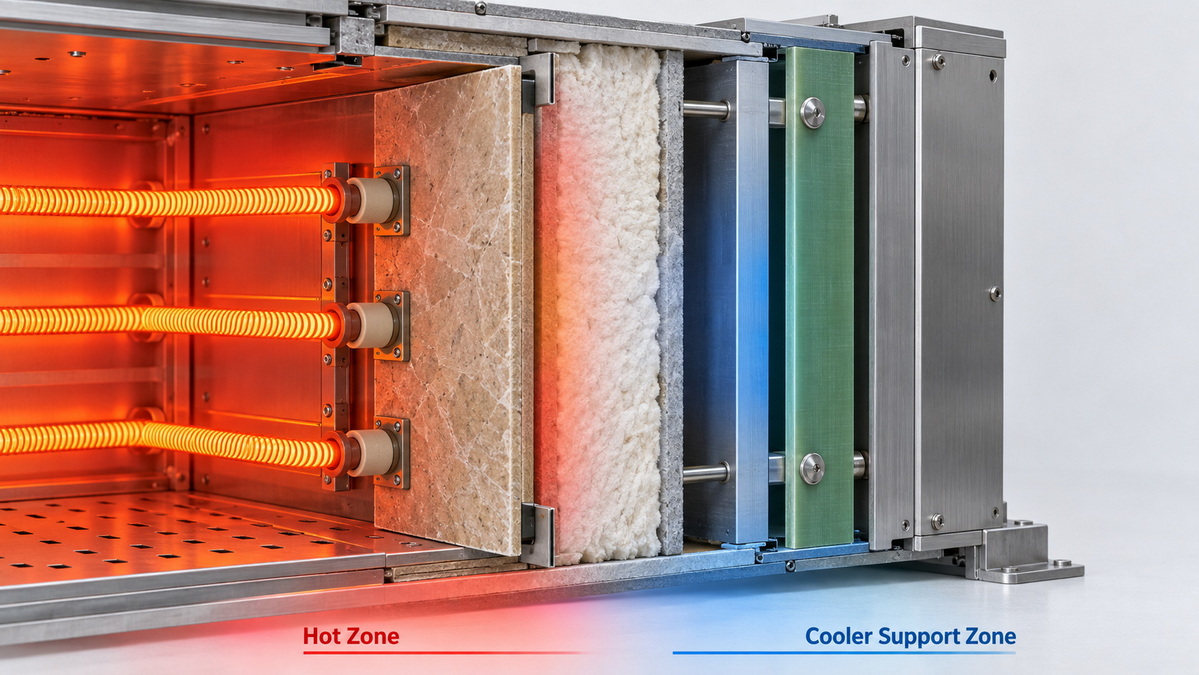
Mechanical strength is one of the biggest advantages of epoxy glass sheet.
G10, FR4, and G11 are reinforced with woven fiberglass cloth. This reinforcement helps the material resist bending, compression, vibration, impact, and mechanical stress.
For industrial equipment manufacturers, this makes epoxy glass sheet highly suitable for components that must do more than provide insulation.
Typical structural applications include:
- Electrical terminal boards
- Busbar supports
- Switchgear insulation parts
- Transformer insulation spacers
- Precision-machined washers
- CNC-routed support plates
- Motor insulation components
- Mold insulation boards
- Mechanical fixtures
- Electrical mounting plates
- Machine spacers
- Structural insulating brackets
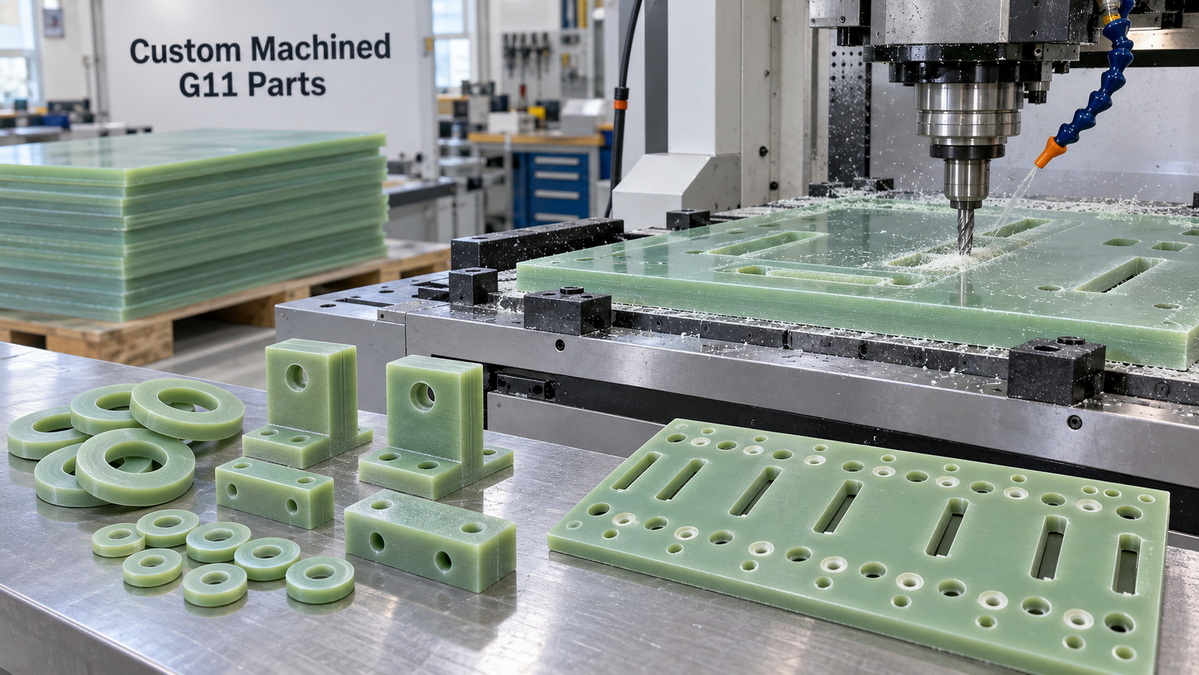
A G11 epoxy glass sheet can be machined into a terminal support plate with holes, countersinks, ventilation slots, wire-routing grooves, and accurate mounting features. This is difficult to achieve with many soft or brittle thermal insulation materials.
Rigid mica sheets can provide useful compressive strength and dimensional stability. However, mica is usually not the first choice for parts that must withstand:
- Continuous vibration
- High bolt torque
- Heavy cantilever loads
- Repeated impact
- Complex CNC features
- Narrow unsupported sections
- Frequent disassembly and installation
Some mica grades can chip or crack if drilled too close to the edge, exposed to concentrated fastener loads, or handled incorrectly during assembly.
For these applications, epoxy glass sheet often provides a more reliable solution—provided that the temperature stays within the suitable service range.
Both epoxy glass sheet and mica sheet are used for electrical insulation. The important difference is their behavior under heat.
Epoxy glass laminate provides reliable dielectric insulation in many electrical systems. It is commonly used in switchgear, transformer systems, electrical cabinets, motor components, high-voltage supports, and industrial control equipment.
Its advantages include:
- Good dielectric strength
- Strong insulation resistance
- Stable dimensions
- Strong mechanical support for live electrical parts
- Good machinability for creepage-distance and clearance designs
- Low moisture absorption in many grades
FR4, G10, and G11 can all be useful when insulation components must be precisely machined and mechanically secured.
However, the epoxy resin matrix becomes the critical limitation in hotter environments. As the working temperature rises, the material can gradually lose stiffness and electrical stability. Long-term heat exposure can also cause discoloration, warpage, resin aging, and reduced service life.
Mica is naturally dielectric and performs well in high-temperature electrical insulation applications.
It is commonly used to isolate heating elements, electrical terminals, and conductive metal parts in ovens, heaters, furnaces, and electrical heating systems.
Mica can provide two essential functions at the same time:
1. Electrical separation between conductive components
2. Thermal protection for nearby wiring, metal housings, and structural parts
This makes mica particularly useful for compact industrial oven designs where the available space between a heater and electrical components is limited.
Thermal insulation is the area where mica sheets usually have a major advantage.
Epoxy glass sheet can tolerate elevated heat, especially G11. However, its main role is not to act as the primary thermal barrier in direct high-temperature zones.
Mica sheets are specifically designed for high-temperature insulation. They are often used near heating elements and hot surfaces because they can limit heat transfer while maintaining electrical insulation performance.
Mica is suitable for applications involving:
- Radiant heat
- Heating elements
- Cartridge heaters
- Strip heaters
- Band heaters
- Heating coils
- High-temperature oven walls
- Furnace doors
- Thermal shields
- Electrical heater supports
When properly selected, mica can withstand temperatures far beyond the practical long-term range of epoxy glass laminates.
This does not mean mica automatically replaces every other insulation material. In very high-temperature equipment, mica may be used together with ceramic fiber, refractory insulation, air gaps, reflective barriers, and metal shielding.
The best system depends on heat source type, thermal transfer method, temperature range, insulation thickness, energy efficiency requirements, and available installation space.
Material safety should be evaluated based on the exact product grade and application environment.
FR4 is widely known as a flame-retardant epoxy glass laminate. It is often selected when electrical insulation components require flame-retardant characteristics.
However, flame retardancy should not be confused with extreme-temperature resistance.
A flame-retardant epoxy sheet may resist ignition under certain test conditions, but this does not mean it is suitable for direct exposure to furnace temperatures, heating coils, or severe radiant heat.
Mica offers a different kind of advantage. Because it is mineral-based, it has strong heat resistance and is commonly used in applications where high temperatures and electrical insulation requirements occur together.
When evaluating material safety, consider:
- Actual operating temperature
- Peak temperature during startup and shutdown
- Distance from heating elements
- Thermal cycling frequency
- Electrical voltage
- Fire-risk requirements
- Installation method
- Fastener type
- Ventilation conditions
- Adjacent materials
- Required service life
For many industrial buyers, the ability to convert a sheet material into a finished part is just as important as the raw material properties.
Epoxy glass sheet is well suited for custom fabrication. It can be processed into precision insulation components for different equipment designs.
Common processing methods include:
- CNC milling
- CNC drilling
- Routing
- Saw cutting
- Grinding
- Punching
- Slotting
- Countersinking
- Edge finishing
- Surface machining
Custom epoxy glass parts can include:
- Insulation plates
- Terminal boards
- Electrical barriers
- Support blocks
- Busbar supports
- Washers
- Spacers
- Motor insulation parts
- Transformer insulation components
- Mold insulation parts
- Custom machine fixtures
For Guangdong Weishi New Materials Co., Ltd., custom processing can provide a practical solution for customers who need finished FR4, G10, or G11 insulation components based on drawings, samples, dimensions, or equipment-specific requirements.
Mica sheets can also be cut, punched, drilled, and formed. However, the processing method must match the mica grade and thickness.
Before ordering machined mica parts, confirm:
- Whether the mica is rigid or flexible
- The required hole size and hole position
- Edge-distance requirements
- The need for countersinks or slots
- Fastener torque requirements
- Whether the component will bend during installation
- Whether the part is subject to vibration
- The maximum operating temperature
- Whether edge sealing is required
- Whether the component will be removed repeatedly for maintenance
Mica is highly effective as a thermal insulation material, but some grades need more careful fabrication and installation than epoxy glass composites.
Consider an electrically heated industrial drying oven with a working chamber temperature of 280°C.
The oven includes heating elements, electrical terminals, metal walls, insulation layers, an outer housing, wiring, and maintenance access panels.
A weak design may place a standard FR4 sheet directly next to a heating element because FR4 is easy to machine and electrically insulating. Over time, high radiant heat may cause the epoxy laminate to discolor, warp, soften, or lose mechanical reliability.
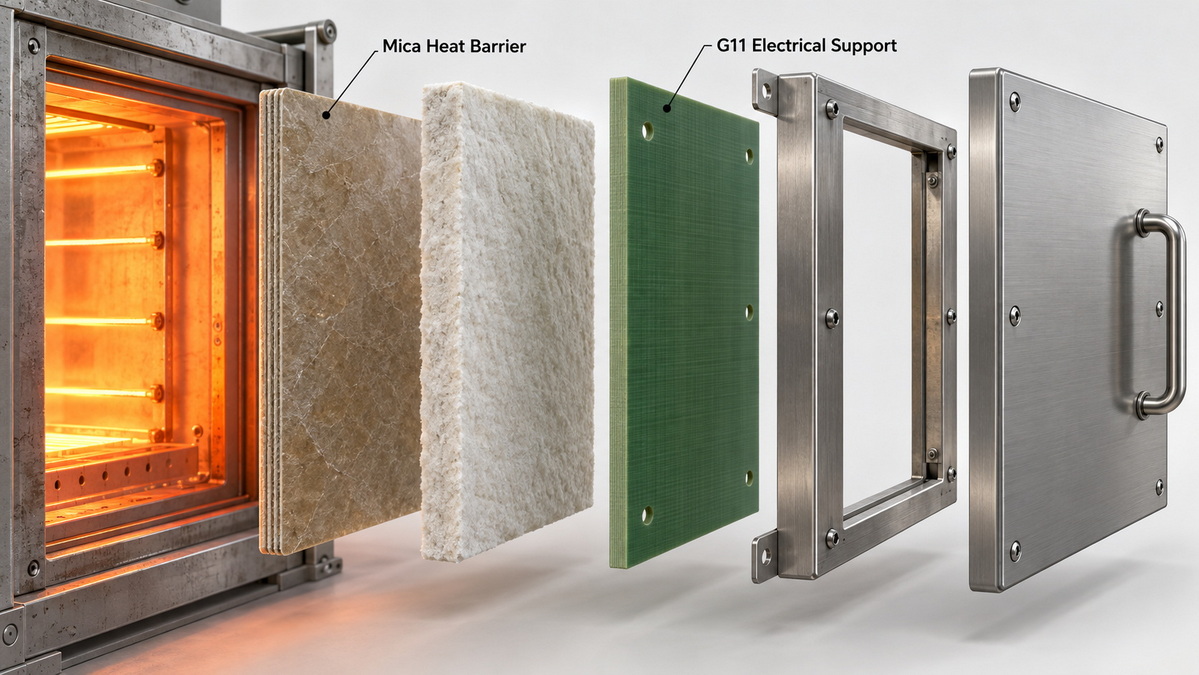
A stronger material arrangement may use several layers.
| Oven Assembly Layer | Recommended Material Function |
|---|---|
| Inner hot-side barrier | Rigid mica sheet for high-temperature thermal and electrical insulation |
| Secondary insulation layer | Ceramic fiber, air gap, or other approved thermal insulation |
| Electrical support layer | G11 epoxy glass sheet for terminals and machined structural supports |
| External protection layer | Metal housing or outer cover |
| Wiring separation system | G11, FR4, mica barriers, or a combined design depending on temperature |
This layered approach allows each material to perform the function it handles best.
Mica protects the assembly from direct high heat. G11 epoxy glass sheet provides strength, accurate machining, electrical separation, and reliable mounting performance in a lower-temperature zone.
A successful material selection process should begin with the real application conditions.
Measure the expected temperature at the insulation component itself.
Consider:
- Oven chamber temperature
- Surface temperature
- Radiant heat
- Heat conduction through metal frames
- Airflow and ventilation
- Heating element distance
- Peak operating temperature
- Startup and shutdown cycles
- Fault-condition temperature
A component may experience much higher temperature than expected if it is close to a radiant heater or connected to a hot metal structure.
Choose epoxy glass sheet when the part must:
- Support mechanical loads
- Hold electrical terminals
- Maintain precise spacing
- Resist vibration
- Carry bolts or fasteners
- Provide CNC-machined features
- Support busbars or wiring assemblies
Choose mica sheet when the part must:
- Block direct heat
- Insulate a heating element
- Protect nearby electrical parts from high temperature
- Provide thermal shielding
- Operate close to a furnace or heater
- Maintain insulation performance under severe heat
Define the electrical conditions before selecting material.
Important requirements include:
- Operating voltage
- Peak voltage
- Dielectric strength
- Insulation resistance
- Creepage distance
- Clearance distance
- Moisture exposure
- Dust exposure
- Chemical exposure
- Frequency and electrical load
Electrical insulation performance should be evaluated together with temperature conditions. A material that performs well at room temperature may not provide the same long-term reliability at elevated heat.
Evaluate how the part will be installed.
Consider:
- Bolt size
- Bolt torque
- Hole location
- Vibration level
- Load direction
- Required flatness
- Thickness tolerance
- Need for repeated maintenance
- Edge-distance requirements
- Risk of impact damage
For highly machined and mechanically loaded components, epoxy glass sheet is often the better option.
Before large-scale production, test the selected material under realistic operating conditions.
A practical validation program may include:
- Thermal cycling testing
- Electrical withstand testing
- Insulation-resistance testing
- Dimensional inspection after heat exposure
- Fastener torque testing
- Vibration testing
- Visual inspection for cracks or delamination
- Surface discoloration inspection
- Load testing for structural support parts
This process helps identify material problems before equipment enters full production or field service.
Epoxy glass sheet is usually the better choice when the application requires a combination of structural strength, electrical insulation, and precision machining.
Choose FR4, G10, or G11 when you need:
- Strong electrical insulation supports
- Machined terminal boards
- Busbar support components
- Transformer insulation parts
- Motor insulation components
- Electrical mounting panels
- Industrial fixture plates
- Mold insulation components
- Accurate holes, slots, and grooves
- Stable material thickness
- Reliable mechanical fastening
- Moderate-temperature insulation performance
For standard industrial electrical applications, G10 and FR4 may be suitable.
For higher-temperature electrical systems, G11 is often the better epoxy glass laminate option because it is designed for improved elevated-temperature performance.
Mica sheet is usually the better choice when the application requires high-temperature resistance and thermal insulation close to a heat source.
Choose mica sheets when you need:
- Heating element insulation
- Furnace thermal barriers
- Industrial oven heat shields
- Electrical insulation near high heat
- High-temperature terminal protection
- Heater plate insulation
- Radiant heat shielding
- Thermal protection for metal enclosures
- High-temperature electrical assemblies
- Thin and efficient insulation layers
Mica is especially useful when standard epoxy laminates may not provide enough long-term thermal stability.
Epoxy glass sheet and mica sheet are both important materials for industrial oven insulation, but they should not be treated as identical alternatives.
Epoxy glass sheet is the preferred material for structural electrical insulation parts that require strength, rigidity, precise machining, stable dimensions, and secure mechanical installation.
Mica sheet is the preferred material for high-temperature thermal barriers, heating element insulation, furnace applications, and hot-zone electrical insulation.
For many industrial ovens, the strongest design uses both materials in different layers. Mica should be placed closer to the heat source, while FR4, G10, or G11 epoxy glass sheet can provide structural and electrical support in cooler areas.
Guangdong Weishi New Materials Co., Ltd. supplies high-performance FR4 sheets, G10 sheets, G11 sheets, epoxy fiberglass boards, and custom-machined electrical insulation components for global industrial applications. Material selection should be based on operating temperature, insulation needs, mechanical load, component geometry, and long-term service expectations.
For technical material evaluation, provide the required thickness, working temperature, voltage level, drawing, part dimensions, quantity, and installation conditions to determine the most suitable epoxy glass laminate or combined insulation structure.
FR4 sheet can be used inside an industrial oven when the actual temperature at the component remains within the suitable operating range of the selected FR4 grade. It is generally more suitable for electrical support parts, terminal boards, and structural insulation components located away from direct heating zones.
G11 is often more suitable than standard FR4 for higher-temperature electrical insulation applications because it is designed to retain useful mechanical and electrical properties under elevated heat. However, G11 is still an epoxy glass laminate and should not be used as a direct substitute for mica in extreme-temperature areas.
Epoxy glass sheet is primarily a rigid structural electrical insulation material. Mica sheet is primarily a high-temperature thermal and electrical insulation material. Epoxy glass sheet is stronger and easier to machine, while mica is more suitable for high-temperature heat shielding.
Yes. Mica sheets can be cut, punched, drilled, and formed into custom shapes. However, the machining process should be adapted to the mica grade, thickness, binder system, hole position, and edge-distance requirements to reduce the risk of cracking or edge damage.
Mica sheet is generally better for heating element insulation because it provides high-temperature resistance and electrical insulation near direct heat sources. It is widely used in heaters, ovens, furnaces, and high-temperature electrical systems.
Yes. Epoxy glass sheet is highly suitable for CNC machining. FR4, G10, and G11 sheets can be drilled, milled, routed, slotted, countersunk, and cut into custom insulation components for industrial equipment.
Yes. In many industrial oven designs, mica sheet is used near the heat source as a thermal barrier, while G11, FR4, or G10 epoxy glass sheet is used in cooler areas for mechanical support, precision machining, and electrical insulation.
1. [UL Solutions — Standards for Evaluating Plastic Products]
2. [Ready Plastics — NEMA G10 vs FR4, G11, G7, G9 Laminates]
3. [Ready Plastics — NEMA G10 Glass-Epoxy Laminate]
4. [ACC Insulations — Fibre Glass Epoxy Laminates]
5. [Universal Gaskets — Epoxy Glass Laminate]
6. [Elmelin — Mica Insulation Sheets]
7. [Elmelin — Major Advantages of Mica for Industrial Insulation]
8. [Von Roll Composites — PAMITHERM 41130]
9. [Von Roll Composites — PAMITHERM 41140]
10. [Elmelin — Mica Insulation Properties vs Common Insulators]


