

Views: 219 Author: Weishi Sheets Publish Time: 2026-09-26 Origin: Site
Content Menu
● What Is a Fiberglass Laminate Sheet?
● Fiberglass Laminate Sheet vs. Epoxy Board: Key Differences
● Why Material Selection Matters in High-Speed Automation Equipment
● Common Material Challenges in Automation Systems
>> Vibration and Repeated Mechanical Loading
>> Humidity and Chemical Exposure
● FR4, G10, and G11: Which Grade Is Best?
>> G11 High-Temperature Epoxy Glass Sheet
● FR4 vs. G10 vs. G11 Comparison
● How to Select the Right Material for Automation Equipment
>> 1. Define the Electrical Requirement
>> 2. Identify the Operating Temperature
>> 3. Evaluate Mechanical Load and Vibration
>> 4. Confirm Flame-Retardant Requirements
>> 5. Define Machining and Tolerance Requirements
● Machining Fiberglass Laminate Sheets for Precision Parts
>> Recommended Machining Practices
● Practical Example: Servo-Control Insulation Plate
● Custom Machining for Automation Applications
● Summary
>> Is a fiberglass laminate sheet the same as an epoxy board?
>> Which material is better for high-speed automation equipment, FR4 or G10?
>> When should G11 be used instead of FR4?
>> Can FR4 sheets be CNC machined into custom components?
>> What information should be provided when ordering epoxy fiberglass insulation parts?
>> Can epoxy fiberglass laminate replace metal parts in automation equipment?
Choosing between a fiberglass laminate sheet and an epoxy board can directly influence the electrical safety, dimensional accuracy, thermal reliability, and service life of high-speed automation equipment. The decision affects more than the initial material cost. It can also affect assembly precision, maintenance frequency, machine uptime, and long-term production stability.
In modern automated systems, insulating components often operate close to servo motors, power modules, electrical terminals, pneumatic controls, robotic arms, and high-frequency switching devices. These environments can expose materials to repeated vibration, local heat buildup, electrical stress, mechanical loading, humidity, coolant mist, and continuous operating cycles.
For this reason, engineers and procurement teams should compare actual material grades, not only broad product names. A fiberglass laminate sheet and an epoxy board may describe similar products in some cases, but their structure, reinforcement, heat resistance, flame performance, machining behavior, and industrial suitability can differ significantly.
Guangdong Weishi New Materials Co., Ltd. specializes in the development, production, and supply of high-performance epoxy insulation boards and composite materials, including FR4 sheets, G10 sheets, G11 sheets, and epoxy fiberglass laminates. These materials are widely used in electronics, electrical systems, precision machining, mold manufacturing, and industrial automation equipment.
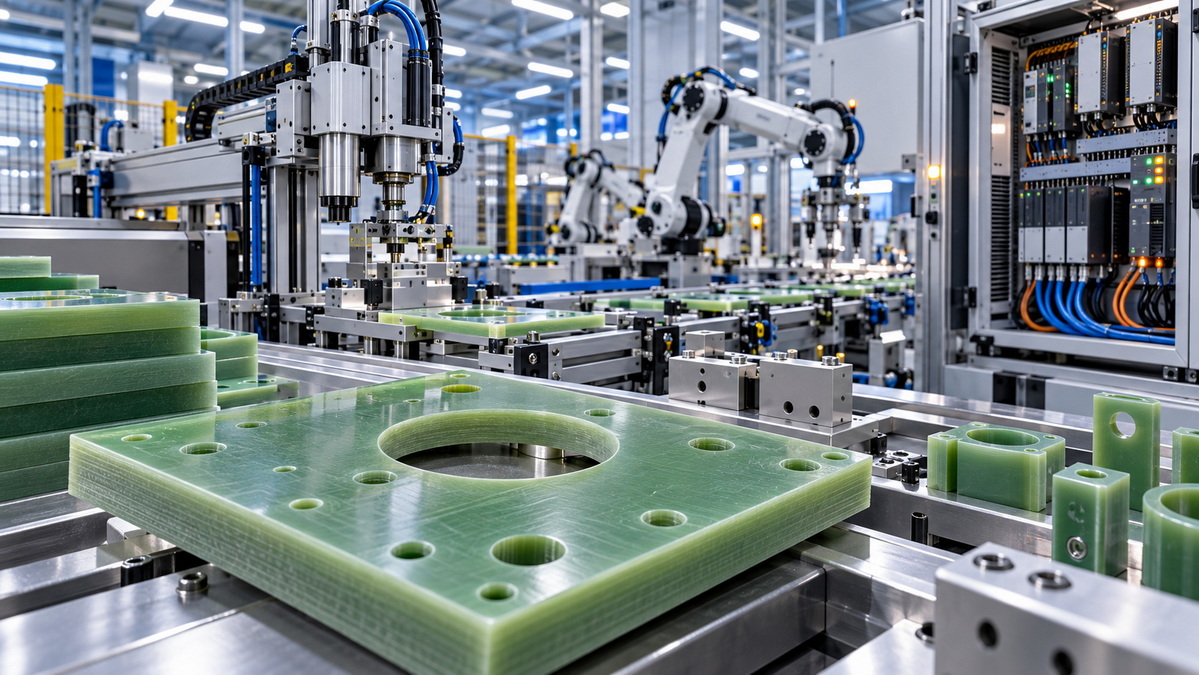
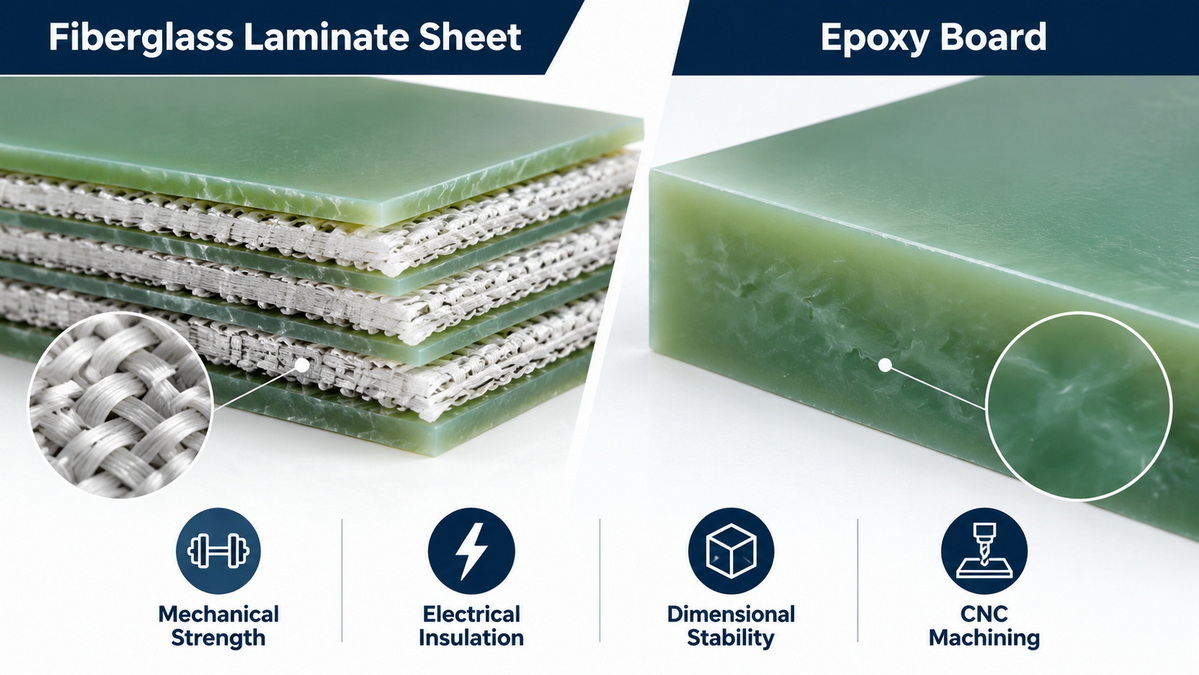
A fiberglass laminate sheet is a reinforced composite material. It is commonly made by combining woven fiberglass cloth with a thermosetting resin system, such as epoxy resin. The material is then cured under controlled heat and pressure to create a rigid, durable, electrically insulating board.
The fiberglass reinforcement provides structural strength and stiffness. The epoxy resin binds the glass fibers together and contributes electrical insulation, chemical resistance, and dimensional stability.
Fiberglass laminate sheets are widely used where a component must provide both mechanical support and electrical isolation.
Common fiberglass laminate sheet grades include:
- FR4 epoxy fiberglass sheet
- G10 epoxy glass laminate
- G11 high-temperature epoxy glass sheet
- EPGC industrial epoxy glass laminate
- 3240 epoxy fiberglass board
These materials can be supplied as full sheets or CNC-machined into custom insulation parts.
An epoxy board is a broader product term. It usually refers to an insulation board made with epoxy resin, but the internal construction can vary significantly from supplier to supplier.
Some epoxy boards use woven fiberglass cloth as reinforcement. Others may use fillers, fabrics, paper layers, mineral additives, or cast epoxy systems. Therefore, not every epoxy board offers the same mechanical strength, electrical insulation capability, thermal stability, or machining performance.
In practical industrial sourcing, epoxy board may refer to:
- Epoxy glass fiber board
- Epoxy resin insulation board
- Cast epoxy sheet
- Epoxy composite board
- Electrical insulation epoxy panel
- CNC-machined epoxy insulation component
- Epoxy laminate sheet
The most important point is that an epoxy board may be a fiberglass laminate sheet, but it is not automatically equivalent to a high-performance fiberglass-reinforced epoxy laminate.
For high-speed automation equipment, buyers should specify material grade, thickness, thermal requirement, flame rating, electrical performance, tolerance requirements, and machining details before placing an order.
| Material Feature | Fiberglass Laminate Sheet | General Epoxy Board |
|---|---|---|
| Main structure | Woven fiberglass cloth reinforced with epoxy resin | Epoxy resin with or without fiberglass reinforcement |
| Mechanical strength | Usually high | Depends on the material formulation |
| Flexural stiffness | Strong and stable | Can vary significantly |
| Electrical insulation | Excellent in qualified grades | May vary by resin system and construction |
| Dimensional stability | High, especially under mechanical load | Can be lower in unreinforced grades |
| Thermal performance | Grade-dependent and generally reliable | Depends on resin type and reinforcement |
| Flame resistance | Available in FR4 grades | Not always available |
| CNC machining | Suitable for drilling, milling, routing, and cutting | Depends on the exact board composition |
| Common applications | Electrical insulation, fixtures, tooling, busbars, industrial machinery | General insulation, panels, covers, low-load components |
| Specification control | Easier when supplied as FR4, G10, or G11 | May be unclear if the board is described only as epoxy board |
The comparison shows why material naming alone is not enough. In many cases, a high-performance fiberglass laminate sheet provides better predictability for demanding industrial applications.
High-speed automation equipment is designed to run continuously, accurately, and efficiently. Even small material failures can create serious production problems.
A low-quality insulating plate may warp under heat. A poorly machined board may cause installation misalignment. An unsuitable resin system may soften near power electronics. A material with unstable thickness may affect electrical clearance or fixture positioning.
These risks become more serious in equipment with fast movement, repetitive cycles, precision alignment requirements, and energized electrical components.
Fiberglass laminate sheets and epoxy boards are commonly used in:
- Servo motor insulation systems
- Electrical control cabinets
- Busbar support components
- Transformer insulation parts
- Robotic fixture plates
- Automated packaging equipment
- CNC machine components
- Sensor mounting structures
- Electrical terminal barriers
- High-voltage isolation panels
- Mold and tooling components
- Battery insulation assemblies
- Industrial conveyor equipment
- Automated testing fixtures
- Mechanical insulation spacers
The correct material helps maintain machine reliability while supporting safe electrical separation and consistent assembly performance.
Automation machinery often produces heat from servo drives, motors, transformers, power modules, electrical switching systems, and enclosed control cabinets.
When an insulation board is exposed to continuous heat beyond its intended operating range, it may lose stiffness or dimensional stability. The part may bend, deform, loosen, or fail to maintain its original position.
For high-temperature applications, selecting a suitable material grade is essential.
High-speed equipment creates continuous vibration, acceleration, deceleration, clamping pressure, and repetitive mechanical stress.
A material used in a robotic fixture, terminal support, or machine bracket must withstand repeated load cycles without cracking, loosening, or deforming.
Glass-fiber reinforcement gives fiberglass laminate sheets a major advantage in applications where stiffness and structural reliability are important.
Electrical insulation materials must prevent current leakage, arcing, tracking, and short circuits.
This is especially important in control cabinets, power distribution systems, battery modules, transformers, switching systems, and industrial electrical assemblies.
A suitable epoxy glass laminate can provide strong dielectric performance while also supporting structural loads.
Industrial environments may include high humidity, coolant mist, cleaning agents, oil vapors, dust, or chemical exposure.
A material that performs well in a dry laboratory environment may behave differently in a real production environment. The selection process should consider moisture absorption, surface resistance, chemical compatibility, and long-term environmental stability.
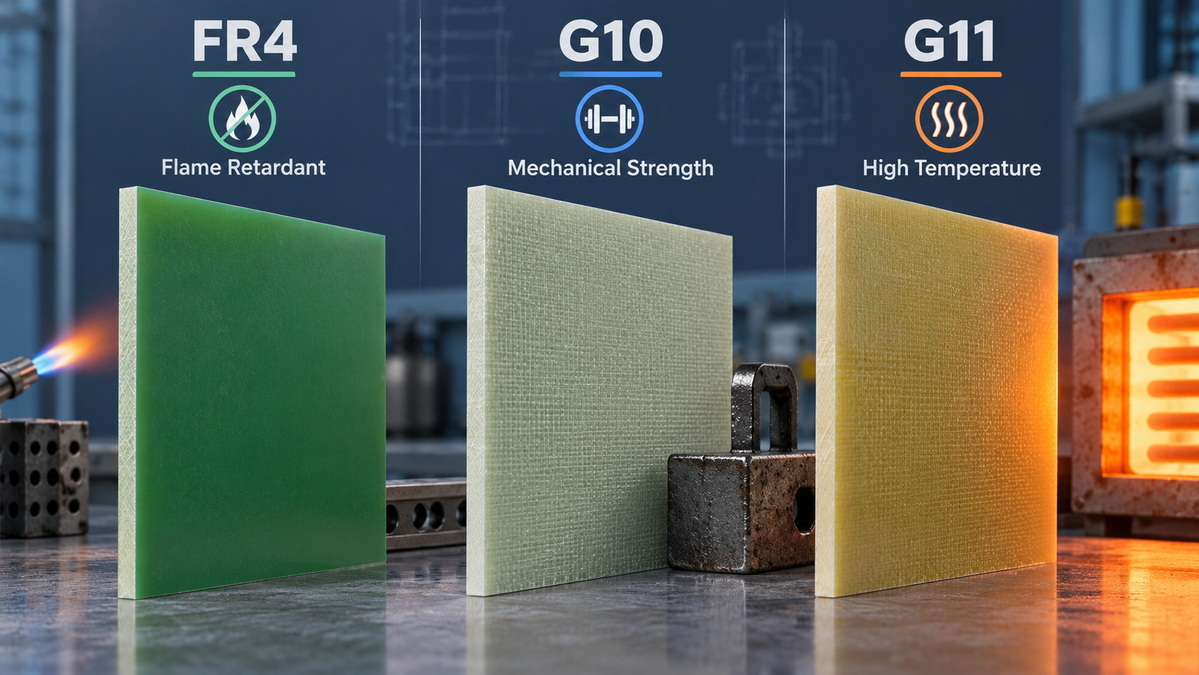
FR4, G10, and G11 are all commonly used epoxy fiberglass laminate materials. However, each grade has different strengths.
FR4 sheet is one of the most widely used electrical insulation materials for industrial automation applications.
It combines:
- Good electrical insulation
- Strong mechanical performance
- Reliable dimensional stability
- Good CNC machining capability
- Flame-retardant properties
- Wide industrial acceptance
- Availability in multiple thicknesses and sheet sizes
FR4 is commonly used for electrical panel components, terminal barriers, insulation plates, mounting boards, switchgear parts, transformer components, and CNC-machined automation parts.
Its flame-retardant characteristic makes it especially suitable for electrical enclosures and applications where safety requirements are important.
Best applications for FR4:
- Electrical control cabinets
- Power distribution systems
- Servo-drive insulation plates
- Busbar support components
- Electrical terminal barriers
- Automation fixture components
- Insulated mounting brackets
- High-precision machined electrical parts
G10 sheet is a strong and durable epoxy fiberglass laminate material. It provides good mechanical strength, electrical insulation, and machinability.
G10 is often selected for industrial parts where flame retardancy is not a mandatory requirement.
It can be a practical option for:
- Mechanical insulation spacers
- Tooling fixtures
- Wear-resistant structural components
- Industrial jigs
- Electrical support plates
- Non-fire-rated insulation structures
- General-purpose machinery components
G10 may offer good value for applications where high structural strength is required but flame-retardant performance is not necessary.
However, G10 should not be used as a direct substitute for FR4 when drawings, safety specifications, or customer requirements demand flame-retardant material.
G11 epoxy glass sheet is designed for more demanding thermal conditions.
It is commonly selected for electrical and mechanical insulation components exposed to elevated operating temperatures. G11 provides strong mechanical support while maintaining stable insulation performance in high-temperature environments.
G11 is suitable for:
- High-temperature motor insulation
- Transformer insulation structures
- Power module support plates
- Heating equipment components
- High-current electrical assemblies
- Industrial electrical systems with elevated heat exposure
- High-speed automation equipment near hot operating zones
For equipment exposed to sustained heat, G11 can provide a higher safety margin than standard FR4 or G10.
| Property | FR4 | G10 | G11 |
|---|---|---|---|
| Base structure | Epoxy resin with woven fiberglass cloth | Epoxy resin with woven fiberglass cloth | High-temperature epoxy resin with woven fiberglass cloth |
| Electrical insulation | Excellent | Excellent | Excellent |
| Mechanical strength | High | High | High |
| Flame resistance | Yes | Usually not specified as flame retardant | Depends on grade and formulation |
| Thermal resistance | Good | Good | Higher than standard FR4 and G10 |
| Dimensional stability | Good | Good | Very good under elevated temperature |
| CNC machinability | Excellent | Excellent | Excellent |
| Typical use | Electrical insulation and automation parts | Structural insulation and industrial fixtures | High-temperature electrical insulation |
| Best for | Electrical enclosures and flame-retardant applications | Cost-effective structural insulation | High-temperature and high-load environments |
In many high-speed automation projects, FR4 provides the best balance between cost, performance, machinability, and safety. G10 is suitable for structural insulation where flame performance is not required. G11 is preferred when operating temperatures are consistently high.
Choosing the right insulation sheet requires more than selecting a thickness and requesting a quotation. The material must match the operating environment and functional requirements of the final component.
Start by identifying the electrical conditions.
Important questions include:
- What is the operating voltage?
- What is the maximum voltage?
- Is the component near high-current conductors?
- Is arc resistance important?
- Is surface tracking a possible risk?
- Are there strict clearance and creepage requirements?
- Does the part need to maintain insulation performance in humidity?
For electrical insulation components, material data should be reviewed carefully before production.
Do not rely only on room temperature.
The actual component temperature may be much higher because of nearby motors, heaters, power electronics, transformers, drives, or enclosed cabinets.
Consider:
- Continuous operating temperature
- Peak operating temperature
- Heat generated by nearby components
- Repeated heating and cooling cycles
- Equipment ventilation
- Thermal buildup in compact assemblies
If the operating environment includes long-term heat exposure, G11 may provide a stronger material solution.
The material must withstand real mechanical stress.
Consider whether the component will:
- Carry a structural load
- Support wires or busbars
- Hold bolts or fasteners
- Experience repetitive vibration
- Act as a fixture plate
- Support moving equipment
- Require precise hole locations
- Maintain flatness during operation
For high-speed machinery, glass-fiber reinforcement helps the material resist deflection and maintain stable dimensions.
FR4 should be selected when flame resistance is required by the project, customer specification, electrical enclosure requirement, or industrial safety standard.
Material color should never be used as proof of material grade. Green, yellow, black, or natural-colored boards may have different compositions and performance characteristics.
Always verify the material grade through technical documentation.
For custom components, the raw sheet is only the starting point.
The final insulation part may require:
- CNC cutting
- Milling
- Drilling
- Slotting
- Chamfering
- Counterboring
- Threaded inserts
- Complex profiles
- Tight tolerances
- Flatness control
- Edge finishing
A well-defined drawing helps ensure that the finished part performs correctly during assembly.
Fiberglass laminate materials can be machined into complex industrial components. However, they require appropriate tooling and process control because the glass fibers are abrasive.
- Use carbide tools or diamond-coated tools.
- Apply stable workholding to reduce vibration.
- Select appropriate spindle speed and feed rate.
- Use dust extraction during cutting and drilling.
- Support thin sheets during machining.
- Inspect drilled holes for cracking or delamination.
- Avoid excessive cutting heat.
- Deburr edges carefully.
- Check flatness after machining.
- Verify dimensions before assembly.
Precision machining is particularly important for components used in high-speed equipment. A small error in hole spacing, slot position, board thickness, or flatness can affect assembly accuracy and equipment performance.
| Problem | Possible Cause | Potential Result |
|---|---|---|
| Delamination | Incorrect feed rate, dull tool, poor workholding | Weak edges and reduced structural reliability |
| Fiber breakout | Improper cutting tool or machining direction | Rough edges and poor appearance |
| Resin burning | Excessive friction or cutting heat | Discoloration and reduced edge quality |
| Hole cracking | Poor drilling parameters | Fastener failure or insulation damage |
| Board warping | Uneven material stress or poor machining sequence | Assembly misalignment |
| Dust contamination | Inadequate extraction | Cleaner production and assembly challenges |
High-quality material should be matched with accurate machining. This combination improves consistency, reduces rework, and supports more stable equipment performance.
Consider a servo-control insulation plate used inside an automated packaging machine.
The component needs to isolate electrical terminals while supporting fasteners and maintaining position during repeated equipment cycles. It is installed near servo-drive electronics, so it may experience both electrical stress and elevated temperature.
The component requires:
- Reliable electrical insulation
- Stable mounting-hole position
- Strong mechanical support
- Good vibration resistance
- Consistent thickness
- Flame-retardant performance
- Accurate CNC machining
For this application, FR4 epoxy fiberglass laminate is often an appropriate choice. It provides electrical insulation, structural stiffness, flame resistance, and good machining performance.
If the insulation plate is installed near a higher-temperature power module or motor assembly, G11 may be considered to provide additional thermal stability.
The material should be specified with clear requirements for thickness, machining tolerance, hole location, flatness, edge treatment, and final inspection.
Many equipment manufacturers need more than standard raw sheets. They need finished parts that can be assembled directly into machines.
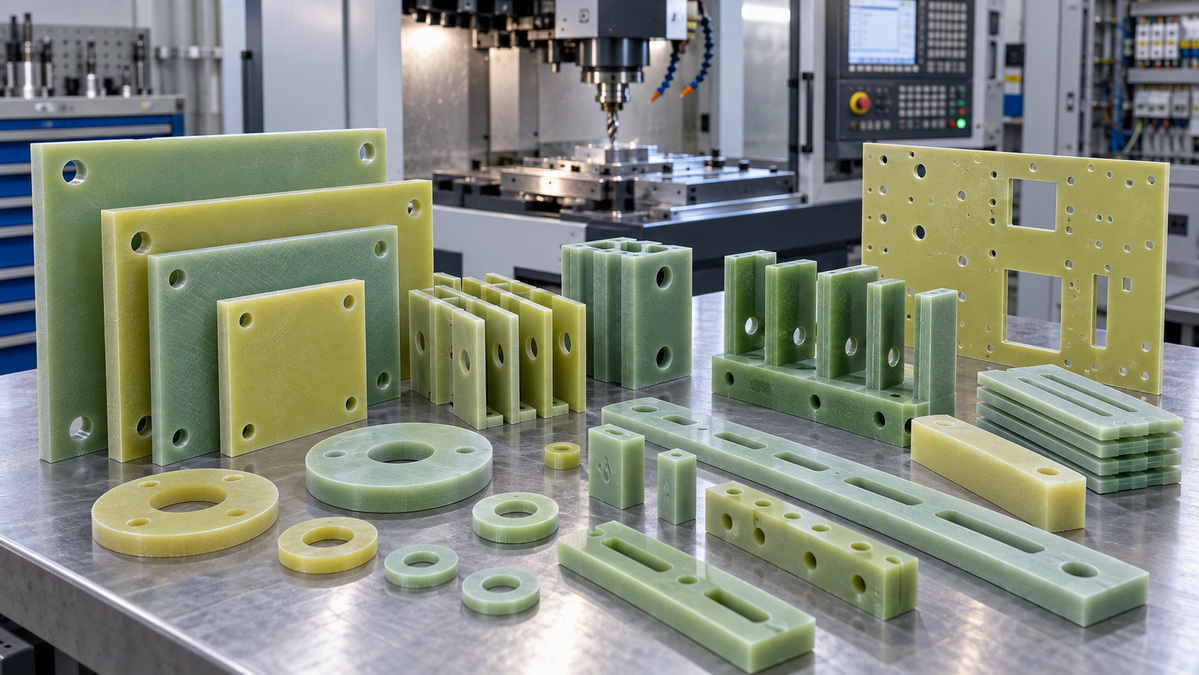
Custom epoxy fiberglass insulation components can include:
- Electrical insulation plates
- Busbar supports
- Terminal barriers
- Servo motor insulation panels
- CNC-machined brackets
- Precision spacers
- Robotic fixture components
- Tooling bases
- Insulation washers
- High-voltage support components
- Mold insulation parts
- Battery pack insulation structures
Custom processing can reduce internal production time, material waste, machining costs, and assembly variation.
Guangdong Weishi New Materials Co., Ltd. provides epoxy fiberglass sheets and custom-machined insulation components for industrial customers. Material selection can be based on application requirements including temperature, insulation performance, flame resistance, mechanical strength, thickness tolerance, and machining complexity.
The choice between a fiberglass laminate sheet and an epoxy board should be based on material structure and real operating conditions rather than product naming alone.
A fiberglass laminate sheet is usually reinforced with woven glass cloth, giving it stronger mechanical performance, higher rigidity, and better dimensional stability. A general epoxy board may offer suitable insulation performance, but its properties can vary depending on reinforcement, resin formulation, fillers, and manufacturing process.
For most high-speed automation equipment:
- FR4 is a balanced choice for electrical insulation, flame resistance, mechanical strength, and CNC machining.
- G10 is suitable for structural insulation and industrial fixtures when flame retardancy is not required.
- G11 is recommended for applications involving sustained elevated temperatures and demanding thermal conditions.
The most reliable approach is to define the material grade, electrical requirements, operating temperature, mechanical load, machining tolerance, and final application before selecting the material.
Guangdong Weishi New Materials Co., Ltd. supports global customers with high-performance FR4 sheets, G10 sheets, G11 sheets, epoxy fiberglass laminates, and customized insulation components designed for demanding industrial applications.
Not always. A fiberglass laminate sheet is generally reinforced with woven fiberglass cloth, while epoxy board is a broader term that can include reinforced or unreinforced epoxy products. FR4, G10, and G11 are commonly classified as both epoxy boards and fiberglass laminate sheets.
FR4 is generally better when flame resistance is required. It is widely used in electrical cabinets, power systems, control panels, and automation equipment. G10 is suitable for structural insulation and mechanical fixtures where flame retardancy is not a requirement.
G11 should be considered when the insulation component will operate in a higher-temperature environment. It is suitable for equipment near motors, transformers, heating zones, power modules, and high-current electrical systems.
Yes. FR4 sheets can be CNC machined into mounting plates, spacers, insulation barriers, terminal supports, electrical brackets, and complex industrial components. Proper tooling, dust extraction, feed rate, and workholding are important for high-quality results.
G10 is generally not specified as flame retardant in the same way as FR4. If flame performance is a project requirement, FR4 should be specified and verified before production.
Provide the material grade, sheet thickness, drawings, dimensions, operating temperature, voltage level, flame-retardant requirement, machining details, tolerances, quantity, and end-use application. This information helps ensure that the selected material matches the performance requirements.
In some applications, yes. Epoxy fiberglass laminate can replace metal where electrical insulation, corrosion resistance, reduced weight, and non-conductive support are required. The part should still be evaluated for load capacity, temperature exposure, fastening method, and dimensional requirements before replacement.
1. International Electrotechnical Commission. "IEC 60893-3-1: Industrial Rigid Laminated Sheets Based on Thermosetting Resins for Electrical Purposes."
2. Ready Plastics. "NEMA FR4 — Flame-Retardant Glass-Epoxy Laminate Specification."
3. Ready Plastics. "NEMA G11 — Glass-Cloth Epoxy High-Temperature Laminate."
4. ACC Insulations. "Glass Composite Sheets: G10, FR4 and G11 Epoxy Laminates."
[Glass Composite Sheet Properties]
5. ACC Insulations. "Fibre Glass Epoxy Laminates: FR4, G10 and G11 Technical Data."
[Epoxy Laminate Technical Information]
6. ACC Insulations. "FR4 Epoxy Laminate Sheet: EPGC 202 and UL 94 V-0."


