
Views: 276 Author: Weishi Sheets Publish Time: 2026-10-21 Origin: Site
Content Menu
● Mica Board vs Epoxy Glass Sheet: Quick Comparison
● What Are Mica Board and Epoxy Glass Sheet?
>> Mica Board: Mineral-Based High-Temperature Insulation
>> Epoxy Glass Sheet: Reinforced Structural Insulation
● Heat Resistance: Why Mica Often Leads Near the Heat Source
>> Compare Finished Materials, Not Mineral and Resin Headlines
>> Published Epoxy-Glass Data Illustrate the Grade Difference
● Thermal Insulation: Surviving Heat Is Not the Same as Blocking It
>> Ask for Direction-Specific Thermal Data
● Mechanical Strength and Machining: Where Epoxy Glass Adds Value
>> Mica Can Be Structural, but Details Matter
● Electrical Insulation and Flame Behavior
>> FR4 Flame Retardancy Does Not Establish Heat-Shield Capability
● A Hybrid Heat Shield Can Separate Conflicting Requirements
● Practical Selection Workflow for Industrial Heat Shields
>> Step 1: Define the Actual Exposure
>> Step 2: Define the Protected-Side Requirement
>> Step 3: Add Structural and Electrical Loads
>> Step 4: Compare Product-Specific Documents
>> Step 5: Test the Finished Assembly
● Illustrative Applications: Three Different Decisions
>> Heater-Facing Electrical Barrier
>> Warm Equipment Mounting Plate
>> Support Near Heated Tooling
● Cost Comparison: Evaluate the Finished Component
● Specify an Epoxy Glass Component for Your Application
>> Is mica board better than epoxy glass sheet for heat shields?
>> Can FR4 be used near a heater?
>> Is G11 more heat resistant than G10?
>> Which mica type is better for high-temperature insulation?
>> Can mica board and epoxy glass sheet be combined?
>> How thick should a heat shield be?
Choosing between mica board and epoxy glass sheet for heat shield applications starts with one question: must the material withstand intense heat, or provide structural support while electrically insulating a moderately heated assembly? Mica board usually deserves priority for the hot-facing barrier. Epoxy glass sheet, including FR4, G10, and G11, often makes more sense for precision-machined supports operating within a verified temperature range.
The distinction matters because heat resistance, thermal insulation, flame retardancy, and mechanical strength describe different requirements. A material can perform well in one category without meeting the others.
From a manufacturing perspective, my selection principle is straightforward: temperature establishes the shortlist; structural, electrical, and fabrication requirements determine the final choice.
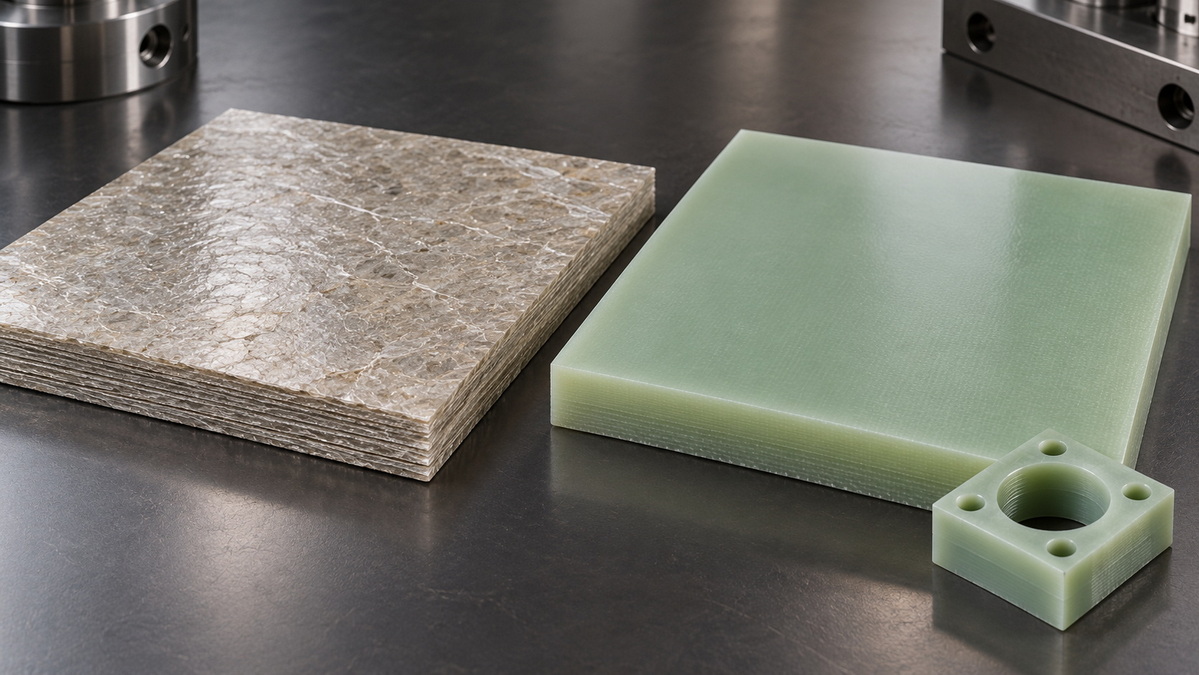
Neither material is universally superior. Their advantages depend on the temperature at the component, exposure duration, load, and assembly design.
| Selection factor | Mica board | Epoxy glass sheet |
|---|---|---|
| Basic construction | Mica layers or mica paper consolidated with a binder | Woven glass fabric consolidated with epoxy resin |
| Main advantage | High-temperature electrical insulation and thermal protection | Combined structural strength and electrical insulation |
| Relevant varieties | Muscovite, phlogopite, rigid and flexible grades | G10, FR4, G11; other qualified formulations |
| Hot-facing heat shield | Usually the stronger starting candidate | Requires careful temperature verification |
| Precision support component | Possible, depending on grade and geometry | Often well suited to machined structural parts |
| Main selection limitation | Binder, brittleness, fastening, and grade-dependent properties | Resin temperature limits and retained strength under heat |
| Typical design role | Barrier near the heat source | Insulating support farther from the heat source |
Treat this table as a selection framework, not a substitute for product-specific test data.
Mica board is a manufactured insulation material, not simply a block of natural mica. Commercial sheets can contain mica paper or mineral layers consolidated with a binder.
Two important varieties are:
- Muscovite mica, valued for its electrical insulation properties.
- Phlogopite mica, commonly considered for more demanding high-temperature applications.
Rigid and flexible products serve different purposes. A rigid heater plate, flexible separator, and reinforced mica barrier should not be treated as interchangeable.
The binder also matters. Mineral temperature resistance alone does not establish the continuous operating capability of the finished board.
Epoxy glass sheet combines glass fabric with cured epoxy resin. This construction provides electrical insulation alongside useful mechanical properties.
For industrial procurement, distinguish the grades:
- G10: glass-epoxy laminate used for structural electrical insulation.
- FR4: flame-retardant glass-epoxy laminate.
- G11: glass-epoxy laminate associated with higher-temperature performance.
FR4 and G10 are frequently grouped commercially, but their designations are not identical. Likewise, a G11 sheet should not automatically be assigned the flame-retardancy characteristics of FR4 or FR5.
Guangdong Weishi New Materials Co., Ltd. focuses on these epoxy-glass material families and customized processing. Selection should nevertheless begin with application requirements rather than a preference for a particular product.
The most misleading comparison places the highest advertised mica temperature beside a generic epoxy operating temperature.
Those figures may describe different conditions:
- Continuous service versus brief exposure.
- Mineral stability versus finished-board performance.
- Unloaded specimens versus loaded components.
- Fire exposure versus normal equipment operation.
Mica-based products are used in heaters, furnaces, and specialized thermal barriers. However, a high-temperature mineral does not make every mica laminate suitable for the same environment. Binder chemistry and construction remain important.
For epoxy glass sheet, the resin system is a major temperature constraint. Glass reinforcement does not remove that limitation.
Acculam's comparative chart reports the following temperature indices for listed sheets at thicknesses of 0.062 inch and above:
| Listed material category | Electrical temperature index | Mechanical temperature index |
|---|---|---|
| G10/FR4 | 130°C | 140°C |
| G11/FR5 | 170°C | 180°C |
These are manufacturer-published values for the listed materials, not universal limits for every supplier's laminate.
They also are not permission to operate an assembly continuously at the stated temperature. Designers must consider loading, electrical stress, thickness, aging, and the actual product qualification.
The practical lesson: G11 may extend the available operating range, but it does not turn epoxy glass into a substitute for a furnace-facing mica barrier.
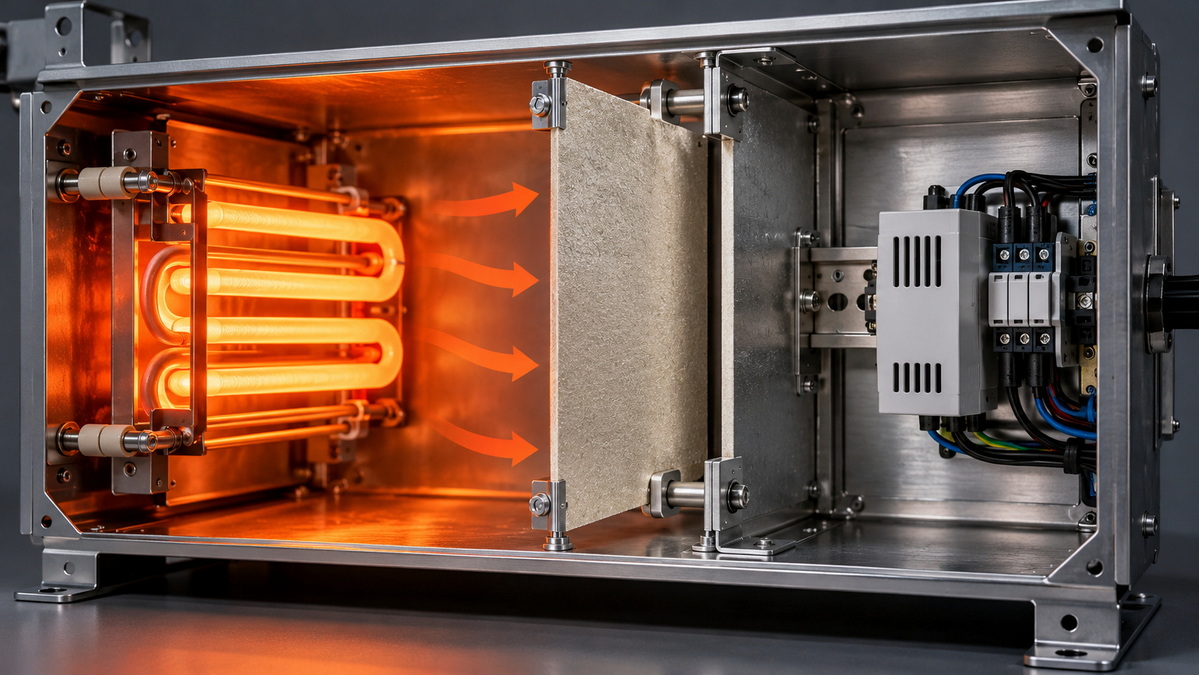
A heat shield has two separate jobs:
1. Remain functional under exposure.
2. Limit the temperature rise of the protected component.
A board may survive heat while still allowing too much energy to reach the cold side.
This relationship is useful, but it does not describe the entire assembly. Radiation, airflow, contact pressure, joints, and metal fasteners can change performance.
Both materials have layered structures. Request conductivity data that match the direction of heat flow, particularly through the thickness.
Also check:
- Measurement temperature.
- Material grade and binder.
- Density and thickness.
- Test method.
- Whether values describe a finished board or a constituent material.
Without comparable data, claiming that one sheet provides a specific percentage improvement would be unreliable.
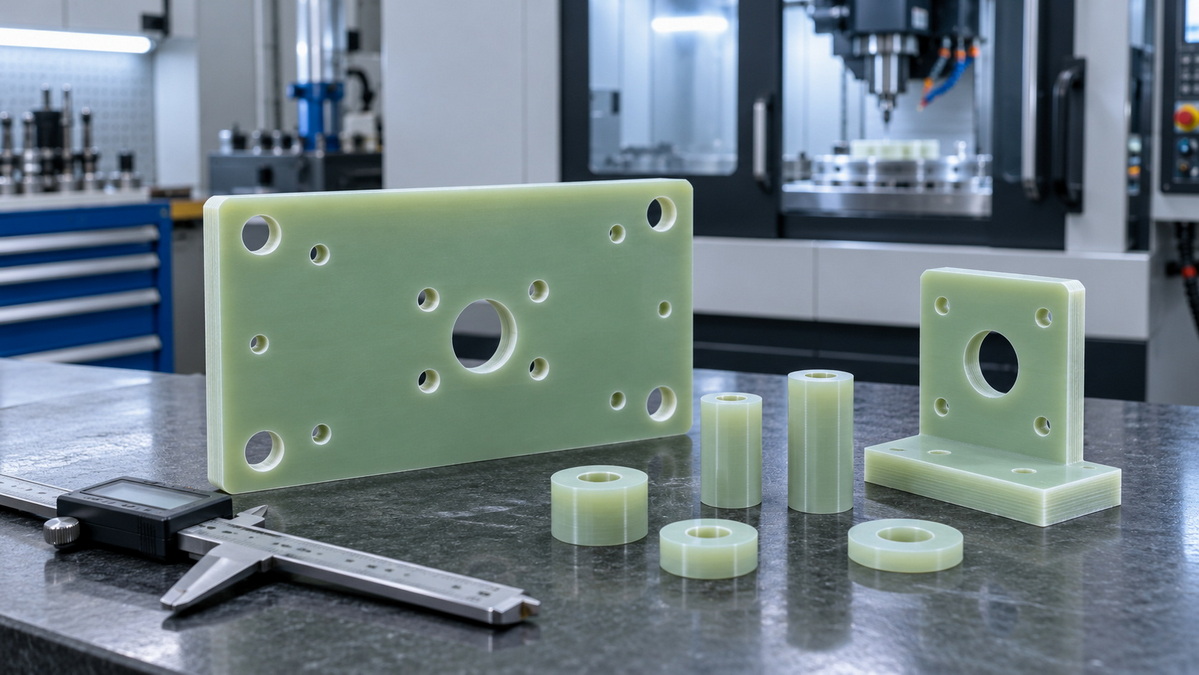
Epoxy glass deserves particular consideration when a component must provide insulation while carrying mechanical loads.
Examples include:
- Equipment mounting plates.
- Machined spacers and supports.
- Electrical isolation brackets.
- Fixtures with controlled hole positions.
- Insulating components near heated tooling.
Acculam's chart lists different lengthwise and crosswise mechanical values. That distinction highlights an important design point: laminate direction can affect performance.
Room-temperature strength, however, does not prove adequate strength during heated operation.
Rigid mica boards can offer useful mechanical properties. Nevertheless, thin edges, small holes, concentrated clamp loads, and unsupported spans require grade-specific evaluation.
For either material, review:
- Hole-to-edge distance.
- Washer size and fastening pressure.
- Unsupported span.
- Thermal expansion accommodation.
- Strength after repeated heating.
A structurally impressive material is not a good choice if the joint damages it during assembly.
Both material families can provide electrical insulation. The right comparison must reflect the operating environment.
Ask whether insulation performance must remain acceptable after:
- Humidity exposure.
- Thermal aging.
- Surface contamination.
- Repeated heating and cooling.
- Mechanical loading.
Dielectric strength is not the same as a safe working voltage for an installed component. Geometry, creepage, clearance, and surface condition also require assessment.
Flame retardancy and continuous heat resistance answer different questions.
An FR4 sheet may resist flame propagation under a specified test while remaining unsuitable for prolonged exposure to a much hotter surface.
Similarly, a mica-based fire barrier still needs verification for its complete construction, including binder, backing, joints, and fastening.
Avoid approving either material on a single label such as "fireproof," "high temperature," or "excellent insulation."
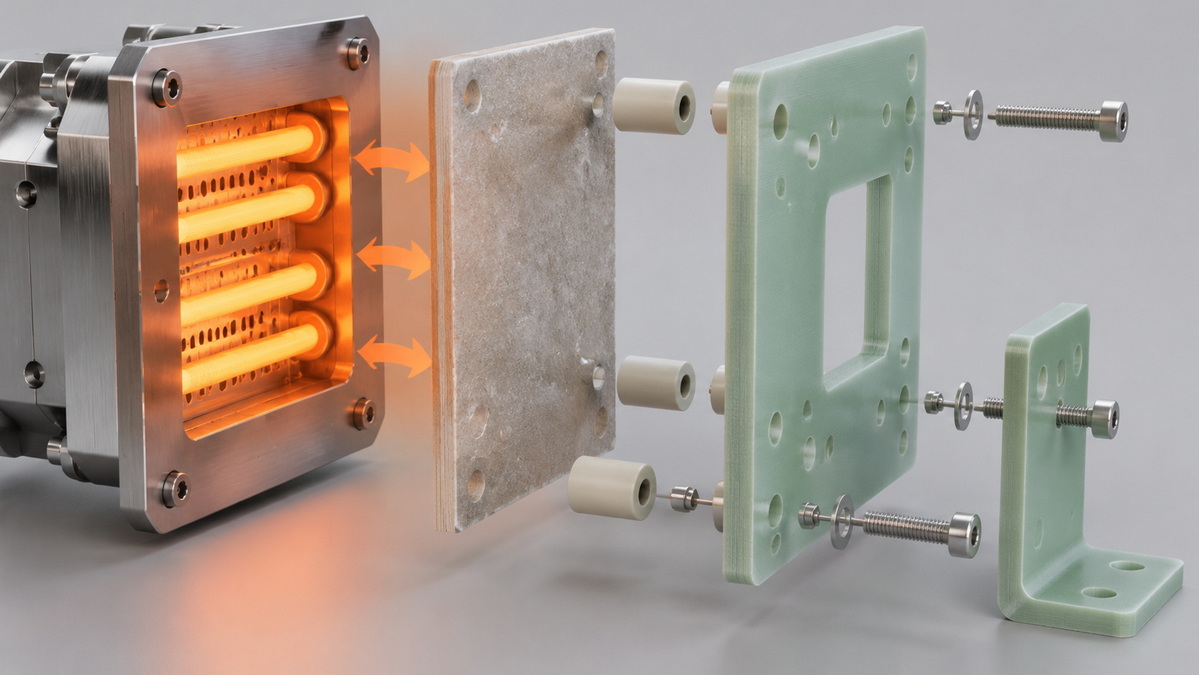
Sometimes the better solution is not mica board versus epoxy glass sheet, but a carefully qualified combination.
Consider this proposed arrangement:
1. A suitable mica barrier faces the heat source.
2. A designed separation limits heat reaching the support.
3. An epoxy-glass component provides mounting geometry and electrical isolation.
4. Fasteners are evaluated for unwanted heat conduction.
This approach separates thermal protection from structural support.
It is a design concept, not a guaranteed result. The epoxy-glass component must remain within its validated operating envelope during normal use and foreseeable abnormal conditions.
Also investigate adhesives and interlayers. A weak bond or unsuitable adhesive can undermine otherwise appropriate materials.
Record the conditions at the material, not only the heater setting:
- Normal operating temperature.
- Peak temperature and duration.
- Heating and cooling frequency.
- Contact, radiant, or convective exposure.
- Startup, shutdown, and fault conditions.
A nearby heater's rated temperature does not establish the temperature of a shield mounted elsewhere.
Specify the maximum acceptable temperature behind the shield.
This shifts the question from "Will the board survive?" to "Will the assembly protect the component?"
Document clamping, bending, vibration, operating voltage, humidity, and contamination.
These requirements help determine whether the barrier can also serve as the support.
Request:
- Exact grade and construction.
- Continuous-use and short-exposure data.
- Temperature-dependent mechanical properties.
- Relevant electrical test results.
- Thermal conductivity under applicable conditions.
- Available thicknesses and machining tolerances.
Measure hot-side and cold-side temperatures over representative cycles.
Inspect joints, edges, holes, and material condition. Where electrical insulation matters, evaluate it after exposure as well as before.
The following scenarios illustrate selection logic; they are not reported customer projects.
A plate installed close to a heating element must tolerate substantial exposure while maintaining electrical isolation.
Start with a suitable mica grade. Verify binder performance, fastening, and protected-side temperature.
Standard FR4 should not be the default simply because it is electrically insulating.
A support in a moderately heated enclosure needs accurate holes, stiffness, and electrical isolation.
An appropriate epoxy glass sheet may offer the better balance. Confirm measured component temperature and retained properties.
A tooling assembly combines local hot spots with structural loading.
Evaluate a higher-temperature epoxy-glass grade where appropriate, but do not assume G11 automatically solves the problem. A separate mica barrier may help isolate the support.
Raw sheet price is only one part of the purchasing decision.
Compare total costs for:
- Material yield.
- Machining and handling.
- Assembly complexity.
- Inspection and qualification.
- Replacement frequency.
- Equipment downtime.
An inexpensive sheet can become costly if it requires a complicated support system. Conversely, a machinable laminate is poor value if heat exposure causes premature replacement.
Ask suppliers to quote against the same drawing, operating conditions, and acceptance criteria.
For projects requiring FR4, G10, G11, or customized epoxy-glass parts, contact Guangdong Weishi New Materials Co., Ltd. with:
- Your drawing or dimensions.
- Required thickness and tolerances.
- Measured operating and peak temperatures.
- Electrical insulation requirements.
- Mechanical loads and fastening details.
- Quantity and relevant testing requirements.
Request a grade-specific datasheet and application review before placing a production order. If exposure exceeds the proposed laminate's capability, evaluate a qualified mica barrier or redesigned assembly rather than forcing an unsuitable material into service.
Mica is generally the stronger starting candidate for high-temperature barriers. Epoxy glass often provides a better combination of structural support, machining flexibility, and electrical insulation at suitable temperatures.
Potentially, but only when its actual temperature and exposure conditions remain within the selected product's verified capability. Proximity alone is insufficient for approval.
Published comparative data support higher temperature indices for the listed G11 materials. Obtain the selected supplier's data before assigning operating limits.
Phlogopite is commonly considered for higher-temperature duties. Muscovite offers strong electrical insulation characteristics. The finished board's binder and construction remain decisive.
Yes, as a qualified assembly. Mica can provide the hot-facing barrier while epoxy glass supplies structural support, provided testing confirms acceptable temperatures and joint performance.
There is no universal thickness. Specify heat exposure, protected-side temperature, conductivity, geometry, and structural requirements, then validate the proposed assembly.
1. [Elmelin — "Mica in Sheets: Phlogopite Mica vs Muscovite Mica"]. Supports mica varieties, rigid and flexible constructions, binders, electrical-property distinctions, and industrial applications. [elmelin]
2. [Acculam — "Sheet Comparative Data Chart"]. Source of the temperature-index table and directional mechanical-property discussion. Values describe the listed materials and conditions, not Guangdong Weishi products. [acculam]
3. [Acculam — Industrial Thermoset Laminate Product Overview]. Supports glass-epoxy construction and combined structural and electrical insulation functions. [acculam]
4. [Elmelin — "Muscovite and Phlogopite Mica: The Elmelin Application"]. Supports distinctions between mica varieties and their furnace and electrical applications. [elmelin]
5. [ELANTAS — "Composites for Aerospace & Ballistic"]. Supports the use of engineered mica-based systems in thermal protection and fire-resistant barriers; specialized system ratings should not be generalized to ordinary boards. [elantas]


