

Views: 239 Author: Weishi Sheets Publish Time: 2026-10-09 Origin: Site
Content Menu
● What Is FR4 Fiberglass Sheet?
● What Is an Epoxy Laminate Sheet?
● FR4 Fiberglass Sheet vs Epoxy Laminate Sheet
● Why Cleanroom Equipment Requires Careful Material Selection
● Particle Control and Surface Quality
● When FR4 Fiberglass Sheet Is the Better Choice
>> Electrical Insulation Components
>> Precision-Machined Fixtures
>> Flame-Retardant Equipment Areas
● When Another Epoxy Laminate Sheet May Be Better
>> G10 for Standard Glass Epoxy Insulation
>> G11 for Higher-Temperature Applications
>> Customized Epoxy Laminate Sheets
● ESD Requirements: Insulation Is Not Static Control
● Chemical Resistance and Cleaning Compatibility
● Practical Material Selection Process
>> Step 1: Define the Part Function
>> Step 2: Define the Operating Environment
>> Step 3: Specify Measurable Requirements
>> Step 4: Review the Finished-Part Design
>> Step 5: Validate Samples Before Volume Production
● Manufacturing Factors That Influence Final Performance
● FAQ
Choosing between FR4 fiberglass sheet and an epoxy laminate sheet for cleanroom equipment is not simply a matter of selecting an insulating board. The right material affects electrical safety, particle control, machining accuracy, chemical resistance, thermal stability, maintenance cycles, and long-term equipment reliability.
For many cleanroom fixtures, FR4 fiberglass sheet is a dependable starting point. It offers strong electrical insulation, stable mechanical performance, and flame-retardant properties. However, "epoxy laminate sheet" is a broader category. It may include FR4, G10, G11, and customized glass epoxy composites with different heat resistance, flame behavior, surface quality, and fabrication characteristics.
For equipment manufacturers, cleanroom integrators, and industrial buyers, the most reliable decision comes from evaluating the finished component rather than selecting material by name alone. The material grade, thickness, machining quality, edge condition, cleaning method, ESD design, and packaging standard must work together.
Guangdong Weishi New Materials Co., Ltd. supplies high-performance epoxy insulation boards, including FR4 fiberglass sheets, G10 sheets, G11 sheets, and customized epoxy composite components. With stable material quality, advanced production processes, and flexible precision machining capabilities, we help global customers build insulation solutions for electronics, electrical equipment, mechanical processing, mold manufacturing, and industrial machinery.
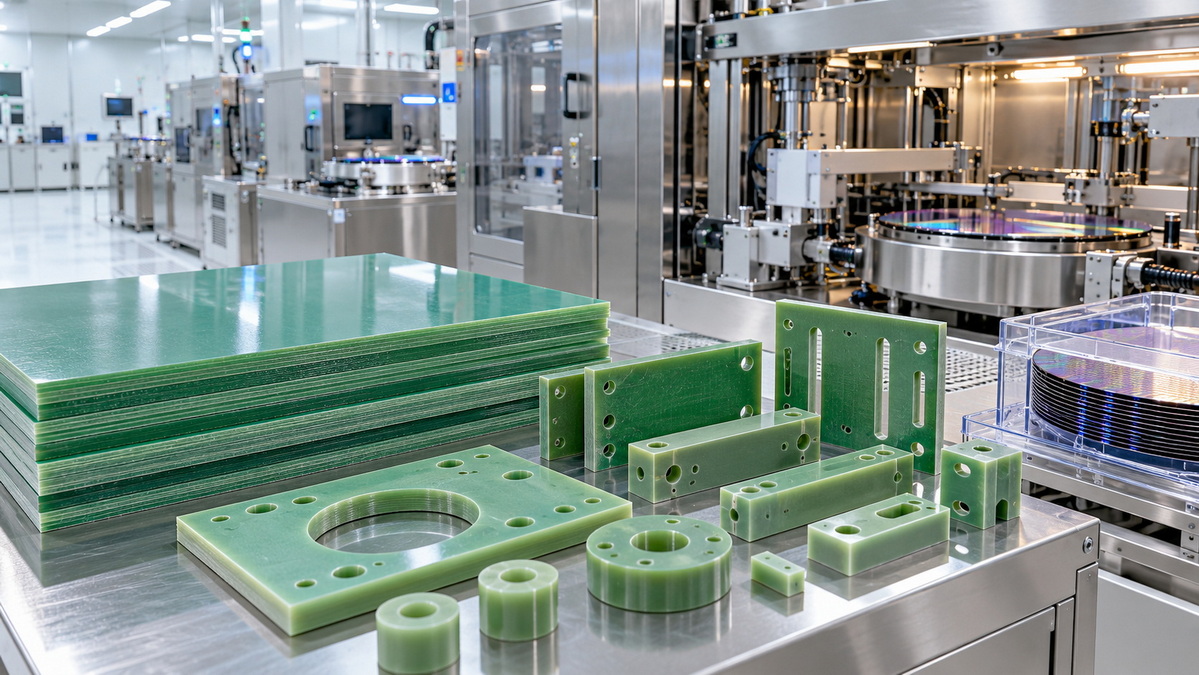
FR4 fiberglass sheet is a rigid, glass-fabric-reinforced epoxy laminate. It is manufactured by impregnating woven fiberglass cloth with epoxy resin, stacking multiple layers, and curing them under controlled heat and pressure.
The "FR" in FR4 generally refers to flame retardancy. Compared with standard glass epoxy laminates, FR4 is widely selected where electrical insulation and flame performance are both important.
FR4 fiberglass sheet is widely used in:
- Electrical insulation barriers
- PCB manufacturing and assembly fixtures
- High-voltage insulation parts
- Terminal boards
- Transformer components
- Test jigs and functional test fixtures
- Automation equipment supports
- CNC-machined brackets and spacers
- Precision industrial tooling
- Cleanroom equipment components
Its structure gives it a practical combination of high mechanical strength, good dielectric properties, low moisture absorption, and reliable machinability.
For cleanroom equipment, FR4 is especially useful when a part must remain rigid, electrically insulating, and dimensionally stable during assembly, routine cleaning, and long-term industrial operation.
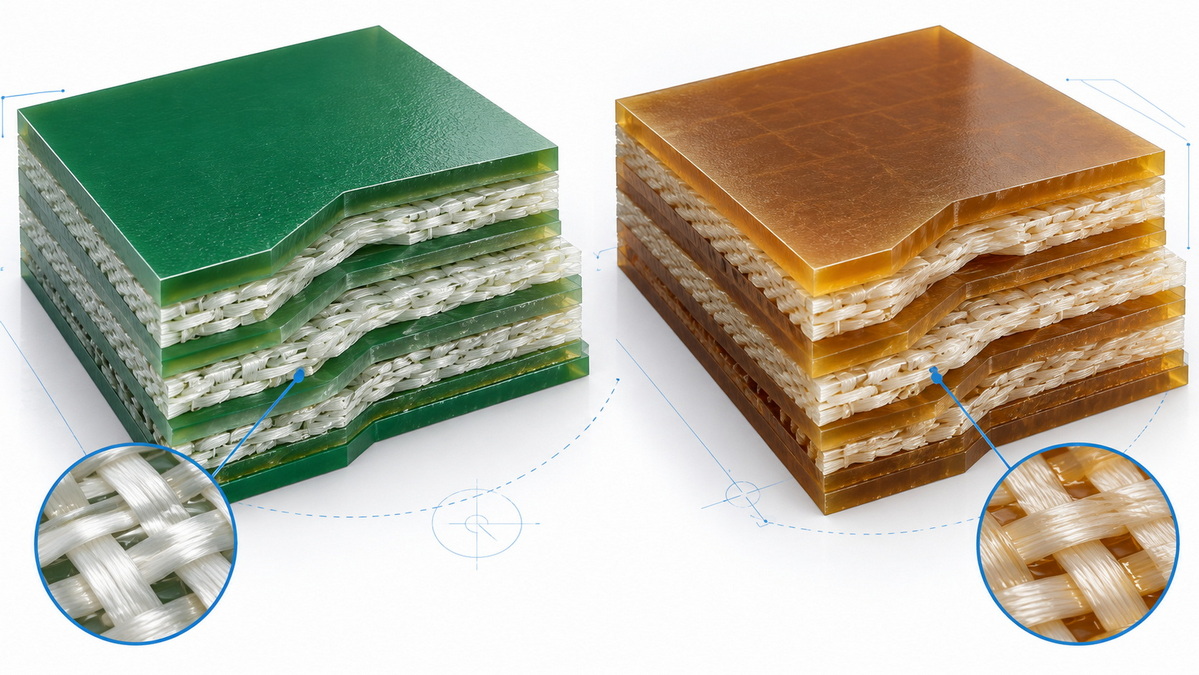
An epoxy laminate sheet is a broad category of composite insulation material made from epoxy resin and a reinforcing substrate. The reinforcement may include woven fiberglass cloth, paper, cotton fabric, or other engineered materials.
In practical industrial sourcing, epoxy laminate sheet may refer to several grades:
- FR4 sheet: Flame-retardant fiberglass epoxy laminate
- G10 sheet: Non-flame-retardant fiberglass epoxy laminate
- G11 sheet: Higher-temperature fiberglass epoxy laminate
- Glass epoxy laminate: A general term for fiberglass-reinforced epoxy insulation boards
- Customized epoxy composite sheet: A material developed for specific thermal, electrical, mechanical, or processing needs
This means that FR4 is an epoxy laminate sheet, but not every epoxy laminate sheet is FR4.
That difference is important for cleanroom equipment procurement. A supplier may offer epoxy laminate sheets with different resin formulations, reinforcement structures, flame ratings, thickness tolerances, surface finishes, and temperature capabilities. Buyers should always confirm the actual material grade and performance data before ordering.
The following table compares FR4 fiberglass sheet with the broader epoxy laminate sheet category for cleanroom equipment manufacturing.
| Selection Factor | FR4 Fiberglass Sheet | Epoxy Laminate Sheet |
|---|---|---|
| Material definition | A defined flame-retardant glass epoxy laminate grade | A broad category that may include FR4, G10, G11, and customized epoxy composites |
| Main reinforcement | Usually woven fiberglass cloth | Fiberglass, paper, cotton fabric, or other reinforcement structures |
| Resin system | Flame-retardant epoxy resin | Standard epoxy, high-temperature epoxy, flame-retardant epoxy, or customized resin systems |
| Flame performance | Commonly selected for flame-retardant applications | Depends on the specific grade and resin formulation |
| Electrical insulation | Excellent for electrical barriers, terminal supports, and insulation fixtures | Varies depending on grade, thickness, resin system, and reinforcement |
| Mechanical strength | High rigidity and strong load-bearing capability | Can range from moderate to very high |
| Heat resistance | Suitable for many medium-temperature industrial applications | May offer standard, high-temperature, or specialized thermal performance |
| Moisture resistance | Generally low moisture absorption | Depends on laminate grade and reinforcement material |
| Machinability | Suitable for CNC routing, drilling, milling, punching, and waterjet cutting | Varies according to material structure and resin formulation |
| ESD behavior | Normally insulating unless part of a designed ESD-control system | Can be insulating, static-dissipative, or conductive depending on the engineered formulation |
| Cleanroom suitability | Suitable when machined, cleaned, and finished correctly | Suitable when the material is selected and processed for the exact cleanroom environment |
| Typical use | Electrical insulation parts, fixture plates, spacer blocks, test jigs, mounting panels | Custom cleanroom components requiring specialized thermal, mechanical, electrical, or chemical performance |
The most important takeaway is simple: FR4 provides a strong all-round performance profile, while epoxy laminate sheet provides a wider material-selection range for specialized applications.
A cleanroom is designed to control contamination. The environment may regulate airborne particles, humidity, temperature, electrostatic charge, pressure differentials, and chemical exposure.
Materials used inside cleanroom equipment should be evaluated for more than basic strength. They should support stable operation without becoming a source of particles, fibers, residues, chemical degradation, or electrostatic risk.
Key material-selection concerns include:
- Particle generation
- Surface cleanliness
- Chemical compatibility
- Electrostatic discharge control
- Thermal stability
- Mechanical durability
- Dimensional accuracy
- Edge finish
- Cleaning resistance
- Packaging quality
A material with good electrical insulation may still be unsuitable if rough machining edges release fibers. A mechanically strong sheet may still create problems if repeated cleaning chemicals cause surface damage. A highly insulating component may also be the wrong choice if the application requires controlled static dissipation.
For this reason, the finished cleanroom part should be treated as a complete engineering solution rather than a simple cut piece of board.
Particle control is one of the most important considerations in cleanroom equipment design. Fiberglass-reinforced epoxy materials can perform reliably, but the finished part must be processed correctly.
A smooth sheet surface alone does not guarantee cleanroom suitability. Particle-release risk may increase when a part has rough edges, exposed fibers, poorly drilled holes, damaged corners, or abrasive contact with nearby components.
Common causes of contamination risk include:
- Unfinished CNC-routed edges
- Fiberglass fibers exposed after cutting
- Burrs around drilled or punched holes
- Rough slots and sharp corners
- Residual machining dust
- Surface scratches from handling
- Incompatible adhesive labels
- Abrasion against metal guide rails
- Cracked or delaminated laminate surfaces
- Inadequate cleaning before packaging
For cleanroom equipment, buyers should consider specifying:
- Rounded external corners
- Deburred holes
- Smooth milled edges
- Controlled drilling procedures
- Surface cleaning before shipment
- Protective packaging
- Reduced fiber exposure
- Separate packaging for precision parts
- Custom labeling outside the primary protective bag
These small manufacturing details can make a major difference in the final cleanliness and service life of the equipment.

FR4 fiberglass sheet is often the preferred option when the equipment requires stable electrical insulation, structural strength, and flame-retardant performance.
FR4 is highly suitable for cleanroom equipment components that must prevent electrical current flow between conductive parts.
Common examples include:
- Insulation panels
- Terminal supports
- High-voltage barriers
- Electrical mounting plates
- Sensor brackets
- Busbar supports
- Insulated standoffs
- PCB assembly fixtures
- Control cabinet insulation components
- Test and inspection jigs
Its fiberglass-reinforced structure helps it withstand mechanical loads better than many unreinforced plastic insulation materials.
FR4 is widely used for custom-machined components because it can be processed into detailed shapes with CNC equipment.
Typical machined FR4 parts include:
- Drilled mounting panels
- Slotted guide plates
- Insulating washers
- Spacer blocks
- Jig plates
- Custom brackets
- Alignment templates
- Component holders
- Electrical isolation pads
- Fixture bases
For parts with tight tolerances, stable sheet quality and controlled machining are essential. Variations in thickness, flatness, hole position, or surface finish can affect assembly accuracy and equipment repeatability.
FR4 is a practical choice when a project requires flame-retardant insulation material near electrical control equipment, power assemblies, heating components, or energized systems.
Buyers should confirm the actual flame-performance requirement before making a final selection. The requested material documentation may include flame rating, insulation properties, thermal performance, or traceability records.
A clear specification reduces the risk of receiving a visually similar green fiberglass board that does not meet the required grade.
FR4 is a versatile material, but it is not the only option. A different epoxy laminate grade may better suit applications with unique heat, chemical, mechanical, or electrical requirements.
G10 is a fiberglass-reinforced epoxy laminate that is often used for electrical insulation and mechanically stable components. It can be suitable for cleanroom fixtures, support parts, and precision-machined industrial components where flame retardancy is not the main requirement.
G10 may be considered for:
- General-purpose insulation structures
- Mechanical support plates
- Machined spacers
- Tooling boards
- Non-flame-retardant fixture components
- Stable guide and alignment parts
However, G10 should not be used as a direct replacement for FR4 when the project explicitly requires flame-retardant performance.
G11 is generally selected for applications requiring better elevated-temperature performance than standard FR4 or G10.
It may be more suitable for:
- Heated fixture bases
- High-temperature electrical supports
- Thermal insulation parts
- Equipment exposed to repeated heat cycles
- Industrial components near heating zones
- Insulated parts in elevated-temperature process equipment
For cleanroom equipment operating near heat sources, buyers should evaluate actual working temperature, exposure duration, mechanical load, and thermal cycling frequency. The material should be selected based on validated performance rather than a general grade description.
A customized epoxy laminate solution may be the best choice when standard FR4, G10, or G11 dimensions do not fully meet the project requirements.
Customized options may include:
- Non-standard thicknesses
- Large-format sheets
- Special colors
- Specific flatness requirements
- Custom resin systems
- Customized glass-cloth structures
- Low-halogen material options
- Non-brominated resin options
- Precision-machined finished components
- Special packaging requirements
- Application-specific mechanical properties
For global equipment manufacturers, sourcing custom-machined components from one supplier can simplify procurement, reduce rework, and improve consistency across repeated production runs.
A common misunderstanding is that electrically insulating materials automatically protect sensitive electronic parts from electrostatic discharge.
This is not always true.
Standard FR4 and many glass epoxy laminate sheets are electrical insulators. They resist the flow of electrical current. However, they may also allow static charge to accumulate on the surface under certain conditions.
In electronics, semiconductor, battery, and precision-assembly cleanrooms, static electricity can damage sensitive components or create process instability. The correct material choice depends on whether the component must be:
- Electrically insulating
- Static-dissipative
- Conductive
- Grounded as part of an equipment system
- Protected by a dedicated ESD-control design
For example, an FR4 insulation plate may be appropriate for an electrical barrier inside a control system. However, a surface that directly supports electrostatic-sensitive components may require a static-dissipative material, a conductive layer, or a grounded fixture design.
Before selecting FR4 or another epoxy laminate sheet, evaluate the full equipment assembly rather than the material in isolation.
1. Will the part be used inside an electrostatic protected area?
2. Will it touch ESD-sensitive electronic devices?
3. Is the part a fixed insulator, a tray, a guide rail, a work surface, or a moving fixture?
4. Does the assembly include a grounding path?
5. Is controlled surface resistance required?
6. Can friction between parts generate static charge?
7. Does the customer require ESD testing or documentation?
8. Will the material be combined with conductive metals, coatings, or polymers?
A complete ESD strategy should include material selection, grounding design, environmental control, work procedures, and equipment validation.
Cleanroom equipment is frequently exposed to cleaning procedures. Depending on the industry, surfaces may be wiped with isopropyl alcohol, disinfectants, detergents, hydrogen peroxide solutions, or other approved cleaning agents.
The correct epoxy laminate sheet should resist the intended cleaning process without cracking, swelling, delaminating, discoloring, or losing mechanical performance.
Before finalizing a material, review:
- Type of cleaning chemical
- Chemical concentration
- Contact time
- Cleaning frequency
- Surface temperature during cleaning
- Mechanical wiping pressure
- Exposure to oils or process fluids
- Required visual appearance after cleaning
- Surface-residue requirements
Chemical compatibility should be tested under realistic use conditions. A material may tolerate occasional short-term exposure but show deterioration after repeated wipe cycles or long-term contact.
For critical equipment, a prototype cleaning test can help identify potential issues before volume production.
The best way to select a cleanroom insulation material is to begin with the final part and application environment.
Identify what the component must do.
Common functions include:
- Electrical isolation
- Mechanical support
- Thermal insulation
- PCB positioning
- Sensor mounting
- High-voltage separation
- Component alignment
- Fixture guidance
- ESD management
- Structural spacing
A material grade should support the required function, not simply match a familiar product name.
Document the real service conditions:
- Cleanroom classification
- Industry application
- Working temperature
- Relative humidity
- Cleaning procedures
- Chemical exposure
- Mechanical loading
- Vibration
- ESD requirements
- Airflow conditions
- Expected service life
This information helps determine whether standard FR4 is sufficient or whether G10, G11, or a customized epoxy laminate is more appropriate.
Avoid vague specifications such as "green epoxy board" or "FR4-like material."
Instead, define:
- Material grade
- Thickness
- Sheet size
- Thickness tolerance
- Flatness requirement
- Flame-retardant requirement
- Thermal performance
- Electrical insulation requirement
- ESD performance requirement
- Surface condition
- Machining tolerance
- Hole diameter and position tolerance
- Chemical compatibility requirement
- Packaging requirement
- Documentation requirement
Clear specifications improve quote accuracy and reduce production risk.
The part geometry can influence material performance.
For example:
- Narrow sections may flex under load
- Small holes may require special drilling control
- Deep slots may increase machining time
- Sharp inside corners may concentrate stress
- Thin walls may chip during handling
- Unsealed edges may be more vulnerable to abrasion
- Large flat panels may require flatness control
An experienced manufacturer can review the design and recommend practical adjustments before production begins.
For high-value or high-cleanliness projects, sample validation is strongly recommended.
Typical checks may include:
- Dimensional inspection
- Flatness inspection
- Hole-location verification
- Visual surface inspection
- Edge-finish review
- Assembly-fit testing
- Cleaning-cycle testing
- Chemical exposure testing
- Thermal cycling
- Mechanical loading
- ESD evaluation
- Packaging inspection
This process helps prevent costly changes after equipment installation.
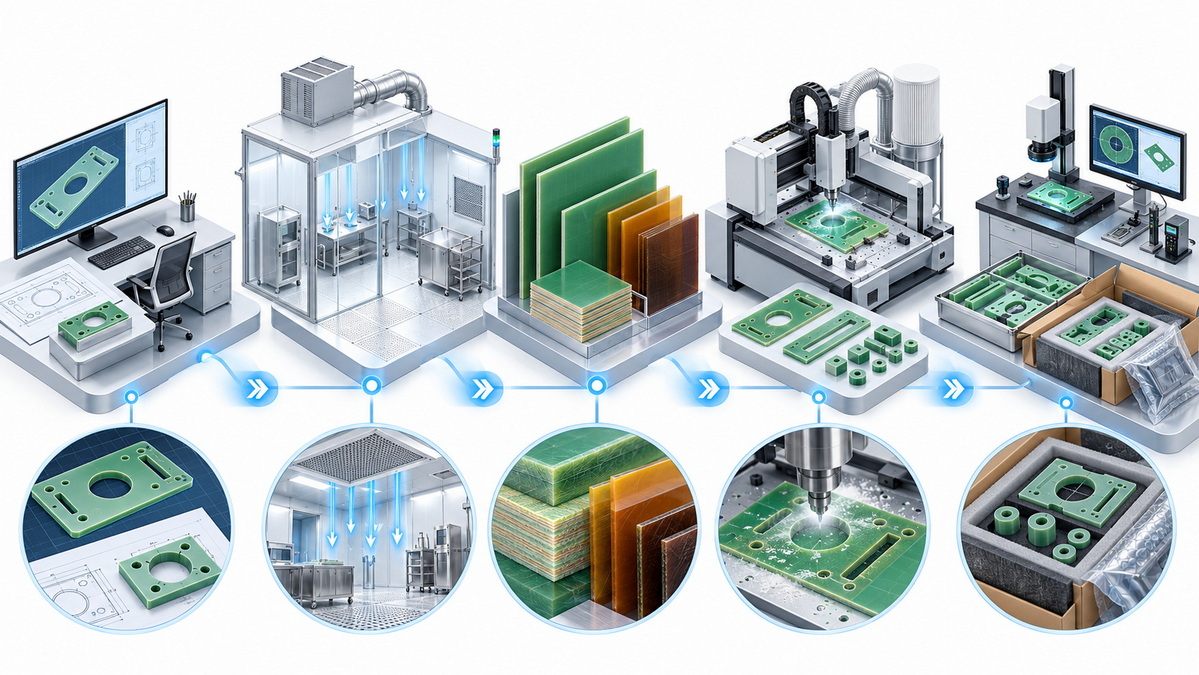
For cleanroom equipment, raw material quality is important, but manufacturing quality often determines how well the final component performs.
A high-quality FR4 sheet may still cause problems if the finished part has rough edges, residual machining dust, exposed glass fibers, poor tolerances, or unsuitable packaging.
Important manufacturing controls include:
| Manufacturing Factor | Importance for Cleanroom Equipment |
|---|---|
| Material grade consistency | Supports stable electrical, mechanical, and thermal performance |
| Thickness control | Helps ensure accurate assembly and reliable spacing |
| Flatness control | Important for large fixture plates and precision mounting surfaces |
| CNC machining accuracy | Supports repeatable hole positions, slots, contours, and assembly fit |
| Edge finishing | Reduces burrs, sharp corners, and fiber-release risk |
| Dust removal | Helps reduce machining residue before final packing |
| Surface inspection | Identifies scratches, chips, delamination, and visible defects |
| Chemical review | Reduces the chance of surface damage during routine cleaning |
| Custom packaging | Helps protect precision parts during transport and storage |
| Lot traceability | Supports quality consistency for repeat orders |
Guangdong Weishi New Materials Co., Ltd. supports customers with epoxy fiberglass sheets and custom-machined insulation components. Our production capability can support raw material supply, CNC processing, drilled parts, milled parts, insulation strips, spacer blocks, fixture plates, and application-specific components.
FR4 fiberglass sheet and epoxy laminate sheet are closely related materials, but they should not be treated as identical choices for cleanroom equipment.
FR4 fiberglass sheet is usually the preferred option when the project requires flame-retardant performance, electrical insulation, mechanical strength, stable machining, and reliable industrial durability. It is well suited for insulation plates, terminal supports, test fixtures, mounting panels, high-voltage barriers, and custom-machined cleanroom equipment parts.
A broader epoxy laminate sheet solution may be better when the project requires higher-temperature performance, customized dimensions, specialized resin chemistry, specific ESD behavior, alternative flame characteristics, or unique mechanical requirements. G10 may suit standard glass epoxy applications, while G11 may be the better choice for elevated-temperature conditions.
The most effective material specification considers the entire application: material grade, operating temperature, electrical requirements, ESD strategy, cleaning process, chemical exposure, machining tolerance, edge finish, packaging, and validation requirements.
For cleanroom equipment projects requiring FR4, G10, G11, or customized epoxy laminate components, Guangdong Weishi New Materials Co., Ltd. can provide stable material solutions and precision processing support based on your drawings, operating conditions, and technical requirements.
An FR4 fiberglass sheet is a specific type of glass-reinforced epoxy laminate made from woven fiberglass and a flame-retardant epoxy resin. “Epoxy laminate sheet” is a broader term that does not, by itself, identify the reinforcement, material grade, or flame-retardant performance. For example, both G10 and FR4 are glass-epoxy laminates, but G10 does not provide the same flame resistance as FR4. When comparing materials for cleanroom equipment, check the exact grade and supplier specifications rather than relying on the product name alone.
FR4 fiberglass sheets can be considered for insulating panels, equipment supports, and fixtures because they provide mechanical strength and electrical insulation. However, these properties do not automatically establish cleanroom suitability. The finished component must also meet the application’s contamination-control requirements, including low particle generation, cleanable surfaces, and acceptable chemical emissions where relevant. Evaluate the actual component, its surface condition, and its operating environment before approving it for cleanroom use.
FR4 is generally the more appropriate choice when comparing it with a non-flame-retardant glass-epoxy grade such as G10 and the equipment specification requires flame resistance. However, not every epoxy laminate is non-flame-retardant, so the comparison must be grade-specific. Verify the supplier’s documented flammability rating for the selected product rather than assuming that all epoxy sheets offer equivalent protection. Flame resistance is also separate from cleanroom suitability: a flame-retardant sheet still requires evaluation for contamination and cleaning compatibility.
Confirm that the selected laminate and any surface treatment are compatible with the cleaning agents and procedures used in your facility. Cleanroom materials should retain cleanable surfaces and generate as little contamination as possible during use and maintenance. Include exposed edges, drilled holes, and frequently contacted areas in the component assessment, rather than evaluating only the sheet’s flat surface. Do not assume that different epoxy laminate grades will respond identically to repeated cleaning or disinfection.
Standard FR4 fiberglass sheets are electrical insulators, not automatically static-dissipative materials. Electrical insulation and electrostatic discharge (ESD) protection serve different purposes: insulation restricts current flow, while a static-dissipative material allows accumulated charge to dissipate in a controlled manner. For cleanroom equipment handling ESD-sensitive components, specify an ESD-grade laminate or another validated static-control solution. Confirm its measured resistance and suitability for the application rather than treating standard FR4 as inherently ESD-safe.
1. The Gund Company. "[NEMA FR4 Glass Epoxy Laminate Technical Data Sheet]." Technical information on NEMA Grade FR4 glass epoxy laminate, flame performance, thermal properties, electrical properties, and typical application characteristics.
2. National Electrical Manufacturers Association. "[NEMA LI 1 Industrial Laminated Thermosetting Products]." Industry standard covering industrial laminated thermosetting products and grade classifications.
3. International Electrotechnical Commission. "[IEC 60893-3-2: Industrial Rigid Laminated Sheets Based on Thermosetting Resins]." International specification framework for rigid laminated sheets based on thermosetting resins.
4. International Organization for Standardization. "[ISO 14644-1: Cleanrooms and Associated Controlled Environments]." Standard for cleanroom classification based on airborne particle concentration.
5. item Industrietechnik GmbH. "[ESD Protection in Cleanrooms – Double the Safety]." Practical information on electrostatic discharge control and ESD considerations in cleanroom environments.
6. Angstrom Technology. "[How to Choose the Right Materials and Design for Cleanroom Storage]." Guidance on cleanroom material selection, particle control, chemical resistance, and equipment design considerations.


