

Views: 242 Author: Weishi Sheets Publish Time: 2026-09-07 Origin: Site
Content Menu
● What Are High-Speed Stamping Fixtures?
● Understanding Phenolic Board for Stamping Tooling
>> Limitations of Phenolic Board in High-Speed Fixtures
>> Why FR4 Performs Well in High-Speed Stamping Fixtures
● Phenolic Board vs FR4: Key Differences
● Mechanical Strength and Repeated Impact Resistance
>> How Phenolic Board Responds to Repeated Loading
>> How FR4 Responds to Repeated Loading
● Moisture Resistance and Dimensional Stability
>> Why This Matters in Precision Tooling
● Electrical Insulation and Safety Considerations
>> Phenolic Board for Electrical Insulation
>> FR4 for Electrical Insulation
● Heat Resistance: When Standard FR4 Is Not Enough
>> Consider G11 for Elevated-Temperature Fixtures
● Machining Phenolic Board and FR4
● Total Cost: Looking Beyond Sheet Price
● How to Select the Right Material
>> Step 1: Identify the Fixture's Primary Function
>> Step 2: Review the Working Environment
>> Step 3: Evaluate Failure Risk
>> Step 4: Choose the Appropriate Grade
● FAQs
>> Is FR4 stronger than phenolic board?
>> Can phenolic board be used in stamping fixtures?
>> Why is FR4 better for high-speed stamping fixtures?
>> Is FR4 difficult to machine?
>> What is the difference between FR4 and G10?
>> When should I choose G11 instead of FR4?
>> Can FR4 be supplied as custom-machined fixture parts?
Choosing between phenolic board and FR4 for high-speed stamping fixtures is more than a material-price decision. The selected laminate can influence fixture life, stamping consistency, tool protection, electrical safety, maintenance frequency, and overall production uptime.
In industrial stamping operations, material failure rarely happens without warning. A fixture may begin with minor hole enlargement, surface wear, edge chipping, movement around mounting points, or unstable insulation performance. Over time, those small issues can create alignment errors, more scrap, unexpected maintenance, and costly production interruptions.
From our experience supplying industrial insulation laminates, the most important question is not simply whether phenolic board or FR4 is "stronger." The practical question is: Which material will remain stable under repeated impact, vibration, heat, oil exposure, electrical requirements, and continuous production cycles?
For many demanding applications, FR4 glass epoxy sheet is the more reliable choice for high-speed stamping fixtures. It offers stronger mechanical performance, better moisture resistance, more stable electrical insulation, and improved long-term dimensional consistency. Phenolic board remains useful for selected low-cost, low-load, short-run, or easily replaceable tooling components.
Guangdong Weishi New Materials Co., Ltd. specializes in high-performance epoxy insulation boards and composite materials, including FR4 sheets, G10 sheets, G11 sheets, epoxy fiberglass laminates, and custom-machined insulation components. This guide compares phenolic board vs FR4 from the perspective of real stamping-fixture requirements.
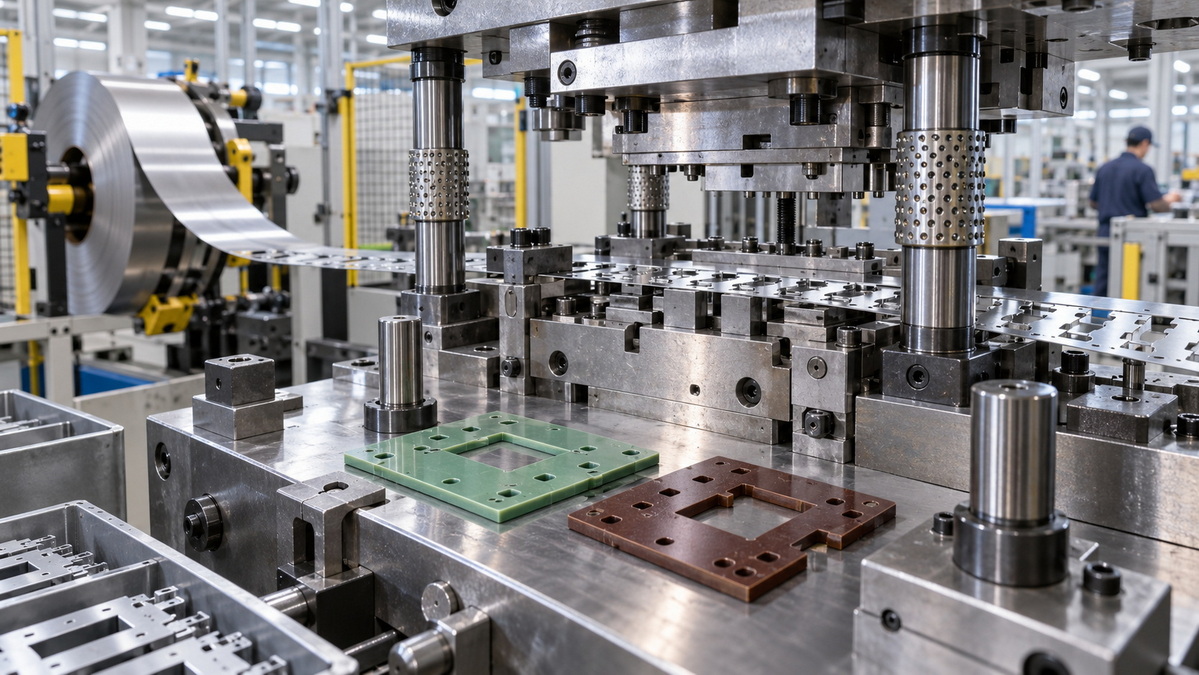
A high-speed stamping fixture is a component or assembly that supports, positions, insulates, guides, protects, or separates parts during a metal stamping process. These fixtures are commonly used in progressive dies, automated press systems, precision metal-forming lines, electrical stamping equipment, and industrial assembly operations.
A stamping fixture may look simple in a technical drawing. However, its actual working environment is often demanding.
It may need to withstand:
- Repeated impact loads
- High-frequency vibration
- Clamping and releasing forces
- Oil mist and lubrication fluids
- Metal chips and abrasive dust
- Elevated tooling temperatures
- Humidity changes
- Electrical insulation requirements
- Tight dimensional tolerances
When a fixture is installed near a high-speed press, even a small loss of flatness or hole accuracy can affect material feeding, punching alignment, die protection, and finished-part quality.
For this reason, fixture material selection should consider the entire operating environment rather than only the initial sheet cost.
Phenolic board is a thermoset laminate produced by combining phenolic resin with reinforcement materials. Depending on the grade, the reinforcement can include paper, cotton fabric, canvas, linen, or glass fabric.
The broad term "phenolic board" can be misleading because not all phenolic laminates perform the same way. A paper phenolic sheet behaves differently from a canvas phenolic or linen phenolic sheet.
Common phenolic laminate types include:
- Paper phenolic board
- Canvas phenolic board
- Linen phenolic board
- Cotton fabric phenolic laminate
- Glass fabric phenolic laminate
Each material grade has different strength, wear resistance, machining behavior, insulation properties, and moisture sensitivity.
Phenolic board has remained widely used in industrial applications because it is economical, familiar, and relatively easy to process.
Its main advantages include:
- Lower initial material cost
- Good electrical insulation for suitable applications
- Easy drilling, sawing, punching, and routing
- Good compressive performance in some configurations
- Useful vibration-damping properties
- Availability in many conventional industrial grades
- Practical performance for replaceable fixture elements
Paper phenolic materials are especially common in flat insulation parts, punched washers, low-cost electrical barriers, spacers, and simple support components.
Canvas and linen phenolic laminates can provide a tougher structure than paper phenolic. They may also offer better wear resistance and machining quality for selected mechanical applications.
Phenolic board can work well in the right environment. However, it may become a weak point in high-speed stamping systems when the fixture experiences demanding mechanical, thermal, or humidity-related conditions.
Common limitations include:
- Higher moisture sensitivity, especially for paper-based phenolic grades
- Reduced dimensional consistency in humid environments
- Greater risk of edge chipping during repeated impact
- Lower stiffness than glass-reinforced epoxy materials
- Potential cracking in thin or highly stressed sections
- Less predictable long-term performance near heat sources
- Lower suitability for highly precise, high-cycle positioning parts
These limitations do not mean phenolic board should be avoided completely. They mean that the material should be matched carefully to the fixture's actual job.
A phenolic spacer used in a low-speed press may perform well for years. A phenolic locating plate exposed to continuous vibration and repeated clamping may wear much faster than expected.
FR4 board is a glass-fabric-reinforced epoxy laminate. It is made from woven fiberglass cloth bonded with an epoxy resin system. The material is commonly recognized for its balance of electrical insulation, mechanical strength, moisture resistance, and flame-retardant characteristics.
FR4 is widely used in:
- Electrical insulation components
- PCB-related applications
- High-voltage equipment
- Precision machining fixtures
- Motor and transformer insulation
- Industrial control panels
- Mold and die support parts
- Mechanical wear components
- Automated production equipment
- Aerospace and transportation systems
For stamping fixtures, FR4 is often selected when the part must provide both mechanical support and electrical isolation.
FR4 offers a stronger performance margin than many common phenolic grades. Its woven glass reinforcement provides rigidity, while the epoxy system supports stable insulation and environmental resistance.
Key benefits of FR4 sheet include:
- High mechanical strength
- Strong flexural performance
- Good dimensional stability
- Low moisture absorption
- Reliable electrical insulation
- Resistance to many industrial oils and chemicals
- Flame-retardant material characteristics
- Good resistance to repeated mechanical stress
- Stable performance in humid workshop environments
- Suitability for CNC machining and custom fabrication
For high-speed stamping fixtures, these properties help reduce the chance of structural movement, hole wear, surface failure, and insulation inconsistency.
FR4 is particularly useful when a fixture includes thin walls, narrow bridges, close-tolerance holes, guide-pin locations, mounting slots, electrical barriers, or repeated clamping zones.
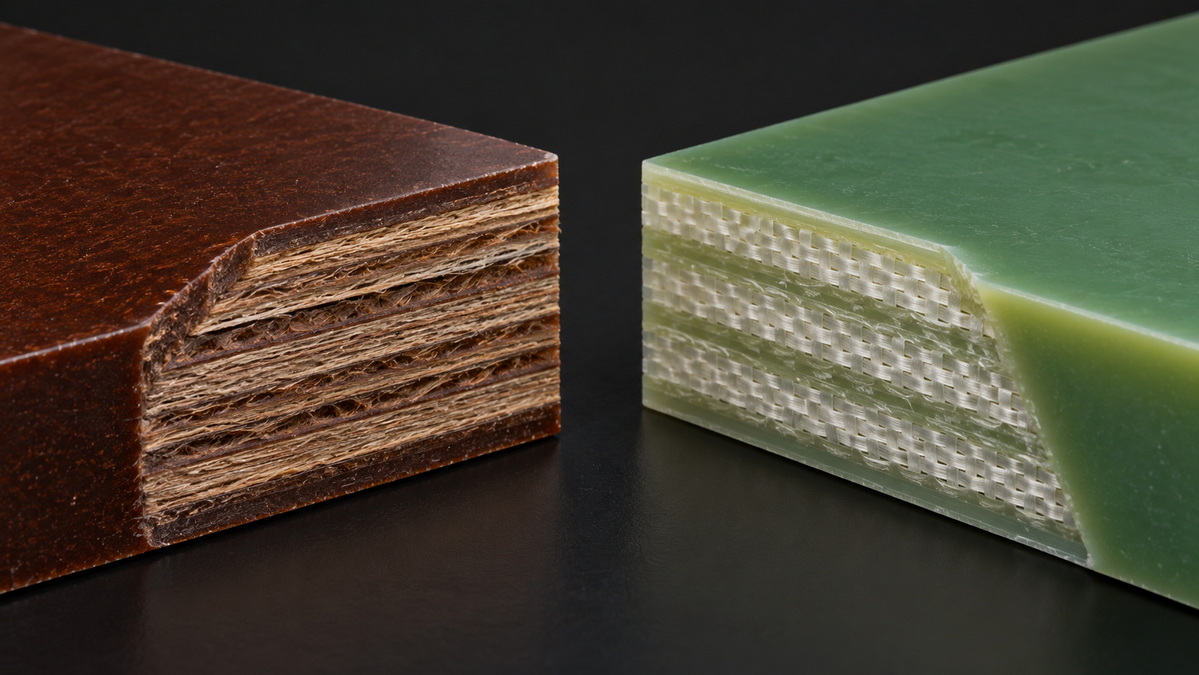
| Comparison Factor | Phenolic Board | FR4 Glass Epoxy Board | Preferred Material for High-Speed Fixtures |
|---|---|---|---|
| Resin system | Phenolic resin | Epoxy resin | FR4 |
| Reinforcement | Paper, canvas, linen, cotton fabric, or glass fabric | Woven fiberglass cloth | FR4 |
| Mechanical strength | Moderate, depending on grade | High strength and rigidity | FR4 |
| Flexural performance | Suitable for general-duty parts | Better for repeated loading and thin sections | FR4 |
| Moisture resistance | Can be limited, especially with paper grades | Stronger moisture resistance | FR4 |
| Electrical insulation | Good in controlled environments | More stable in demanding industrial conditions | FR4 |
| Flame resistance | Depends on grade | Commonly selected for flame-retardant applications | FR4 |
| Machining ease | Generally easier on tools | Requires carbide tools due to glass fibers | Phenolic |
| Tool wear during machining | Lower | Higher because of fiberglass reinforcement | Phenolic |
| Cost | Usually lower | Usually higher | Phenolic |
| Long-term stability | Suitable for moderate-duty use | Better for high-cycle, precision applications | FR4 |
| Best application | Low-cost and lower-load fixtures | High-speed, high-precision, high-cycle fixtures | FR4 |
The comparison shows why material selection should not be based on cost alone. Phenolic board can reduce initial spending. FR4 can reduce long-term risk.
For demanding production lines, the more expensive material may deliver a lower total cost of ownership when it reduces replacement frequency, maintenance work, scrap, and downtime.
High-speed stamping fixtures are exposed to repeated cycles rather than a single static force. Each cycle can add vibration, compression, impact, and stress around drilled holes, mounting slots, and unsupported sections.
Over thousands or millions of cycles, weak points can become visible.
Phenolic laminate may be suitable for moderate mechanical loading. However, repeated impact can create gradual wear or damage, particularly when the part has sharp corners, thin walls, deep slots, unsupported overhangs, or highly concentrated loads.
Potential issues include:
- Surface cracking
- Edge chipping
- Hole enlargement
- Layer separation
- Reduced flatness
- Localized crushing
- Fixture movement around mounting points
The risk increases when the fixture is exposed to heat, humidity, lubrication fluids, or irregular loading.
FR4 offers a more rigid and structurally stable platform. The woven glass reinforcement helps distribute stress across the laminate structure.
This is particularly valuable for fixture components such as:
- Precision locating plates
- Insulating guide blocks
- Clamping support plates
- High-voltage isolation barriers
- Thin-wall structural insulators
- Drilled fixture bases
- Slotted support components
- Custom CNC-machined die inserts
FR4 is not indestructible. Like any composite material, it must be designed with appropriate thickness, support, fastening methods, and safety margins. However, it generally provides a stronger starting point for demanding high-cycle applications.
Moisture is one of the most overlooked factors in stamping-fixture material selection.
A fixture may be machined accurately in a controlled workshop. Then it may be transported through changing climate conditions, installed in a humid factory, exposed to oil mist, and heated during continuous production.
If the material absorbs moisture, its size and insulation performance can change.
Small dimensional changes may create larger production problems when the fixture controls a critical process.
For example, moisture-related movement can affect:
- Alignment between guide pins and holes
- Clearance around stamped components
- Flatness of an insulating support plate
- Positioning accuracy in progressive dies
- Electrical isolation distances
- Clamping consistency
- Repeatability of automated feeding systems
FR4 is generally preferred when stable dimensions are important because the glass-epoxy construction provides better resistance to moisture-related change than many paper phenolic materials.
For high-speed stamping, this becomes especially important when a fixture must maintain accuracy through long shifts and seasonal humidity variation.
Many stamping fixtures are not only mechanical parts. They are also insulation components.
The fixture may separate energized components, isolate conductive tooling, support electrical assemblies, or prevent unintended contact between metal parts.
Phenolic board can provide useful electrical insulation in dry, moderate-duty applications. It remains a practical material for many flat insulating components.
However, insulation performance can be influenced by moisture absorption, contamination, heat, and surface wear. When a phenolic part absorbs moisture or becomes contaminated with oil and metal dust, its electrical behavior may become less predictable.
FR4 is commonly selected when a fixture needs more stable electrical insulation performance in industrial conditions.
Its advantages include:
- Reliable dielectric performance
- Good resistance to humidity
- Strong mechanical support for electrical barriers
- Better long-term consistency
- Suitability for high-voltage and powered equipment
- Flame-retardant characteristics for safety-focused applications
For electrically sensitive stamping systems, FR4 is often a more conservative material choice.
High-speed stamping can generate heat through friction, tooling contact, surrounding machinery, and continuous production cycles.
Standard FR4 works well in many industrial fixture applications. However, some projects require a higher-temperature material.
G11 is a high-temperature epoxy glass laminate that can be more suitable when the fixture is exposed to continuous heat or thermal cycling.
G11 may be considered for:
- Heated dies
- Hot-forming systems
- Thermal insulation fixtures
- Electrical insulation near heat sources
- Mold support applications
- High-temperature mechanical components
- Continuous elevated-temperature production lines
The correct material should always be selected based on the real working temperature, contact time, mechanical load, thickness, and required service life.
For standard high-speed stamping fixtures, FR4 is often sufficient. For hotter environments, G11 may offer a better long-term solution.
Machining performance is an important factor because many stamping fixtures require custom holes, slots, steps, channels, countersinks, profiles, and tight tolerances.
Phenolic board is generally easy to machine. It can be cut, drilled, routed, punched, and shaped using conventional equipment.
Advantages include:
- Lower tool wear
- Faster processing for simple shapes
- Good suitability for punched flat parts
- Easier cutting for lower-budget projects
- Practical fabrication of spacers and basic insulation components
However, machining quality depends on material grade. Paper phenolic may chip differently from canvas or linen phenolic. Thin areas should also be supported carefully during fabrication.
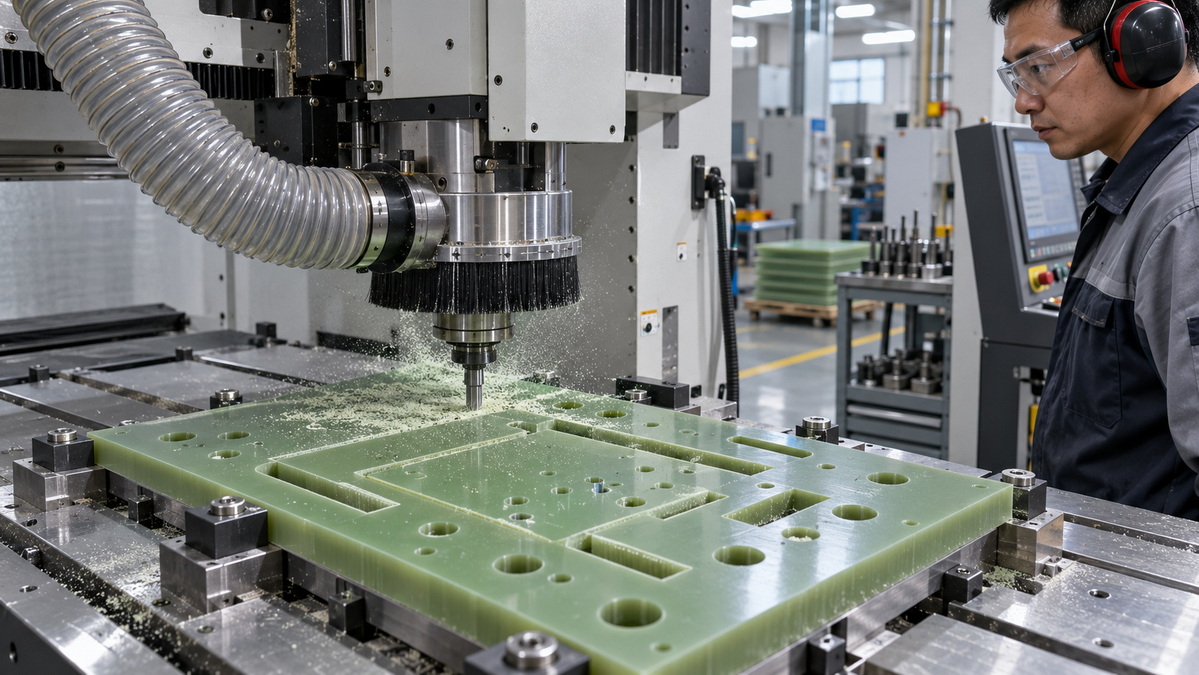
FR4 is highly machinable, but its fiberglass reinforcement makes it more abrasive to cutting tools.
For best results, FR4 machining should use:
1. Carbide cutting tools for longer tool life
2. Controlled feed rates to reduce heat buildup
3. Effective dust extraction for clean and safe processing
4. Sharp drills and end mills for accurate holes and edges
5. Proper workpiece support to reduce breakout and vibration
6. Rounded internal corners where the design allows
7. Edge finishing to improve handling safety and appearance
With proper equipment and fabrication experience, FR4 can be processed into highly accurate industrial parts.
Guangdong Weishi New Materials Co., Ltd. can support customized FR4 machining requirements, including cut-to-size sheets, drilled components, CNC-routed profiles, insulation blocks, slots, holes, and drawing-based fixture parts.
Phenolic board is often less expensive than FR4 at the time of purchase. For simple, low-risk parts, this can make it an efficient choice.
However, the initial sheet price does not show the complete cost.
A lower-cost fixture material can become more expensive if it leads to:
- More frequent replacement
- Unexpected press stoppages
- Increased maintenance labor
- Tooling alignment problems
- Higher scrap rates
- Emergency machining costs
- Expedited replacement shipments
- Reduced equipment availability
For high-speed stamping lines, one unplanned interruption may cost more than the difference between phenolic board and FR4.
This is why high-volume manufacturers often consider total cost of ownership, not just raw material cost.
If a fixture is critical to part accuracy, equipment safety, or production continuity, FR4 often provides better long-term value.
Use the following process before choosing phenolic board or FR4 for a stamping fixture.
Determine whether the part is mainly used for:
- Electrical insulation
- Structural support
- Positioning
- Wear resistance
- Vibration control
- Heat protection
- Temporary tooling
- Long-term production use
A simple spacer does not require the same material performance as a precision locating plate.
Consider:
- Press speed
- Production cycle frequency
- Impact and clamping force
- Operating temperature
- Humidity level
- Oil and coolant exposure
- Electrical requirements
- Dimensional tolerance
- Expected fixture life
- Replacement accessibility
Ask what will happen if the fixture wears, cracks, absorbs moisture, or loses dimensional accuracy.
If failure only causes a quick and low-cost replacement, phenolic board may be acceptable.
If failure can stop a press line, damage a die, create safety concerns, or increase scrap, FR4 is usually the more reliable option.
Use phenolic board when the project is cost-sensitive, low-load, dry, and easily serviceable.
Use FR4 when the fixture requires strength, precision, stable insulation, moisture resistance, and long service life.
Use G11 when elevated temperature becomes a major operating condition.
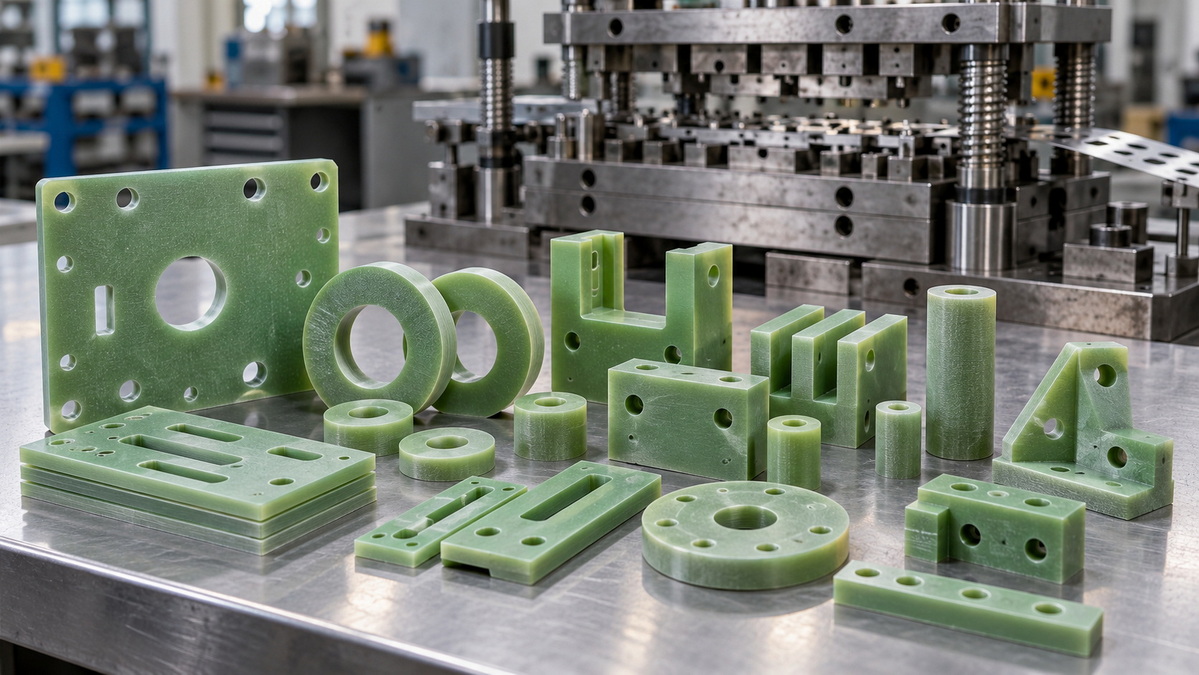
For most high-speed stamping fixtures, FR4 is the preferred material when long-term stability, mechanical strength, electrical insulation, and dimensional accuracy are important.
Phenolic board remains valuable for low-cost, low-load, and replaceable fixture components. It can be a practical solution when the operating environment is controlled and the part does not perform a critical positioning or structural role.
However, FR4 is usually the stronger investment for high-cycle, high-speed, or electrically sensitive stamping systems. Its glass-reinforced epoxy structure gives it a more stable foundation for demanding industrial production.
Guangdong Weishi New Materials Co., Ltd. provides FR4, G10, G11, epoxy fiberglass boards, and customized machined insulation components for industrial stamping, electrical equipment, molds, mechanical fixtures, and automation systems. Share your drawing, thickness, tolerance, working temperature, press conditions, and required quantity so the material can be matched to the real operating demands of your fixture.
Yes. In many standard industrial applications, FR4 offers higher tensile strength, flexural strength, stiffness, and long-term structural stability than paper phenolic board. Its woven fiberglass reinforcement gives it an advantage in high-speed and high-cycle fixture applications.
Yes. Phenolic board can be used for low- to medium-duty stamping fixtures, insulating pads, spacers, support blocks, and temporary tooling components. It is often selected when cost and ease of machining are the main priorities.
FR4 is better suited to high-speed stamping because it provides stronger mechanical support, better moisture resistance, more stable electrical insulation, and improved dimensional consistency during repeated production cycles.
FR4 can be machined accurately using CNC routers, milling machines, saws, and drills. Because it contains glass fibers, carbide cutting tools and effective dust extraction are recommended. With proper machining methods, FR4 can be made into precision fixture components.
FR4 and G10 are both glass-reinforced epoxy laminates. FR4 is commonly selected when flame-retardant material behavior is required. G10 is also a strong glass-epoxy laminate but is generally used where flame-retardant performance is not the primary requirement.
Choose G11 when the fixture will operate at higher temperatures or experience repeated thermal cycling. G11 is often used for heated dies, hot-forming equipment, electrical insulation near heat sources, and high-temperature industrial components.
Yes. FR4 can be supplied as standard sheets or fabricated into custom parts with drilled holes, routed slots, countersinks, cut-to-size dimensions, machined profiles, insulating barriers, fixture plates, and drawing-based components.
1. Norplex-Micarta. "[NEMA LI 1-1998: Industrial Laminated Thermosetting Products]."
Provides NEMA laminate material classifications, including FR4 epoxy glass flame-retardant, G10 epoxy glass, G11 high-temperature epoxy glass, and phenolic paper, canvas, and linen laminate grades.
2. Professional Plastics. "[Phenolic, G-10 and FR4 Material Data Sheets]."
Provides typical comparative mechanical, thermal, electrical, moisture-resistance, and flammability data for glass epoxy, paper phenolic, canvas phenolic, and linen phenolic laminate materials.
3. Professional Plastics. "[NEMA Grade Laminates: Phenolics C, CE, L, LE, G-10]."
Reviews common NEMA laminate grades, reinforcement systems, resin types, and industrial application areas.
4. Proto Express. "[How to Choose PCB Laminates Based on IPC Standards]."
Explains key laminate performance factors, including thermal behavior, glass transition temperature, dielectric properties, and FR4-related laminate selection considerations.
5. Ready Plastics. "[FR4 Material: Complete Guide to the Standard PCB Laminate]."
Reviews FR4 material composition, flame-retardant characteristics, performance features, machining considerations, and differences between FR4 and G10.
6. Precision Punch. "[Thermoset Industrial Laminate Properties]."
Includes comparative physical and mechanical property information for industrial phenolic and glass-epoxy laminate grades.


