

Views: 265 Author: Weishi Sheets Publish Time: 2026-09-08 Origin: Site
Content Menu
● Why China Is a Major Source of Epoxy Fiberglass Sheets
>> Guangdong
>> Jiangxi, Henan and Central China
● How to Evaluate an Epoxy Fiberglass Sheet Manufacturer
● Top 10 Epoxy Fiberglass Sheet Manufacturers in China
>> 1. Guangdong Weishi New Materials Co., Ltd.
>> 2. Jiujiang Xinxing Insulation Material Co., Ltd.
>> 3. Hebei JingHong Electronic Technology Co., Ltd.
>> 4. Guangzhou Shengrui Insulation Materials Co., Ltd.
>> 5. Shenzhen Xiongyihua Plastic Insulation Ltd.
>> 7. Xuchang Chengrui Insulation Material Co., Ltd.
>> 8. Zhejiang Jingjing Insulation Materials
>> 9. Guangde Huachang New Materials Co., Ltd.
>> 10. Shenzhen Keruomei Electronics Co., Ltd.
● Comparison of Key Supplier Profiles
● Common Problems When Buying Epoxy Fiberglass Sheets
>> Material Grade Substitution
>> Poor Internal Lamination Quality
>> Unclear Flame-Retardancy Claims
● Buyer's Guide for First Orders
>> Define Your Exact Requirements
>> Request Samples Before Mass Production
>> What is the difference between FR4 and G10 epoxy fiberglass sheet?
>> How can I check whether an ISO certificate is expired?
>> Is G11 always suitable for high-temperature applications?
>> What documents should I request for FR4 sheet imports?
>> How can I prevent receiving low-quality epoxy fiberglass sheets?
China is one of the world's most important manufacturing bases for epoxy fiberglass sheets, including FR4, G10, G11, FR5, 3240 epoxy boards and EPGC-grade laminated insulation materials. For international buyers, sourcing from China is not only about achieving a competitive purchase price. It is also about accessing an integrated manufacturing ecosystem that includes fiberglass cloth, epoxy resin systems, hot-press lamination, precision machining, industrial inspection, export packaging and global logistics support.
Epoxy fiberglass sheet materials are widely used in electrical insulation, electronics, industrial machinery, molds, fixtures, switchgear, battery packs, transformers, motors and high-voltage equipment. Their value comes from a practical combination of electrical insulation, mechanical strength, low moisture absorption, dimensional stability and heat resistance.
However, professional buyers should understand that not every supplier offering "FR4 sheet" provides the same material quality. Product performance can vary significantly because of resin formulation, fiberglass cloth quality, flame-retardant additives, pressing temperature, curing time, thickness control and quality-inspection standards.
This article introduces 10 notable epoxy fiberglass sheet manufacturers in China and provides a practical framework for evaluating suppliers. It is designed for procurement managers, engineering teams, importers, distributors, OEM buyers and industrial brands that need stable, long-term sources of insulation materials.
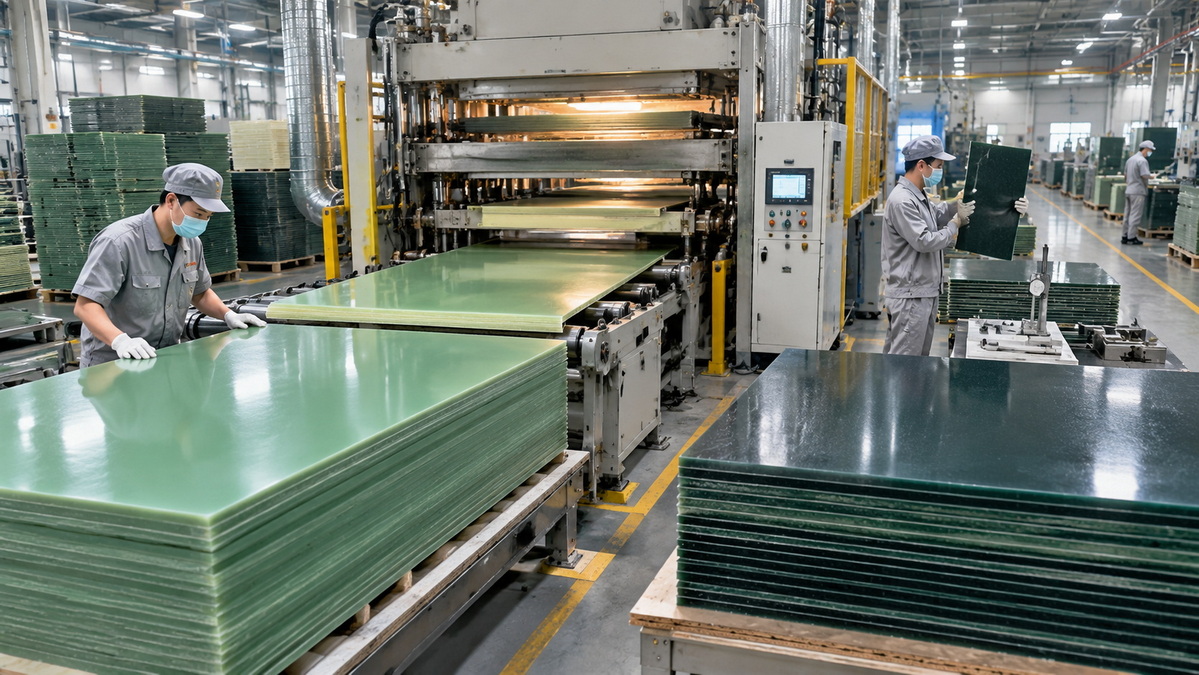
China has developed a mature industrial supply chain for electrical-insulation materials and fiberglass-reinforced composites. Manufacturers can source raw materials domestically, including woven fiberglass cloth, epoxy resin, curing agents, flame-retardant compounds, pigments, anti-static additives and packaging materials.
This supply-chain density makes it easier for Chinese factories to offer different material grades, sheet sizes, thicknesses, colors and machining options. Buyers can source both standard panels and finished custom components from the same supply network.
Several manufacturing regions are especially relevant for epoxy fiberglass sheets.
Guangdong is closely connected with electronics, battery manufacturing, electrical equipment, CNC machining, industrial automation and export logistics. Cities such as Shenzhen, Dongguan, Guangzhou, Foshan and Heyuan are supported by large networks of component manufacturers, mold factories, machinery producers and international trading companies.
For buyers of FR4, G10 and G11 sheets, Guangdong offers advantages in communication speed, prototype development, custom processing and delivery coordination.
Jiangsu and Zhejiang have strong industrial-material, electrical-equipment and machinery-manufacturing sectors. These regions support a broad range of laminated insulation materials, composite components, engineering plastics and electrical parts.
They are often suitable for buyers that require stable standard specifications and access to eastern China's manufacturing and port infrastructure.
Jiangxi, Henan and nearby provinces have established suppliers of rigid electrical insulation materials, epoxy glass-cloth laminates and industrial composite boards. Many factories in these areas focus on large-scale production of standardized grades for electrical equipment, motors, transformers and industrial machinery.
For high-volume buyers, central-China manufacturers can be attractive because of their manufacturing scale and access to domestic raw-material networks.
Selecting an epoxy fiberglass sheet supplier should be a technical and commercial decision. The lowest quotation does not always produce the lowest total procurement cost. A low-cost sheet may create hidden costs through machining waste, inconsistent thickness, poor dielectric strength, delamination, production delays or product failures after installation.
The following criteria can help buyers compare manufacturers more effectively.
A capable manufacturer should have control over the production process, from fiberglass cloth and epoxy resin selection to hot pressing, curing, cutting and final inspection.
Important production capabilities include:
- Fiberglass cloth selection and inspection
- Resin impregnation control
- High-pressure and high-temperature lamination
- Thickness and flatness management
- Curing-cycle consistency
- Sheet trimming and edge finishing
- Surface treatment
- Custom cutting and CNC machining
- Batch traceability
Factories that manage more of the production process internally are generally better positioned to control product consistency, lead times and customized specifications.
Professional suppliers should be able to provide clear technical documents for each material grade. These documents should match the product being quoted and should not be generic files copied from another supplier.
Buyers should request:
- Technical data sheets
- Material safety data sheets
- Certificates of analysis
- Product inspection reports
- RoHS declarations
- REACH declarations
- Flame-retardancy reports, when required
- Material-grade descriptions
- Thickness-tolerance specifications
- Batch or lot traceability information
For electrical-insulation applications, technical data should include dielectric strength, insulation resistance, water absorption, density, flexural strength and thermal-performance information.
Quality control should be visible in the factory process, not only mentioned in a brochure. Buyers should evaluate whether the manufacturer has procedures for raw-material inspection, process monitoring, final inspection and corrective action.
A reliable supplier should be able to explain:
- How incoming fiberglass cloth is inspected
- How resin batches are controlled
- How pressing pressure and curing conditions are monitored
- How thickness is measured across a full panel
- How defects are identified and separated
- How finished goods are labeled by batch
- How nonconforming products are handled
For repeat orders, batch consistency is often more important than one good sample.
Many industrial buyers do not need only a raw green FR4 panel. They need a supplier that can adapt the material to a specific assembly, fixture, insulation barrier, battery component or machined part.
Useful customization options include:
- Custom thicknesses
- Custom panel dimensions
- Cut-to-size sheets
- Black, green, yellow, natural and custom colors
- Anti-static FR4 and G10 grades
- Copper-clad composite sheets
- CNC drilling
- Routing
- Slots and cutouts
- Countersinks
- Chamfers
- Engraved identification marks
- Special packaging and pallet labels
A supplier with both material-production capability and custom-processing support can reduce coordination work between multiple vendors.
Delivery performance matters especially when epoxy fiberglass sheets are used in electrical-equipment assembly, CNC machining or export production. A missed material delivery can stop a production line even when the material cost is relatively low.
Buyers should confirm:
- Standard production lead time
- Sample lead time
- Raw-material inventory policy
- Capacity during peak seasons
- Export packaging method
- Container-loading capability
- Port of shipment
- Incoterms offered
- Communication process during production
- Delay-notification procedure
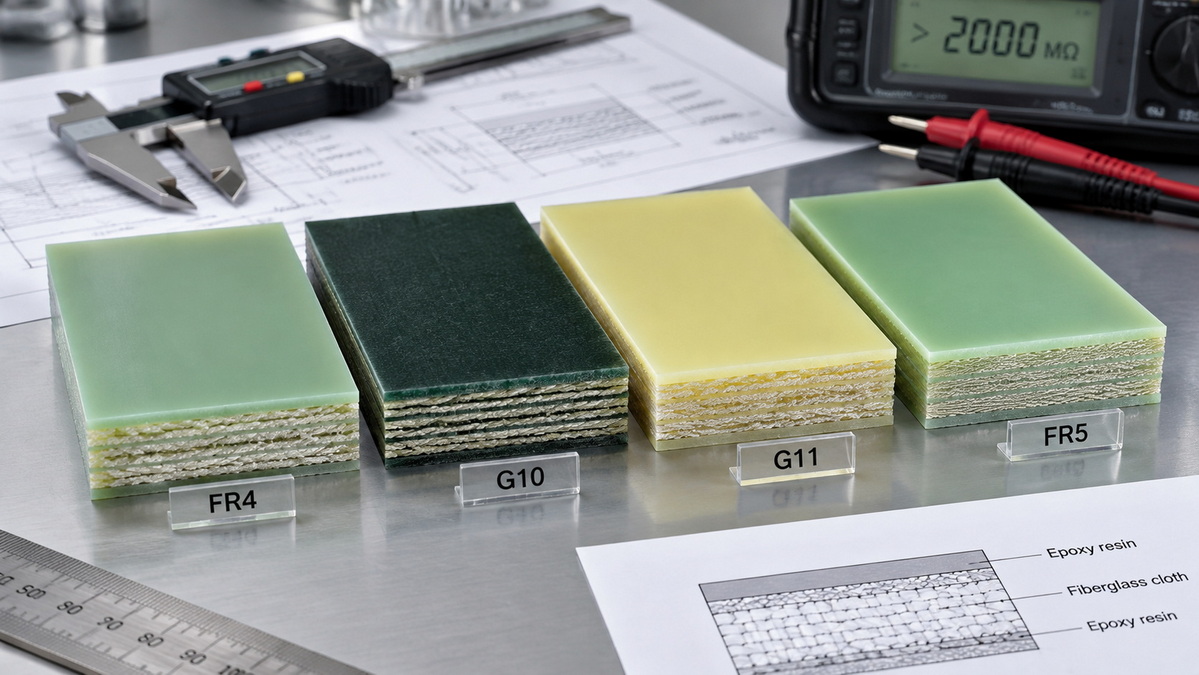
The following manufacturers represent different sourcing profiles, including flexible custom suppliers, volume-oriented producers, broad insulation-material providers and CNC-machining-focused companies.
This list is intended to help buyers begin supplier research. Before approving a supplier, buyers should verify technical documents, request samples, review production capability and conduct quality testing based on the final application.
Location: Heyuan, Guangdong, China
Established: 2007
Main products: FR4 epoxy fiberglass sheets, G10 sheets, G11 sheets, FR5 sheets, 3240 epoxy boards, anti-static insulation sheets, copper-clad sheets and related composite materials
Main applications: Electrical insulation, battery packs, high-voltage components, industrial machinery, mold manufacturing, test fixtures, electronics and electrical equipment
Customization scope: Sheet thickness, size, color, machining support, cut-to-size processing and application-oriented material selection
Guangdong Weishi New Materials Co., Ltd. is a suitable manufacturer for buyers seeking a practical balance between material quality, custom service and procurement flexibility. The company focuses on high-performance epoxy fiberglass sheets and composite insulation materials for electrical, electronic, mechanical and industrial applications.
The company's product range includes FR4, G10, G11, FR5, 3240 epoxy laminate boards, anti-static sheets and copper-clad composite materials. These products can be used in high-voltage insulation systems, lithium-ion battery packs, electrical equipment, CNC-machined insulation parts, molds and industrial support structures.
One important advantage is its ability to support customized projects. Many small and medium-sized brands need more than standard sheet dimensions. They may require a specific thickness, custom size, special color, drilled holes, routed slots, finished edges or pre-cut components. Guangdong Weishi New Materials is well positioned for buyers that value responsive communication and practical support during the sampling and production stages.
For example, a battery-pack manufacturer may require FR4 or G11 insulation sheets with specific thickness tolerances, flame-retardant performance, controlled dimensions and protective packaging for international transport. Instead of purchasing standard panels and arranging processing through another supplier, the buyer can work with a manufacturer that understands both material performance and secondary fabrication requirements.
The company is particularly suitable for customers who want a long-term supply partner rather than a simple trading intermediary. It can be a good fit for buyers with mixed requirements, recurring custom orders, prototype development needs or gradual growth from sample quantities to larger production volumes.
Best fit for:
Small and medium-sized industrial brands, electrical-equipment manufacturers, battery-pack producers, CNC machining companies, mold factories and importers needing customized insulation materials.
Location: Jiujiang, Jiangxi, China
Established: 2003
Main products: FR4 sheets, G10 sheets, EPGC202 epoxy fiberglass laminate sheets, electrical-insulation composite boards
Main applications: Electrical insulation, industrial machinery, electrical panels, electronic equipment and standard composite-material distribution
Customization scope: Sheet dimensions, thicknesses, colors and cut-to-size services
Jiujiang Xinxing Insulation Material Co., Ltd. is a recognized supplier in the rigid electrical-insulation composite sector. The company focuses on epoxy glass-cloth laminated materials and is suitable for buyers looking for standard FR4 and EPGC202 grades.
Its material portfolio includes epoxy fiberglass sheets made from glass cloth and epoxy resin through high-temperature, high-pressure lamination. This type of material is widely used where electrical insulation, mechanical stability and moisture resistance are required.
The company is a practical option for buyers that need standardized panel sizes, repeat-volume purchasing and conventional insulation grades. It may be particularly suitable for electrical-equipment manufacturers, industrial distributors and component fabricators that work with repeatable specifications.
When working with a volume-oriented manufacturer, buyers should clearly define the required material thickness, acceptable tolerance, flame-retardancy level, surface quality and inspection criteria. Even when ordering standard grades, a detailed purchase specification remains important.
Best fit for:
Volume buyers, electrical-insulation distributors, industrial-equipment manufacturers and customers seeking standardized FR4 or EPGC202 sheet materials.
Location: Hebei, China
Main products: FR4/G10 sheets, FR5/G11 sheets, 3240 epoxy sheets, bakelite sheets, phenolic cotton-cloth sheets, insulation rods, insulation tubes and ESD materials
Main applications: Electrical insulation, electrical equipment, industrial machinery, tooling, switchgear and electronic manufacturing
Customization scope: Sheets, rods, tubes and multi-material sourcing support
Hebei JingHong Electronic Technology Co., Ltd. offers a broad range of electrical-insulation materials rather than concentrating only on FR4 epoxy fiberglass sheets. This can be useful for buyers who want to consolidate different insulating materials under one supplier relationship.
Its product range covers FR4/G10 sheets, G11/FR5 high-temperature sheets, 3240 epoxy boards, phenolic materials, insulation rods, tubes and other industrial composite products. This broader catalog can simplify procurement for manufacturers that use several insulation materials across different product lines.
For example, a transformer manufacturer may require G11 sheets for higher-temperature zones, FR4 sheets for insulation barriers, 3240 sheets for general insulation components and phenolic materials for certain structural parts. Working with one qualified multi-material supplier can reduce the number of purchase orders and simplify incoming inspection.
Buyers should still evaluate each material grade separately. A company with a broad catalog may have different performance levels, production methods or sourcing arrangements across product categories.
Best fit for:
Electrical-equipment manufacturers, insulation-material distributors, transformer and motor component producers, and buyers requiring multiple industrial insulation materials.
Location: Guangzhou, Guangdong, China
Established: 2012
Main products: FR4/G10 sheets, G11/FR5 sheets, ESD FR4 materials, 3240 epoxy sheets, prepreg sheets, copper-clad laminates, carbon-fiber sheets and CNC-machined components
Main applications: Electrical insulation, fixtures, switch bases, industrial components, electronic equipment and high-voltage applications
Customization scope: Custom colors, sizes, CNC machining, prepreg supply and composite-part processing
Guangzhou Shengrui Insulation Materials Co., Ltd. is a suitable option for buyers seeking a wide selection of fiberglass laminate and composite-material products. Its range includes conventional FR4/G10 sheets as well as G11/FR5 higher-temperature grades, anti-static materials, prepregs and carbon-fiber products.
This type of product range can be valuable when a buyer needs several composite materials for tooling, fixtures, electrical insulation and finished components. The company's machining-related capability may also be useful for customers that want routed, drilled or shaped parts instead of raw sheet panels.
For buyers in electronics, industrial automation and test-fixture manufacturing, anti-static FR4 sheets may be especially relevant. However, anti-static performance should be specified with measurable surface-resistance requirements rather than only requesting "ESD FR4."
A professional RFQ should define the required resistance range, test method, environmental conditions and acceptance criteria. Without these details, different suppliers may quote different anti-static material structures.
Best fit for:
Electronics manufacturers, fixture makers, automation-equipment suppliers, CNC processors and buyers needing both standard and anti-static fiberglass laminates.
Location: Shenzhen, Guangdong, China
Main products: FR4/G10 sheets, 3240 epoxy boards, industrial plastics and insulation materials
Main applications: Electronics, industrial machinery, electrical components, tooling, machining and general insulation
Customization scope: Sheet sizing, industrial-plastic alternatives and mixed-material procurement
Shenzhen Xiongyihua Plastic Insulation Ltd. serves buyers that need epoxy fiberglass sheets alongside engineering plastics. This is useful for companies that compare FR4, G10, nylon, POM, PET, PVC, acrylic and other machinable materials during product development.
In some applications, FR4 may be selected for its electrical insulation and mechanical strength, while another engineering plastic may be more suitable for lower load, lower temperature or less demanding structural components. A supplier with knowledge of multiple industrial materials can help purchasing teams compare options during early-stage design.
The company can be relevant for buyers working in Shenzhen's broad electronics and industrial-equipment ecosystem. It may also be a useful supplier for distributors that want to source both epoxy fiberglass sheets and industrial plastic panels.
Buyers should request product-specific data for each material because FR4, G10 and engineering plastics have very different thermal, electrical and mechanical characteristics.
Best fit for:
Industrial distributors, electronics manufacturers, machinery workshops and buyers that source insulation laminates together with engineering plastics.
Location: Dongguan, Guangdong, China
Main products: CNC-machined FR4/G10 components, custom composite parts and engineering plastic components
Main applications: Test fixtures, electrical insulation parts, prototypes, custom machine components and maintenance parts
Customization scope: CNC cutting, drilling, routing, low-volume production and prototype support
BeePlastic is better suited for buyers requiring finished FR4/G10 components rather than large quantities of raw epoxy fiberglass sheet. The company focuses on custom machining and may be a practical option for prototype projects, maintenance parts, fixtures and low-volume industrial components.
Machining fiberglass epoxy laminate can create specific challenges. The material is abrasive, which increases tool wear. Poor machining can cause rough edges, burrs, delamination, heat marks and dimensional variation. A supplier with experience in machining FR4/G10 can help reduce these problems.
For buyers of finished insulation parts, it is important to provide a detailed drawing that includes dimensions, tolerances, hole positions, countersinks, surface requirements, edge requirements and inspection standards.
A small machining error may not matter for a raw panel, but it can cause serious assembly issues in a finished electrical enclosure, battery module, fixture or industrial device.
Best fit for:
Prototype buyers, maintenance teams, fixture manufacturers, industrial designers and customers needing CNC-machined FR4/G10 parts.
Location: Xuchang, Henan, China
Main products: FR4 sheets, G10 sheets, G11 sheets, EPGC materials and fiberglass epoxy laminate boards
Main applications: Electrical power systems, industrial equipment, electronics, transportation, laboratory equipment and electrical insulation
Customization scope: Custom dimensions, thicknesses and application-specific insulation sheets
Xuchang Chengrui Insulation Material Co., Ltd. is a supplier to consider for conventional FR4, G10 and G11 fiberglass epoxy laminate materials. The company serves industrial applications where electrical insulation, mechanical strength and heat resistance are important.
Its material range can support electrical cabinets, industrial machinery, electrical power systems, laboratory equipment and transportation-related electrical components. G11 and FR5 grades may be relevant when the application requires improved thermal performance compared with standard G10 or FR4 materials.
When sourcing high-temperature insulation boards, buyers should not rely only on the grade name. They should request temperature-related data, dielectric-performance data at operating temperature, thermal-aging results and sample testing under real use conditions.
Best fit for:
Industrial electrical-equipment producers, power-system component manufacturers and buyers requiring standard FR4/G10/G11 sheet materials.
Location: Zhejiang, China
Main products: Electrical-insulation laminated materials and FR4-related sheet products
Main applications: Industrial electrical equipment, insulation components, machinery and material distribution
Customization scope: To be confirmed during supplier evaluation
Zhejiang Jingjing Insulation Materials is a potential supplier for buyers that want to explore electrical-insulation material options in eastern China. Zhejiang has a mature industrial base with strong connections to machinery, electrical equipment, hardware processing and export logistics.
This company may be suitable for buyers building a diversified supplier portfolio. Supplier diversification can reduce sourcing risk, particularly when a buyer depends heavily on one region, one factory or one material grade.
Before moving forward with a purchase, buyers should request detailed technical data sheets, factory information, product samples and batch-control information. It is also important to confirm whether the company operates its own lamination production line or primarily functions as a trading and distribution supplier.
Best fit for:
Buyers seeking to qualify additional suppliers in eastern China and build a more diversified sourcing structure.
Location: Guangde, Anhui, China
Main products: FR4 laminate sheets and related insulation materials
Main applications: Electrical insulation, industrial machinery, electrical components and general composite-material applications
Customization scope: To be confirmed based on product grade and project requirements
Guangde Huachang New Materials Co., Ltd. is another potential supplier for buyers sourcing FR4 laminate sheets and electrical-insulation materials from China. Its location in Anhui provides access to central and eastern China manufacturing networks.
For buyers, the most important question is whether the company has direct manufacturing control over fiberglass cloth impregnation and hot-press lamination. A direct manufacturer can usually provide stronger traceability and more flexible control of thickness, color, resin formulation and panel size.
If the company operates mainly as a converter or distributor, it may still be useful for stock materials, fast local supply or mixed product sourcing. However, buyers should establish where the original material is manufactured and how batch traceability will be maintained.
Best fit for:
Buyers looking for additional FR4 supply options, regional sourcing flexibility and standard insulation-sheet materials.
Location: Shenzhen, Guangdong, China
Main products: FR4 sheets, EPGC202 epoxy fiberglass laminated sheets and electrical-insulation boards
Main applications: Electrical power systems, electronics, communication equipment, industrial equipment, laboratory equipment, medical equipment and transportation
Customization scope: Customized dimensions, colors and insulation-sheet requirements
Shenzhen Keruomei Electronics Co., Ltd. serves the electronics and industrial-equipment market with epoxy fiberglass laminated sheets. Its FR4 and EPGC202 materials can be used in electrical insulation, electronic device housings, switch components, industrial supports and machined composite parts.
A Shenzhen-based supplier can be particularly useful for buyers that have other suppliers in the Pearl River Delta region. This can simplify sample consolidation, factory visits, freight coordination and supply-chain communication.
For electronic and electrical applications, buyers should define whether the material will be used as a structural panel, electrical barrier, high-voltage insulation component, fixture board or machined assembly part. Each use case may require different thickness tolerances, flame-retardancy levels, electrical properties and surface conditions.
Best fit for:
Electronics companies, electrical-equipment manufacturers and buyers sourcing customized FR4 or EPGC202 sheets within Guangdong.
| Manufacturer | Main Material Focus | Custom Processing | Typical Order Profile | Compliance Documents to Request |
|---|---|---|---|---|
| Guangdong Weishi New Materials Co., Ltd. | FR4, G10, G11, FR5, 3240, anti-static and copper-clad sheets | Strong support for sizes, thicknesses and custom processing | Small to medium recurring orders, OEM projects and industrial applications | Material data sheet, RoHS, REACH, flame-retardancy reports and batch COA |
| Jiujiang Xinxing Insulation Material Co., Ltd. | FR4, G10, EPGC202 and rigid composite laminates | Standard panels and customized dimensions | Standardized and repeat-volume orders | Technical data sheet, thickness report and batch traceability |
| Hebei JingHong Electronic Technology Co., Ltd. | FR4/G10, G11/FR5, 3240, rods, tubes and phenolic materials | Broad multi-material supply | Consolidated insulation-material purchasing | Quality-management certificates, product data sheets and compliance files |
| Guangzhou Shengrui Insulation Materials Co., Ltd. | FR4/G10, G11/FR5, ESD sheets, prepregs and carbon fiber | CNC machining and multi-grade customization | Electronics, fixtures and custom composite projects | ESD test data, flame-retardancy reports and machining inspection standards |
| Shenzhen Xiongyihua Plastic Insulation Ltd. | FR4/G10, 3240 and engineering plastics | Mixed-material sourcing and custom sizing | Buyers comparing composites and plastics | Material-specific test reports and RoHS declarations |
| BeePlastic | CNC-machined FR4/G10 components | Strong for finished parts and prototypes | Low-volume, custom and prototype orders | Material traceability, machining inspection reports and dimensional records |
| Xuchang Chengrui Insulation Material Co., Ltd. | FR4, G10, G11 and EPGC materials | Custom sheet sizing | Industrial electrical applications | Material data sheets, thermal-performance data and compliance declarations |
| Zhejiang Jingjing Insulation Materials | Electrical-insulation laminates | Confirm during inquiry | Supplier diversification and standard sheets | Factory profile, technical documents and sample COA |
| Guangde Huachang New Materials Co., Ltd. | FR4 laminates and insulation sheets | Confirm during inquiry | Standard industrial sheet sourcing | Manufacturing-process confirmation, TDS and batch reports |
| Shenzhen Keruomei Electronics Co., Ltd. | FR4 and EPGC202 sheets | Customized sheet specifications | Electronics and industrial-equipment projects | Electrical-performance data, RoHS documents and material certification |
One of the most common issues is material substitution. A quotation may identify a sheet as FR4, G10 or G11, but the actual resin system, glass-cloth quality or flame-retardant performance may not match the intended grade.
For example, a buyer may order FR4 because the final electrical assembly requires flame-retardant insulation. If the delivered product uses a lower-cost epoxy formulation without proven flame-retardant performance, the sheet may look similar but create compliance or safety problems.
The solution is to define measurable requirements in the purchase order. These can include flame-rating requirements, dielectric-strength minimums, thickness tolerance, density range, water-absorption limits and required documentation.
Thickness inconsistency can create problems during machining and assembly. The sheet may measure correctly at one corner but vary across the center or edges because of uneven pressing pressure or curing conditions.
This is especially important for:
- CNC-machined parts
- Electrical spacers
- Insulation barriers
- Battery-pack components
- Transformer components
- Stacked assemblies
- Mold and fixture plates
Buyers should define a thickness tolerance and specify how many measurement points will be used for inspection.
A sheet can appear smooth on the surface while containing internal voids, poor resin penetration, dry fiberglass areas or weak bonding between layers. These defects may appear only after drilling, routing, cutting or thermal exposure.
A useful internal inspection method is to request a cross-section sample from the same production batch. After cutting the sample, inspect the interior for resin distribution, voids, visible dry cloth and interlayer separation.
This is one of the most useful but often overlooked checks when qualifying a fiberglass epoxy laminate supplier.
Some suppliers may use general descriptions such as "FR4 V-0" without providing a report that matches the exact material. Flame performance can vary depending on resin formulation, color, thickness and material construction.
When flame retardancy is important, request a report showing:
- Product grade
- Material thickness
- Test method
- Test laboratory
- Report date
- Manufacturer name
- Relevant flame classification
If the supplier cannot provide clear supporting documents, do not assume the material meets the required fire-performance level.
Epoxy fiberglass sheets are durable, but they can still be damaged during shipping. Common problems include chipped edges, warped panels, moisture exposure, scratches and pallet damage.
For sea freight, buyers should specify:
- Protective film or separator sheets
- Edge protectors
- Moisture-resistant wrapping
- Desiccant when necessary
- Strong pallets
- Clear batch labels
- Maximum pallet weight
- Fumigation requirements for wooden packaging
- Container-loading instructions
Good packaging is particularly important for large sheets, machined components and high-value custom orders.
Avoid sending a vague inquiry such as "Please quote FR4 sheet." A useful request should include:
- Material grade
- Thickness
- Tolerance
- Sheet dimensions
- Color
- Quantity
- Required flame rating
- Operating temperature
- Electrical-insulation requirements
- Machining requirements
- Destination port
- Preferred shipping term
- Required documents
- Expected annual demand
A detailed request helps the manufacturer provide a more accurate quotation and reduces the risk of receiving the wrong grade.
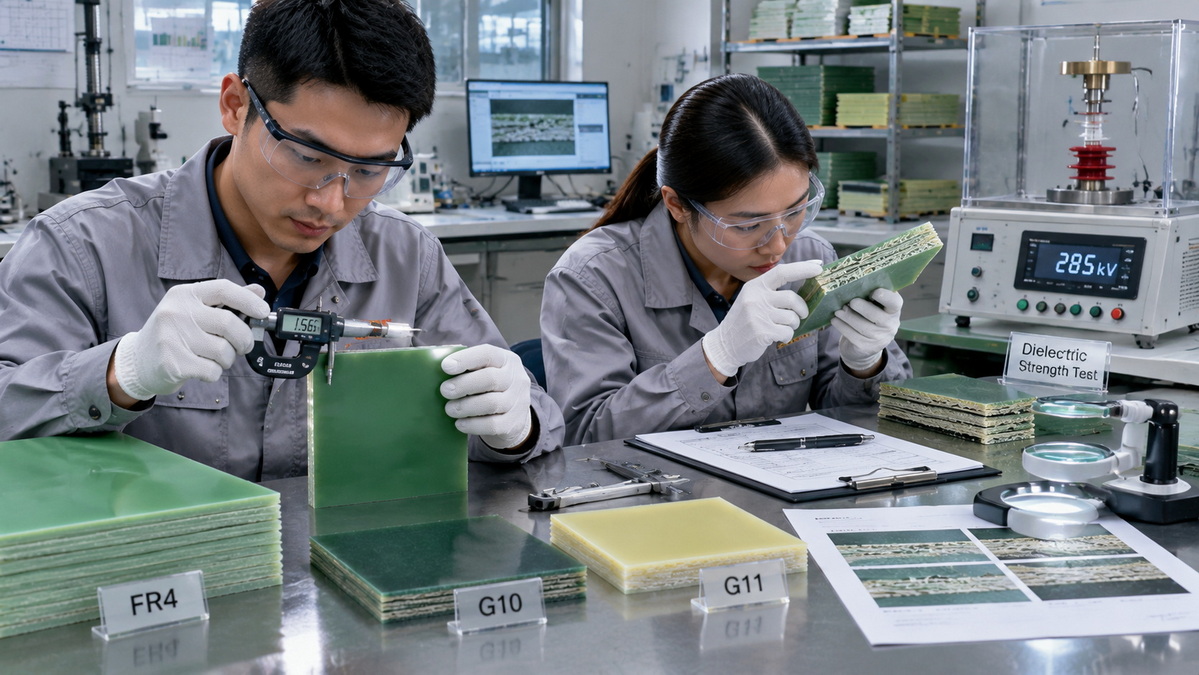
Samples should be tested under conditions that reflect real use. A standard visual inspection is not enough for critical electrical or high-temperature applications.
Useful sample checks may include:
- Thickness measurement
- Flatness check
- Dielectric-strength test
- Insulation-resistance test
- Water-absorption test
- Flexural-strength test
- Flame-retardancy validation
- Thermal-aging test
- CNC machining trial
- Drill-hole quality inspection
- Delamination inspection
If the final product includes holes, slots, thin walls or tight tolerances, the sample should be machined into a real part rather than evaluated only as a raw panel.
A remote factory review can still provide valuable information. Ask the supplier to show its production process through a video call or detailed factory video.
Important areas to review include:
- Raw-material warehouse
- Fiberglass cloth storage
- Resin mixing and impregnation area
- Lamination press equipment
- Cutting area
- Inspection instruments
- Finished-goods warehouse
- Packaging station
- Batch labeling process
The goal is not only to confirm that a factory exists. It is to understand whether the company has control over manufacturing, quality inspection and order traceability.
A pilot order is often the safest way to qualify a new supplier. Instead of ordering multiple grades, colors and dimensions at the same time, begin with one material grade and one controlled specification.
For example, a buyer may start with one pallet of 2 mm FR4 sheets in a defined dimension. After confirming thickness consistency, machining quality, electrical performance and packaging reliability, the buyer can expand to additional grades such as G11, anti-static FR4 or CNC-machined parts.
This process reduces risk and gives both sides time to establish clear technical communication.
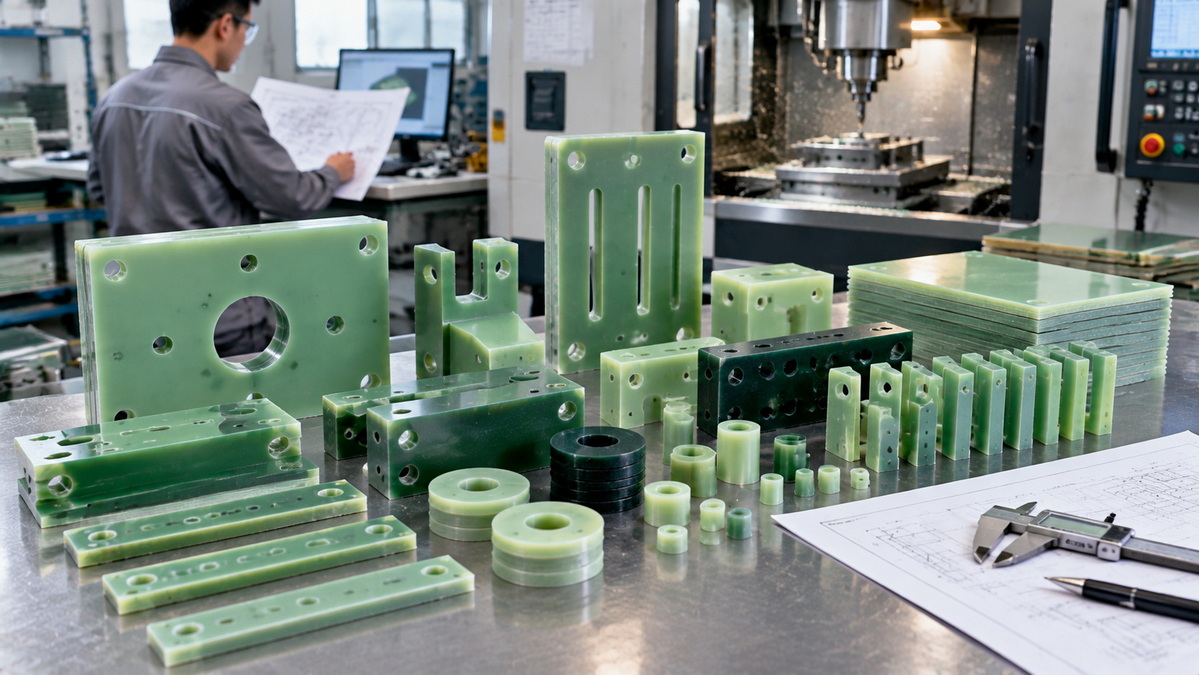
China offers a wide range of suppliers for FR4, G10, G11, FR5, 3240 and other epoxy fiberglass laminated insulation materials. Buyers can find manufacturers that specialize in standard panels, large-volume industrial production, custom CNC machining, anti-static materials and high-temperature electrical-insulation applications.
The strongest sourcing decision is based on technical alignment, not on price alone. Material grade, fiberglass cloth quality, resin formulation, thickness control, electrical performance, flame-retardant requirements, documentation and batch consistency should all be reviewed before approving a supplier.
Among the manufacturers listed, Guangdong Weishi New Materials Co., Ltd. is a practical option for buyers that need high-performance epoxy fiberglass sheets with flexible customization, efficient communication and deep support for OEM projects. Its product range covers FR4, G10, G11, FR5, 3240, anti-static and copper-clad materials for electrical, electronic, mechanical and industrial applications.
A structured qualification process—clear specifications, technical-document review, sample testing, factory verification and a controlled pilot order—will help buyers build a more stable and reliable supply chain for epoxy fiberglass sheet materials.
FR4 and G10 are both epoxy resin and fiberglass cloth laminated materials. The main difference is that FR4 is generally associated with flame-retardant performance, while G10 is commonly used where mechanical strength and electrical insulation are required but flame retardancy may not be the primary requirement.
The correct choice depends on the final application, required flame classification, operating temperature, electrical performance and local regulations.
Ask the supplier for the complete certificate and check the certificate number, issue date, expiry date, certification body, legal company name, factory address and scope. The certification scope should cover the relevant manufacturing activity rather than only sales or trading operations.
When possible, verify the certificate through the certification body's official database or by contacting the issuer directly.
G11 is commonly selected for applications requiring higher heat resistance than standard G10, but performance depends on the specific resin system and manufacturing process. Buyers should request technical data for the exact material grade and test samples under actual operating conditions.
Do not select G11 only because of the grade name. Confirm thermal performance, dielectric strength, mechanical strength and long-term stability at the intended service temperature.
Most buyers should request a technical data sheet, material safety data sheet, certificate of analysis, commercial invoice, packing list, product specification, RoHS declaration when required, REACH declaration when required and flame-retardancy documentation when required.
For custom parts, also request a dimensional inspection report and a drawing revision confirmation.
Use a written product specification, request samples, inspect material cross-sections, define thickness tolerance, require batch traceability and test the material after machining. A pilot order is usually safer than moving directly to a large purchase.
The most important factor is consistency. A good supplier should deliver the same material performance across different production batches, not only provide one acceptable sample.
1.Guangdong Weishi New Materials Co., Ltd.: https://www.wsepoxysheet.com/
2.World Integrated Trade Solution: China Glass Fibres and Articles Export Data: https://wits.worldbank.org/trade/comtrade/en/country/CHN/year/2024/tradeflow/Exports/partner/ALL/product/701990
3.General Administration of Customs of the People's Republic of China: Statistics: http://english.customs.gov.cn/Statistics/Statistics?ColumnId=1
4.General Administration of Customs of the People's Republic of China: Customs Statistics Platform: http://stats.customs.gov.cn/indexEn
5.Jiujiang Xinxing Insulation Material Co., Ltd.: EPGC202 Epoxy Fiberglass Laminated Sheet: https://www.xx-insulation.com/epgc202-epoxy-fiberglass-laminated-sheet-product/
6.Hebei JingHong Electronic Technology Co., Ltd.: FR4 G10 Epoxy Resin Materials: https://www.jhd-material.com/insulation-rod/fr4-g10-epoxy-resin-rod
7.Atlas Fibre: G11 Material Specification Overview: https://www.atlasfibre.com/material/g-11/
8.China Fiberglass Industry Research Report 2025–2030: https://wci-research.com/newsinfo/3180415.html


