

Views: 221 Author: Weishi Sheets Publish Time: 2026-09-24 Origin: Site
Content Menu
● How to Evaluate an Epoxy Resin Sheet Supplier
>> Manufacturing and Processing Capability
>> Material Grade Transparency
● Understanding Epoxy Resin Sheet Grades
>> G10 vs. FR4
>> FR4 vs. G11
● Why Canada Is a Relevant Sourcing Market
>> Québec
>> Ontario
>> Alberta
● Top Epoxy Resin Sheet Manufacturers and Suppliers Serving Canada
>> 1. Guangdong Weishi New Materials Co., Ltd.
>>> Core Strengths
>>> OEM and Custom Processing Scope
>> 2. Synthane Taylor Canada Ltd.
>>> Core Strengths
>>> OEM and Custom Processing Scope
>>> Core Strengths
>>> OEM and Custom Processing Scope
>> 4. uMake
>>> Core Strengths
>>> OEM and Custom Processing Scope
>>> Core Strengths
>>> OEM and Custom Processing Scope
>>> Core Strengths
>>> OEM and Custom Processing Scope
● Common Procurement Problems and How to Avoid Them
>> Material Grade Substitution
>> Misleading Flame-Retardant Claims
>> Poor Flatness After Machining
● An Important Insider Verification Method
>> 1. What is the difference between FR4, G10, and G11?
>> 2. How can I verify FR4 epoxy resin sheet quality?
>> 3. Can FR4, G10, and G11 sheets be custom machined?
>> 4. What should I include in an epoxy resin sheet RFQ?
>> 5. Should I buy from a local Canadian supplier or an overseas manufacturer?
Canada offers a practical sourcing environment for epoxy resin sheet buyers who require local fabrication support, short domestic delivery cycles, technical communication, traceable documentation, and reliable custom processing. At the same time, procurement teams should understand that Canada is not primarily a high-volume manufacturing base for every grade of epoxy glass laminate.
Instead, the Canadian market combines local material distributors, custom fabricators, engineered-component specialists, and international manufacturers that support Canadian projects through direct export. This creates several sourcing options for buyers in electrical equipment, industrial machinery, battery manufacturing, mold production, electronics, transportation, power systems, and automation.
For procurement managers, the right supplier is not necessarily the one with the lowest quoted sheet price. The right partner should be able to provide consistent grade control, relevant technical documentation, stable production planning, manageable minimum order quantities, suitable machining capability, and reliable delivery.
This guide reviews six relevant suppliers and supply models for buyers seeking FR4 sheets, G10 sheets, G11 epoxy glass laminates, custom insulation panels, anti-static boards, and machined composite components for the Canadian market.
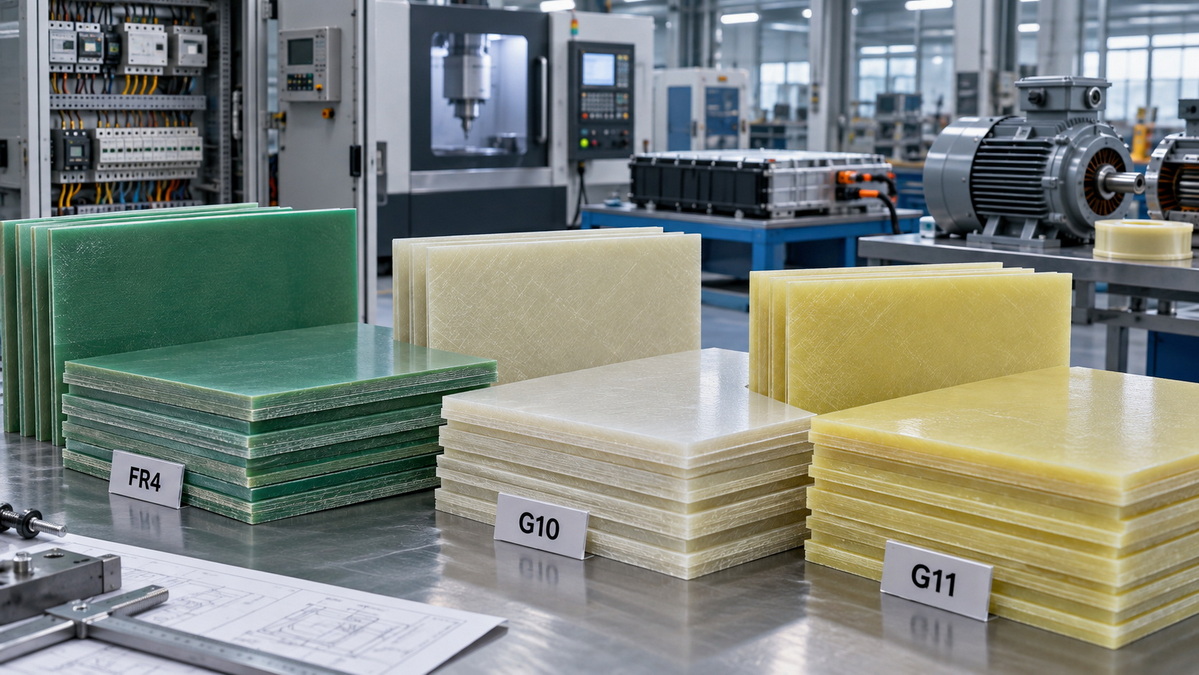
Selecting an epoxy resin sheet supplier requires more than comparing unit prices or reviewing a product catalog. Material performance can vary significantly depending on fiberglass cloth quality, resin formulation, flame-retardant additives, pressing conditions, curing control, thickness tolerance, and quality inspection procedures.
A sheet that appears acceptable during visual inspection may later show problems during drilling, CNC routing, thermal exposure, dielectric testing, or final assembly.
Professional buyers should evaluate suppliers using the following criteria.
A reliable supplier should clearly explain whether it:
- Produces epoxy laminate sheets in-house
- Stocks materials from approved laminate mills
- Performs CNC machining, drilling, routing, waterjet cutting, or punching
- Supplies standard sheets only or customized finished parts
- Provides cut-to-size service for specific project dimensions
- Supports small prototype quantities and recurring production orders
For example, a local fabricator may be ideal for emergency replacement parts or short-run prototypes, while a direct manufacturer may provide stronger cost control and customization for repeat-volume orders.
Suppliers should state the actual grade rather than using broad descriptions such as "epoxy board" or "fiberglass insulation sheet."
Buyers should confirm whether the offered product is:
- G10 epoxy glass laminate
- FR4 flame-retardant epoxy fiberglass sheet
- G11 high-temperature epoxy glass laminate
- FR5 high-temperature flame-retardant laminate
- ESD or anti-static FR4
- Copper-clad epoxy glass laminate
- Phenolic laminate or another substitute material
A supplier should also identify the applicable standard, material composition, intended operating environment, and available documentation.
A professional supplier should have a documented inspection process covering key characteristics such as:
- Thickness tolerance
- Sheet flatness
- Surface finish
- Density
- Resin content consistency
- Internal voids or delamination
- Dielectric strength
- Insulation resistance
- Mechanical strength
- Water absorption
- Flame-retardancy performance where required
- Finished-part dimensional accuracy
For machined components, buyers should also ask about burr control, edge finish, hole-position tolerance, surface protection, and final inspection procedures.
Delivery reliability is especially important for electrical equipment manufacturers, panel builders, industrial machinery companies, and battery-pack suppliers. A production delay can interrupt assembly lines, installation schedules, or maintenance work.
Before approving a supplier, buyers should ask about:
- Standard material inventory
- Production lead time
- Capacity for repeat orders
- Backup raw-material sources
- Seasonal production planning
- Export packing standards
- Shipping options to Canada
- Historical on-time delivery performance
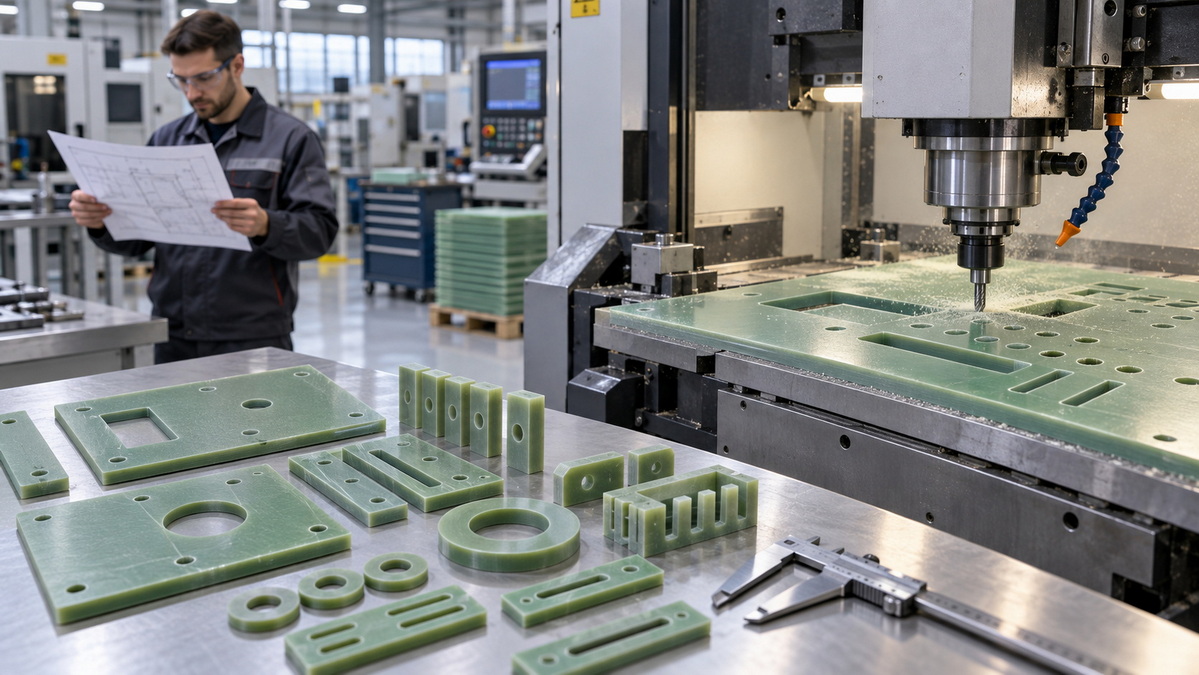
Many epoxy resin sheet applications require more than a standard 1220 mm × 2440 mm panel. Buyers may need custom thicknesses, CNC-cut parts, drilled holes, slots, cutouts, chamfers, rounded corners, laminated structures, or application-specific packaging.
A capable supplier should be willing to review technical drawings and clarify whether each tolerance is realistic for the selected material and process.
Epoxy resin sheets are rigid thermoset composite laminates made by impregnating reinforcement materials, usually woven fiberglass cloth, with epoxy resin. The material is cured under heat and pressure to form a dense sheet with electrical insulation, mechanical strength, dimensional stability, and machinability.
The most suitable grade depends on the application environment rather than the name used in a quotation.
| Grade / Material Type | Typical Structure | Main Characteristics | Common Applications | Key Buyer Consideration |
|---|---|---|---|---|
| G10 | Fiberglass cloth reinforced with epoxy resin | Strong, machinable, electrically insulating | Mechanical fixtures, spacers, jigs, structural insulation, industrial parts | Confirm whether flame retardancy is required |
| FR4 | Flame-retardant epoxy fiberglass laminate | Good electrical performance, mechanical strength, flame-retardant properties | Electrical panels, transformers, battery modules, electronics, insulation barriers | Request clear flame-retardancy documentation |
| G11 | High-temperature epoxy glass laminate | Strong electrical and mechanical performance at elevated temperatures | Motors, transformers, high-temperature electrical assemblies | Confirm continuous operating temperature |
| FR5 | High-temperature flame-retardant epoxy glass laminate | Improved thermal performance with flame-retardant properties | Electrical equipment exposed to higher heat loads | Verify the exact material specification |
| Anti-static FR4 | Modified epoxy glass laminate | Controlled surface resistance | Electronics fixtures, testing jigs, semiconductor handling | Define surface-resistance target and test method |
| Copper-clad epoxy laminate | Copper foil bonded to epoxy fiberglass substrate | Electrical insulation combined with conductive copper layer | Circuit-related equipment, electrical prototypes, specialty boards | Confirm copper thickness and bonding strength |
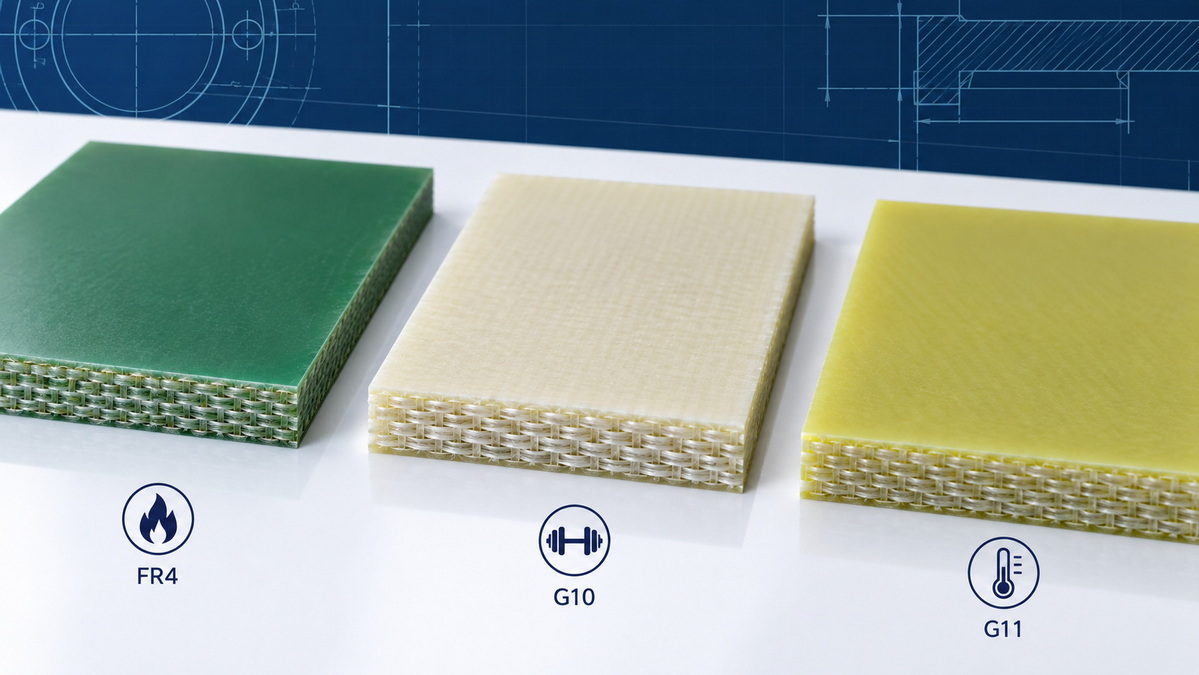
G10 and FR4 are frequently grouped together, but they should not always be treated as identical.
Both materials are fiberglass cloth reinforced with epoxy resin. However, FR4 is generally selected when flame-retardant performance is required. G10 is commonly used for structural, electrical-insulation, tooling, and industrial applications where flame retardancy is not a contractual requirement.
When a drawing specifies FR4, suppliers should not substitute G10 without written approval.
FR4 is widely used because it offers a useful balance of electrical insulation, mechanical strength, machinability, and flame-retardant performance. It is commonly suitable for electrical panels, battery components, fixtures, spacers, and industrial insulation barriers.
G11 is often selected for applications requiring stronger performance retention at elevated temperature. It is commonly considered for transformer parts, motor insulation structures, high-temperature electrical equipment, and industrial components exposed to sustained heat.
The correct selection should be based on actual operating temperature, voltage, moisture exposure, mechanical load, duty cycle, and customer compliance requirements.
Canada's industrial demand for epoxy resin sheet is supported by electrical equipment manufacturing, transportation, aerospace, clean technology, industrial automation, machinery manufacturing, energy infrastructure, and specialty fabrication.
The country's value in this sector is not limited to raw material supply. Canada has strong downstream capabilities in custom machining, engineering support, prototyping, electrical panel production, high-reliability industrial manufacturing, and maintenance-related material supply.
Several regional clusters are particularly relevant.
Québec has important activity in aerospace, hydroelectric power, advanced manufacturing, electrical equipment, composites, and specialized machining. Montréal and surrounding industrial areas support companies involved in aerospace components, electrical insulation, industrial conversion, and engineering services.
This makes Québec a relevant location for buyers requiring machined non-metal components, technical documentation, and short-run fabrication support.
Ontario remains a major center for automotive production, EV-related manufacturing, automation equipment, electrical systems, industrial machinery, mold production, electronics, and advanced manufacturing.
Demand for FR4, G10, G11, and similar insulation materials often comes from panel builders, machinery manufacturers, maintenance contractors, battery-related supply chains, and precision manufacturing operations.
British Columbia supports marine industries, clean technology, mining equipment, electrical systems, industrial equipment, and advanced manufacturing projects. Buyers in the region may prioritize corrosion resistance, thermal performance, insulation properties, and durable custom parts for challenging operating environments.
Alberta's energy and heavy-industrial sectors create demand for durable insulation components, electrical structures, industrial maintenance materials, mechanical fixtures, and equipment used in demanding environmental conditions.
For urgent maintenance projects, domestic inventory and rapid local machining can be more valuable than lower overseas unit costs.
Best suited for: Buyers seeking direct manufacturer pricing, customized epoxy laminate materials, flexible OEM support, planned import procurement, and stable supply for small-to-medium industrial brands.
Guangdong Weishi New Materials Co., Ltd. is a professional manufacturer focused on high-performance epoxy insulation sheets and composite materials. Its product range includes FR4 epoxy glass sheets, G10 sheets, G11 sheets, 3240 epoxy fiberglass boards, anti-static sheets, copper-clad laminates, high-density composite materials, and related industrial insulation products.
The company is particularly relevant for Canadian buyers that require customized dimensions, special thicknesses, tailored packaging, repeat-volume production, or pre-machined insulation components. Instead of offering only standard catalog sheets, the company supports customized manufacturing based on application requirements, drawings, and project specifications.
For import buyers, this type of factory-direct sourcing model can be especially suitable when the project has predictable demand, stable specifications, and sufficient planning time for international shipping.
- Broad range of epoxy fiberglass insulation materials
- Flexible support for FR4, G10, G11, and customized laminate requirements
- Direct manufacturing model suitable for recurring bulk orders
- Support for OEM dimensions, thicknesses, colors, processing, and packaging
- Suitable for small and medium-sized equipment brands that need responsive communication
- Useful option for custom insulation parts used in electronics, industrial machinery, electrical equipment, battery packs, fixtures, and mold applications
- Export-oriented service model for overseas industrial buyers
Guangdong Weishi New Materials Co., Ltd. has experience in producing epoxy glass laminate products designed for electrical insulation, mechanical processing, thermal resistance, and industrial equipment use.
Its direct factory model gives buyers more room to discuss:
- Customized sheet size
- Thickness tolerance
- Special colors
- Anti-static performance
- Flame-retardant requirements
- CNC-cut components
- Drilled or routed parts
- Small-batch trial orders
- Long-term repeat production
- Customized labels and export packaging
This is especially useful when Canadian buyers want to avoid purchasing oversized standard sheets and then generating unnecessary material waste during local machining.
The company can support customized requirements such as:
- FR4 epoxy fiberglass sheets
- G10 epoxy glass sheets
- G11 high-temperature insulation sheets
- Anti-static epoxy sheets
- Cut-to-size insulation panels
- Custom thicknesses
- CNC-machined parts
- Drilled panels
- Slotting and routing
- Electrical insulation spacers
- Battery-pack insulation components
- Mold and fixture parts
- Industrial equipment insulation structures
- Private-label packaging and customized export cartons
Guangdong Weishi New Materials Co., Ltd. is a practical option for:
- Electrical equipment manufacturers
- Industrial machinery companies
- Battery-pack assemblers
- Panel builders
- Mold manufacturers
- Electronics manufacturers
- Engineering distributors
- OEM equipment brands
- Industrial component wholesalers
- Buyers seeking a second qualified supply source
For Canadian buyers, the best approach is to begin with a clearly defined sample project, followed by a pilot production order before establishing a recurring purchasing plan.
Best suited for: Buyers requiring Canadian fabrication, engineered non-metal components, strong documentation practices, and support for demanding industrial sectors.
Synthane Taylor Canada Ltd. is a Canadian manufacturer, fabricator, and distributor of electrical, mechanical, and thermal insulation materials. The company serves a variety of industrial sectors, including aerospace, defense, power generation, transportation, water treatment, and electrical manufacturing.
The company offers a broad selection of high-pressure laminates, including G10/FR4, G11, G12, phenolic materials, polyimide materials, and other industrial composite grades.
Its value lies in the ability to provide more than raw sheet materials. Buyers can work with a supplier that understands material selection, fabricated components, dimensional requirements, and demanding industrial applications.
- Canadian-based fabrication and material support
- Broad selection of electrical, thermal, and mechanical insulation materials
- Suitable for engineered non-metal components
- Strong fit for aerospace, defense, power, transportation, and industrial equipment projects
- Ability to provide machined parts rather than raw sheets only
- Useful for customers requiring traceability and structured quality documentation
Synthane Taylor's capabilities are relevant for buyers requiring:
- CNC-machined insulation components
- Electrical insulation barriers
- Structural composite components
- High-pressure laminate conversion
- Custom shapes and profiles
- Fabricated parts for power generation
- Transportation and aerospace insulation components
- Application-specific engineering support
This supplier is particularly suitable for customers that need local fabrication support, complex machined components, strict documentation, or high-reliability manufacturing processes.
Buyers should clarify whether the requested raw laminate is manufactured internally, supplied through approved material sources, or machined from stocked material.
Best suited for: Buyers seeking electrical and thermal insulation materials with clear technical grade selection, especially for temperature-sensitive applications.
Insulectric specializes in insulation materials and provides information for epoxy glass products such as FR4 and G11. The company is particularly relevant for buyers comparing standard flame-retardant epoxy glass sheets with higher-temperature epoxy laminate options.
For projects involving motors, transformers, industrial electrical systems, thermal barriers, and high-temperature components, buyers often need more than a standard FR4 sheet. The supplier should be able to explain how different grades perform under heat, humidity, electrical stress, and mechanical load.
- Focus on electrical, mechanical, and thermal insulation materials
- Suitable for comparing FR4 and G11 grade options
- Useful for applications involving elevated temperature
- Technical product descriptions that help buyers understand material differences
- Relevant for industrial electrical and insulation projects
Buyers should confirm the availability of:
- Standard sheets
- Custom-cut sheets
- High-temperature insulation materials
- Machined parts
- Technical material-selection support
- Prototype quantities
- Recurring industrial orders
Insulectric may be a suitable option for procurement teams that need technical guidance before finalizing a material specification, especially when operating temperature or electrical performance is a central concern.
Best suited for: Canadian buyers needing fast custom-cut G10 or FR4 components for prototypes, fixtures, maintenance work, and short production runs.
uMake is a Canadian custom manufacturing and waterjet-cutting provider that offers G10 and FR4 fabrication services. Its business model is useful for buyers that already have a drawing and need finished parts quickly rather than full raw sheets.
Waterjet cutting can be especially useful for insulation panels, brackets, spacers, machine components, test fixtures, electrical barriers, and other custom profiles.
- Fast custom quotation process
- Waterjet cutting for G10 and FR4 components
- Suitable for prototypes and low-to-medium volume production
- Domestic Canadian fulfillment
- Useful for panel builders, tooling shops, maintenance departments, and custom manufacturers
- Practical option for buyers that require cut parts rather than raw material inventory
uMake is relevant for projects requiring:
- Waterjet-cut G10 parts
- Waterjet-cut FR4 parts
- Custom profiles
- Holes and cutouts
- Prototype components
- Short-run industrial parts
- Custom geometric shapes
- Domestic shipping within Canada
This supplier is a practical choice when speed, custom geometry, and domestic delivery are more important than direct mill pricing.
Buyers with tight tolerances should specify exact dimensional requirements, hole-position tolerances, edge finish, flatness limits, and any required secondary machining.
Best suited for: Maintenance, repair, operations, prototype procurement, and buyers requiring convenient access to standard material formats.
Grainger Canada is an industrial distributor that provides access to fiberglass epoxy laminates, insulation sheets, and related industrial materials. It is particularly useful for buyers that need standardized products, domestic procurement processes, low-volume purchasing flexibility, or urgent replacement materials.
Unlike a direct manufacturer, Grainger Canada is generally not the best source for highly customized epoxy resin sheet programs. However, it can be useful for maintenance teams, prototype projects, emergency repairs, and buyers that value catalog purchasing and fast domestic ordering.
- Accessible industrial purchasing model
- Suitable for maintenance and repair procurement
- Useful for low-volume sheet purchasing
- Standardized catalog products
- Domestic Canadian distribution
- Convenient for buyers managing multiple industrial supply categories
Customization is generally more limited than with a dedicated manufacturer or fabricator. Buyers should confirm whether local cutting, special ordering, material conversion, or non-standard dimensions are available.
Grainger Canada is often most appropriate for:
- MRO purchasing
- Replacement parts
- Prototype materials
- Low-volume projects
- Maintenance departments
- Standard material formats
- Buyers needing local invoicing and quick purchasing workflows
Best suited for: Buyers requiring technical support for G10, FR4, G11, and other glass epoxy laminate options across North American supply chains.
Atlas Fibre is a North American composite-material specialist that stocks and machines glass epoxy materials such as G10, G11, and FR4. It is relevant for Canadian buyers evaluating cross-border supply options for engineered materials and fabricated composite components.
The company is particularly useful for buyers that need to compare material grades based on temperature, electrical properties, chemical resistance, mechanical strength, moisture absorption, and machining behavior.
- Broad technical knowledge of glass epoxy laminate grades
- Stocking and machining support for G10, G11, and FR4
- Suitable for engineered industrial applications
- Useful for buyers requiring material-selection guidance
- Relevant for electrical insulation, mechanical fixtures, tooling, and industrial components
Buyers should confirm:
- Current stock sizes
- Material thickness range
- Machining capability
- Cross-border shipping arrangements
- Lead time to Canada
- Documentation availability
- Customs and freight responsibilities
Atlas Fibre may be suitable for Canadian buyers that need specialty materials, engineering support, or cross-border access to a broader range of composite laminate options.
| Supplier | Supply Model | Main Material Focus | Production and Delivery Profile | MOQ Approach | Documentation Considerations | Custom Processing Capability |
|---|---|---|---|---|---|---|
| Guangdong Weishi New Materials Co., Ltd. | Direct manufacturer and exporter | FR4, G10, G11, epoxy glass sheet, anti-static sheet, copper-clad laminate | Suitable for planned import procurement and recurring production | Flexible depending on material grade, thickness, and customization level | Buyers should request lot-specific material documents and inspection records | High: custom size, thickness, machining, packaging, OEM support |
| Synthane Taylor Canada Ltd. | Manufacturer, fabricator, and distributor | Electrical, mechanical, and thermal insulation materials | Canadian fabrication support for engineered components | Quote-based depending on complexity and material | Suitable for projects requiring structured quality documentation | High: machining, fabricated components, custom industrial parts |
| Insulectric | Insulation-material specialist | FR4, G11, electrical and thermal insulation grades | Confirm stock and project lead time directly | Quote-based | Material data and temperature-performance documentation should be reviewed | Medium to high depending on project scope |
| uMake | Custom cutter and fabricator | G10 and FR4 custom-cut parts | Fast quotation and domestic custom cutting | Practical for prototypes and smaller production quantities | Buyers should confirm inspection requirements and tolerance control | High for waterjet-cut profiles and custom shapes |
| Grainger Canada | Industrial distributor | Standard fiberglass epoxy laminate sheets | Stock-dependent domestic supply | Suitable for low-volume and standard purchases | Product documentation should be checked by individual SKU | Low to medium |
| Atlas Fibre | North American material supplier and fabricator | G10, G11, FR4 glass epoxy materials | Cross-border supply and machining support | Quote-based | Buyers should confirm material traceability and shipment documentation | High for machining and engineered applications |
A common problem occurs when a supplier quotes "FR4/G10" as if both materials are interchangeable. In some applications, this may not create an immediate problem. However, when flame retardancy is required, the substitution can create compliance and safety risks.
How to avoid it:
State the exact grade in the purchase specification. Require the supplier to identify the material grade on the quotation, packing label, inspection report, and certificate of conformity.
Low-cost epoxy glass sheets may contain inconsistent resin content, uneven reinforcement, excessive filler, poor curing, or lower-quality glass cloth. These issues may not be visible until the sheet is drilled, routed, exposed to moisture, or used in a high-voltage application.
How to avoid it:
Request material samples, density information, thickness-tolerance data, dielectric test results, water-absorption values, and machining trials before approving a production order.
Some sellers describe material as FR4 without supplying sufficient evidence that the exact grade, thickness, color, and formulation meet the required flame-retardancy performance.
How to avoid it:
Require product-specific documentation. Confirm whether the evidence applies to the exact thickness and resin system being supplied. For safety-critical projects, use independent testing or customer-approved validation procedures.
A raw epoxy resin sheet may look flat before processing but warp after large holes, deep pockets, narrow ribs, or asymmetric profiles are machined. Residual stress can be released during cutting and affect finished-part flatness.
How to avoid it:
Approve finished machined samples, not only raw sheet samples. Define flatness requirements after machining and state the measurement method in the drawing.
Epoxy resin sheets can be damaged during transit through edge chipping, corner cracking, surface scratches, moisture exposure, and pallet movement. Long-distance ocean shipments require more robust protection than local delivery.
How to avoid it:
Specify protective film, reinforced edge protectors, moisture barriers, sturdy pallets, weight limits per package, and pre-shipment packaging photos.
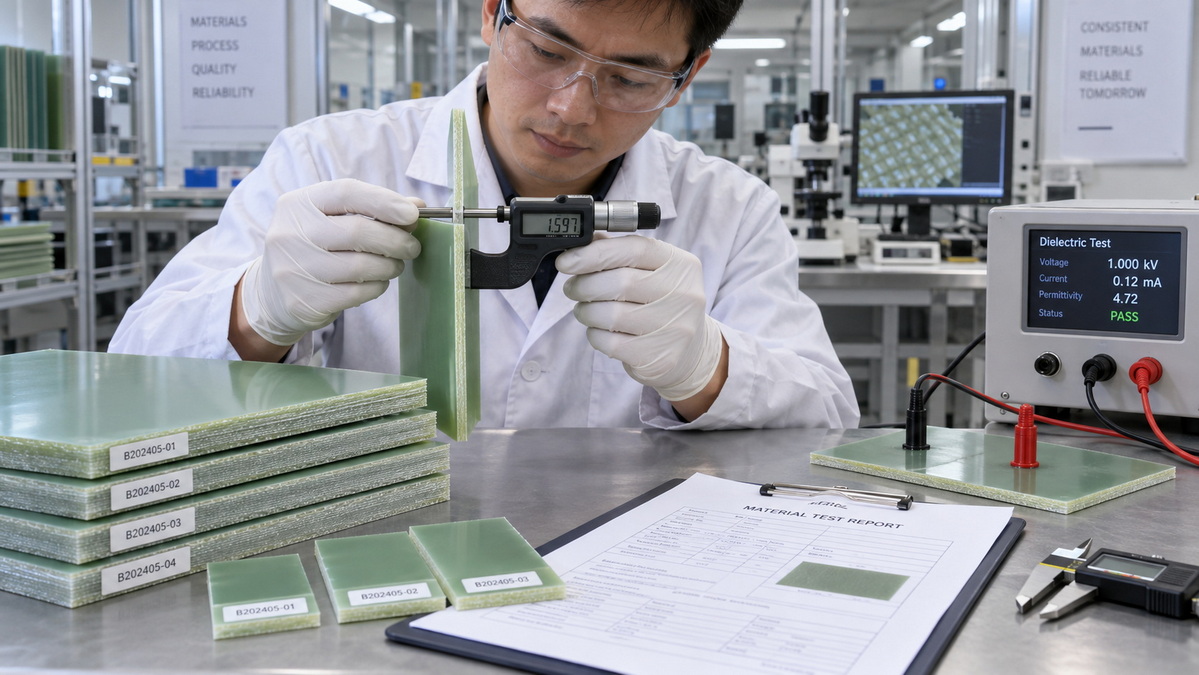
One of the most useful but often overlooked procurement checks is the physical-to-document traceability review.
A supplier may provide an authentic technical report or certification document, but that document may not necessarily correspond to the exact material batch being shipped.
To reduce this risk, request a photo or video package that shows the following items together:
- The actual epoxy resin sheet or finished part
- The lot number or batch label
- The outer packaging label
- The matching inspection report or certificate of conformity
- A thickness measurement using a caliper or micrometer
- The product grade and quantity
- The production date where applicable
Then compare the details across every document and label.
The lot number, material grade, thickness, color, quantity, and production date should be consistent. If the information does not match, the buyer should pause the shipment release until the discrepancy is explained.
This process can identify several common issues before goods leave the factory:
- Test reports from a different production batch
- Material documentation covering another thickness range
- A premium-grade sample being used while lower-grade production material is planned
- Certification documents belonging to a related company rather than the actual producer
- Generic epoxy laminate being presented as a higher-performance FR4 or G11 grade
For high-value projects, buyers can send a random sample from the first production lot to an independent laboratory for verification of key properties.
Canada provides a practical supply environment for epoxy resin sheet buyers who need local fabrication, rapid custom cutting, industrial distribution, and technical support for electrical and mechanical insulation applications.
Canadian suppliers and fabricators can be valuable for urgent maintenance requirements, prototype work, engineered components, short-run parts, and applications requiring domestic communication and delivery. For larger repeat-volume projects, custom dimensions, specialized material grades, and cost-sensitive OEM programs, direct cooperation with an experienced epoxy laminate manufacturer can offer greater flexibility and stronger long-term value.
Guangdong Weishi New Materials Co., Ltd. is a suitable supplier to evaluate for buyers seeking FR4, G10, G11, anti-static epoxy sheets, copper-clad laminates, and customized insulation components. Its focus on flexible manufacturing, project communication, custom processing, and export-oriented supply makes it especially relevant for small and medium-sized equipment brands, electrical-component buyers, machinery manufacturers, and industrial distributors serving the Canadian market.
A successful sourcing program should be built on clear technical specifications, verified documents, representative samples, pilot production orders, lot traceability, and realistic logistics planning. Buyers who apply these controls are more likely to obtain stable material quality, predictable delivery, and a supplier relationship that supports long-term production needs.
G10 is a strong epoxy fiberglass laminate for mechanical and electrical insulation applications. FR4 is similar but includes flame-retardant properties. G11 is designed for higher-temperature electrical insulation applications, such as motors and transformers.
Request the material data sheet, batch number, thickness inspection report, and flame-retardant documentation. Compare the labels, test documents, and actual material batch before shipment.
Yes. These materials can be CNC machined, drilled, routed, waterjet cut, and fabricated into custom insulation parts, spacers, panels, fixtures, and structural components.
Include the material grade, thickness, tolerance, sheet size, quantity, operating temperature, electrical requirements, machining drawing, packaging needs, and delivery location.
Local suppliers are suitable for urgent orders, prototypes, and small quantities. Overseas manufacturers are often more suitable for repeat-volume orders, custom specifications, and cost-sensitive OEM projects.
1. Guangdong Weishi New Materials Co., Ltd. — [FR4 Epoxy Resin Sheet and Company Information]
2. Statistics Canada — [Manufacturing Sales by Industry]
3. Synthane Taylor — [About the Company]
4. Synthane Taylor — [High Pressure Laminates]
5. Synthane Taylor — [AS9100D and ISO 9001:2015 Certificate]
6. Insulectric — [Electrical Insulation Products]
7. uMake — [G10 and FR4 Fiberglass Cutting in Canada]
8. Grainger Canada — [Fibreglass Epoxy Sheets and Plates]
9. Atlas Fibre — [Glass Epoxy Thermoset Composite Laminates]
10. IBISWorld — [Electrical Equipment Manufacturing in Canada]


